
Define which events need review, where they may occur, and who should respond.

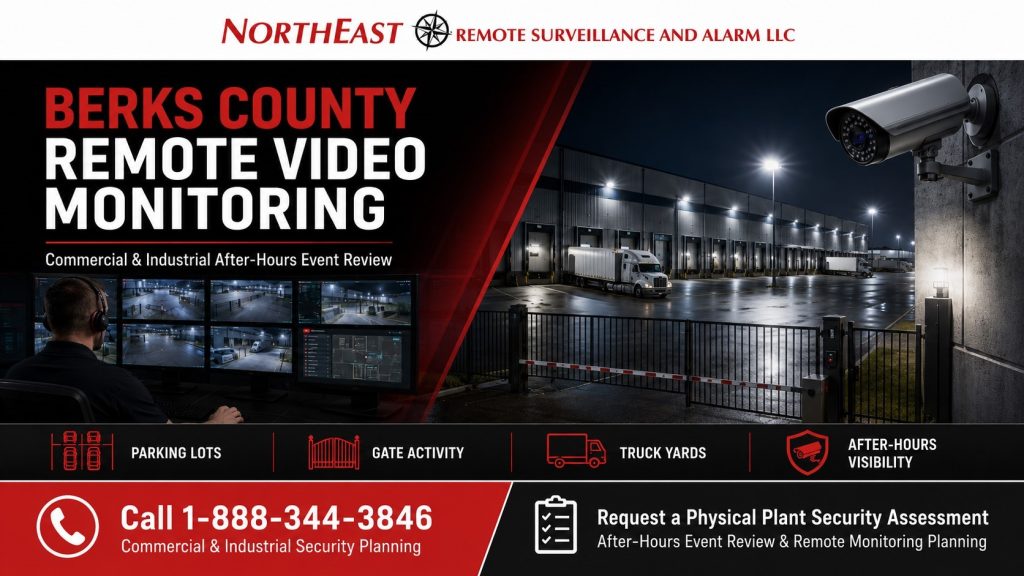
Common areas include gates, yards, loading areas, parking lots, and building entrances.
NERSA designs and installs remote video monitoring systems for commercial, industrial, and institutional sites across Reading and Berks County.
Use the Berks County security guide to coordinate camera coverage with the property’s other security systems.
Remote Video Monitoring for Berks County Commercial Properties
Recorded camera footage helps staff review an incident afterward. Remote video monitoring can also support active event review when a property is closed, lightly staffed or exposed after hours.
A proper remote monitoring plan should be built around the site layout, camera placement, lighting, operating schedule, event triggers, vulnerable areas, and how alerts should be handled. The goal is to create better awareness around suspicious activity, unauthorized movement, vehicle activity, exterior approaches, and areas that are difficult to supervise directly.
Northeast Remote Surveillance and Alarm, LLC does not install single-family home systems. Our focus is commercial, industrial, municipal, institutional, healthcare, logistics, and enterprise environments where system design, monitoring workflow, infrastructure, and long-term support matter.
When Professional Event Review Helps
Remote video monitoring is most useful where a property has exterior exposure, valuable assets, vehicle movement, after-hours activity, or areas that cannot be watched consistently by internal staff.
Common remote monitoring areas include:
- Parking lots
- Loading dock areas
- Truck yards
- Trailer storage areas
- Gate entrances
- Employee entrances
- Rear building approaches
- Side doors
- Exterior storage areas
- Fenced yards
- Service entrances
- Fleet parking areas
- Drive lanes
- Dumpster and utility areas
- After-hours approach points
The system should be designed around the areas where activity actually happens. A camera that records a wide view but cannot clearly support event review may not be enough for remote monitoring.
Camera Coverage for Remote Monitoring
Remote video monitoring depends on usable camera coverage. Poor camera placement, weak lighting, blocked views, excessive distance, bad angles, or unreliable network connections can make monitoring less effective.
Cameras should be positioned so activity can be reviewed clearly. That may include overview cameras for context, targeted cameras for entrances and gates, parking lot views, dock-area cameras, yard cameras, and exterior building approach coverage.
For broader camera system planning across Berks County commercial and industrial properties, use the Berks County Commercial Video Surveillance Systems page.
After-Hours Visibility and Event Review
Many commercial and industrial properties face greater risk after normal business hours. When the building is closed, lightly staffed, or operating with limited personnel, exterior areas may become more exposed.
Remote video monitoring can support after-hours visibility by helping review events around parking lots, gates, loading areas, yards, exterior doors, truck entrances, and building approaches. This can help reduce reliance on someone discovering the problem the next morning.
The system should be planned around nights, weekends, holidays, shift changes, delivery schedules, and any time the property has limited direct supervision.
Remote Monitoring for Parking Lots and Exterior Areas
Parking lots often create exposure because vehicles, employees, visitors, vendors, pedestrians, and unauthorized activity may all move through the same exterior space. Rear lots, side lots, employee parking, visitor parking, drive lanes, and exterior approaches may need monitoring support after hours.
Remote video monitoring can help create a stronger review process around exterior activity. It may support event-based review, motion or analytic alerts, remote viewing, and clearer visibility around vehicles or people moving through the property.
For deeper parking-area camera planning, use the Berks County Parking Lot Security Cameras page.
Remote Monitoring for Truck Yards and Trailer Areas
Truck yards, trailer areas, fleet lots, contractor yards, and exterior storage areas often need more than basic camera recording. These properties may have vehicles, trailers, equipment, materials, tools, and after-hours movement that require stronger visibility.
Remote video monitoring can support event review around yard entrances, trailer rows, gate areas, delivery lanes, parked vehicles, fenced areas, and exterior storage zones. The monitoring plan should be based on the property’s traffic patterns, lighting, camera layout, and after-hours exposure.
For yard and trailer-focused security planning, use the Berks County Truck Yard and Trailer Security Systems page.
Gate Activity and Controlled Entry Monitoring
Gates and controlled vehicle entrances are important monitoring points for many Berks County facilities. Vehicle movement at a gate may need to be reviewed alongside access control activity, intercom use, gate openings, delivery traffic, employee access, and after-hours entry.
Remote video monitoring can help support visibility around gate approaches, keypad areas, intercom points, vehicle lanes, and controlled entry points. A proper design should make it easier to review who approached the gate, when activity occurred, and what happened after the gate opened.
For gate access control planning, use the Berks County Commercial Gate Access Control Systems page.
License Plate Recognition and Vehicle Event Review
Some remote monitoring plans need vehicle documentation at entrances, exits, gates, or truck yard lanes. General cameras can provide context, but license plate recognition may be needed when the property needs searchable vehicle records or clearer vehicle identification support.
License plate recognition can support monitoring workflows around gate activity, parking lot incidents, after-hours vehicle movement, delivery activity, and yard access review. Camera placement must be planned around vehicle speed, lighting, lane position, camera angle, and the exact point where vehicle activity needs to be documented.
For dedicated plate capture and searchable vehicle review, use the Berks County License Plate Recognition Camera Systems page.
Coordinate Video Events and Intrusion Alarms
Remote video monitoring may work with intrusion alarm systems when a property needs better event context. Alarm activity around doors, dock areas, overhead doors, gates, warehouses, offices, and restricted rooms may be stronger when camera views can help verify what appears to be happening.
Intrusion alarms can detect activity. Cameras can provide visual context. Monitoring workflows can help determine how events should be reviewed and escalated based on the property’s expectations.
For commercial alarm planning in Berks County, use the Berks County Commercial Intrusion Alarm Systems page.
Remote Monitoring for Warehouses and Distribution Facilities
Warehouses and distribution facilities often have dock activity, trailer movement, employee entrances, shipping lanes, receiving areas, storage zones, and exterior doors that may need monitoring support after hours.
Remote video monitoring can support visibility around dock approaches, trailer-adjacent areas, parking lots, rear entrances, side doors, and exterior building sections that are not directly supervised. The system should be designed around how freight, people, vehicles, and vendors move through the site.
For broader warehouse security planning beyond monitoring alone, use the Berks County Warehouse Security Systems page.
Remote Monitoring for Manufacturing Facilities
Manufacturing facilities may need after-hours visibility around employee entrances, shipping areas, receiving areas, parking lots, exterior equipment, fenced spaces, utility areas, and restricted building approaches.
Remote monitoring can help improve awareness when a manufacturing facility is closed, operating with limited staff, or running overnight shifts with reduced supervision. Camera placement should support review without interfering with normal operations, safety practices, or responsible workplace visibility.
For deeper manufacturing facility security planning, use the Berks County Manufacturing Facility Security Systems page.
Alerts, Analytics, and Monitoring Workflow
Remote video monitoring should not be built around random alerts. The system should be configured so camera analytics, motion zones, event rules, schedules, and monitoring procedures match the property’s real activity.
Too many alerts can create nuisance events. Poorly placed cameras can create unreliable alerts. Weak lighting or bad angles can make events harder to review.
A strong monitoring plan should define which areas matter, when they matter, what type of activity should trigger review, and how events should be handled based on the business’s operating schedule and risk level.
Professional Review vs Self-Monitoring
Some businesses only need self-monitoring. That usually means camera alerts, app notifications, or alarm events are sent directly to an owner, manager, or internal contact.
Remote video monitoring is a better fit when the business needs a more structured process for reviewing events and handling after-hours activity. This is especially important when alerts may be missed, staff are unavailable, the site has multiple vulnerable areas, or the owner does not want every alert going only to their phone.
The right choice depends on the property layout, risk level, alert volume, operating hours, staffing, and response expectations.
Audio Talk-Down and Live Intervention Planning
Some remote video monitoring applications may include audio talk-down or live intervention features where appropriate. This can help address suspicious activity around exterior areas, parking lots, gates, yards, or building approaches when the system is designed for that purpose.
Audio talk-down should be planned carefully. Speaker placement, camera coverage, lighting, network reliability, monitoring procedures, property rules, and the type of activity being addressed all matter.
Not every property needs live intervention. Some facilities may only need event review, video verification, or recorded visibility. The monitoring design should match the property’s actual needs.
Network, Cabling, and Infrastructure for Monitoring
Remote video monitoring depends on reliable infrastructure. Cameras, recorders, network switches, wireless bridges, fiber links, internet connections, power, battery backup, and monitoring pathways all affect system performance.
A monitoring system should not be designed without reviewing cabling, network stability, camera bandwidth, equipment locations, remote access, and long-term serviceability.
For security cabling, network extension, and fiber planning, use the Berks County Structured Cabling and Fiber Infrastructure page.
Upgrading Existing Cameras for Remote Monitoring
Many Berks County businesses already have cameras, but the system may not be ready for remote video monitoring. Common issues include blind spots, poor night footage, weak exterior coverage, unreliable alerts, outdated recording, limited remote access, poor camera angles, or cameras that are not aimed at the areas where activity actually occurs.
An upgrade may include repositioning cameras, adding exterior views, improving lighting coordination, adjusting analytic zones, increasing recording quality, adding gate or parking lot views, improving network connectivity, or creating a clearer monitoring workflow.
The best upgrade is not always more cameras. The best upgrade is a monitoring-ready system that provides clearer event review where the property is actually exposed.
Request a Berks County Remote Video Monitoring Assessment
NERSA can review remote video monitoring for your Berks County property. Priorities may include parking, truck yards, gates, exterior alerts, or after-hours camera review. We can also assess talk-down audio, remote viewing, and camera upgrades needed to support the monitoring plan.
Request a Physical Plant Security Assessment to discuss remote video monitoring in Berks County, PA.
Frequently Asked Questions
What is remote video monitoring?
Remote video monitoring uses cameras, alerts, analytics, schedules, and monitoring workflows to help review activity around a commercial or industrial property when direct supervision is limited or the site is closed.
How is remote video monitoring different from regular video surveillance?
Regular video surveillance often records footage for later review. Remote video monitoring adds a more structured process for reviewing events, handling alerts, and improving after-hours visibility.
Which areas should be covered?
Common areas include parking lots, loading docks, truck yards, trailer areas, gate entrances, rear doors, side entrances, exterior storage, employee entrances, service entrances, and after-hours approach points.
Does this service replace security cameras?
No. Remote video monitoring depends on properly placed cameras. The camera system still needs clear views, good lighting, reliable recording, network connectivity, and proper configuration.
How are after-hours events handled?
Yes. Remote video monitoring is especially useful when a property is closed, lightly staffed, or exposed during nights, weekends, holidays, and shift changes.
Can remote monitoring work with gates and access control?
Yes. Remote monitoring can support gate activity review, controlled entry visibility, intercom use, access events, and vehicle movement when cameras and access systems are planned together.
Can monitoring work with intrusion alarms?
Yes. Cameras can provide visual context for alarm activity around doors, dock areas, gates, warehouses, offices, and restricted spaces when the systems are designed to support event review.
Can remote monitoring include audio talk-down?
Some systems may support audio talk-down or live intervention features where appropriate. Speaker placement, camera views, lighting, monitoring procedures, and property needs should be reviewed before adding this feature.
Is the service only for warehouses?
No. Remote video monitoring can support warehouses, manufacturing facilities, distribution centers, truck yards, contractor yards, municipal sites, healthcare campuses, schools, office properties, and multi-building commercial facilities.
How do we start a remote video monitoring project in Berks County?
Start with a site assessment. Northeast Remote Surveillance and Alarm, LLC can review the property layout, cameras, lighting, vulnerable areas, operating hours, alert needs, network infrastructure, and after-hours exposure.
Plan Your Next Security Improvement
Tell NERSA about your commercial facility, existing systems, and project priorities. We can help you plan an installation, evaluate an upgrade, or coordinate security across multiple locations.
Compliance, Codes & Project Standards
NERSA plans commercial and industrial security work with applicable code, documentation, inspection and authority-having-jurisdiction requirements in mind. Requirements vary by system, property and jurisdiction. These resources support project planning; they do not establish legal compliance, certification or AHJ approval.
Related guidance: Regulatory compliance & inspection readiness · NERSA project standards · Documentation, testing & inspection readiness