
Commercial access control door hardware costs depend on the door type, lock method, egress requirements, fire rating, frame condition, cabling path, power needs, and required operation.

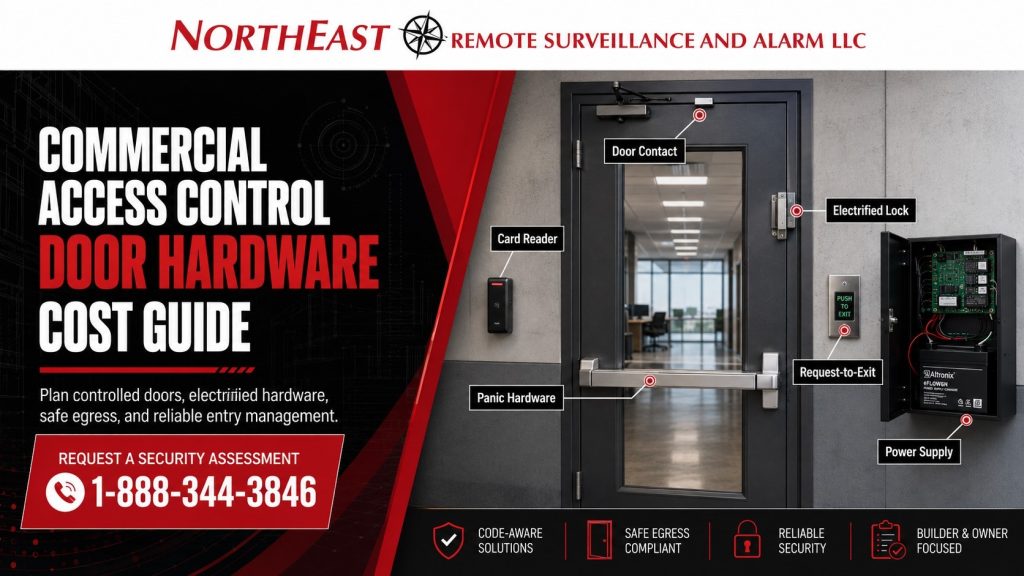
This guide helps commercial and industrial buyers understand why door hardware often drives access control cost more than the card reader itself.
For the broader pricing structure, start with Commercial & Industrial Security System Costs, Comparisons & Buyer Guides.
Commercial Access Control Door Hardware Cost Guide for Planning
Access control is not just a reader on the wall. The door hardware determines how the opening locks, unlocks, releases, monitors, and supports safe exit.
A commercial access-controlled door may involve an electric strike, electrified lockset, electrified panic bar, magnetic lock, request-to-exit device, door position switch, power supply, transfer hinge, door loop, card reader, keypad, credential reader, and controller connection.
The cost changes because every door is different. A hollow metal employee entrance, aluminum storefront door, glass office entry, warehouse man door, fire-rated stair door, and pair of exterior doors may all require different hardware.
What Changes Access Control Door Hardware Cost
Door hardware cost changes based on the condition of the opening, the required lock method, and the safety rules that apply to that door.
Major cost drivers include:
- door type
- frame type
- existing lock condition
- electric strike compatibility
- panic hardware requirements
- mortise lock or cylindrical lock type
- magnetic lock requirements
- fire-rated opening conditions
- request-to-exit requirements
- door position monitoring
- power transfer method
- low-voltage cabling path
- fire alarm interface
- backup power requirements
- ADA usability considerations
- exterior weather exposure
- security level of the opening
- after-hours locking schedule
- future expansion needs
A simple interior office door will not cost the same as a fire-rated warehouse exit door, storefront entrance, stairwell door, or exterior employee entrance that needs electrified panic hardware and monitored egress.
Electric Strikes, Electrified Locks, and Magnetic Locks
The lock method is one of the biggest cost factors.
An electric strike releases the latch at the frame when access is granted. It can be a practical choice for some doors, but it must be matched to the door, frame, latch, security level, and code conditions.
An electrified lockset or electrified mortise lock controls the lock body itself. This may be useful when the door condition, hardware type, or security requirement calls for lock-side electrification instead of a strike.
A magnetic lock uses holding force to secure the door. Maglocks require careful planning because they may involve request-to-exit devices, power loss behavior, emergency release, signage, fire alarm interface, and authority having jurisdiction review.
The right hardware choice depends on the door, not a generic preference.
Panic Hardware and Exit Devices
Panic hardware can significantly affect access control cost. Doors with panic bars, rim exit devices, vertical rod hardware, electrified trim, or latch retraction may require more expensive hardware than a basic office door.
Exterior employee doors, warehouse man doors, assembly areas, public exits, and certain commercial openings may need hardware that supports controlled entry while still allowing safe exit.
Electrified panic hardware can be a strong solution, but it must be selected correctly. The system may need power supplies, transfer hinges, door loops, relay control, request-to-exit monitoring, door position monitoring, and proper coordination with the access control panel.
Door Type, Frame Condition, and Field Modification
The existing door and frame can change the entire budget. Some doors are already prepared for compatible hardware. Others require cutting, drilling, reinforcing, adapter plates, filler plates, new trim, or replacement hardware.
Common door and frame variables include:
- hollow metal doors
- wood doors
- aluminum storefront doors
- glass doors
- fire-rated doors
- pairs of doors
- exterior doors
- warehouse man doors
- stairwell doors
- older frames
- damaged doors
- non-standard lock prep
- existing key hardware
A door that looks simple during a walkthrough may become more complex once the hardware, frame, latch alignment, door closer, strike prep, and egress requirements are reviewed.
Commercial Access Control Door Hardware Cost Guide Request-to-Exit and Door Monitoring Devices
Access-controlled doors often need more than a reader and lock. They may also need request-to-exit devices and door monitoring.
Request-to-exit devices help the system understand when someone is leaving. These may include motion sensors, push buttons, touch bars, exit-device switches, or other hardware depending on the door and locking method.
Door position switches help report whether the door is open or closed. This supports forced-door alerts, held-door alerts, event history, and better accountability.
These devices add cost, but they also help the system work correctly. Without proper monitoring, the business may not know whether a controlled door was forced open, held open, or left unsecured.
Power Supplies, Backup Power, and Fire Alarm Interface
Access control door hardware requires reliable power. The system may need a dedicated access control power supply, lock power supply, relay modules, backup batteries, fused outputs, or fire alarm interface depending on the hardware and door function.
Some locks are fail-secure. Some are fail-safe. Some doors must unlock under specific emergency conditions. Some doors must remain latched to preserve fire-door function.
For broader access control budgeting, use Commercial & Industrial Access Control Cost.
The power design should be planned before installation. Poor power planning can create unreliable locks, nuisance failures, code issues, or doors that do not behave correctly during normal operation or emergency conditions.
Code, Egress, UCC, and NFPA Door Hardware Planning
Commercial access control door hardware must support secure entry without creating unsafe exit conditions. Egress, accessibility, fire-rated openings, emergency release, door hardware operation, low-voltage pathways, power supplies, and local code review can all affect the final design.
For Pennsylvania commercial projects, PA Uniform Construction Code considerations may apply when controlled doors affect construction conditions, inspections, door modifications, accessibility, egress, fire-rated openings, or coordination with a building owner, general contractor, design professional, or authority having jurisdiction.
NFPA standards may also be relevant depending on the opening. NFPA 80 is important when access-control hardware affects fire doors or opening protectives, NFPA 101 may apply where controlled doors affect safe egress or life-safety paths, and NFPA 70 can be relevant to wiring, power, and electrical installation practices for access-control equipment.
NERSA does not treat access control hardware as a simple lock sale. Door hardware must be coordinated so the opening supports security, daily operation, safe exit, code awareness, and long-term maintainability.
Exterior Doors, Warehouses, and Industrial Openings
Exterior commercial and industrial doors often cost more to control than interior office doors. Weather exposure, door condition, frame strength, traffic volume, shift schedules, employee entry, vendor access, and after-hours risk can all affect the hardware choice.
Warehouse and industrial openings may need durable hardware, stronger locking methods, monitored door contacts, controlled employee entry, and protection against doors being propped open.
The system should be practical for the people using the door every day. A door that slows down employees, creates nuisance alarms, or fails under heavy use will not support the operation well.
New Hardware vs Reusing Existing Hardware
Sometimes existing door hardware can be reused. Other times, reuse creates more problems than savings.
Existing hardware may not be compatible with electric strikes, card readers, request-to-exit devices, reporting needs, or safe egress requirements. Older locks may also be worn, misaligned, poorly installed, or difficult to support.
A proper assessment should determine whether the door can be converted, whether hardware should be replaced, or whether the door and frame need correction before access control is installed.
The cheapest option at the door is not always the best option for the building.
One-Time Costs vs Long-Term Door Hardware Costs
Access control door hardware cost includes more than the first installation.
One-time costs may include lock hardware, readers, credentials, request-to-exit devices, door contacts, power supplies, cabling, controllers, programming, fire alarm interface, door modification, testing, and training.
Long-term costs may include service, replacement parts, credential changes, hardware adjustments, battery replacement, software support, user management, and future door expansion.
A properly planned system should reduce avoidable service calls by using the right hardware, clean wiring, correct power, tested egress, and maintainable installation practices.
Why Generic Door Pricing Fails
Generic access control pricing often fails because it ignores the door.
Two projects may both say “three doors of access control,” but the cost can be completely different. One project may involve three simple interior office doors. Another may involve exterior panic hardware, fire-rated openings, aluminum storefront doors, power transfer hardware, and fire alarm coordination.
The real cost is driven by the opening. The door, frame, lock, egress path, power condition, user flow, and compliance requirements determine the final approach.
That is why commercial access control door hardware should be reviewed on site before a final budget is created.
When Door Hardware Upgrades Are Worth the Cost
Door hardware upgrades are worth evaluating when the business has key-control problems, employee turnover, shared entrances, restricted rooms, after-hours risk, warehouse access issues, tenant changes, or doors that are frequently left unsecured.
Hardware upgrades may also be necessary when existing locks are unreliable, incompatible, damaged, outdated, or not appropriate for the access control goal.
A better door hardware design can improve entry control, reduce key dependence, support audit history, improve user management, and make the building easier to operate.
Why Businesses Choose Northeast Remote Surveillance and Alarm, LLC
Northeast Remote Surveillance and Alarm, LLC designs access control around the opening, the users, the schedule, and the property’s real operating needs. The goal is not simply to install a reader. The goal is to make the door work correctly as part of a controlled, manageable, and reliable access control system.
NERSA helps commercial and industrial buyers evaluate door types, existing locks, card readers, electrified hardware, power supplies, egress requirements, user management, restricted areas, and future expansion.
The right system should control access without creating daily frustration, unreliable locking, unsafe exit conditions, or maintenance problems.
Request an Access Control Door Hardware Assessment
If your business is budgeting access control, replacing keys, adding controlled doors, upgrading old locks, securing restricted rooms, or planning multi-door access control, Northeast Remote Surveillance and Alarm, LLC can help.
A site-specific assessment can review door types, frame conditions, existing locks, reader locations, wiring paths, egress requirements, ADA usability, fire-rated openings, power needs, credential management, and long-term support requirements.
Call 1-888-344-3846 or Request a Security Assessment.
Frequently Asked Questions About Commercial Access Control Door Hardware Costs
Why does access control door hardware cost vary so much?
Access control door hardware cost varies because every opening is different. Door type, frame condition, lock method, panic hardware, fire rating, egress requirements, cabling path, power needs, and existing hardware all affect the final cost.
Is the card reader the most expensive part of access control?
Not always. On many commercial projects, the door hardware, electrified lock, panic hardware, power supply, fire alarm interface, and labor can cost more than the reader itself.
What is the difference between an electric strike and an electrified lock?
An electric strike releases the latch at the frame. An electrified lock controls the lock body or trim hardware. The right choice depends on the door, frame, latch type, security requirement, and egress conditions.
Are magnetic locks allowed on commercial doors?
Magnetic locks may be allowed in certain commercial applications, but they require careful planning around safe egress, emergency release, power loss behavior, request-to-exit devices, fire alarm coordination, signage, and local code review.
Can existing door hardware be reused?
Sometimes. Existing hardware may be reused if it is compatible, reliable, code-appropriate, and suitable for the access control design. If the hardware is worn, incompatible, misaligned, or not appropriate for electrification, replacement may be needed.
Does access control door hardware need backup power?
Many systems require backup power so controlled doors, readers, controllers, and locking hardware behave properly during power issues. The exact approach depends on the door, lock type, code requirements, and system design.
Do access-controlled doors still need safe exit?
Yes. Commercial access control must control entry while still supporting safe exit. Egress, fire-rated doors, request-to-exit devices, panic hardware, accessibility, and authority having jurisdiction review may all affect the final hardware design.
What is the best way to budget for access control door hardware?
The best way to budget is to review each door individually. The assessment should include door type, frame condition, existing lock, egress path, fire rating, reader location, wiring path, power needs, user flow, and access control goals.