
Commercial security upgrade planning helps businesses improve existing cameras, access control, intrusion alarms, monitoring, infrastructure, documentation, and system support without rushing into unnecessary replacement.

request a commercial security assessment
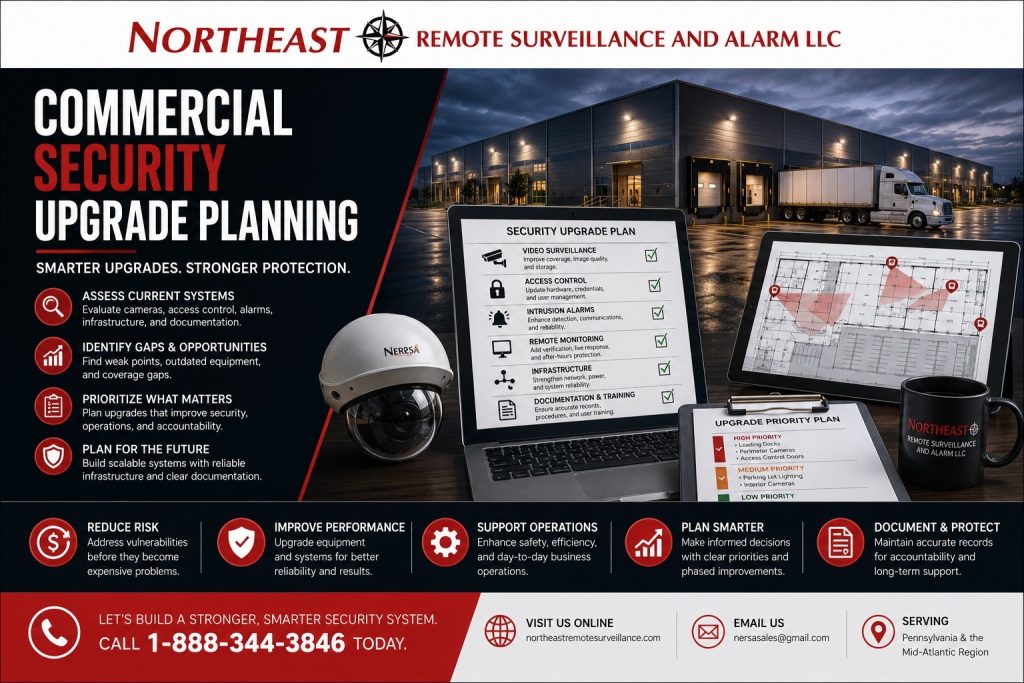
Northeast Remote Surveillance and Alarm, LLC helps commercial and industrial clients evaluate what should be reused, corrected, expanded, replaced, or phased over time.
For the parent project framework, start with Commercial Security Trust & Project Standards.
Why Commercial Security Upgrade Planning
Many commercial properties already have some type of security system in place. The system may include older cameras, a recorder, alarm devices, access control doors, card readers, motion detectors, keypads, cabling, power supplies, switches, cellular communicators, or monitoring service.
The problem is that older systems often grow in pieces. Cameras get added without a clear coverage plan. Access control expands one door at a time. Alarm zones are renamed, changed, or forgotten. Network equipment becomes outdated. Documentation gets lost. User permissions remain active long after employees, vendors, or managers leave.
Commercial security upgrade planning helps organize the system before money is spent. The goal is to improve security in a way that supports the facility, the budget, the operations, and future service.
When a Commercial Security System Should Be Reviewed
A system does not need to be completely broken before it deserves review. Many commercial security systems still turn on, record video, arm alarms, or unlock doors while failing to support the business properly.
Upgrade planning may be needed when:
- Cameras no longer provide usable detail
- Video storage is too short
- Remote access is unreliable
- Access control users are difficult to manage
- Former employees or vendors may still have access
- Alarm communication uses outdated phone lines
- False alarms are increasing
- Documentation is missing
- The building has expanded
- Operating hours have changed
- Loading docks, yards, or parking areas need better coverage
- The client needs cloud access or multi-site management
- Old equipment is no longer supported
- Cybersecurity concerns have increased
- Management wants clearer accountability
A proper upgrade plan helps identify what matters most before equipment is replaced.
Start With Current Conditions
The first step in upgrade planning is understanding what already exists. A commercial security system may include usable equipment, outdated equipment, undocumented equipment, abandoned cabling, or hidden infrastructure that affects the upgrade path.
Northeast Remote Surveillance and Alarm, LLC reviews existing cameras, recorders, access control hardware, alarm panels, motion detectors, door contacts, keypads, sirens, power supplies, cabling, network switches, remote access methods, monitoring paths, and system documentation.
This review helps determine whether the existing system can be improved, partially upgraded, integrated into a new platform, or phased out responsibly.
For a deeper review of current weaknesses, use Risk Review and Security Gap Analysis as the supporting planning resource.
Upgrade Planning for Video Surveillance
Camera upgrades should be based on what the business needs to see, identify, verify, and document. Replacing cameras one-for-one is not always the best answer.
A good video surveillance upgrade may include better camera placement, higher resolution, improved night visibility, better lens selection, longer video retention, remote access improvements, AI analytics, license plate recognition, cloud video options, or replacement of unsupported recorders.
Commercial properties should review camera coverage at:
- Main entrances
- Employee entrances
- Visitor entrances
- Parking lots
- Loading docks
- Shipping and receiving areas
- Warehouse aisles
- Production areas
- Restricted rooms
- Gates and fence lines
- Trailer yards
- Fleet parking areas
- Office common areas
- Public-facing counters
- Exterior low-light zones
A camera upgrade should solve a real visibility problem. The purpose may be general overview, incident documentation, employee accountability, vehicle activity review, alarm verification, or identification-level detail.
Upgrade Planning for Access Control
Access control systems often need upgrades when key management becomes difficult, employees change frequently, doors are added, user permissions become unclear, or old platforms no longer support the business.
Upgrade planning may include adding controlled doors, replacing outdated readers, improving credential management, moving from keys to cards or mobile credentials, separating access groups, improving reporting, upgrading controllers, or standardizing access across multiple locations.
Commercial access control upgrades should review:
- Which doors are currently controlled
- Which doors still rely on keys
- Who manages credentials
- How former users are removed
- Whether audit trails are useful
- Whether door hardware is serviceable
- Whether egress and life-safety concerns need coordination
- Whether the platform supports future expansion
- Whether managers need remote user administration
- Whether multi-site access should be standardized
Access control upgrades must support daily operations. A system that is technically advanced but difficult for employees, managers, visitors, vendors, or service teams to use can create new problems.
Upgrade Planning for Intrusion Alarms
Intrusion alarm systems may need upgrades when they rely on outdated communication paths, have poor zone descriptions, miss important doors, create false alarms, lack partitions, or no longer match the way the business operates.
Commercial alarm upgrade planning may review:
- Main entry doors
- Rear doors
- Overhead doors
- Dock doors
- Glass areas
- Interior motion detection
- Restricted rooms
- Panic or duress needs
- Siren locations
- Keypad locations
- Alarm partitions
- Cellular communication
- Backup battery condition
- User code management
- Monitoring contacts
- Alarm response procedures
Older alarm systems may still function, but they may not communicate reliably, support the right users, protect the right areas, or provide the documentation needed for long-term service.
Upgrade Planning for Remote Monitoring
Remote video monitoring, live talk-down, video verification, and alarm monitoring can strengthen commercial security when the system is designed around real response needs. Monitoring should not be added as an afterthought.
Upgrade planning should review where monitoring may help, what cameras are needed for verification, what areas need lighting, whether talk-down speakers are appropriate, how alarm events should escalate, and who should be contacted when activity is detected.
Monitoring upgrades may be useful for:
- After-hours parking lots
- Loading docks
- Trailer yards
- Fence lines
- Vehicle gates
- Exterior storage areas
- Vacant buildings
- Contractor yards
- High-value inventory areas
- Repeated trespassing locations
- Video-verified alarm response
Remote monitoring works best when camera views, alarm inputs, lighting, communication paths, and response procedures are planned together.
Upgrade Planning for Infrastructure
Many security upgrades depend on infrastructure that may not be visible during a quick walkthrough. Cameras, access control panels, alarm communicators, intercoms, cloud systems, and monitoring platforms may all depend on cabling, switching, power, internet service, backup power, cellular signal, or network segmentation.
Upgrade planning should review:
- Existing cable condition
- Cable pathways
- Network room location
- Available rack space
- Switch capacity
- PoE availability
- UPS backup
- Internet reliability
- Cellular signal
- Fiber requirements
- Wireless bridge needs
- Conduit requirements
- Power availability
- Environmental conditions near equipment
A security upgrade can fail to perform properly if the infrastructure underneath it is weak, undocumented, or undersized.
Upgrade Planning for Documentation
Documentation is one of the most important parts of a security upgrade. Without documentation, a business may not know what cameras exist, what doors are controlled, what alarm zones mean, where equipment is located, how users are managed, or what monitoring procedures apply.
Upgrade planning should identify missing or outdated documentation before the project begins. This helps with service, troubleshooting, user management, future expansion, insurance review, and multi-site support.
Documentation may include camera names, camera locations, door lists, alarm zone descriptions, equipment locations, network notes, monitoring contacts, user permission responsibility, service history, and platform information.
For deeper handoff and recordkeeping planning, continue with Security System Documentation Standards.
Reuse, Replace, or Phase the System
Not every commercial security upgrade requires full replacement. Some existing cameras, cabling, panels, power supplies, door hardware, or network infrastructure may still be useful. Other parts may need to be replaced because they are unsupported, unreliable, insecure, poorly documented, or unable to meet the client’s current needs.
A practical upgrade plan may separate the project into:
- Equipment that can remain
- Equipment that should be repaired
- Equipment that should be replaced now
- Equipment that can be phased later
- Infrastructure that must be corrected first
- Documentation that must be rebuilt
- Monitoring or user-management issues that need immediate attention
This approach helps clients control budget while still moving toward a stronger, more supportable security system.
Cybersecurity and Data Protection During Upgrades
Security upgrades are a good time to review cybersecurity concerns. Network-connected cameras, cloud dashboards, access control software, remote monitoring portals, mobile apps, and video management systems may all involve user permissions, passwords, remote access, firmware, and data retention.
Upgrade planning should consider whether old equipment is still supported, whether users are properly managed, whether default credentials were removed, whether remote access is controlled, and whether the system is aligned with the client’s IT expectations.
Commercial security upgrades should reduce both physical and digital risk. A newer system should not create avoidable cybersecurity exposure because of weak credential practices, unsupported firmware, or unmanaged remote access.
Scope Development for Upgrade Projects
A security upgrade proposal should clearly explain what is included, what is excluded, what existing equipment will be reused, what will be removed, what will be replaced, and what assumptions are being made.
This is especially important when working around occupied buildings, active warehouses, production environments, healthcare facilities, schools, municipalities, contractor yards, logistics facilities, and multi-site organizations.
A clear scope helps avoid confusion about cameras, doors, alarm zones, monitoring, cabling, network requirements, documentation, training, and support.
For proposal clarity, use Security Proposal and Scope Development Standards as the supporting scope resource.
Upgrade Planning for Multi-Site Organizations
Multi-site businesses need extra discipline when upgrading security. Each location may have different cameras, doors, alarm zones, managers, networks, monitoring contacts, and documentation history.
Upgrade planning can help standardize platforms, naming conventions, user permissions, reporting, monitoring procedures, documentation, and service expectations across locations. At the same time, each site must still be reviewed for its own layout, risks, operating hours, and infrastructure conditions.
A multi-site upgrade should create consistency without ignoring the operational reality of each property.
Facilities That Benefit From Upgrade Planning
Commercial security upgrade planning is useful for many property types, including warehouses, manufacturing facilities, offices, healthcare properties, schools, municipalities, logistics operations, contractor yards, industrial buildings, distribution centers, retail-commercial properties, industrial parks, and multi-site organizations.
It is especially valuable for facilities that have changed operations, expanded square footage, added employees, increased inventory, added loading areas, inherited older systems, changed management, experienced theft, or developed new after-hours concerns.
Upgrade planning helps the client improve the system in a controlled, practical, and supportable way.
What Clients Gain From a Structured Upgrade Plan
A structured upgrade plan helps clients understand what they have, what is working, what is failing, what should be prioritized, and what can be phased. It reduces guesswork and helps prevent wasted money on equipment that does not solve the real problem.
The client gains a clearer path for improving visibility, access control, intrusion detection, monitoring, infrastructure, documentation, cybersecurity awareness, and long-term support.
A strong upgrade plan does not just replace devices. It improves the way the security system supports the business.
Frequently Asked Questions
What is commercial security upgrade planning?
Commercial security upgrade planning is the process of reviewing an existing security system and deciding what should be reused, repaired, replaced, expanded, documented, or phased. It may include cameras, access control, intrusion alarms, monitoring, infrastructure, cybersecurity, and system documentation.
When should a business upgrade its security system?
A business should consider an upgrade when cameras no longer provide usable detail, access control is difficult to manage, alarm communication is outdated, monitoring procedures are unclear, equipment is unsupported, documentation is missing, or the building’s operations have changed.
Does an upgrade mean the entire system must be replaced?
No. A security upgrade does not always require full replacement. Some equipment, cabling, or infrastructure may remain useful. The purpose of planning is to decide what can stay, what needs correction, and what should be replaced.
What security systems can be included in an upgrade plan?
An upgrade plan may include video surveillance, access control, intrusion alarms, remote monitoring, alarm communication, intercoms, low-voltage cabling, network equipment, cloud platforms, cellular communicators, and system documentation.
Why is documentation important during a security upgrade?
Documentation helps the client and service provider understand what was installed, where equipment is located, what doors are controlled, what cameras are named, what alarm zones mean, and who is responsible for managing access or monitoring details.
Should cybersecurity be reviewed during a security upgrade?
Yes. Any network-connected security system should be reviewed for user permissions, remote access, passwords, firmware support, cloud access, data retention, and manufacturer support. Upgrades are a good opportunity to reduce avoidable digital risk.
Can security upgrades be phased over time?
Yes. Many commercial and industrial clients phase upgrades based on risk, budget, operations, and urgency. A phased plan may address immediate vulnerabilities first while scheduling future improvements for lower-priority areas.
Who should be involved in upgrade planning?
Useful participants may include the business owner, facility manager, operations manager, property manager, IT contact, warehouse manager, maintenance supervisor, security contact, or anyone responsible for daily use of the system.
Request a Commercial Security Assessment
Northeast Remote Surveillance and Alarm, LLC helps commercial and industrial clients plan security upgrades with clarity, documentation, and long-term support in mind.
To begin with a structured upgrade review, request a commercial security assessment.