
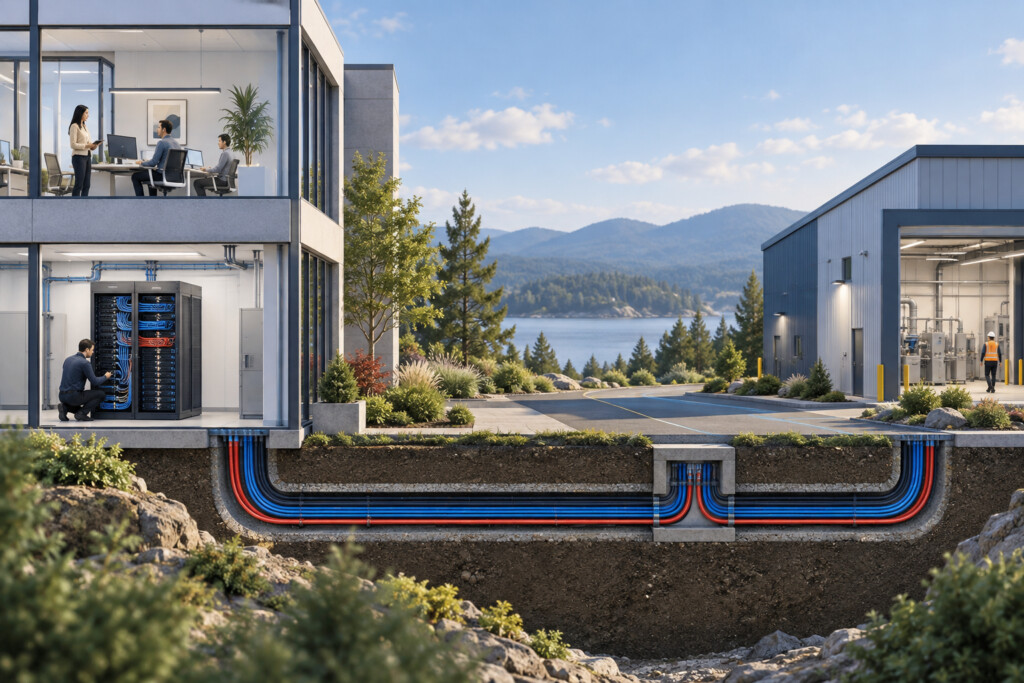


Enterprise security infrastructure connects local equipment to shared management, identity, time, storage, and support services. The design needs an agreed boundary between the security system and the customer’s IT environment at every site.
Part of Enterprise Security Systems Integration.
Start with service dependencies
For cameras, controllers, intercoms, and servers, record the services needed for normal operation and recovery. Distinguish local device operation from centralized administration, event delivery, and remote review. A branch can have an active internet connection while a required name, time, authentication, or application service is unavailable.
Create a repeatable site reference design
Define site identifiers, addressing rules, approved network zones, switch capacity, power budgets, uplinks, and remote-access methods. Allow site-specific designs for detached buildings, leased networks, industrial systems, and limited connectivity. Record exceptions so they are understood during support and future expansion.
Validate capacity across the complete path
Review camera traffic, live viewing, exports, cloud transfer, and recovery traffic together. Confirm switch and uplink headroom, power availability, and the responsibilities for fiber, wireless, and wide-area connections. Test the busiest representative operating conditions rather than relying only on an idle connection test.
Make recovery part of the handover
Map each critical function to the switch, power supply, link, server, or hosted service it depends on. Document recovery order, approved configuration backups, escalation contacts, and spare-equipment assumptions. Acceptance should demonstrate required local behavior when the central connection is interrupted.
Explore supporting enterprise resources
- Enterprise Security Network Reference Design — A security network reference design gives new and existing facilities a consistent set of connectivity rules without assuming every building has the same infrastructure.
- Enterprise Physical Security Cybersecurity Coordination — Enterprise physical security cybersecurity coordination translates the customer’s IT requirements into maintainable controls for cameras, controllers, servers, hosted platforms, and support access.
Related planning resources
- Commercial Security Infrastructure Planning
- Commercial Low-Voltage Infrastructure & Cabling
- Network Segmentation for Commercial Security Systems
Let’s talk about your next step
Tell us what you want to improve and which locations are involved. We can help you work through the questions, check what your systems support, and define a practical project scope.