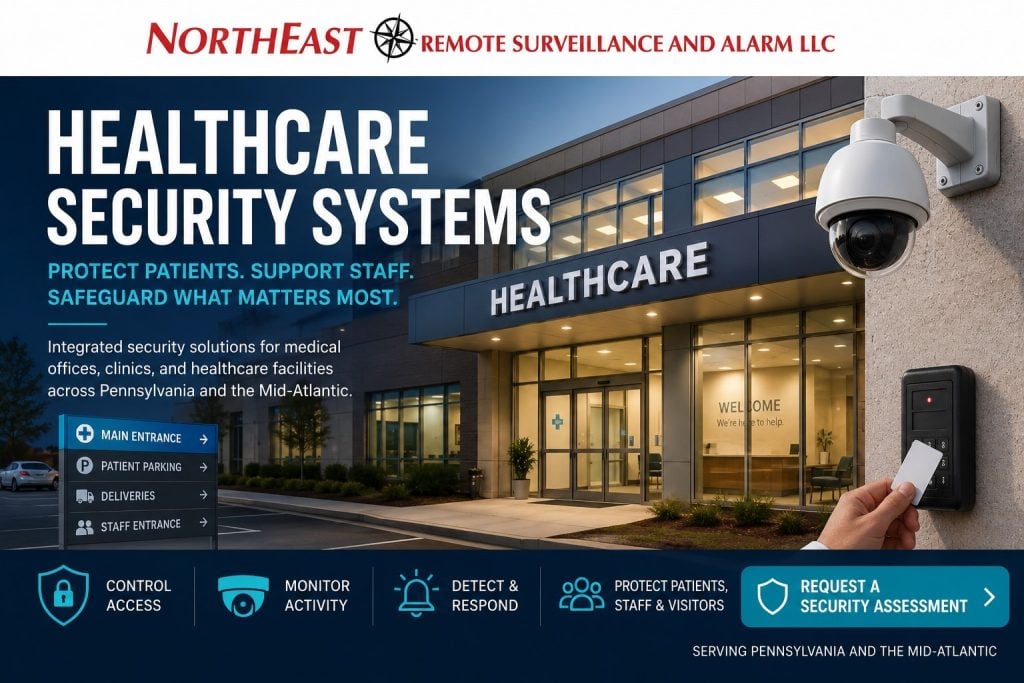
Healthcare security systems should protect patients, staff, visitors, records, medication areas, administrative offices, parking areas, entrances, restricted rooms and after-hours activity while supporting a calm and professional care environment.
Northeast Remote Surveillance and Alarm, LLC (NERSA) designs, installs, monitors, upgrades and supports commercial security systems for medical offices, healthcare clinics, dental offices, urgent care centers, specialty practices, outpatient facilities, therapy offices, healthcare administrative spaces and multi-tenant medical buildings.
Healthcare security may involve:
- Access control
- Video surveillance
- Intrusion alarms
- Panic and duress protection
- Visitor entry
- Intercoms
- Professional monitoring
- Remote video monitoring
- Parking-lot security
- Restricted-area protection
- Fire and life-safety coordination
- Supporting network infrastructure
- Existing-system upgrades and takeovers
The objective is not to make a healthcare property difficult to use.
The objective is to provide a dependable, manageable security environment that supports patient flow, staff safety, visitor control, restricted-area protection and normal clinical operations.
For broader planning by facility type, visit Industries We Serve.
For the complete service structure, visit Commercial & Industrial Security Services.
For regional and city planning, visit NERSA Service Areas.
Request a Healthcare Security Assessment or call 1-888-344-3846.
Commercial and Industrial Systems Only • Medical Offices • Clinics • Healthcare Facilities • Multi-Tenant Medical Properties • New Installations • Upgrades • Takeovers • Monitoring
Security Planning Around Healthcare Operations
Healthcare security differs from standard office, retail, warehouse or industrial security.
Medical environments may include public waiting areas, patient-facing spaces, staff-only rooms, medication storage, records areas, billing offices, IT closets, exterior entrances, employee parking and after-hours cleaning or vendor access.
A strong healthcare security plan should reflect how the facility actually operates.
Planning may need to consider:
- Patient arrivals
- Visitor movement
- Staff entrances
- Deliveries
- Vendor access
- Restricted rooms
- Medication areas
- Records storage
- Parking
- After-hours activity
- Alarm response
- Security documentation
- Fire and life-safety coordination
The system should support daily operations without creating unnecessary friction for patients or clinical personnel.
Access Control for Healthcare Facilities
Access control can help healthcare organizations manage who may enter staff-only areas, medication rooms, records spaces, rear doors, administrative offices and other restricted locations.
Healthcare facilities may use cards, fobs, mobile credentials, PINs, intercom release, schedules and managed user permissions.
Common controlled locations may include:
- Employee entrances
- Staff-only corridors
- Medication rooms
- Records rooms
- Billing offices
- IT and server rooms
- Administrative offices
- Rear and service doors
- Storage spaces
- Mechanical and utility rooms
- Tenant suite entrances
The system should provide authorized personnel with appropriate access while making former-user removal and permission changes manageable.
For broader planning, visit Commercial & Industrial Access Control Systems.
Video Surveillance for Healthcare Properties
Video surveillance can help healthcare facility managers document activity around public and operational areas where incident review and property visibility are appropriate.
Common locations may include:
- Main entrances
- Lobbies and reception areas
- Parking lots
- Exterior doors
- Shared corridors
- Delivery areas
- Exterior walkways
- Service entrances
- Other common areas
Camera placement should be planned carefully in healthcare environments.
The goal is to provide useful incident evidence without creating unnecessary privacy concerns.
For broader camera planning, visit Commercial & Industrial Video Surveillance Systems.
Intrusion Alarms and After-Hours Protection
Healthcare facilities may contain valuable equipment, medication, records, electronics and business infrastructure that require after-hours protection.
Intrusion systems may protect:
- Exterior doors
- Offices
- Storage rooms
- Restricted areas
- Vacant suites
- Records spaces
- Equipment rooms
- Other selected interior areas
Alarm schedules should reflect actual operations, including evening appointments, cleaning personnel, maintenance staff and different tenant schedules.
For broader intrusion planning, visit Commercial & Industrial Intrusion Alarm Systems.
Reception, Visitor Entry and Staff Safety
Reception is often the primary transition between public access and restricted healthcare spaces.
A healthcare reception plan may involve:
- Entry cameras
- Controlled doors behind reception
- Panic or duress devices
- Visitor procedures
- Intercom communication
- Staff-only access
- Delivery procedures
- After-hours entry controls
The system should support reception and clinical staff without making patients feel unnecessarily restricted.
For panic and duress planning, visit Panic, Duress and Emergency Alert Systems.
Intercoms and Controlled Visitor Communication
Healthcare facilities may need communication at main entrances, rear doors, service entrances or multi-tenant suite doors.
Intercoms can help staff communicate with visitors, vendors or delivery personnel before authorizing entry.
Where appropriate, intercoms may be coordinated with video surveillance and access control.
For broader planning, visit Two-Way Communication and IP Speaker Systems.
Parking Lots, Exterior Doors and After-Hours Visibility
Healthcare security extends beyond the lobby.
Staff may arrive early, leave late or access the property when occupancy is low.
Patients and visitors may also use parking areas outside typical business hours.
Exterior planning may include:
- Parking-lot cameras
- Employee entrances
- Rear and side doors
- Exterior walkways
- Delivery areas
- Lighting coordination
- Alarmed exterior openings
- Remote monitoring
A strong exterior plan should support visibility and incident review around the areas people use before entering and after leaving the building.
Remote Video Monitoring for Healthcare Properties
Selected healthcare properties may benefit from active video review around exterior areas with limited staffing.
Applications may include:
- Parking areas
- Rear entrances
- Service doors
- Exterior walkways
- Delivery areas
- After-hours building approaches
Monitoring should be based on defined cameras, schedules, event conditions and response procedures.
For dedicated planning, visit Remote Video Monitoring and Live Talk-Down.
Restricted Rooms and Sensitive Areas
Healthcare properties may contain spaces that require tighter control than general public or employee areas.
These can include:
- Medication rooms
- Records rooms
- Billing offices
- IT rooms
- Server closets
- Administrative offices
- Equipment rooms
- Storage rooms
- Lab-support spaces
- Utility rooms
Access control, door monitoring, intrusion protection and cameras at appropriate approaches may be used depending on the facility and operating requirements.
The goal is to limit access to authorized personnel while maintaining useful accountability.
Compliance-Aware Healthcare Security
Healthcare facilities often operate in privacy-sensitive, access-sensitive and inspection-sensitive environments.
Security systems do not replace healthcare compliance programs, privacy policies, training, emergency procedures or life-safety responsibilities.
Security planning may need to consider:
- Privacy-sensitive areas
- Staff-only access
- Medication storage
- Records protection
- Accessible entrances
- Fire alarm coordination
- Electrified door hardware
- Emergency egress
- Documentation
- Secure video access
- Administrator permissions
For broader code-aware planning, visit Regulatory Compliance and Inspection Readiness.
For fire and life-safety planning, visit Commercial Fire Alarm and Life-Safety Systems.
Multi-Tenant Medical Building Security
Multi-tenant medical buildings may require separate building-level and tenant-level security.
Property management may control:
- Main entrances
- Shared lobbies
- Parking areas
- Common corridors
- Service entrances
- Building-wide cameras
Individual practices may separately control:
- Suite entrances
- Staff permissions
- Interior restricted rooms
- Local alarm systems
- Tenant-specific users
The system should clearly establish which party controls each security function.
This helps reduce problems such as former staff retaining access, inconsistent alarm procedures, propped shared doors or unclear administrative ownership.
Unified Healthcare Security Systems
Video surveillance, access control, intrusion alarms, intercoms and monitoring may be coordinated when integration improves operations or incident review.
Examples may include:
- Video around a controlled-door event
- Alarm events associated with nearby cameras
- Visitor communication linked to a controlled entrance
- After-hours access coordinated with alarm schedules
Integration should solve a practical problem rather than create unnecessary complexity.
For broader planning, visit Unified Commercial and Enterprise Security Systems.
Existing Healthcare Security Systems
Healthcare facilities may inherit cameras, alarms, access control, intercoms and other equipment from previous tenants, owners or providers.
An existing system does not automatically require complete replacement.
NERSA can evaluate installed equipment, administrator access, credentials, door hardware, communication paths, monitoring, infrastructure and documentation to determine what may reasonably be retained, repaired, reprogrammed, expanded or replaced.
Begin with Commercial Security System Inspection and Assessment.
For modernization and takeover planning, visit Commercial Security System Upgrades, Retrofits and Takeovers.
Healthcare Facilities NERSA Supports
NERSA supports security planning for:
- Medical office buildings
- Healthcare clinics
- Dental offices
- Urgent care centers
- Specialty practices
- Physical therapy offices
- Behavioral healthcare offices
- Outpatient facilities
- Healthcare administrative offices
- Multi-tenant medical buildings
- Diagnostic and imaging offices
- Chiropractic offices
- Veterinary medical offices
- Wellness and clinical-service facilities
Each environment requires a different balance of access, video, alarms, visitor procedures, restricted-area protection and after-hours security.
Healthcare Security Assessment
A property-specific healthcare security assessment may review:
- Main entrance and reception flow
- Patient and visitor movement
- Staff-only entrances
- Medication and records areas
- Administrative offices
- IT and server rooms
- Exterior doors
- Parking and walkways
- Delivery and service access
- Alarm schedules
- After-hours activity
- Existing camera coverage
- Access-control systems
- Door hardware
- Monitoring procedures
- Fire and life-safety interfaces
- Documentation
- Future expansion
The objective is to understand how the healthcare property operates before equipment is selected.
Why Healthcare Facilities Choose NERSA
Northeast Remote Surveillance and Alarm, LLC focuses on commercial and industrial security rather than residential alarm packages.
NERSA plans healthcare security around:
- Patients
- Staff
- Visitors
- Vendors
- Entrances
- Parking
- Restricted areas
- Medication and records spaces
- After-hours activity
- Visitor communication
- Alarm response
- Video evidence
- System administration
- Documentation
The objective is not to create an unnecessarily complicated security environment.
The objective is to provide controlled access, useful visibility, dependable after-hours protection and a manageable security system that supports normal healthcare operations.
Request a Healthcare Security Assessment
If your medical or clinical property needs stronger access control, improved video coverage, more reliable intrusion protection, better visitor procedures, staff-safety support, parking visibility, restricted-area protection or modernization of existing systems, Northeast Remote Surveillance and Alarm, LLC can help.
Request a Healthcare Security Assessment or call 1-888-344-3846.
Commercial and Industrial Systems Only • Medical Offices • Clinics • Healthcare Facilities • Multi-Tenant Medical Properties • New Installations • Upgrades • Takeovers • Monitoring
Frequently Asked Questions About Healthcare Security Systems
What is a healthcare security system?
A healthcare security system may combine access control, video surveillance, intrusion alarms, visitor entry, intercoms, monitoring, restricted-area protection and supporting infrastructure around the way patients, staff and visitors use the property.
Do healthcare facilities need access control?
Many do. Access control can help protect staff entrances, medication rooms, records areas, IT spaces, administrative offices and other restricted locations.
Where should healthcare cameras be installed?
Common locations may include entrances, reception areas, parking lots, exterior doors, shared corridors, delivery areas and other appropriate public or operational spaces.
Should healthcare facilities have intrusion alarms?
Many healthcare properties benefit from after-hours intrusion protection around exterior doors, offices, storage rooms, equipment spaces and other selected areas.
Can healthcare security systems support multiple tenants?
Yes. Compatible systems may provide separate access permissions, alarm partitions and administrative responsibilities for building management and individual practices.
Can remote video monitoring help healthcare facilities?
Yes. Qualifying properties may use remote video monitoring for selected exterior cameras, schedules and defined event conditions.
Does healthcare security need to consider compliance and life safety?
Yes. Security systems should be planned with awareness of privacy, accessibility, emergency egress, fire alarm operation and other applicable building conditions.
Can existing healthcare security systems be upgraded in phases?
Yes. Existing equipment can be evaluated and modernization can be phased around the highest-priority entrances, cameras, alarms, restricted areas or infrastructure.
How does a healthcare security project begin?
The project begins with a property-specific assessment of patient flow, staff access, entrances, restricted rooms, parking, existing systems, after-hours activity and future requirements.