Northeast Remote Surveillance and Alarm, LLC designs commercial and industrial security systems for industrial parks, warehouse campuses, logistics facilities, manufacturing buildings, contractor yards, truck courts, multi-tenant industrial properties, and business parks across Pennsylvania and the surrounding Mid-Atlantic region. Industrial park security requires more than a few cameras or a basic alarm system; it requires coordinated video surveillance, access control, intrusion detection, remote video monitoring, gate control, intercom communication, alarm monitoring, low-voltage infrastructure, and long-term service planning. For broader regional coverage, start with Commercial & Industrial Security Systems in Pennsylvania and the Mid-Atlantic.
Industrial parks create unique security challenges because multiple buildings, tenants, employees, contractors, trucks, visitors, vendors, delivery drivers, exterior yards, loading docks, gates, parking areas, and shared drive lanes may all operate in the same property environment. Northeast Remote Surveillance and Alarm, LLC focuses on commercial and industrial security systems, not residential alarm packages, so every recommendation is built around real facility conditions, operational risk, documentation needs, and long-term serviceability.
Industrial Park Security Planning Pages
This directory is the main hub for industrial park security planning across Pennsylvania and the Mid-Atlantic. Use these NERSA pages for regional, corridor, and service-specific planning.
Commercial & Industrial Security Systems in Pennsylvania and the Mid-Atlantic
Review NERSA’s broader commercial and industrial security coverage across Pennsylvania, New Jersey, Delaware, Maryland, and surrounding Mid-Atlantic markets.
Commercial Security Systems in the Lehigh Valley
Plan security for industrial, manufacturing, warehouse, logistics, office, and commercial properties across Allentown, Bethlehem, Easton, and the Lehigh Valley corridor.
Commercial & Industrial Park Security Installation in Bethlehem, PA
Plan security systems for Bethlehem industrial parks, multi-tenant industrial properties, manufacturing buildings, warehouses, gates, yards, and shared commercial environments.
Lehigh Valley Industrial Park Security Systems in Bethlehem, PA
Plan camera systems, access control, intrusion alarms, monitoring, and infrastructure for Lehigh Valley Industrial Park properties and nearby Bethlehem industrial facilities.
Manufacturing & Industrial Security Systems in Bethlehem, PA
Plan manufacturing and industrial security for Bethlehem production buildings, warehouse-connected operations, industrial properties, and multi-building facilities.
NEPA Logistics Hub Security Directory
Plan security for Northeastern Pennsylvania logistics hubs, warehouse corridors, industrial parks, distribution centers, truck yards, and trailer areas.
Wilkes-Barre Industrial and Logistics Security Systems
Plan security systems for Wilkes-Barre warehouses, logistics facilities, industrial parks, loading docks, truck courts, gates, access control, and monitoring.
Greater Scranton Logistics Hub
Plan security for Scranton-area logistics facilities, industrial parks, trucking terminals, warehouse properties, and regional distribution operations.
Greater Philadelphia Commercial & Industrial Security Installation
Plan commercial and industrial security systems across Philadelphia, King of Prussia, Montgomery County, Bucks County, Chester County, Delaware County, South Jersey, and nearby regional corridors.
Greater Reading Area Commercial and Enterprise Security
Plan commercial, enterprise, warehouse, logistics, and industrial security systems for Reading, Berks County, and surrounding business markets.
Remote Video Monitoring and Live Talk-Down
Use monitored video, event review, live response procedures, speaker warnings, and documented escalation instructions for yards, gates, loading docks, and after-hours industrial park activity.
Commercial and Industrial Security Monitoring
Plan professional monitoring for intrusion alarms, video verification, alarm communication paths, escalation procedures, and commercial security response.
What We Mean by Industrial Park Security
Industrial park security refers to the planning, installation, monitoring, and long-term support of security systems for properties where commercial, industrial, warehouse, logistics, manufacturing, flex, contractor, and multi-tenant operations share a larger business environment.
An industrial park may include single-tenant manufacturing buildings, multi-tenant warehouse suites, distribution centers, office-warehouse buildings, contractor yards, fenced storage areas, truck courts, loading docks, detached buildings, shared parking lots, private roads, gate entrances, exterior utility areas, and common property management zones.
Because these properties are usually larger and more operationally complex than standard commercial buildings, security should be planned as a site-wide system. Cameras, access control, intrusion alarms, intercoms, gates, remote monitoring, lighting, low-voltage infrastructure, network equipment, and response procedures should support the property’s real activity.
Why Industrial Parks Need Dedicated Security Planning
Industrial parks have different risks than small offices, retail stores, or basic commercial buildings. They may operate with multiple tenants, multiple shifts, exterior storage, high truck activity, contractor traffic, employee turnover, shared lots, shared gates, remote building entrances, and large areas that are not visible from a single office or reception point.
A generic camera layout can leave blind spots around dock doors, trailer areas, rear doors, fence lines, utility spaces, and shared parking areas. A basic alarm system may not account for tenants with different schedules. A poorly planned access control system may fail to separate employees, drivers, visitors, contractors, and property management access.
Dedicated planning helps reduce confusion. The security system should clarify who is entering the property, which doors are being used, which areas are protected, how alarms are handled, what cameras document, how tenants are separated, and how events are reviewed after hours.
Industrial Park Security Challenges
Industrial parks commonly face risks that require layered security.
Common challenges include:
- Shared entrances and shared drive lanes
- Multi-tenant parking and access confusion
- Loading docks and overhead doors
- Trailer parking and drop lots
- Fence lines and remote perimeter areas
- Contractor and vendor access
- After-hours trespass and vandalism
- Illegal dumping in shared areas
- Theft of tools, materials, copper, batteries, fuel, equipment, and inventory
- Employee doors being propped open
- Uncontrolled key use
- Unclear tenant boundaries
- Camera systems with poor coverage or weak retention
- Alarm systems that do not match operating schedules
- Gate systems without proper camera verification
- Low-voltage infrastructure that cannot support expansion
A strong industrial park security plan should solve these problems without interfering with normal business operations.
Video Surveillance for Industrial Parks
Video surveillance is one of the most important parts of industrial park security. Cameras should help property owners, tenants, managers, and authorized users understand what happened across the property.
Important camera areas may include main entrances, vehicle gates, truck courts, loading docks, overhead doors, shared parking lots, tenant entrances, exterior walls, rear doors, fence lines, trailer areas, dumpsters, exterior storage, utility areas, and common drive lanes.
A properly planned camera system should provide useful coverage, not just general images. Camera placement, viewing angle, lens selection, lighting, recording retention, network infrastructure, and management access all affect whether the system will help when an incident occurs.
Remote Video Monitoring for Industrial Parks
Remote video monitoring can help industrial parks improve after-hours awareness around exterior areas that are difficult to watch from inside the building. This may include gates, yards, fence lines, truck courts, trailer areas, parking lots, loading docks, and shared property areas.
A monitored video system can support event review, live talk-down, alarm verification, escalation instructions, and documented response procedures. This can be especially useful for properties that have repeated trespassing, after-hours vehicle activity, dumping, vandalism, theft attempts, or large exterior areas that would otherwise require costly on-site guard coverage.
Remote monitoring works best when camera placement, lighting, analytics, speaker locations, and response instructions are designed together.
Access Control for Industrial Park Buildings
Access control helps industrial park properties manage who can enter specific doors, gates, buildings, tenant spaces, offices, warehouse areas, utility rooms, restricted spaces, and common areas.
A commercial access control system may include card readers, key fobs, mobile credentials, keypad entry, door position monitoring, request-to-exit devices, electrified locks, gate access, schedules, user groups, and reporting.
Access control can help reduce uncontrolled key use, separate tenant access, remove former users, manage employee turnover, limit contractor entry, and document door activity when something happens. It is especially valuable for multi-tenant industrial buildings, shared entrances, warehouse suites, production areas, IT rooms, tool rooms, utility rooms, and gated yards.
Intrusion Alarms for Industrial Parks
Industrial park alarm systems should be designed around the building layout, tenant schedules, door count, overhead doors, restricted areas, shared spaces, and monitoring needs.
An intrusion alarm system may include door contacts, overhead door contacts, motion detection, partitions, keypads, sirens, communication modules, video verification, and professional monitoring. Different tenants or areas may need separate schedules, user codes, zones, and escalation instructions.
A strong alarm design helps reduce false alarms while still protecting the property. The system should be understandable for users, clear for management, and serviceable for long-term support.
Gate Security and Vehicle Entry Control
Industrial parks often have vehicle entrances that need stronger control and documentation. A gate system may include cameras, access control, intercoms, license plate recognition where appropriate, remote release, scheduled access, and monitoring support.
Gate security should not be treated as a standalone feature. The gate, cameras, intercom, access credentials, lighting, and response procedures should work together. If a vehicle enters after hours, management should have a way to review the activity. If someone tailgates through a gate, the system should help document it. If a visitor or driver needs access, communication should be clear before entry is granted.
Vehicle entry control is especially important for truck courts, trailer yards, contractor yards, industrial parks with exterior storage, and properties with repeated after-hours activity.
Loading Dock and Truck Court Security
Loading docks and truck courts are high-activity areas in industrial parks. They may involve employees, drivers, vendors, contractors, forklifts, freight, trailers, overhead doors, staged materials, and after-hours deliveries.
A dock security plan may include interior and exterior cameras, overhead door contacts, door position monitoring, access control, intercoms, alarm monitoring, lighting coordination, and remote video monitoring. The system should help management understand truck arrival, trailer position, dock door use, freight movement, driver activity, and after-hours activity.
Dock security should be planned around workflow. The goal is to improve documentation and control without slowing down shipping and receiving operations.
Perimeter Security for Industrial Parks
Perimeter security helps protect the exterior boundary of the industrial park. This may include fence lines, gates, remote parking areas, trailer lots, exterior storage areas, stormwater or utility areas, rear drive lanes, wooded edges, and dark corners of the property.
Perimeter security may include cameras, analytics, lighting coordination, remote monitoring, gate control, intercoms, signage, fence awareness, and response planning. The system should be designed around the actual property layout and risk areas.
A few cameras on the front of the building rarely protect the entire industrial park. Larger properties need a perimeter plan that considers distance, lighting, sight lines, weather, network connectivity, power, and the type of activity that needs to be detected.
Multi-Tenant Industrial Park Security
Multi-tenant industrial parks need careful security planning because property owners, tenants, employees, visitors, drivers, vendors, contractors, and management teams may all use the same site in different ways.
Security planning should clarify common areas and tenant-controlled areas. Shared parking lots, gates, drive lanes, dumpster areas, exterior walls, loading docks, and property entrances may need camera coverage or monitoring. Tenant entrances may need access control, cameras, or alarm systems specific to each space.
A well-planned system can reduce disputes, clarify access activity, improve common-area visibility, and help property management support tenants more effectively.
Manufacturing and Production Building Security
Manufacturing buildings inside industrial parks often need security systems that support employee movement, production activity, contractor access, restricted rooms, tool rooms, utility spaces, loading docks, exterior yards, and after-hours protection.
Security may include production-area cameras, employee entrance access control, intrusion alarms, remote monitoring, restricted-area protection, low-voltage infrastructure, and fire alarm coordination.
Manufacturing security should be built around operations. Cameras, doors, alarms, and monitoring procedures should support production without creating unnecessary bottlenecks.
Warehouse and Logistics Security
Warehouse and logistics properties in industrial parks often have high door counts, dock activity, trailer yards, temporary labor, delivery schedules, and exterior exposure. Security should focus on dock doors, truck courts, employee entrances, vendor access, freight staging, restricted areas, gates, and after-hours activity.
A strong warehouse security plan may include dock cameras, yard cameras, overhead door alarms, remote video monitoring, access control, gate intercoms, alarm monitoring, and low-voltage infrastructure planning.
Warehouse security should help management document activity, reduce blind spots, verify events, and respond more effectively when incidents occur.
Contractor Yard and Outdoor Asset Security
Contractor yards, building supply yards, equipment storage areas, and bulk material sites often rely on exterior security. These properties may contain tools, vehicles, trailers, fuel, copper, batteries, pallets, equipment, generators, building materials, and machinery stored outside.
Security planning may include gate cameras, perimeter cameras, long-range cameras, remote video monitoring, intercoms, access control, lighting coordination, intrusion detection, and yard-specific response procedures.
Outdoor asset security needs to account for weather, long distances, dark zones, power availability, wireless connectivity, and after-hours activity.
Cold Storage and Food Distribution Security
Cold storage and food distribution facilities require security planning that supports delivery accountability, controlled access, temperature-sensitive workflows, vendor access, loading dock documentation, and restricted-area control.
Security systems may support receiving activity, outbound lanes, employee entrances, contractor access, storage areas, dock doors, and incident review. Cameras and access control can help document activity, but they do not replace food safety programs, written procedures, inspections, or regulatory requirements.
The security system should support accountability while respecting the facility’s operational needs.
Low-Voltage Infrastructure for Industrial Parks
Industrial park security systems depend on reliable infrastructure. Cameras, access control readers, alarm devices, intercoms, gate systems, wireless bridges, fiber links, network switches, PoE equipment, backup power, and monitoring equipment all need proper planning.
Industrial parks often require long cable paths, exterior infrastructure, multiple buildings, detached structures, gate locations, network rooms, equipment racks, wireless links, and expansion planning. Poor infrastructure can lead to unreliable cameras, difficult service, weak network performance, and expensive future corrections.
A strong infrastructure plan should include cable pathways, labeling, documentation, equipment locations, power planning, network capacity, and future expansion.
Fire Alarm, Egress, and Life-Safety Awareness
Industrial park security should be planned with awareness of emergency egress, fire alarm systems, controlled doors, electrified hardware, gate systems, alarm communication, power supplies, and inspection-sensitive conditions.
Security systems do not replace fire alarm requirements, code review, AHJ approval, employee training, safety programs, or written procedures. They can support better documentation, access accountability, event review, and facility awareness when planned correctly.
Controlled doors, access systems, electric strikes, electrified trim, magnetic locks, gate controls, monitoring communication paths, and backup power should be coordinated carefully before installation.
Documentation and Long-Term Serviceability
A security system should remain understandable and serviceable after installation. Documentation may include camera names, device locations, access-controlled doors, alarm zones, user permissions, monitoring instructions, communication paths, cable labels, equipment rooms, power supplies, backup power locations, and service records.
Good documentation helps property owners, tenants, managers, technicians, and future decision-makers understand the system. It also helps when tenants change, buildings expand, security needs grow, or incidents need to be reviewed.
NERSA plans industrial park security systems with long-term support in mind.
Pennsylvania Industrial Park Security Markets
Northeast Remote Surveillance and Alarm, LLC supports commercial and industrial security planning across Pennsylvania markets where industrial parks, warehouses, manufacturing buildings, logistics properties, contractor yards, and multi-building operations need professional security systems.
Pennsylvania markets may include:
- Lehigh Valley
- Allentown
- Bethlehem
- Easton
- Reading and Berks County
- Scranton
- Wilkes-Barre
- Hazleton
- Northeastern Pennsylvania
- Harrisburg
- Lancaster
- York
- King of Prussia
- Greater Philadelphia
- Bucks County
- Montgomery County
- Chester County
- Delaware County
- Central Pennsylvania
- Industrial corridors connected to I-78, Route 22, Route 33, I-81, I-80, I-476, and the Pennsylvania Turnpike
Project availability depends on scope, system type, support requirements, distance, licensing, and long-term service needs.
Mid-Atlantic Industrial Park Security Markets
NERSA may also support larger commercial, industrial, logistics, multi-site, and referral-based projects across nearby Mid-Atlantic markets depending on project requirements.
Mid-Atlantic markets may include:
- South Jersey
- Central New Jersey
- Northern Delaware
- Wilmington and New Castle County
- Maryland industrial corridors
- Philadelphia metro industrial properties
- Multi-site regional operations
- Warehouse and logistics properties tied to Pennsylvania and Mid-Atlantic distribution networks
For larger regional projects, the system design should account for serviceability, monitoring, remote access, documentation, equipment standards, and whether the property can be properly supported long term.
Industrial Park Security Buyer Checklist
When comparing industrial park security proposals, buyers should ask practical questions.
Video surveillance checklist:
- Are gates, docks, parking areas, tenant entrances, and rear areas covered?
- Are cameras placed for useful identification, not just general activity?
- Is night coverage planned around real lighting conditions?
- Is recording retention appropriate for incident review?
- Can managers quickly find and export footage?
Access control checklist:
- Can tenant, employee, contractor, visitor, and management access be separated?
- Are door-held-open and forced-door events tracked?
- Can credentials be removed quickly?
- Are shared doors and restricted areas handled correctly?
- Are reports usable for management review?
Alarm checklist:
- Are overhead doors and man doors protected?
- Are zones and partitions designed around tenant schedules?
- Are monitoring instructions clear?
- Is video verification available for important areas?
- Are false alarms reduced through proper design?
Perimeter checklist:
- Are gates visually verified?
- Are fence lines and dark zones reviewed?
- Is lighting aligned with camera performance?
- Are trailer yards, storage areas, and remote lots covered?
- Is remote monitoring appropriate for after-hours exposure?
Infrastructure checklist:
- Are cable pathways documented?
- Are network switches and equipment rooms planned?
- Is backup power considered?
- Can the system expand later?
- Is the system serviceable without major disruption?
Common Industrial Park Security Problems We Help Solve
Industrial park owners, tenants, and facility managers often need help when cameras do not cover the right areas, gates are not documented, access control is missing, alarm systems create nuisance events, dock doors are not monitored, tenants share uncontrolled keys, or exterior areas are not watched after hours.
Other common problems include poor camera retention, weak night visibility, no video verification, unclear alarm zones, old phone-line alarm communication, unlabeled wiring, unreliable wireless links, weak network infrastructure, no access reports, and no clear monitoring instructions.
NERSA can evaluate the property, existing systems, tenant layout, gates, docks, yards, access points, alarm needs, infrastructure, and future expansion goals to recommend a practical security plan.
Areas NERSA Can Help Secure
- Industrial parks
- Warehouse campuses
- Logistics facilities
- Distribution centers
- Manufacturing buildings
- Multi-tenant industrial properties
- Flex industrial buildings
- Contractor yards
- Building product yards
- Truck courts
- Trailer yards
- Drop lots
- Loading docks
- Overhead doors
- Shipping offices
- Receiving areas
- Gate entrances
- Guard shacks
- Employee entrances
- Visitor entrances
- Vendor doors
- Contractor entrances
- Shared parking lots
- Fence lines
- Exterior storage areas
- Utility rooms
- IT rooms
- Tool rooms
- Mechanical rooms
- Electrical rooms
- Security equipment rooms
- Multi-building properties
Why Industrial Park Owners and Tenants Choose NERSA
Industrial park owners and tenants choose Northeast Remote Surveillance and Alarm, LLC because NERSA designs commercial and industrial systems around real facility conditions. Industrial parks need more than equipment; they need a practical plan for people, vehicles, doors, docks, tenants, gates, cameras, alarms, access control, monitoring, and infrastructure.
NERSA focuses on video surveillance, access control, intrusion alarms, alarm monitoring, remote video monitoring, gate communication, intercoms, low-voltage infrastructure, documentation, compliance-aware planning, and long-term support. Whether the property needs a new camera system, gate access, monitored alarms, tenant entrance control, dock coverage, remote video monitoring, or a complete integrated security plan, the design starts with how the property actually operates.
Request an Industrial Park Security Assessment
If your industrial park, warehouse campus, manufacturing property, logistics facility, contractor yard, truck court, or multi-tenant industrial building needs stronger cameras, access control, intrusion alarms, remote video monitoring, alarm monitoring, gate control, intercoms, perimeter security, or low-voltage infrastructure, Northeast Remote Surveillance and Alarm, LLC can evaluate the property and recommend a system built around your operation.
Call 1-888-344-3846 to request a commercial and industrial park security assessment.
Pennsylvania and Mid-Atlantic Industrial Park Security FAQs
What is industrial park security?
Industrial park security is the planning and installation of cameras, access control, alarms, monitoring, intercoms, gates, perimeter systems, and low-voltage infrastructure for properties with warehouses, manufacturing buildings, tenants, truck courts, docks, yards, and shared business areas.
Why do industrial parks need specialized security planning?
Industrial parks often include multiple tenants, large exterior areas, truck traffic, loading docks, employee entrances, contractor access, shared parking, gates, and after-hours activity. These conditions require more planning than a basic commercial camera or alarm system.
What security systems are commonly used in industrial parks?
Common systems include video surveillance, access control, intrusion alarms, remote video monitoring, alarm monitoring, intercoms, gate access control, license plate recognition where appropriate, low-voltage infrastructure, and backup power planning.
Can industrial park cameras monitor shared areas?
Yes. Cameras can be used to monitor shared entrances, drive lanes, parking lots, docks, gates, dumpsters, fence lines, exterior yards, and common property areas depending on the layout and ownership responsibilities.
Can access control separate tenants?
Yes. Access control can separate tenant users, employee groups, contractors, property managers, vendors, and restricted areas using credentials, schedules, door permissions, and reporting.
Can remote video monitoring help industrial parks after hours?
Yes. Remote video monitoring can help review activity around gates, docks, yards, parking areas, trailer lots, fence lines, and exterior doors when the property is closed or lightly staffed.
Can industrial park gates be integrated with cameras and intercoms?
Yes. Gate systems can be integrated with cameras, intercoms, access control, remote release, monitoring procedures, and license plate recognition where appropriate.
Should overhead doors be monitored?
Many industrial properties benefit from overhead door monitoring, especially around loading docks, warehouse spaces, and after-hours access points. Door contacts, position monitoring, alarm schedules, and video verification can help protect these openings.
Can NERSA support multi-building industrial parks?
Yes. NERSA can help plan security systems for multi-building industrial parks using cameras, access control, alarms, monitoring, fiber, wireless bridges, network equipment, and documented service planning.
Does industrial park security need fire alarm or egress awareness?
Yes. Security systems may affect controlled doors, electrified locks, gates, egress paths, alarm communication, and inspection-sensitive conditions. Planning should account for life-safety requirements where applicable.
Can NERSA upgrade older industrial park security systems?
Yes. NERSA can evaluate older cameras, alarms, access control systems, monitoring communication, wiring, network equipment, and infrastructure to recommend practical upgrades or replacement options.
Does NERSA install residential security systems?
No. Northeast Remote Surveillance and Alarm, LLC focuses on commercial and industrial security systems.
How do I request an industrial park security assessment?
Call Northeast Remote Surveillance and Alarm, LLC at 1-888-344-3846 to request a commercial and industrial park security assessment.
Schedule a Pennsylvania and Mid-Atlantic Industrial Park Security Assessment
Industrial park security should be built around the way tenants, employees, trucks, visitors, contractors, doors, docks, cameras, alarms, access control, monitoring, and infrastructure actually work at the property. Northeast Remote Surveillance and Alarm, LLC can help your industrial park, warehouse campus, logistics property, manufacturing building, or multi-tenant industrial facility plan a system that improves visibility, controls access, supports alarm response, documents activity, and protects the areas that matter most.
Call 1-888-344-3846 to request a Pennsylvania and Mid-Atlantic industrial park security assessment.
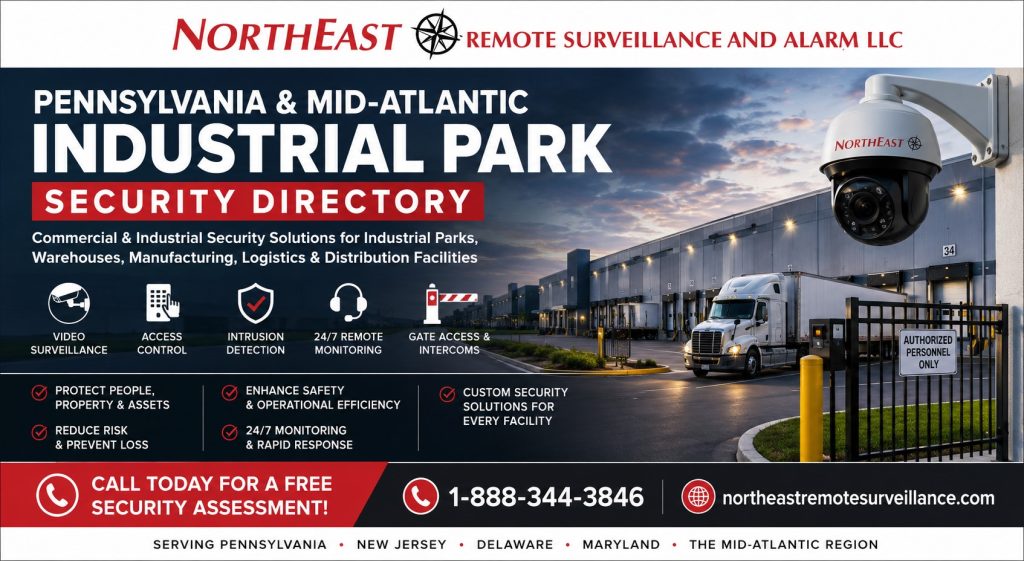
Pennsylvania and Mid-Atlantic Industrial Park Security Directory by Northeast Remote Surveillance and Alarm, LLC showing warehouses, industrial parks, loading docks, truck courts, gate access control, video surveillance, intrusion alarms, remote video monitoring, and commercial industrial security planning.