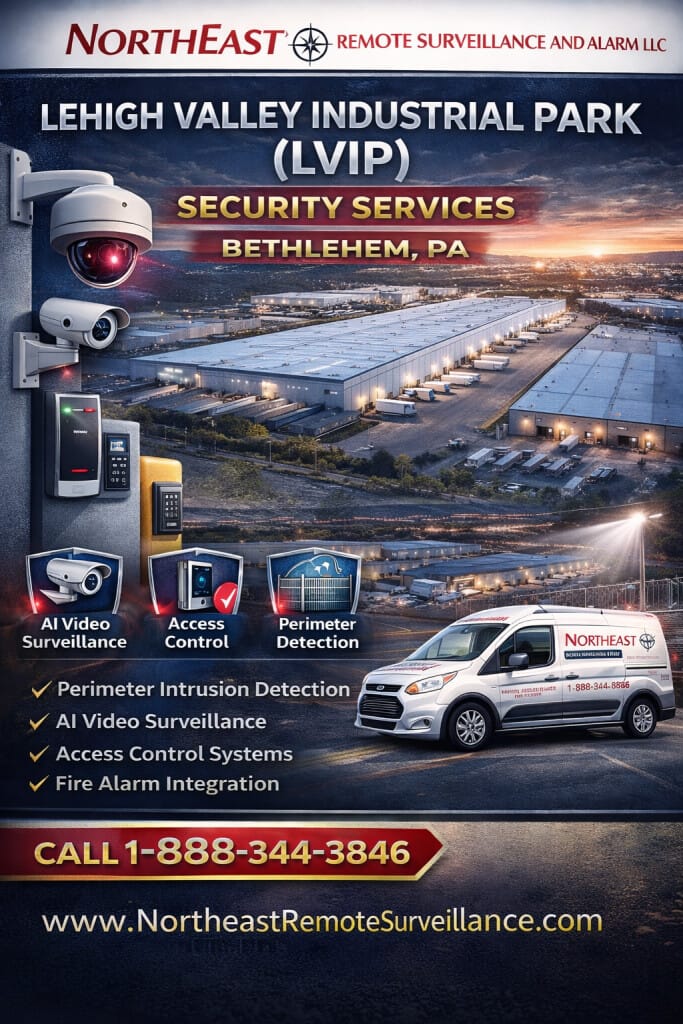
Lehigh Valley Industrial Park, often referred to as LVIP, is one of the most important industrial, logistics, manufacturing, warehouse, and business park areas in the Bethlehem and Lehigh Valley market. Northeast Remote Surveillance and Alarm, LLC designs and installs commercial and industrial security systems for LVIP tenants, property owners, warehouse operators, manufacturers, logistics companies, and multi-tenant commercial facilities. For broader regional planning, visit Lehigh Valley Commercial and Industrial Security Systems.
LVIP facilities often combine large building footprints, multiple loading docks, employee entrances, parking lots, fenced yards, truck access, shared infrastructure, inventory areas, restricted rooms, production spaces, and after-hours exposure. These environments need security systems designed around how the facility actually operates, not generic equipment packages.
Northeast Remote Surveillance and Alarm, LLC helps LVIP facilities improve visibility, access accountability, intrusion protection, monitoring, documentation, and long-term system reliability.
Call 1-888-344-3846 to request an LVIP commercial security assessment.

Commercial and Industrial Security for LVIP Facilities
Security planning inside Lehigh Valley Industrial Park should account for more than doors and cameras. Many LVIP properties operate as warehouses, manufacturing plants, distribution centers, flex industrial spaces, office-industrial buildings, contractor support facilities, technology spaces, and multi-tenant commercial buildings.
A proper LVIP security plan may include video surveillance, access control, intrusion alarms, gate access control, perimeter cameras, remote video monitoring, intercoms, low-voltage infrastructure, fire alarm coordination, and system documentation.
The right design depends on the building layout, tenant structure, yard exposure, dock activity, employee movement, truck traffic, operating hours, and future expansion needs.
For Bethlehem-area industrial planning, visit Bethlehem Manufacturing and Industrial Security Systems.
Why LVIP Requires Industrial-Grade Security Planning
Lehigh Valley Industrial Park facilities often have security challenges that are different from standard retail, office, or residential properties. Large industrial buildings can include long exterior walls, multiple dock doors, high ceilings, forklift activity, heavy equipment, trailer areas, restricted spaces, and employees working across multiple shifts.
Standard security layouts are often not enough for these environments.
LVIP properties may need planning for:
- Loading dock visibility
- Warehouse camera coverage
- Employee entrance access control
- Truck court monitoring
- Trailer staging areas
- Fenced yard security
- Gate access control
- After-hours intrusion detection
- Restricted room protection
- Production floor visibility
- Parking lot surveillance
- Visitor and vendor movement
- Multi-tenant access permissions
- Fire alarm and door hardware coordination
- Network and cabling infrastructure
- Video retention and incident review
Security systems should support the operation, not interfere with it. A well-designed system helps management understand who entered, when they entered, what happened, where activity occurred, and how the event can be reviewed later.
Security Systems for Lehigh Valley Industrial Park Properties
LVIP properties may need one system or several systems working together. Northeast Remote Surveillance and Alarm, LLC designs commercial and industrial security systems that can be scaled to match the facility, tenant, campus, or property owner’s risk profile.
Warehouse and Distribution Security
Warehouses and distribution centers inside LVIP often need security systems designed around receiving, shipping, dock doors, warehouse aisles, inventory areas, employee entrances, office areas, parking lots, and truck courts.
A warehouse security system may include interior cameras, exterior cameras, dock cameras, access control, alarm protection, gate visibility, restricted-area control, video retention, and remote review for management.
For warehouse-specific planning, visit Warehouse Security Systems.
Perimeter and Yard Security
Many LVIP properties include fenced yards, outdoor storage, trailer areas, equipment zones, service roads, parking areas, and exterior building exposure. These areas often create risk because they are harder to monitor than interior spaces.
Perimeter and yard security may include exterior cameras, AI video analytics, thermal camera options, gate cameras, fence-line coverage, lighting coordination, intrusion alarm points, and remote video monitoring.
The goal is to reduce blind spots, improve after-hours awareness, and help management review exterior activity when an incident occurs.
AI Video Surveillance and Camera Systems
Commercial video surveillance inside LVIP should be planned for usable visibility, not just camera count. Cameras should be positioned to help review entrances, loading docks, truck lanes, parking areas, warehouse aisles, shipping offices, production areas, gate lanes, restricted rooms, and exterior exposure points.
AI video analytics can help support people detection, vehicle detection, after-hours alerts, perimeter awareness, loitering review, and operational visibility when properly designed around the site.
For broader camera planning, visit Commercial Security Camera Systems.
Access Control for LVIP Buildings
Access control helps LVIP tenants and property managers manage who can enter specific areas, when they can enter, and what doors they are allowed to use.
Access control may be used for employee entrances, warehouse-to-office doors, shipping offices, inventory rooms, IT rooms, tool rooms, maintenance spaces, tenant areas, management offices, and restricted production areas.
Instead of relying only on keys, facilities can use keycards, fobs, mobile credentials, schedules, permissions, audit trails, and access logs to improve accountability.
For warehouse door and credential planning, visit Warehouse Access Control Systems.
Gate Access Control and Vehicle Documentation
Vehicle movement is a major part of many LVIP facilities. Truck entrances, employee parking gates, contractor entrances, trailer areas, service roads, and delivery lanes may all need stronger control and documentation.
Gate access control can help manage authorized vehicle entry, employee vehicle access, vendor traffic, contractor traffic, gate event history, and after-hours yard access.
When gate control is paired with cameras, management can better understand who entered, when they entered, and what happened after the vehicle was on site.
For vehicle gate planning, visit Commercial Gate Access Control Systems for Truck Yards and Industrial Facilities.
Intrusion Alarm Systems for LVIP Facilities
Industrial alarm systems in LVIP should be designed around real exposure points. This may include employee doors, dock-adjacent doors, warehouse doors, overhead doors, offices, restricted rooms, shop areas, storage rooms, utility rooms, and detached spaces.
A commercial alarm system may include door contacts, overhead door contacts, motion detection, glass break detection, panic or duress buttons, partitions, keypads, user codes, cellular communication, monitoring, and video verification.
For intrusion alarm planning, visit Commercial and Enterprise Intrusion Alarm Systems.
Remote Video Monitoring and Live Talk-Down
Some LVIP properties need more than recorded video. Facilities with yard exposure, trailer storage, remote parking areas, gate lanes, after-hours activity, exterior equipment, or repeated trespassing concerns may benefit from remote video monitoring and live talk-down.
Remote monitoring can help identify suspicious activity, support real-time review, and create a stronger response process for outdoor areas and unattended property zones.
For monitoring and live talk-down planning, visit Remote Video Monitoring and Live Talk-Down.
Fire Alarm, Egress, and Life-Safety Coordination
Access control, doors, alarms, and security hardware should be planned with awareness of emergency egress, fire alarm interfaces, door release requirements, inspection expectations, and long-term serviceability.
Security systems should not interfere with life-safety systems. When access control is installed on doors that affect egress, door hardware and release methods should be coordinated with the building use, fire alarm system, AHJ expectations, and applicable code requirements.
For broader code and inspection planning, visit Regulatory and Compliance Hub for Commercial Security, Fire Alarm and Life Safety.
Network, Cabling, and Security Infrastructure
Industrial security systems depend on reliable infrastructure. Cameras, access control panels, alarm communicators, intercoms, wireless bridges, fiber, PoE switches, network cabinets, and backup power should be planned cleanly so the system can be serviced, expanded, and documented over time.
LVIP facilities may need network segmentation, secure remote access, clean cable pathways, properly labeled devices, power planning, switch capacity review, and documentation for future maintenance.
A security system is only as reliable as the infrastructure behind it.
Common Security Challenges in LVIP Facilities
LVIP facilities often have large sites, multiple users, and several different types of activity happening at once. A warehouse may have employees arriving, vendors checking in, trucks backing into docks, visitors entering the office, contractors accessing restricted rooms, and managers reviewing activity remotely.
Common security challenges include:
- Poor visibility around dock doors
- Uncontrolled employee entrances
- Unmanaged keys and door permissions
- Limited parking lot camera coverage
- Weak fence-line visibility
- Unprotected trailer staging areas
- No documentation of after-hours access
- Disconnected cameras, alarms, and access control
- Limited alarm coverage around overhead doors
- Poor camera angles at truck entrances
- No video verification for alarm events
- No clear review process after incidents
- Shared tenant spaces without segmented access
- Outdated cabling or network infrastructure
- Security systems that cannot scale with facility growth
A locked LVIP security plan should identify the actual exposure points and design the system around them.
What This Page Does Not Cover
This page focuses specifically on commercial and industrial security planning for Lehigh Valley Industrial Park facilities in the Bethlehem, PA area. It is not the main page for warehouse security systems, commercial security cameras, access control, intrusion alarms, fire alarm systems, remote monitoring, gate access control, low-voltage cabling, or regulatory compliance.
Those systems may be part of an LVIP security project, but each should be reviewed through its own dedicated page when the primary need is a specific system design. This page is intended to help LVIP tenants, property owners, and facility managers understand how those systems work together across industrial buildings, yards, docks, gates, parking areas, and tenant spaces.
Compliance and Documentation Awareness for LVIP Security Projects
Commercial and industrial security systems inside LVIP should be planned with awareness of building use, emergency egress, fire alarm coordination, low-voltage wiring, workplace safety, documentation, cybersecurity, and insurance expectations.
Security systems do not replace code compliance, fire protection engineering, workplace safety programs, or insurance requirements. However, a properly designed system can support safer operation, better documentation, stronger access accountability, alarm review, incident investigation, and long-term serviceability.
For industrial and commercial environments, documentation matters. Device locations, access permissions, alarm zones, cable pathways, network structure, inspection-related interfaces, user training, and system records should be organized so the property can be supported over time.
LVIP Security Assessment
If your facility operates inside Lehigh Valley Industrial Park or the surrounding Bethlehem industrial market, Northeast Remote Surveillance and Alarm, LLC can evaluate the property and design a system around the actual exposure points.
An LVIP security assessment may review:
- Building entrances
- Loading docks
- Employee doors
- Truck courts
- Trailer staging areas
- Fenced yards
- Parking lots
- Restricted rooms
- Warehouse interiors
- Production spaces
- Office areas
- Visitor movement
- Vendor access
- Contractor access
- Alarm points
- Camera coverage
- Gate activity
- Lighting conditions
- Network infrastructure
- Access control needs
- Monitoring options
- Future expansion needs
The goal is to design a system that fits the building, supports daily operations, improves visibility, and gives management better control over access, alarms, video, and incident documentation.
For site-specific planning, visit Physical Plant Security Assessment or call 1-888-344-3846.
Frequently Asked Questions About LVIP Security Services
Who installs commercial security systems in Lehigh Valley Industrial Park?
Northeast Remote Surveillance and Alarm, LLC designs and installs commercial and industrial security systems for LVIP tenants, warehouse operators, manufacturers, logistics companies, property owners, and facility managers in the Bethlehem, PA area.
Does NERSA install residential alarm systems in LVIP?
No. Northeast Remote Surveillance and Alarm, LLC focuses on commercial, industrial, institutional, logistics, municipal, healthcare, and enterprise security systems. NERSA does not install residential security systems.
What types of facilities does NERSA secure in LVIP?
NERSA secures warehouses, distribution centers, manufacturing facilities, flex industrial spaces, office-industrial buildings, contractor support spaces, technology facilities, and multi-tenant commercial buildings.
Why do LVIP facilities need industrial-grade security planning?
LVIP facilities often have large buildings, multiple dock doors, truck traffic, employee shift changes, fenced yards, restricted areas, exterior exposure, and multi-tenant access needs. Those conditions require a more detailed security design than a basic commercial package.
Can NERSA secure large warehouse perimeters in LVIP?
Yes. NERSA can design perimeter security using exterior cameras, AI video analytics, gate cameras, fence-line coverage, lighting coordination, alarm points, and remote monitoring options where appropriate.
Are fenced yards enough to protect LVIP properties?
Fencing helps define and slow access, but it is usually not enough by itself. Yards often need camera coverage, gate control, lighting, vehicle documentation, alarm planning, and monitoring procedures.
Can AI video analytics help LVIP facilities?
Yes. AI video analytics can help support people detection, vehicle detection, after-hours alerts, perimeter awareness, loitering review, and operational visibility when the system is properly designed.
Is thermal surveillance useful for LVIP yards?
Thermal camera options may be useful for large outdoor areas, low-light environments, perimeter exposure, and difficult visibility conditions. The right choice depends on the site layout, lighting, camera distance, and monitoring goals.
Can loading docks in LVIP be monitored with cameras?
Yes. Loading docks are among the most important camera locations for warehouses and distribution centers. Dock cameras can help review freight activity, driver movement, staged product, door activity, claims, disputes, and after-hours events.
Can trailer staging areas be secured in LVIP yards?
Yes. Trailer staging areas can be supported with cameras, gate visibility, license plate review, lighting coordination, access control, perimeter coverage, and remote monitoring options depending on the facility.
Can access control support multiple tenants in one LVIP building?
Yes. Access control can be designed with separate permissions, schedules, credentials, and audit trails for different tenants, departments, employees, vendors, or restricted areas.
Can contractors receive temporary access credentials?
Yes. Access control systems can support temporary credentials, scheduled access, limited permissions, and audit trails for contractors, vendors, maintenance teams, and service providers.
Can access control integrate with video surveillance?
Yes. Access control events can be paired with camera coverage so management can review door activity, credential use, denied access, forced-door events, and after-hours entry.
Must access control be coordinated with fire alarm and egress requirements?
Yes. Access control should be planned with awareness of emergency egress, fire alarm interfaces, door hardware, release requirements, and inspection expectations where applicable.
Do LVIP facilities need intrusion alarm systems?
Many LVIP facilities benefit from intrusion alarm systems, especially when they have exterior doors, overhead doors, offices, storage rooms, restricted areas, warehouse spaces, shop areas, or after-hours exposure.
Can alarm systems be verified with video?
Yes. Alarm systems and cameras can be designed to support video verification so management or monitoring personnel can review what happened during an alarm event.
Can NERSA upgrade existing LVIP security systems?
Yes. NERSA can evaluate existing cameras, access control, alarm systems, cabling, network infrastructure, and monitoring procedures to determine whether the best path is service, expansion, takeover, replacement, or redesign.
Is cybersecurity important for LVIP security systems?
Yes. Industrial security systems may include network-connected cameras, access control panels, remote viewing, cloud services, switches, wireless bridges, and monitoring tools. Network segmentation, secure remote access, and proper infrastructure planning are important.
Can security systems support insurance and incident documentation?
Yes. Camera coverage, access logs, alarm reports, system documentation, and incident review procedures can help support management review, insurance discussions, claims, investigations, and operational accountability.
How do I schedule an LVIP security assessment?
Call Northeast Remote Surveillance and Alarm, LLC at 1-888-344-3846 to schedule an LVIP commercial security assessment for your warehouse, manufacturing facility, distribution center, industrial building, yard, or multi-tenant property.
Protecting Lehigh Valley Industrial Park Facilities
Lehigh Valley Industrial Park facilities face security challenges that standard commercial systems often do not solve. Large buildings, dock activity, truck movement, employee access, tenant spaces, restricted rooms, fenced yards, parking areas, and after-hours exposure all need to be reviewed together.
Northeast Remote Surveillance and Alarm, LLC designs commercial and industrial security systems for LVIP properties that need stronger visibility, controlled access, intrusion protection, remote monitoring, documentation, and long-term reliability.
Systems can support warehouse security, AI video surveillance, access control, gate access control, intrusion alarms, fire alarm coordination, remote video monitoring, low-voltage infrastructure, and multi-site commercial security.
If your facility operates inside Lehigh Valley Industrial Park or the surrounding Bethlehem industrial market, Northeast Remote Surveillance and Alarm, LLC can design a system around the way your property actually works.
Call 1-888-344-3846 to request an LVIP commercial security assessment.