
Northeast Remote Surveillance and Alarm, LLC installs commercial access control systems in Reading, PA for offices, warehouses, manufacturers, healthcare properties, multi-tenant buildings, schools, and other nonresidential facilities.

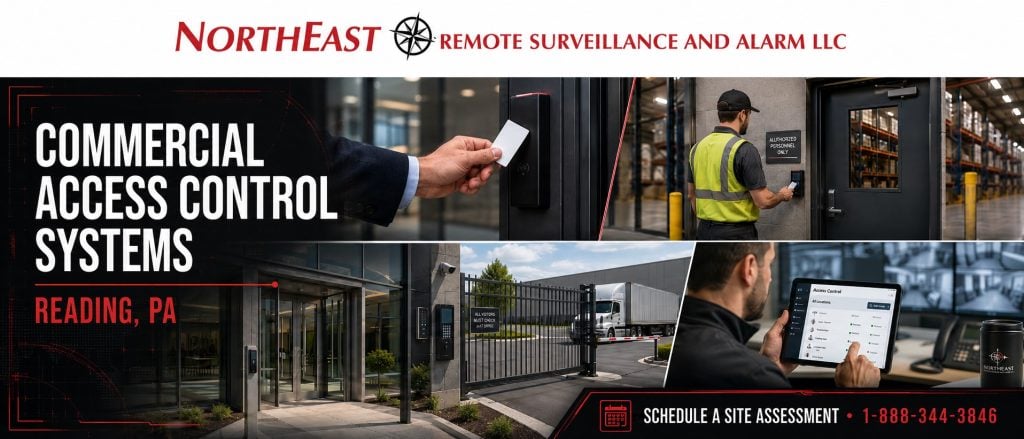
We handle the complete controlled opening, including readers, controllers, credentials, locks, door-position monitoring, power, wiring, and required door adjustments.
Plan the complete controlled opening
For a Reading access-control project, start with the door and the people who use it. A reader is only one component. The existing lock, door condition, power, controller, cabling, entry routine, and building coordination all affect the proposed scope. Describe the intended operation before deciding which credentials or management platform to use.
Use the door and hardware guide for an individual opening, the gate guide for vehicle access, and visitor communication guidance when staff must speak with someone before admitting them. Employee permissions and visitor entry are different workflows and should be documented separately.
Define permission changes and everyday exceptions
List staff groups, permitted areas, working hours, and the person who authorizes changes. Include cleaners, contractors, late arrivals, lost credentials, and temporary access. A clear process for removing permission is as necessary as the process for adding a new user.
For an inherited system, confirm administrative access, equipment compatibility, and available records before proposing expansion. At handover, check authorized and unauthorized entry attempts, schedules, door-event names, and the agreed behavior during interruptions. Coordinate any building or life-safety implications with the responsible project team before changing door operation.
Complete Hardware Installation and Door Adjustments Included
NERSA installs all access-control hardware specified for your system and fine-tunes the complete door opening as part of the installation. This includes door, hinge, latch and closer adjustments so the door closes, latches and operates reliably with the access-control system.
Before handover, we test credential operation, authorized entry, door closing, latching and required exit operation. Hardware installation and these door adjustments are part of our installation work.
Access-Control Guides
Commercial Door Access and Electrified Hardware — Review the complete controlled opening.
Vehicle Gate Access Control — Plan authorized vehicle entry.
Intercom and Controlled Entry — Verify visitors before releasing an authorized entrance.
Focused Applications
Employee Entrance Security — Coordinate workforce access and door events.
Tool Crib and Controlled Storage Access — Limit entry to restricted tools and materials.
Existing-System Upgrades
Access Control Upgrades and Hardware Retrofits — Review modernization of existing access systems.
Phased Door Access Retrofits — Plan a staged changeover while the facility operates.
Reading Security Services
Commercial Security Installation in Reading — Return to the Reading city installation guide.
Questions About Access-Control Installation in Reading
What should an access-control installer check before quoting?
Start with a door-by-door survey: the door and frame, existing lock, power, cable route, network connection, and who needs entry. Identify staff schedules, delivery access, visitor procedures, and the person responsible for adding or removing credentials. These details help distinguish a complete installation from a reader-only replacement.
Can existing doors and credentials be retained?
That depends on the hardware condition and platform compatibility.
Bring the current system name, credential type, door list, and administrator access to the assessment.
Where an existing opening needs work, use the Reading door-hardware and access-control retrofit guide to plan that scope.
How should the finished installation be checked?
Agree on acceptance tests before installation. Check authorized and denied entry, schedule changes, lost-credential removal, door closing and latching, and event records. Include the proposed behavior during a power or network interruption, then document administrator responsibilities and training.
Should access control connect with cameras or alarms?
Connect systems around a defined workflow, such as reviewing a door event against Reading video surveillance or coordinating after-hours activity with commercial intrusion alarms.
Confirm the supported integration and who will review events before choosing equipment.
NERSA’s local business connection can be reviewed through its Greater Reading Chamber Alliance membership; project assessment should still focus on hardware, door operation, testing and ongoing service.
Complete Reading Access-Control Installation: Door, Lock, Power and Controller
A secured opening is more than a reader beside a door. NERSA evaluates door alignment, frame condition, closers, exit hardware, electric strikes, electrified cylindrical or mortise locks, request-to-exit provisions, power transfer, door-position switches, controllers and power supplies. Applicable accessibility, fire-rating and egress requirements must be reviewed for the particular opening. A magnetic lock, exit device or integrated automatic operator requires the correct listed hardware and approved release behavior; neither a generic card reader package nor software settings can substitute for that assessment.
Reading offices, apartment management facilities, warehouses and manufacturing properties often inherit a mixture of aluminum storefront, hollow-metal, glass and older tenant doors. The installation scope should state which mechanical repairs and adjustments are included, not leave an unreliable closer or misaligned latch for the owner to discover after the system goes live.
Credential Management and Shift-Based Permissions
Employees, contractors, visitors, delivery drivers and building administrators should not share one credential policy. Plan card and fob formats, mobile credentials, PIN use, temporary enrollment, time schedules, anti-passback where supported, and prompt removal when workers leave. Warehouses around Reading may require different access privileges for shipping, production and maintenance; shared office buildings need clear responsibility for tenant doors and the lobby. NERSA verifies controller, reader and software compatibility before reusing credentials during a takeover.
Access-Control Retrofits and Existing-System Takeovers
An existing system assessment documents reader technologies, existing controllers, electric locking devices, backup power, wiring, software licensing and ownership of administrator accounts. Each controlled opening is tested independently for valid entry, denied access, relock, held-open alarms, manual exit and power loss. Upgrades can be phased around site traffic, keeping designated entrances functional while new hardware and credentials are commissioned. Integration with intercoms, video and intrusion detection requires supported interfaces and a defined owner for each event.
Turnstiles, Management Platforms and Reading Installation Infrastructure
NERSA is an authorized Hayward Turnstiles dealer, providing Hayward Turnstiles sales and installation for appropriate employee or lobby entrances.
For occupied Reading buildings, plan pedestrian routing, accessible entry and work windows alongside the existing reception and tenant arrangements.
We can coordinate automatic door operators with the selected electrified hardware, release sequence and required exit operation.
Compare on-premises, cloud-managed and hybrid administration against the building’s staffing and IT responsibilities.
Confirm supported readers and credentials, controller operation during an internet interruption, software ownership, licensing and administrator permissions before migrating an inherited system.
The broader commercial access-control capabilities guide covers platform and specialized-opening options.
The proposal can include conduit and raceway installation using appropriate EMT, rigid metal, stainless steel, PVC or surface Wiremold-style pathways, plus cabling and network infrastructure for copper control wiring, Cat6/Cat6A and fiber.
Point-to-point or point-to-multipoint links and cellular connectivity can serve suitable detached entrances after network and security review.
Solar at a remote gate requires a calculated equipment load, winter-generation assessment and battery reserve.
Specify local lock power, backup power, surge protection and the tested interruption behavior rather than assuming a wireless link also supplies power.
Acceptance Testing, Training and Scalable Handover
A complete Reading access-control proposal identifies every opening, materials, door modifications, wiring, power, licenses, credential quantities, lift or access requirements, schedule and testing criteria. The handover should include a door schedule, wiring and controller labels, account administration, tested credential revocation and staff training. Before adding a second facility, confirm system capacity, available controller inputs, credential compatibility, vendor support and operational ownership. This avoids an expensive rebuild after modest growth.
Reading Access-Control Questions
Can an existing card reader stay? Possibly, after compatibility and security review of the controller, credential technology and software. What happens when power fails? Required behavior depends on the opening, its approved hardware and life-safety design; that condition is tested. Does NERSA handle door hardware? Installation scope can include compatible electrified hardware and necessary door adjustments, not just the reader and software.
Plan Your Access-Control Project
Request a Security Assessment to review your openings, users, and access requirements.
Compliance, Codes & Project Standards
NERSA plans commercial and industrial security work with applicable code, documentation, inspection and authority-having-jurisdiction requirements in mind. Requirements vary by system, property and jurisdiction. These resources support project planning; they do not establish legal compliance, certification or AHJ approval.
Related guidance: Regulatory compliance & inspection readiness · Access control & door hardware standards · NFPA 101 & egress planning · ADA access-control planning