
Commercial low-voltage cabling and security infrastructure in Reading, PA connect cameras, controlled doors, alarms, and intercoms with dependable pathways, network capacity, and power.

Request a security infrastructure assessment
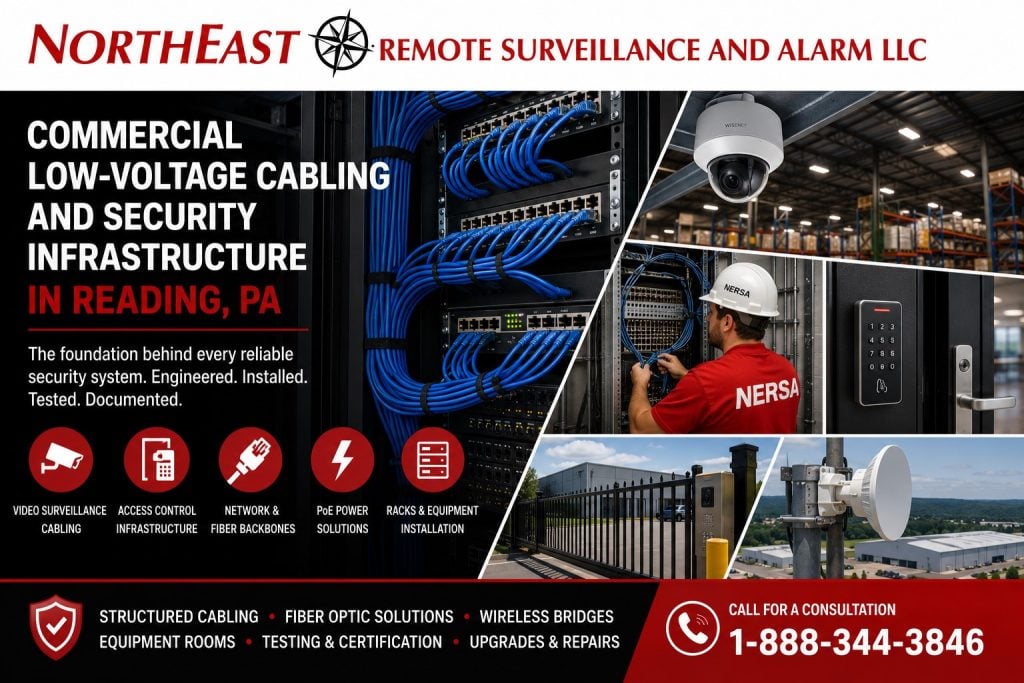
Choose infrastructure by the connection problem
A Reading infrastructure review should identify whether the need is a new device connection, an unreliable existing route, a link to another building, or capacity for an expansion. Start with the relevant cabling, fiber, wireless, switching, or power guide once that problem is clear. These are supporting design choices, not interchangeable solutions.
Trace the full path from each endpoint to the network and power equipment serving it. A camera addition may also affect switch power capacity, network traffic, recording capacity, and equipment-space organization. Assess the complete path instead of treating the cable run as the entire project.
Include records and support access
Provide current diagrams, equipment locations, known faults, and planned device counts. Identify who manages the network and who can authorize changes. Where work crosses tenant or building boundaries, confirm the available route and the parties responsible for it.
A useful handover includes clear labels, an updated connection record, and appropriate test results. Verify that connected devices perform their intended tasks after the infrastructure work. Document retained equipment and any constraints affecting later expansion so the next installer or support technician can understand the system without tracing everything again.
Focused Infrastructure Guides
Low-Voltage Security Cabling — Review cable planning for commercial security equipment.
PoE Switching for Video Surveillance — Plan network switching and camera power capacity.
Reading Infrastructure Upgrades — Evaluate existing pathways, connections, and equipment support.
Connected Reading Systems
Video Surveillance — Coordinate camera placement with recording and network connections.
Access Control — Plan connections for controlled doors and credentials.
Intrusion Alarms — Coordinate wiring for selected alarm devices.
Intercom and Controlled Entry — Plan connections for entrance communication.
Related Infrastructure Planning
Commercial Infrastructure and Cabling — Explore the broader infrastructure service.
TIA infrastructure administration background — Read the association’s 2017 announcement about telecommunications infrastructure administration.
Reading Commercial Security Cabling: Define the Endpoint and Pathway
A new camera, door controller, intercom or alarm communicator needs more than an unused network port. Survey where each device will be mounted, the route to the communication room, necessary power, physical protection, permitted ceiling or wall access, and any loading-dock or industrial exposure. In Reading manufacturing and distribution buildings, document high bays, outdoor crossings, equipment rooms and future racking changes. Keep the security low-voltage scope distinct from general IT wiring and any separately regulated fire-alarm circuits.
Structured Copper, Fiber and PoE Requirements
Plan suitable category-rated copper for device connections and account for switch-port capacity, PoE budgets, cable lengths, grounding and separation from interference sources. For longer links between production areas, warehouses or other buildings, a properly designed fiber backbone may provide a more dependable path and electrical isolation than copper. Cable and fiber certification, where required by the project, should use the correct test standard and preserve equipment identification and results. NERSA provides security infrastructure installation, maintenance and certification capabilities, including Fluke Versiv testing, as the project scope requires.
Remote Wireless Bridges, Cellular and Off-Grid Camera Connections
Point-to-point wireless extensions can be considered for detached yards or gates when line of sight, interference, bandwidth and safe antenna access have been surveyed. Cellular options require review of data plans, signal reliability and what recording or alarm reporting continues during a link outage. Solar-supported surveillance needs a realistic battery and winter generation budget, not just a panel size. None of those technologies eliminates the need for suitable local power, weather protection and routine maintenance.
Installation Commissioning and Owner-Controlled Documentation
The handover should include cable labels, patch-panel schedules, equipment and IP inventories, certification results when specified, power-supply and PoE allocations, network segregation, administrator account ownership and drawings showing connections to detached structures. A practical acceptance test verifies connected equipment under normal load, recording and event retrieval, expected response to interrupted power or connectivity and safe service access. For replacement of existing damaged or unsupported cabling, follow the separately scoped Reading low-voltage infrastructure upgrades page.
Reading Security Planning
Reading Commercial Security Systems — Return to the main Reading guide for coordinated property planning.
Request a security infrastructure assessment to review your Reading property’s connections and capacity.
Compliance, Codes & Project Standards
NERSA plans commercial and industrial security work with applicable code, documentation, inspection and authority-having-jurisdiction requirements in mind. Requirements vary by system, property and jurisdiction. These resources support project planning; they do not establish legal compliance, certification or AHJ approval.
Related guidance: Regulatory compliance & inspection readiness · Low-voltage infrastructure compliance · NEC & low-voltage wiring