
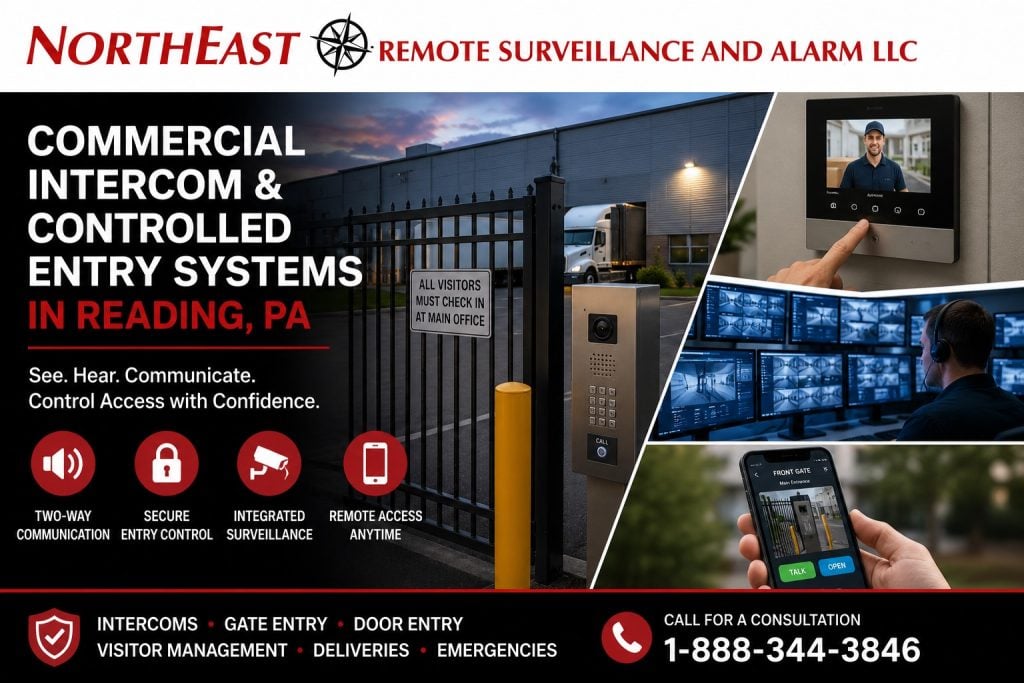
Commercial intercom-controlled entry systems in Reading, PA allow authorized employees, reception personnel, security staff, tenants, or remote managers to communicate with visitors before releasing a secured door or vehicle gate.
For complete controlled-entry planning, return to Reading Commercial Access Control Systems.
Northeast Remote Surveillance and Alarm, LLC designs and installs commercial video intercoms, audio entry stations, IP intercoms, reception call stations, loading-dock communication systems, gate intercoms, remote answering solutions, and compatible controlled-entry hardware for businesses, warehouses, manufacturing facilities, offices, schools, healthcare properties, municipal buildings, industrial sites, and multi-tenant facilities throughout Reading and surrounding Berks County markets.
Verify Visitors Before Releasing a Commercial Entrance
A properly designed entry intercom gives authorized personnel the information and control needed to evaluate a visitor before unlocking the door or opening the gate.
A commercial entry workflow may allow personnel to:
- Receive a call from the entrance.
- Speak directly with the visitor.
- View the visitor through an integrated camera.
- Determine the visitor’s name, company, purpose, or delivery assignment.
- Contact the employee or department being visited.
- Release the correct door or gate remotely.
- Deny entry without approaching the entrance.
- Route unanswered calls to another station or authorized mobile user.
- Review associated video when the platform supports it.
- Maintain a secured entrance instead of leaving it unlocked for convenience.
The system should be planned around who answers, what information must be confirmed, which opening may be released, and what happens when the primary answering position is unavailable.
Commercial Video Intercom Systems
A commercial video intercom combines two-way audio with a camera so authorized personnel can see and speak with the person requesting entry.
Video intercom systems may be appropriate for:
- Main office entrances
- Secured reception vestibules
- Employee-only buildings
- School entrances
- Healthcare reception areas
- Municipal buildings
- Warehouse shipping offices
- Manufacturing entrances
- Multi-tenant office properties
- Interior restricted departments
- Vehicle gates
- Delivery entrances
A usable video intercom requires more than a camera built into a call station because mounting height, visitor position, lighting, backlighting, weather exposure, field of view, audio quality, network performance, and answering-screen placement all affect the completed system.
Audio Intercom and Door-Release Systems
An audio intercom can provide dependable two-way communication where visual confirmation is unnecessary or handled through a separate security camera.
Audio systems may be used at:
- Interior controlled doors
- Warehouse service entrances
- Loading docks
- Shipping and receiving areas
- Maintenance entrances
- Equipment gates
- Employee support points
- Reception entrances with separate camera coverage
- Restricted departments
- Building-to-building entrances
The intercom should provide intelligible communication in the actual environment, including entrances affected by traffic, wind, machinery, truck engines, warehouse activity, or background conversations.
IP and Network-Based Entry Intercoms
IP intercom systems use the organization’s approved network infrastructure to connect entrance stations, answering devices, management software, cameras, and compatible access-control functions.
Depending on the selected platform, an IP intercom system may support:
- Multiple entrance stations
- Multiple answering stations
- Centralized system management
- Call routing between buildings
- Mobile or computer-based answering
- Video and audio communication
- Event history
- System-health reporting
- Integration with compatible access-control platforms
- Integration with compatible video-management systems
- Multi-site administration
- Expansion without creating an entirely separate intercom system at every entrance
Network-based entry should be coordinated with the organization’s information-technology personnel so addressing, segmentation, power, bandwidth, remote access, account security, software maintenance, and device ownership are understood before installation.
Remote and Mobile Intercom Answering
Remote answering can allow an authorized user to respond to an entrance call from a supported mobile device, computer, remote office, security desk, or centralized management location.
This capability may help organizations that have:
- An intermittently staffed reception desk
- Several buildings
- Multiple visitor entrances
- A remote property manager
- Centralized corporate security
- After-hours deliveries
- Employees who move throughout the facility
- A warehouse office located away from the entrance
- More than one business location
- A gate that is not visible from the main office
Remote release should be limited to authorized users, protected through appropriate account security, and supported by procedures that prevent personnel from unlocking an entrance without sufficient verification.
A mobile application should not be treated as the entire entry plan because the organization must still decide who answers when the primary user is busy, unavailable, outside coverage, or no longer employed.
Reception and Secure-Lobby Entry
A reception intercom allows the exterior entrance to remain secured while visitors request assistance from an occupied or remotely staffed reception area.
A secure-lobby system may include:
- Exterior video call station
- Interior answering monitor
- Desktop or wall-mounted answering station
- Reception telephone or computer integration
- Mobile answering
- Electric door release
- Door-position monitoring
- Entrance camera coverage
- Accessible call-button placement
- Automatic door-operator coordination
- Visitor-management integration
- Secondary answering location
The entrance should be designed so the receptionist can clearly identify which door is calling and release only that opening rather than operating an unidentified or incorrectly labeled relay.
Warehouse and Loading-Dock Intercoms
Warehouse intercoms help drivers, vendors, contractors, service personnel, and delivery crews contact employees without entering an active dock, walking through a truck court, or searching for an unlocked personnel door.
Common warehouse applications include:
- Driver check-in doors
- Shipping-office entrances
- Receiving-office entrances
- Loading-dock call stations
- Truck-gate intercoms
- Will-call entrances
- After-hours delivery points
- Warehouse-to-office doors
- Maintenance entrances
- Detached guard buildings
The call station should be positioned where a driver or visitor can use it safely without standing in a vehicle travel lane, dock approach, gate path, or other hazardous operating area.
Warehouse systems may require weather-resistant equipment, higher audio output, supplemental cameras, protective housings, illuminated labels, remote answering, and call routing to more than one employee.
Commercial Gate Intercom Systems
A gate intercom lets drivers, vendors, contractors, visitors, and delivery personnel request entry before a commercial vehicle entrance is opened.
A gate-entry system may combine:
- Video or audio call station
- Gate camera
- Remote answering
- Mobile answering
- Keypad or credential reader
- Long-range vehicle credentials
- Gate-operator interface
- Vehicle-detection equipment
- License plate camera
- Separate employee and visitor workflows
- Timed gate release
- Call and event history
Gate intercom design should account for passenger vehicles, tractor-trailers, delivery vans, driver reach, pedestal placement, traffic direction, weather, lighting, background noise, gate travel, and the location where the vehicle should stop.
For complete gate planning involving operators, safety devices, credentials, vehicle detection, cameras, and access permissions, visit our commercial gate access control systems in Reading, PA page.
School and Educational Entry Intercoms
School entry intercoms can support a secured main entrance by allowing office personnel to communicate with visitors before admitting them into the building.
A school entrance solution may include:
- Video intercom at the main entrance
- Secure-entry vestibule communication
- Administrative answering station
- Secondary answering location
- Camera coverage
- Remote door release
- Door-position monitoring
- Staff credential access
- Visitor-management coordination
- After-hours entrance routing
- District-wide administration
- Separate systems for multiple buildings
The intercom does not replace the school’s visitor-screening policies, emergency procedures, access-control plan, or required life-safety functions.
School entrances should be coordinated with administrators, facility personnel, information-technology staff, door-hardware professionals, accessibility requirements, and the applicable reviewing authorities.
Healthcare and Medical Office Entry
Healthcare and medical-office intercoms can help staff control public access, after-hours entry, deliveries, employee entrances, and access to restricted departments.
Potential applications include:
- Main patient entrance
- After-hours entrance
- Staff-only entrance
- Pharmacy delivery door
- Medication-storage area
- Records department
- Behavioral-health entrance
- Laboratory entrance
- Service and delivery door
- Medical-office suite
- Senior-care reception
- Restricted clinical department
The answering workflow should protect patient and business information by avoiding unnecessary discussion of private matters over an exterior speaker.
Municipal and Public-Facing Buildings
Municipal and institutional facilities can use intercom-controlled entry to manage visitors while keeping staff areas and nonpublic entrances secured.
Applications may include:
- Municipal administration buildings
- Public-works facilities
- Police or emergency-service administrative entrances
- Records departments
- Utility buildings
- Public meeting entrances
- Employee-only doors
- Service gates
- Evidence or property areas
- After-hours visitor points
Public-facing entry systems should clearly direct the visitor to the correct call station and identify what to do when the building is closed or the primary office is temporarily unstaffed.
Office and Multi-Tenant Entry Systems
Multi-tenant intercom systems route visitors to the appropriate business, tenant, department, or authorized answering user without leaving the main entrance unlocked.
A multi-tenant design may provide:
- Searchable tenant directory
- Individual tenant call buttons
- Reception routing
- Mobile tenant answering
- Separate door-release permissions
- Property-manager administration
- Temporary tenant changes
- Time-based call routing
- Main-door and secondary-door control
- Event and call records
- Integration with tenant access credentials
- Central management for several properties
Administrative permissions should prevent one tenant from changing another tenant’s users, call routing, entry permissions, or system information.
Manufacturing and Industrial Entry Communication
Industrial intercoms can help manage contractors, vendors, inspectors, maintenance personnel, deliveries, and visitors entering facilities where the main office is separated from production or shipping areas.
Industrial applications may include:
- Main employee and visitor entrance
- Guard station
- Contractor entrance
- Shipping office
- Receiving office
- Tool crib
- Maintenance department
- Process area
- Clean or restricted production area
- Exterior equipment gate
- Utility building
- Multiple-building campus
Equipment selection should consider noise, dust, moisture, vibration, temperature, protective mounting, cable distance, network availability, and the possibility that employees answering the call may wear hearing protection or work away from a fixed desk.
Door Hardware and Controlled Release
The intercom determines when entry is approved, but the physical door hardware determines whether the entrance unlocks, opens, closes, and relocks correctly.
A controlled-entry opening may involve:
- Electric strike
- Electrified lockset
- Electrified panic hardware
- Magnetic lock where permitted
- Door-position switch
- Request-to-exit device
- Power supply
- Battery backup
- Door closer
- Automatic door operator
- Accessible activation device
- Power-transfer hardware
- Access-control relay
- Intercom release relay
A door that drags, fails to latch, has damaged panic hardware, or lacks a dependable closer may remain unreliable regardless of the intercom equipment installed beside it.
Electrified locking, emergency release, accessibility, fire alarm interaction, and means-of-egress requirements should be evaluated as part of the complete opening rather than addressed after the intercom has already been selected.
Integration With Commercial Access Control
Intercom and access control perform different jobs but can work together at the same controlled entrance.
The intercom allows a visitor to request assistance, while access control allows authorized employees or approved users to enter with a card, key fob, mobile credential, PIN, or other supported credential.
A combined entrance may support:
- Credential entry for employees
- Intercom entry for visitors
- Remote release by reception
- Door-position monitoring
- Forced-door reporting
- Held-open-door alerts
- Time-based unlocking
- Visitor-specific access
- Camera association
- Centralized event review
- Separate administrative permissions
- Multi-building management
The release command should operate through a properly designed access-control or door-control arrangement rather than bypassing the system in a way that eliminates useful door status, event history, or security functions.
Integration With Entrance Cameras
A dedicated entrance camera can supplement the camera built into an intercom by providing a wider view of the doorway, surrounding approach, packages, vehicles, or additional people standing outside the call station’s immediate field of view.
Entrance video may help document:
- Who approached the entrance
- Whether more than one person was present
- Which vehicle arrived
- When a package was delivered
- Whether someone followed an authorized visitor
- What occurred before and after the call
- Whether a person moved to another door
- Whether an entrance was left open
Camera placement should preserve a useful facial and situational view without relying solely on an extremely wide image that lacks identifying detail.
Video recording and intercom calling should be time-synchronized where practical so personnel can locate the corresponding footage efficiently.
Existing Intercom Upgrades and Takeovers
An aging or inherited intercom may be improved by replacing selected stations, modernizing call routing, repairing door-release problems, reusing serviceable cabling, or migrating the property to a supported IP platform.
NERSA can evaluate:
- Exterior call stations
- Interior answering stations
- Cameras
- Audio quality
- Door-release relays
- Electric locking hardware
- Power supplies
- Cabling
- Network connections
- Mobile applications
- Existing user accounts
- Tenant directories
- Call routing
- Licensing
- Software support
- Event history
- Weather damage
- Protective housings
- System documentation
An upgrade assessment should determine what can be retained, what is unsupported, why calls or release commands are failing, and whether the existing infrastructure can support the required new system.
Replacing only the exterior call station may not correct an underlying problem involving damaged cabling, weak network connectivity, failing lock hardware, incorrect power, or an obsolete answering platform.
Intercom Cabling, Network, and Power Planning
Reliable intercom operation depends on the infrastructure connecting the entrance to the answering and door-control equipment.
Project planning may include:
- Category-rated network cabling
- Approved low-voltage cabling
- Fiber connections between buildings
- Network switches
- Power over Ethernet
- Local power supplies
- Battery backup
- Surge protection
- Weather-rated pathways
- Conduit
- Wireless bridges where appropriate
- Network segmentation
- Equipment labeling
- Rack and panel documentation
Existing cabling should be tested and identified before reuse because visible cable at each end does not confirm that the pathway, conductor condition, termination, distance, or cable type is suitable for the proposed equipment.
Commercial Intercom Installation Process
A controlled-entry project should connect the entrance equipment, answering workflow, lock hardware, network, access permissions, and operating procedure into one tested system.
1. Entrance and Facility Assessment
NERSA reviews the door or gate, visitor approach, existing hardware, cabling, network availability, answering locations, lighting, noise, weather exposure, and current entry procedure.
2. Visitor Workflow Planning
The organization identifies who will call, who will answer, what information must be verified, which entrances may be released, and how unanswered or after-hours calls should be handled.
3. Equipment and Integration Design
The call station, camera, answering devices, door hardware, access-control connection, power, network, mobile functions, and supporting infrastructure are selected.
4. Professional Installation
Equipment is mounted, wired, labeled, configured, and integrated with the approved entrance hardware and management platform.
5. Communication and Release Testing
Audio, video, call routing, mobile answering, door release, gate release, door status, user permissions, and failure conditions are tested.
6. Administrator and User Training
Authorized personnel learn how to answer calls, release entrances, manage users, adjust routing, review events, and report system problems.
7. Documentation and Support
The finished project should identify call stations, controlled entrances, answering devices, power supplies, network requirements, administrative accounts, and future service considerations.
Entry Systems for Small Businesses Through Multi-Site Organizations
NERSA designs commercial intercom-controlled entry for organizations ranging from one secured office entrance to multiple buildings, gates, answering teams, and business locations.
A smaller installation may include:
- One exterior video intercom
- One reception monitor
- One electric door release
- Several authorized users
- Basic mobile answering
A larger installation may include:
- Multiple entrances
- Several buildings
- Vehicle gates
- Central security answering
- Reception and mobile routing
- Multi-tenant directories
- Access-control integration
- Video-management integration
- Role-based administrators
- Multi-site management
- After-hours routing
- Standardized equipment and naming
The system should meet the current entry requirement while preserving a realistic path for additional doors, users, locations, answering stations, and integrations.
Why Reading Businesses Choose NERSA
NERSA approaches intercom-controlled entry as a complete visitor communication and entrance-control system rather than treating the project as a call box mounted beside a door.
Our commercial approach includes:
- Commercial and industrial specialization
- Video and audio entry intercoms
- IP and network-based systems
- Reception and remote answering
- Mobile call handling
- Commercial gate intercoms
- Warehouse and loading-dock communication
- Door-release integration
- Access-control coordination
- Entrance-camera planning
- Electrified door-hardware evaluation
- Existing-system upgrades and takeovers
- Multi-building and multi-location scalability
- Infrastructure and network coordination
- Small-business through enterprise capability
- System testing, training, and documentation
Northeast Remote Surveillance and Alarm, LLC has served commercial clients since 2008 and focuses on non-residential security, access control, intercom, monitoring, surveillance, alarm, and low-voltage system requirements.
Reading and Berks County Service Area
NERSA supports qualifying commercial intercom and controlled-entry projects throughout Reading, West Reading, Wyomissing, Shillington, Sinking Spring, Muhlenberg Township, Exeter Township, Spring Township, Bern Township, and surrounding Berks County business markets.
Service is provided for commercial, industrial, municipal, institutional, educational, healthcare, and multi-tenant properties rather than residential doorbell installations.
Frequently Asked Questions About Commercial Entry Intercoms
What is a commercial intercom-controlled entry system?
A commercial intercom-controlled entry system allows a visitor to call an authorized employee, receptionist, tenant, security officer, or remote manager who can communicate with the visitor and release a secured entrance when appropriate.
What is the difference between a video intercom and an audio intercom?
A video intercom provides visual and voice communication, while an audio intercom provides voice communication without a built-in visitor image.
Can an intercom unlock a commercial door?
Yes, a compatible intercom can send an authorized release command to properly designed access-control or electrified door hardware.
Can employees still use keycards or mobile credentials?
Yes, employees can use access-control credentials while visitors use the intercom to request entry at the same door.
Can intercom calls be answered on a mobile phone?
Supported systems may route calls to authorized mobile users, although application licensing, internet connectivity, account security, and fallback procedures should be evaluated.
Can one intercom call multiple employees?
Compatible platforms may route a call sequentially or simultaneously to reception, security, departments, mobile users, or other approved answering positions.
Can NERSA install an intercom at a truck gate?
Yes, gate intercoms can be designed for commercial vehicle entrances, warehouses, manufacturing plants, contractor yards, fleet properties, and distribution facilities.
Can a gate intercom work with a keypad or card reader?
Yes, the gate can support credentialed employee entry and intercom-authorized visitor entry when the operator, access-control system, intercom, and safety equipment are compatible.
Can NERSA install an intercom at a loading dock?
Yes, weather-resistant audio or video call stations can help drivers and delivery personnel contact shipping or receiving employees without entering the warehouse unassisted.
Can the intercom integrate with security cameras?
Compatible intercom, access-control, and video platforms may associate calls, entrance events, and recorded camera views.
Can an existing analog intercom be upgraded?
Many existing systems can be evaluated for partial replacement or migration, but the stations, cabling, power, lock interface, and answering equipment must be inspected first.
Can existing intercom wiring be reused?
Existing wiring may be reusable when its type, condition, distance, pathway, and terminations meet the proposed system’s requirements.
Can one system manage several buildings?
Yes, compatible IP and enterprise platforms can support multiple entrances, buildings, answering stations, administrators, and locations.
Does an intercom replace access control?
No, an intercom manages visitor communication and authorized release, while access control manages credentials, users, schedules, permissions, and controlled-opening activity.
Does an intercom replace a visitor-management system?
No, an intercom helps communicate with and admit visitors, while visitor-management software may handle registration, host notification, identification, badges, policies, and visit records.
Can NERSA support a small commercial property?
Yes, NERSA can design a focused system for one secured entrance while preserving options for mobile answering, additional users, cameras, or future doors.
Can NERSA support enterprise and multi-site facilities?
Yes, systems can be planned for multiple locations, buildings, entrances, gates, answering groups, administrative roles, and compatible integrations.
Does NERSA install residential video doorbells?
No, Northeast Remote Surveillance and Alarm, LLC focuses on commercial, industrial, institutional, educational, healthcare, municipal, and other non-residential properties.
How much does a commercial intercom entry system cost?
Cost depends on the number of entrances, audio or video requirements, answering stations, mobile licensing, door hardware, gate integration, cabling, network infrastructure, weather protection, and existing equipment.
Schedule a Reading Intercom and Controlled-Entry Assessment
A commercial entry assessment reviews where visitors should call, who should answer, how identity is verified, which opening may be released, and whether existing equipment can support the required workflow.
Request an intercom and controlled-entry assessment for your Reading commercial property.