Distribution Center Security Systems Along the Lehigh Valley Route 33 Industrial Corridor

Distribution center security systems along the Lehigh Valley Route 33 industrial corridor should be built around how high-volume distribution properties actually operate. These facilities often depend on constant shipping and receiving activity, employee movement, staged freight, trailer flow, dock operations, inventory turnover, and after-hours site exposure. A properly designed system should improve visibility, tighten control, support incident review, and protect the parts of the property where disruption, loss, and unauthorized activity create the most risk.

Northeast Remote Surveillance and Alarm, LLC provides distribution center security systems along the Lehigh Valley Route 33 industrial corridor for properties that need stronger operational visibility, tighter access control, better after-hours protection, and a more practical system design built around the way distribution environments actually function.

This page is focused specifically on distribution center security along the Lehigh Valley Route 33 industrial corridor. For broader corridor planning, visit [Lehigh Valley Route 33 Industrial Corridor Security Systems]. For broader warehouse-focused coverage, visit [Warehouse Security Systems Along the Lehigh Valley Route 33 Industrial Corridor].

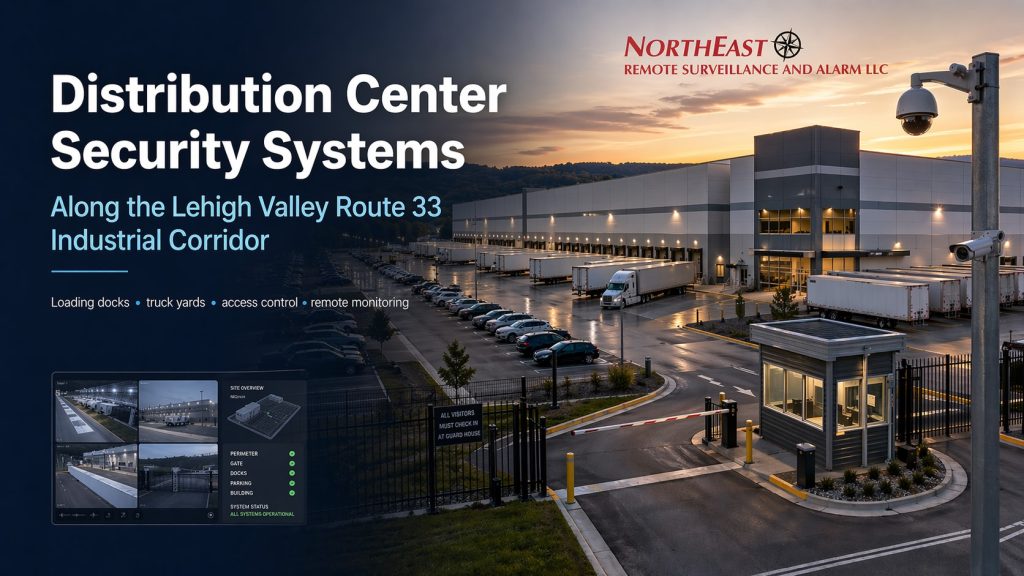
Hero image showing a secured Lehigh Valley Route 33 distribution center with loading docks, tractor-trailers, guard gate, perimeter fencing, security cameras, and Northeast Remote Surveillance and Alarm LLC branding.

Security Systems Built for Distribution Center Operations

Distribution centers do not operate like generic commercial buildings. They are high-movement environments where freight, people, vehicles, schedules, and operational flow intersect throughout the day and often well beyond normal business hours. Employee entrances, dock lines, shipping lanes, receiving zones, trailer areas, inventory staging locations, supervisor offices, restricted spaces, and exterior approaches all create different security demands.

A distribution center security system should reflect those realities. It should be designed around the operational flow of the property, not around a generic equipment package or a one-size-fits-all layout.

What Distribution Center Properties Along the Route 33 Corridor Commonly Need to Protect

Distribution center properties along the Lehigh Valley Route 33 corridor often need stronger protection around the areas where activity is concentrated and where loss, disruption, or unauthorized movement create the greatest exposure.

Shipping and Receiving Areas

Shipping and receiving zones are often some of the most active and exposed parts of the site. Freight movement, dock door activity, scheduled pickups, carrier traffic, and staged product movement all create visibility and accountability demands.

Dock Doors and Exterior Dock Aprons

Dock lines and apron areas often need better coverage than standard exterior cameras provide. These zones may involve trailer backing, outbound loading, inbound unloading, driver activity, and after-hours exposure around multiple openings.

For dock-focused protection, visit [Loading Dock Security Systems Along the Lehigh Valley Route 33 Industrial Corridor].

Employee Entrances and Interior Transition Points

Distribution centers often have multiple employee access points and internal movement paths between warehouse floors, offices, control areas, and restricted operational spaces. These openings often need stronger control and better review capability.

Trailer Rows, Yard Areas, and Vehicle Movement Zones

Some distribution centers depend heavily on trailer staging, truck circulation, yard movement, or perimeter lanes. These areas often need stronger visibility and more deliberate exterior coverage than the rest of the site.

For yard-focused protection, visit [Truck Yard and Trailer Security Systems Along the Lehigh Valley Route 33 Industrial Corridor].

Inventory Staging and Operational Risk Areas

High-volume distribution properties may also need better visibility around inventory staging areas, high-value storage points, cross-docking zones, and other operational areas where shrink, disputes, or undocumented movement can create real problems.

Distribution Center Security Should Be Built Around Flow, Not Just Footage

A distribution center security system should do more than record activity. It should be built around how the site moves. That includes how freight enters and exits, how employees circulate through the property, how carriers access the site, where inventory is most exposed, and which areas remain vulnerable after hours.

This is especially important along the Lehigh Valley Route 33 industrial corridor, where many facilities operate in high-traffic logistics environments with multiple docks, broad footprints, recurring carrier activity, and exterior exposure that can extend well beyond the building itself.

Common Security Priorities for Distribution Centers Along Route 33

Better Visibility Across High-Activity Zones

Distribution centers often need better video coverage across dock lines, receiving lanes, outbound areas, employee entries, shipping offices, parking areas, and exterior approaches so management can review events more clearly and respond faster when issues arise.

Stronger Control Over Entrances and Restricted Areas

Not every user group should have the same level of access. Employees, drivers, contractors, vendors, supervisors, and visitors may all need different access levels depending on how the site is structured.

For entry-control intent, visit [Warehouse Access Control Systems Along the Lehigh Valley Route 33 Industrial Corridor].

Better After-Hours Awareness

Many distribution centers remain exposed after daily staffing changes, during overnight trailer activity, or when only part of the building is occupied. A stronger after-hours strategy often becomes one of the most important parts of the overall design.

For stronger monitored awareness, visit [Remote Video Monitoring Along the Lehigh Valley Route 33 Industrial Corridor].

Better Vehicle Documentation

Some distribution properties need stronger documentation around truck entrances, service drives, gate lanes, employee parking entrances, or recurring vehicle activity tied to operations.

For vehicle identification intent, visit [License Plate Recognition Systems Along the Lehigh Valley Route 33 Industrial Corridor].

Distribution Center Security Is Not the Same as General Warehouse Security

This page is intentionally focused on distribution center environments. A distribution center often has more concentrated freight flow, more shipping and receiving intensity, more scheduled carrier movement, and more pressure around dock operations than a broader warehouse environment.

That is why this page should stay centered on distribution-specific operating conditions rather than turning into a general warehouse page, a dock page, a truck-yard page, or a broader Route 33 corridor hub.

If the property is better defined by broader warehousing needs, visit [Warehouse Security Systems Along the Lehigh Valley Route 33 Industrial Corridor]. If the main concern is concentrated dock activity, visit [Loading Dock Security Systems Along the Lehigh Valley Route 33 Industrial Corridor]. If the main issue is yard activity and trailer movement, visit [Truck Yard and Trailer Security Systems Along the Lehigh Valley Route 33 Industrial Corridor].

Security Systems for Distribution Centers Along the Lehigh Valley Route 33 Industrial Corridor

Northeast Remote Surveillance and Alarm, LLC designs security systems for distribution center properties that need stronger protection around freight movement, employee access, inventory exposure, exterior approaches, and after-hours risk. These systems may involve stronger dock visibility, better entry control, improved yard awareness, clearer review of operational zones, and better coordination across the parts of the site where activity and risk are concentrated.

The right security design depends on the layout of the property, the operational flow, the number of docks, the vehicle movement patterns, the user groups on site, and the areas where the property is most exposed.

Get a Quote for Distribution Center Security Systems Along the Lehigh Valley Route 33 Industrial Corridor

If your distribution center operates along the Lehigh Valley Route 33 industrial corridor and needs stronger visibility, tighter control, better after-hours protection, or a more practical security system built around real operating conditions, Northeast Remote Surveillance and Alarm, LLC can help design a solution around the way your property actually functions.

For broader corridor planning, visit [Lehigh Valley Route 33 Industrial Corridor Security Systems].

Scroll to Top
1-888-344-3846