
Small warehouse security systems should protect inventory, employees, overhead doors, loading areas, customer pickup points, tools, equipment, offices, exterior doors, parking areas, and after-hours activity without creating unnecessary enterprise-level complexity.

Request a Small Warehouse Security Assessment
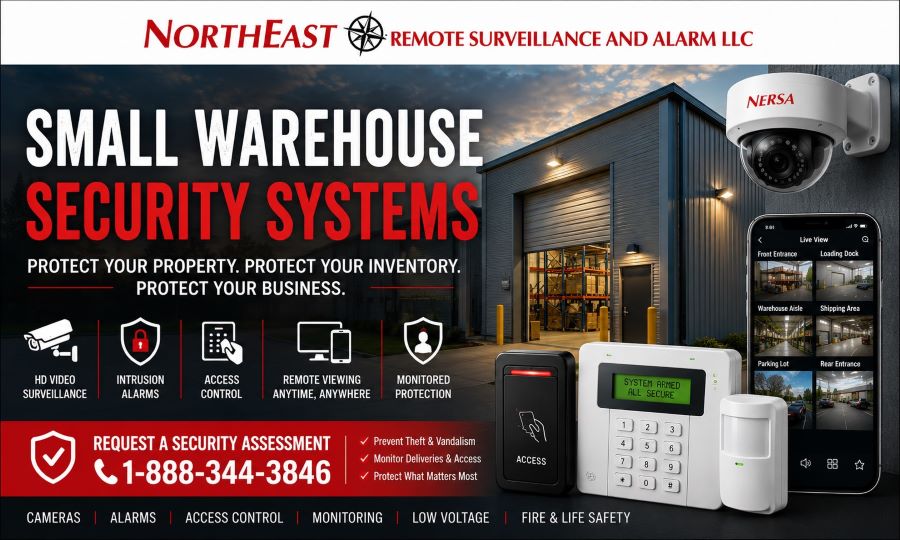
Northeast Remote Surveillance and Alarm, LLC designs, installs, integrates, monitors, upgrades, takes over, and supports commercial-grade security systems. We serve qualifying light-industrial buildings, contractor warehouses, trade suppliers, distributors, and small logistics operations. Other properties include e-commerce fulfillment sites, flex-space warehouses, storage facilities, and commercial tenant bays.
Small warehouses can concentrate inventory, offices, employees and deliveries in a compact space. Customer pickup, overhead doors, loading areas and exterior activity add to the security needs. Plan around that layout instead of copying a large distribution-center design.
For broader small-business security planning, visit Small Business Security Systems.
Commercial Security Planning for Small Warehouses
A small warehouse security system should be designed around how employees, vendors, delivery drivers, customers, inventory, equipment, and vehicles move through the property.
Planning may consider:
- Main entrances
- Employee entrances
- Overhead doors
- Loading doors
- Shipping and receiving
- Customer pickup areas
- Inventory aisles
- Tool storage
- Equipment storage
- Office areas
- Exterior doors
- Parking areas
- Rear lots
- Delivery approaches
- Restricted rooms
- After-hours access
The objective is not to cover every square foot with equipment.
The objective is to protect the important doors, movement paths, inventory areas, loading points, and exterior approaches while keeping the system practical and manageable.
Small Warehouse Security Risks
Small warehouse properties may need to address:
- Inventory theft
- After-hours break-ins
- Unauthorized entry
- Employee-access problems
- Overhead doors being left unsecured
- Delivery disputes
- Customer-pickup incidents
- Tool or equipment theft
- Rear-door exposure
- Parking-lot incidents
- Vendor-access problems
- Shared alarm codes
- Former employees retaining access
- False alarms
- Limited owner visibility
A properly planned system should help ownership understand who entered, what occurred, when inventory or deliveries moved, and whether activity was expected.
Video Surveillance for Small Warehouses
Small warehouse cameras should focus on locations where useful evidence matters most.
Common camera locations may include:
- Main entrances
- Employee entrances
- Overhead doors
- Shipping and receiving
- Loading areas
- Inventory aisles
- Office entrances
- Customer pickup areas
- Exterior doors
- Parking areas
- Rear approaches
Camera placement should be based on the intended result.
A wide warehouse view may provide general operational context, while a focused camera may be needed at an overhead door, pickup counter, loading point, or other location where identification or delivery documentation matters.
For broader small-business camera planning, visit Small Business Security Camera Systems.
Overhead Doors and Loading Areas
Overhead and loading doors are often among the most important security points in a small warehouse.
Security planning should consider:
- Door status
- After-hours openings
- Delivery activity
- Employee use
- Vehicle movement
- Camera visibility
- Alarm protection
- Exterior approaches
The objective is to know when a large opening was used, whether the activity was expected, and what entered or exited the property.
Inventory, Tools, and Equipment Protection
Small warehouses may contain valuable inventory, tools, equipment, parts, materials, electronics, or customer property.
Security planning may need to consider:
- Inventory aisles
- Restricted stock rooms
- Tool storage
- Equipment areas
- High-value inventory
- Manager-only spaces
- Employee permissions
- After-hours access
The system should help provide accountability around important storage areas without interfering with normal warehouse workflow.
Employee, Vendor, and Delivery Access
Small warehouses often have a mix of employees, managers, delivery drivers, vendors, cleaners, service contractors, and occasional customers.
Different users may need different levels of access.
Access control can help reduce key-management problems and provide individually managed permissions for selected doors and restricted areas.
For employee credentials, schedules, and controlled entry, visit Small Business Access Control Systems.
Intrusion and After-Hours Protection
Small warehouses are often lightly staffed or completely vacant outside normal operating hours.
A commercial intrusion system may protect:
- Main entrances
- Employee doors
- Rear doors
- Windows
- Overhead doors
- Loading doors
- Interior movement areas
- Offices
- Restricted storage
The system should match the warehouse’s operating schedule and account for early deliveries, late pickups, cleaning crews, and other authorized after-hours activity.
For broader commercial after-hours protection, visit Small Business Alarm Systems.
Parking and Exterior Security
Warehouse security extends beyond the building interior.
Exterior planning may need to consider:
- Employee parking
- Customer pickup parking
- Delivery approaches
- Rear lots
- Side doors
- Loading approaches
- Exterior storage
- Fenced areas
- Dumpster areas
- After-hours activity
For dedicated parking-area camera planning, visit Small Business Parking Lot Security Cameras.
Remote Visibility for Owners and Managers
Small warehouse owners and managers may not be physically present throughout every operating hour.
Secure remote visibility can help approved users review:
- Openings and closings
- Deliveries
- Customer pickups
- Employee access
- Overhead-door activity
- Alarm events
- Exterior activity
- Parking incidents
- After-hours concerns
Remote access should use individual permissions rather than shared administrator accounts.
For selected loading-area, exterior, or after-hours events requiring professional review and live audio response, visit Remote Video Monitoring and Live Talk-Down.
Existing Small Warehouse Security Systems
Many warehouse properties inherit cameras, alarms, access-control equipment, cabling, administrator accounts, or monitoring arrangements from a previous tenant, owner, installer, or property manager.
Existing systems should be evaluated before complete replacement is recommended.
Potential concerns may include:
- Poor loading-door coverage
- Missing overhead-door protection
- Weak inventory-area visibility
- Shared alarm codes
- Former employees retaining access
- Old alarm communicators
- Poor exterior coverage
- Unknown administrator ownership
- Inadequate documentation
- Unsupported equipment
- Unreliable network infrastructure
- Limited expansion capability
The appropriate project may involve repair, reconfiguration, selective replacement, provider takeover, or phased modernization.
For aging, inherited, unreliable, or poorly documented warehouse security systems, visit Commercial Security System Upgrades, Retrofits & Takeovers.
Multi-Location Small Warehouse Operations
Businesses operating several warehouses, flex spaces, or commercial locations may need consistent camera standards, alarm procedures, access permissions, monitoring, and administration across locations.
For broader multi-location planning, visit Multi-Location Small Business Security Systems.
Infrastructure for Small Warehouse Security
Warehouse security systems depend on reliable cabling, PoE capacity, network switching, power, fiber or wireless links where required, and organized equipment locations.
For structured cabling, PoE, fiber, wireless links, network equipment, power, and supporting security infrastructure, visit Commercial & Industrial Infrastructure and Cabling.
Why Small Warehouse Operators Choose Northeast Remote Surveillance and Alarm
Northeast Remote Surveillance and Alarm, LLC focuses on commercial and industrial security systems rather than residential-style alarm packages.
NERSA evaluates small warehouse properties around:
- Building layout
- Overhead doors
- Loading areas
- Inventory
- Employee movement
- Deliveries
- Customer pickup
- Restricted spaces
- Parking
- Exterior exposure
- After-hours activity
- Existing equipment
- Monitoring
- Network infrastructure
- Future growth
The objective is to provide a warehouse security system that remains practical, manageable, supportable, and strong enough for commercial use without unnecessary complexity.
Frequently Asked Questions About Small Warehouse Security Systems
What should a small warehouse security system include?
The exact system depends on the property, but common components may include video surveillance, intrusion alarms, overhead-door protection, employee access control, exterior camera coverage, remote viewing, and professional monitoring.
Where should cameras be installed in a small warehouse?
Common locations include entrances, overhead doors, loading areas, shipping and receiving, inventory aisles, office entrances, customer pickup areas, exterior doors, parking lots, and rear approaches.
Should overhead doors be protected?
Yes. Overhead doors are major access points and may benefit from door-status monitoring, alarm protection, and camera coverage.
Can cameras help with delivery disputes?
Yes. Properly positioned cameras may help document vehicle arrival, unloading, pickup activity, personnel movement, and the condition of the loading area during a disputed event.
Do small warehouses need access control?
Some do. Access control can be useful for employee entrances, offices, inventory rooms, tool rooms, IT rooms, restricted storage, and shared tenant entrances.
Can warehouse alarms be professionally monitored?
Yes. Compatible commercial intrusion systems can transmit approved events for professional monitoring.
Can owners view warehouse cameras remotely?
Yes. Compatible commercial systems can provide secure remote viewing for approved owners and managers.
Can an existing warehouse security system be upgraded?
Yes. Existing cameras, alarms, access control, cabling, monitoring, and administrator ownership can be evaluated to determine what should be retained, corrected, upgraded, or replaced.
What makes small warehouse security different from large distribution-center security?
A smaller warehouse usually requires a more compact and manageable system while still addressing important commercial risks such as overhead doors, inventory, deliveries, employee access, parking, and after-hours exposure.
Request a Small Warehouse Security Assessment
NERSA can assess security for your small warehouse, contractor storage facility, trade-supply business, or light-industrial property. Tell us about loading doors, inventory, employee access, parking, and after-hours activity. We can recommend a new system or practical upgrades for your existing equipment.
Request a Small Warehouse Security Assessment or call 1-888-344-3846.
Compliance, Codes & Project Standards
NERSA plans commercial and industrial security work with applicable code, documentation, inspection and authority-having-jurisdiction requirements in mind. Requirements vary by system, property and jurisdiction. These resources support project planning; they do not establish legal compliance, certification or AHJ approval.
Related guidance: Regulatory compliance & inspection readiness · Warehouse & logistics compliance · NERSA project standards