
Plan small-business parking-lot cameras around the entrances, vehicle routes and incident areas your team needs to review.

Request a Small Business Parking Lot Camera Assessment
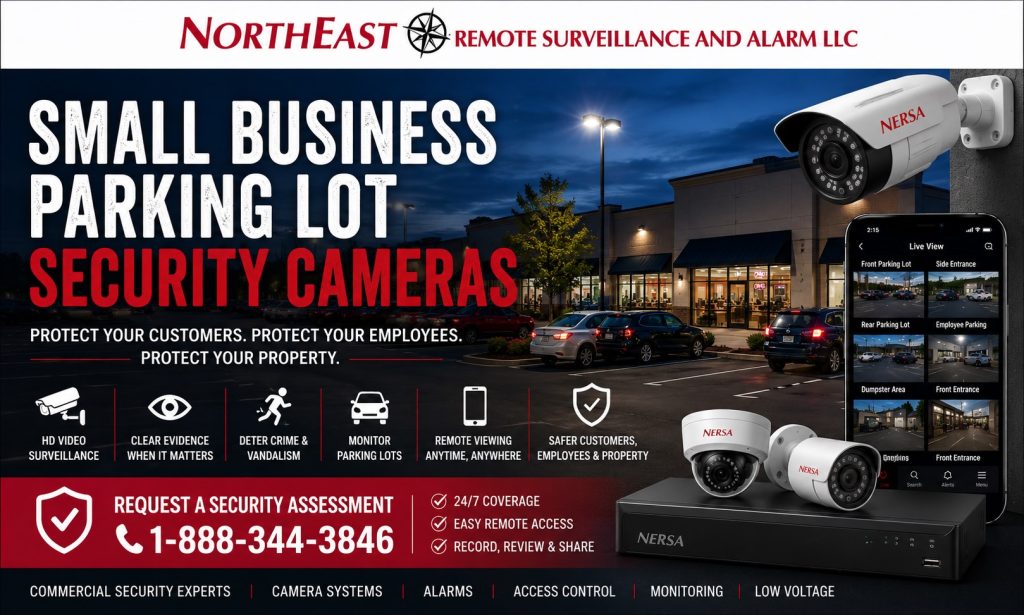
NERSA assesses the views, lighting, recording and authorized access needed for that purpose. Bring sample footage or identify gaps in the current coverage to define a focused installation or upgrade.
Northeast Remote Surveillance and Alarm, LLC designs, installs, upgrades, integrates, monitors, and supports commercial parking-lot camera systems for qualifying small businesses that need better exterior visibility and stronger incident documentation.
Start parking-lot camera planning with the movement of people and vehicles. Identify likely incident areas and the evidence your business may need. Those decisions should guide camera locations and coverage.
For broader small-business camera planning involving indoor, outdoor, parking, recording, and remote viewing needs, visit Small Business Security Camera Systems.
Parking Lot Security for Small Businesses
Parking lots are one of the most common areas where small businesses experience theft, vandalism, vehicle damage, suspicious activity, delivery disputes, customer incidents, and after-hours problems.
A business may have strong protection inside the building while still having weak visibility outside.
Parking-lot planning may need to consider:
- Customer parking
- Employee parking
- Entrances and exits
- Drive lanes
- Front entrances
- Side entrances
- Rear doors
- Delivery areas
- Walkways
- Dumpster areas
- Vehicle storage
- Loading areas
- Exterior storefronts
- Outdoor equipment
- After-hours gathering areas
The objective is not simply to record pavement.
The objective is to capture useful video of people, vehicles, direction of travel, building approaches, and activity near important exterior areas.
Camera Placement and Evidence Quality
Camera placement can determine whether recorded video is useful.
A camera mounted too high, aimed too wide, positioned against glare, or installed without considering nighttime conditions may show that activity occurred without providing enough detail to understand what happened.
Parking-lot camera placement should consider:
- Viewing distance
- Mounting height
- Camera angle
- Lens selection
- Vehicle travel
- Pedestrian movement
- Exterior lighting
- Headlight glare
- Building features
- Landscaping
- Weather
- Network availability
- Cabling pathways
A useful design may combine broader overview cameras with more focused views around entrances, building approaches, or drive lanes.
Daytime and Nighttime Performance
Exterior camera systems should be designed around the conditions that matter when the business is open and closed.
Nighttime performance can be affected by:
- Low ambient light
- Headlights
- Uneven lighting
- Shadows
- Weather
- Reflections
- Long viewing distances
- Moving vehicles
- Seasonal vegetation
A camera that provides a strong daytime image may perform very differently after dark.
Lighting, camera positioning, viewing distance, and image settings should be considered together.
Vehicle and Pedestrian Activity
A parking-lot system should provide enough context to understand how people and vehicles move through the property.
Depending on the business, useful views may include:
- Vehicle entrances
- Vehicle exits
- Parking rows
- Building approaches
- Customer entrances
- Employee entrances
- Rear doors
- Delivery routes
- Pedestrian paths
Overview views can show movement through the property, while focused views may be needed where the business requires greater detail.
The camera layout should follow actual traffic patterns rather than simply providing the widest possible image.
Recording and Retention
Parking-lot incidents are not always reported immediately.
A customer may call several days later about vehicle damage. An employee may report a concern after a weekend. Management may need to review activity from a previous date.
Recording retention may be affected by:
- Number of cameras
- Resolution
- Recording method
- Frame rate
- Compression
- Scene activity
- Storage capacity
- Cloud-platform limitations
The system should provide a practical balance between useful image quality and enough recording history to support realistic incident-review needs.
Remote Viewing and User Permissions
Authorized owners and managers may need remote access to parking-lot cameras for after-hours checks, deliveries, employee arrivals, weather incidents, vehicle claims, or other exterior concerns.
Remote access should be managed with appropriate user permissions rather than one shared account.
The business should understand:
- Who can view live video
- Who can review recordings
- Who can export clips
- Who can manage users
- Who owns the administrator account
Not every employee should automatically receive access to every exterior camera or system setting.
Existing Parking Lot Camera Systems
Older or inherited exterior camera systems should be evaluated before complete replacement is recommended.
Existing cameras, cabling, network equipment, recording equipment, poles, mounts, pathways, and other infrastructure may sometimes remain useful when they are dependable, compatible, secure, supportable, and appropriate for the completed system.
Common existing-system problems may include:
- Poor nighttime images
- Cameras mounted too high
- Cameras aimed too wide
- Blind spots
- Weak vehicle detail
- Failed recording
- Short retention
- Headlight glare
- Unreliable remote access
- Weak wireless connections
- Unsupported equipment
- Missing administrator accounts
The correct project may involve camera repositioning, selective replacement, recorder modernization, infrastructure correction, or phased upgrades.
Small Business Parking Lot Security Resources
For broader small-business camera planning covering indoor and outdoor areas, recording, remote access, and system administration, visit Small Business Security Camera Systems.
For dedicated vehicle and license-plate capture requiring tighter lane-specific design, visit License Plate Recognition Camera Systems.
For selected exterior-camera events requiring professional review and documented response procedures, visit Remote Video Monitoring and Live Talk-Down.
For after-hours intrusion protection, perimeter detection, alarm communication, and professional alarm response, visit Small Business Alarm Systems.
For employee entrances, controlled doors, restricted areas, and access-event accountability, visit Small Business Access Control Systems.
For broader commercial camera projects beyond the small-business environment, visit Commercial Security Camera Installation.
For aging, inherited, unreliable, or poorly documented camera systems requiring modernization, visit Commercial Security System Upgrades, Retrofits, and Takeovers.
Parking Lot Security by Business Type
For retail businesses requiring customer parking, entrance, storefront, employee, and after-hours exterior coverage, visit Retail Store Security Systems.
For restaurants requiring late-night exterior visibility, customer parking, employee entrances, delivery areas, and after-hours protection, visit Restaurant Security Systems.
For offices requiring employee and visitor parking, entrances, walkways, and after-hours exterior visibility, visit Office Security Systems.
For healthcare practices requiring staff and patient parking, entrances, walkways, and privacy-aware exterior security, visit Medical Office Security Systems.
For contractor properties requiring fleet parking, exterior storage, equipment areas, gates, and after-hours yard visibility, visit Contractor Shop Security Systems.
For automotive businesses requiring customer vehicles, overnight parking, service areas, exterior storage, and vehicle documentation, visit Auto Repair Shop Security Systems.
For extended-hour businesses requiring customer parking, entrance coverage, after-hours visibility, and remote review, visit Laundromat Security Systems.
For fitness facilities requiring member parking, entrances, after-hours access, and exterior visibility, visit Gym and Fitness Studio Security Systems.
For smaller warehouse and flex-commercial properties requiring employee parking, loading areas, rear entrances, and exterior coverage, visit Small Warehouse Security Systems.
Why Small Businesses Choose Northeast Remote Surveillance and Alarm
Northeast Remote Surveillance and Alarm, LLC focuses on commercial and industrial security systems rather than consumer camera packages.
NERSA has supported business and professionally managed properties since 2008 and evaluates parking-lot camera projects around the property, vehicle movement, pedestrian activity, lighting, required evidence, recording needs, infrastructure, remote access, and long-term serviceability.
A properly planned parking-lot camera system should provide:
- Useful exterior coverage
- Dependable recording
- Practical retention
- Secure remote access
- Appropriate user permissions
- Useful vehicle context
- Reliable nighttime performance
- Clear administrator ownership
- Expansion capability
- Long-term serviceability
The objective is not to install the greatest possible number of cameras.
The objective is to provide useful exterior video that authorized personnel can locate, understand, preserve, and use when an incident needs to be reviewed.
Frequently Asked Questions About Small Business Parking Lot Security Cameras
What areas should parking-lot cameras cover?
Common areas include customer parking, employee parking, entrances, exits, drive lanes, exterior doors, walkways, delivery areas, rear doors, and other high-use exterior locations.
Can parking-lot cameras help document vehicle incidents?
Yes. Properly positioned cameras can provide useful context around vehicle damage, theft, vandalism, suspicious activity, and direction of travel.
Will a standard parking-lot camera always capture license plates?
No. Dependable license-plate capture often requires dedicated camera placement, tighter viewing angles, appropriate lighting, and lane-specific design.
Can owners and managers view parking-lot cameras remotely?
Yes. Compatible systems can provide secure remote access for approved users.
Do parking-lot cameras work at night?
Yes, but performance depends on lighting, camera selection, placement, viewing distance, glare, weather, and configuration.
Can parking-lot cameras work with alarm and access-control systems?
Yes. Compatible systems can provide video context around exterior alarms, door events, and after-hours activity when integration serves a practical purpose.
Can existing parking-lot cameras be upgraded?
Often, yes. Existing cameras, cabling, recording equipment, mounts, and infrastructure should first be evaluated for condition and compatibility.
Can a parking-lot camera system expand later?
Yes. Proper planning can allow additional cameras, storage, analytics, remote monitoring, or other exterior coverage to be added as requirements change.
Request a Small Business Parking Lot Camera Assessment
NERSA can review your customer and employee parking areas. Tell us about nighttime video, vehicle documentation, recording retention, and secure remote viewing. We can assess existing equipment and recommend useful improvements.
Request a Small Business Parking Lot Camera Assessment.
Compliance, Codes & Project Standards
NERSA plans commercial and industrial security work with applicable code, documentation, inspection and authority-having-jurisdiction requirements in mind. Requirements vary by system, property and jurisdiction. These resources support project planning; they do not establish legal compliance, certification or AHJ approval.
Related guidance: Regulatory compliance & inspection readiness · Video surveillance compliance · NERSA project standards