Warehouse intrusion alarm and video verification systems help commercial and industrial facilities improve after-hours protection, alarm response, exterior door awareness, dock door security, motion detection, and incident review. This anonymous case study shows how Northeast Remote Surveillance and Alarm, LLC approaches a warehouse alarm project when a facility needs stronger intrusion detection, better verification around alarm events, cleaner notification procedures, and a practical system layout built around how the warehouse actually operates. For the full proof library, visit Commercial and Industrial Security Case Studies.
Call 1-888-344-3846 to request a warehouse intrusion alarm and video verification assessment.
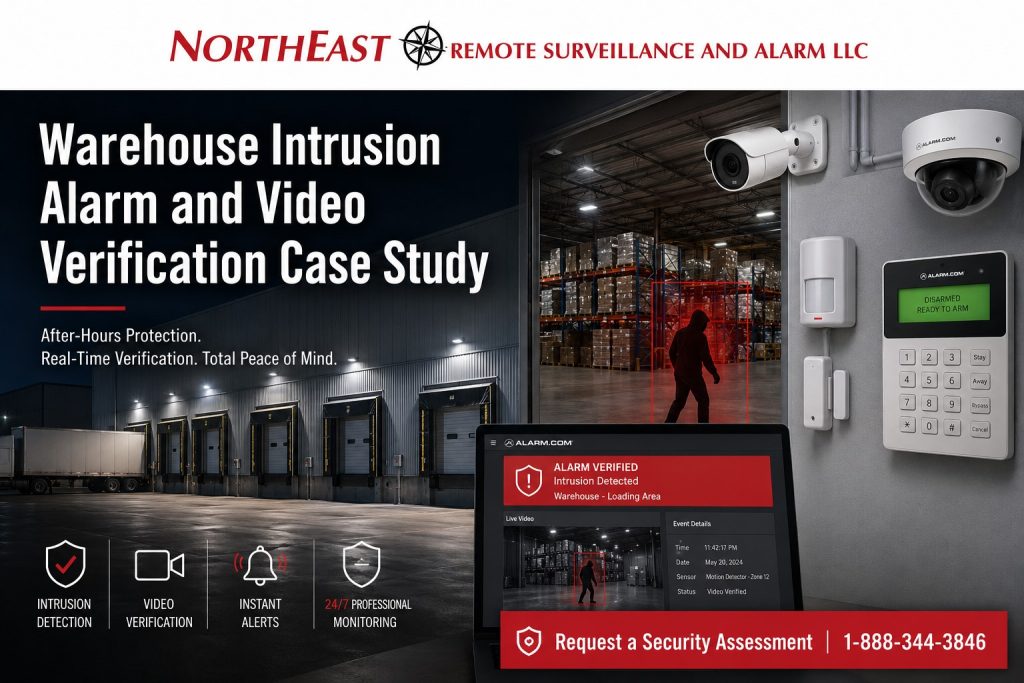
Case Study Overview
This case study is based on a common warehouse security challenge: the facility had doors, dock activity, employee movement, inventory areas, shipping and receiving activity, and after-hours exposure, but management needed a more reliable way to detect unauthorized entry and verify alarm events with useful video.
The property did not need a basic burglar alarm alone. It needed a warehouse intrusion alarm strategy designed around overhead doors, exterior man doors, interior movement, alarm partitions, central station communication, camera views, and after-hours response.
The goal was to improve security around:
- Exterior man doors
- Overhead dock doors
- Shipping and receiving areas
- Warehouse aisles
- Interior motion areas
- Office-to-warehouse transitions
- Restricted rooms
- Inventory areas
- Employee entrances
- After-hours activity
- Alarm communication
- Video verification
- Central station monitoring
- Event documentation
This page focuses only on the warehouse intrusion alarm and video verification case study. For broader alarm planning, visit Commercial and Industrial Alarm Installation. For broader warehouse planning, visit Warehouse Security Systems.
Property Type
The property was an anonymous warehouse and distribution-style facility with multiple exterior openings, dock doors, interior warehouse areas, office spaces, inventory movement, shipping activity, and after-hours alarm needs.
The site included:
- Exterior man doors
- Overhead dock doors
- Warehouse aisles
- Shipping and receiving areas
- Office areas
- Employee access points
- Restricted rooms
- Inventory storage areas
- Existing camera coverage
- Existing alarm needs
- After-hours exposure
- A need for stronger alarm verification
Like many warehouse properties, the security challenge was not one single door. The challenge was creating a complete alarm and verification strategy around how the building was actually used.
The Security Challenge
The main challenge was improving alarm confidence.
The facility needed a better way to detect unauthorized entry, understand which area triggered the alarm, and review related video before or after the event.
Common concerns included:
- Exterior doors exposed after hours
- Overhead dock doors needing stronger protection
- Interior motion activity needing better zoning
- Warehouse areas that were difficult to verify remotely
- Alarm events without enough visual context
- False alarm concerns
- Delayed understanding of what caused an alarm
- Limited ability to connect camera footage with alarm activity
- Need for clearer after-hours contact procedures
- Need for better documentation of intrusion events
This is a common issue in warehouse security. A traditional alarm signal may show that a zone activated, but video verification helps management or monitoring workflows understand what may have caused the event.
For dedicated video-verified alarm planning, visit Video Verified Alarm Systems.
Why Warehouses Need Intrusion Alarm and Video Verification Together
Warehouses are large, active, and often exposed through multiple openings.
They may include:
- Dock doors
- Shipping doors
- Receiving doors
- Employee entrances
- Office entrances
- Side doors
- Rear doors
- Trailer-adjacent doors
- Warehouse aisles
- Storage cages
- Inventory rooms
- Mechanical rooms
- Dispatch offices
- Exterior yards
- After-hours activity zones
An intrusion alarm helps detect a possible event. Video verification helps provide context around that event.
Together, they help answer:
- Which door or area triggered?
- Was there visible activity near the alarm point?
- Was the event caused by a person, vehicle, animal, weather, employee, vendor, or door condition?
- Was the building armed?
- Was the event after hours?
- Was video available for review?
- Should the event be escalated?
- Was this a false alarm or a real security concern?
The value comes from designing alarms and cameras together instead of treating them as separate systems.
Site Conditions Reviewed
Before recommending the final layout, Northeast Remote Surveillance and Alarm, LLC reviewed how the warehouse operated.
The review focused on:
- Exterior door locations
- Overhead door locations
- Dock activity
- Employee entrance use
- Office-to-warehouse transitions
- Shipping and receiving workflow
- Interior motion paths
- Inventory areas
- Restricted rooms
- Existing alarm equipment
- Existing camera views
- Lighting conditions
- Communication paths
- Cellular backup needs
- Alarm monitoring requirements
- Contact notification procedures
- Future expansion needs
The design started with the building’s operating pattern, not a generic alarm package.
Intrusion Alarm Design Strategy
The recommended alarm strategy focused on the areas most likely to matter during an unauthorized-entry event.
Exterior Door Protection
Exterior man doors were treated as priority alarm points because they create direct access into the warehouse or office areas.
Door protection may include:
- Door contacts
- Door status monitoring
- Alarm zone assignment
- Door-forced-open awareness
- After-hours monitoring
- Camera support near key openings
- Alarm event history
Exterior doors should be identified clearly so management and monitoring contacts understand where an alarm occurred.
Overhead Dock Door Protection
Overhead dock doors are major exposure points in warehouse environments.
Dock door alarm protection may include:
- Overhead door contacts
- Door status awareness
- Dock-area motion detection
- After-hours schedules
- Camera views near dock openings
- Video verification around alarm events
A warehouse with many dock doors should not treat all openings the same. Dock activity, door use, after-hours schedules, and camera coverage should all be considered.
For dock camera proof, visit Loading Dock Camera Coverage Case Study.
Interior Motion Detection
Interior motion detection was reviewed to protect warehouse areas after the building was armed.
Motion planning may consider:
- Warehouse aisle layout
- High-bay areas
- Office transitions
- Shipping and receiving zones
- Storage areas
- Restricted rooms
- Environmental conditions
- False alarm reduction
- Camera support
Motion detectors should be positioned for the actual warehouse environment. Large spaces, racking, forklifts, air movement, heat changes, and operating schedules can all affect design.
Restricted Room Alarm Protection
Warehouses often include rooms that need stronger protection.
These may include:
- IT rooms
- Tool rooms
- Inventory cages
- Shipping offices
- Records rooms
- Management offices
- Maintenance rooms
- Parts rooms
- High-value storage rooms
Restricted-room alarm protection can help create a tighter security layer inside the building.
Video Verification Strategy
Video verification was designed to support alarm events with relevant camera views.
The goal was not to attach cameras randomly to alarms. The goal was to make sure alarm activity could be reviewed with useful visual context.
Video verification may support:
- Exterior door alarm review
- Dock door alarm review
- Interior motion alarm review
- Shipping office alarm review
- Warehouse aisle event review
- Restricted room alarm review
- After-hours building activity
- False alarm reduction
- Better incident documentation
For broader camera system planning, visit Commercial Video Surveillance Systems.
Camera Views That Support Alarm Events
A warehouse alarm verification layout may include several camera-view categories.
Door Event Cameras
Door event cameras can show activity near key openings.
These views may help determine:
- Whether someone approached the door
- Whether the door opened normally or suspiciously
- Whether a vehicle was nearby
- Whether an employee or vendor was present
- Whether the door was left unsecured
- Whether activity happened before or after the alarm
Dock Area Cameras
Dock cameras can help review alarms near overhead doors, shipping areas, and trailer-related openings.
These views may help document:
- Trailer activity
- Forklift movement
- Freight movement
- Door openings
- After-hours dock activity
- Shipping and receiving events
Interior Verification Cameras
Interior warehouse cameras can help verify motion events.
These views may help show:
- Movement inside the warehouse
- Activity near storage areas
- Employee or contractor presence
- False alarm conditions
- Motion near aisles or restricted spaces
Exterior Approach Cameras
Exterior cameras can help show what happened before someone reached the building.
These views may help document:
- Vehicle approach
- Pedestrian movement
- Gate or driveway activity
- Parking lot activity
- Exterior door approach
- After-hours movement
For remote monitoring and active deterrence planning, visit Remote Video Monitoring and Live Talk-Down.
Alarm Monitoring and Communication Path
A warehouse intrusion alarm system should communicate reliably.
The system design may include:
- Central station monitoring
- Cellular communication
- Internet communication
- Dual-path communication where appropriate
- Alarm contact lists
- Escalation procedures
- User codes
- Schedules
- Partitioning
- Event history
- Service documentation
If internet service fails, a commercial warehouse may still need alarm signals to transmit through a backup path.
For monitoring planning, visit Commercial and Industrial Security Monitoring.
Alarm Partitions and Schedules
Warehouses may operate differently from standard office buildings.
Some areas may be active while others are closed. A shipping office may operate at different hours than the main warehouse. A warehouse may have multiple shifts, early deliveries, late pickups, or weekend activity.
Alarm partitioning may help separate:
- Office areas
- Warehouse areas
- Shipping and receiving areas
- Restricted rooms
- Tenant areas
- Exterior-connected spaces
Schedules should match the operation. A poorly planned schedule can create false alarms, missed events, or user frustration.
False Alarm Reduction
False alarm reduction was part of the design.
A stronger warehouse alarm design may reduce false alarms through:
- Proper device selection
- Correct sensor placement
- Clear zone naming
- User training
- Video verification
- Proper schedules
- Door status review
- Good communication paths
- Environmental review
- Clear contact lists
The goal is not only to detect events. The goal is to detect meaningful events and help the business respond correctly.
Operational Result
The warehouse intrusion alarm and video verification design helped the facility move toward stronger after-hours protection and better event review.
The system supported:
- Better exterior door alarm protection
- Better dock door alarm awareness
- Better interior motion coverage
- Better restricted-room protection
- Better video context around alarm events
- Better alarm confidence
- Better false alarm review
- Better after-hours response procedures
- Better event documentation
- Better long-term alarm serviceability
No sensitive customer information, exact alarm zones, camera maps, passwords, response procedures, contact lists, or security weaknesses are published in this case study.
The value of the project was the alarm verification strategy, not just the alarm devices.
What This Case Study Does Not Cover
This page is focused specifically on a warehouse intrusion alarm and video verification case study.
It is not the main warehouse security page. It is not the main commercial alarm installation page. It is not the main video surveillance page. It is not the main remote monitoring page. It is not a loading dock-only page. It is not a city hub.
For warehouse security planning, visit Warehouse Security Systems.
For alarm planning, visit Commercial and Industrial Alarm Installation.
For video verification planning, visit Video Verified Alarm Systems.
For camera system planning, visit Commercial Video Surveillance Systems.
For the full case-study hub, visit Commercial and Industrial Security Case Studies.
Lessons From This Warehouse Intrusion Alarm Case Study
This case study highlights several practical lessons for warehouse alarm planning.
Alarm Zones Should Match the Building
Warehouse alarm zones should be named and organized around real areas such as dock doors, exterior doors, office areas, warehouse spaces, and restricted rooms.
Video Verification Adds Context
An alarm signal tells management that something happened. Video helps show what may have caused the event.
Dock Doors Need Special Attention
Overhead dock doors can be major exposure points and should be reviewed carefully during alarm design.
Communication Backup Matters
Commercial alarm signals should not rely on a weak or outdated communication path when after-hours protection matters.
False Alarm Reduction Starts With Design
False alarm reduction depends on sensor choice, placement, schedules, user training, video verification, and clear procedures.
Recommended Warehouse Intrusion Alarm and Video Verification Assessment
A warehouse intrusion alarm and video verification assessment should review the full facility before final recommendations are made.
Northeast Remote Surveillance and Alarm, LLC may review:
- Exterior doors
- Overhead dock doors
- Shipping and receiving areas
- Warehouse aisles
- Office areas
- Employee entrances
- Restricted rooms
- Inventory areas
- Existing alarm equipment
- Existing camera views
- Lighting conditions
- Communication paths
- Cellular backup needs
- Alarm schedules
- Alarm partitions
- Contact lists
- Video verification needs
- Monitoring requirements
- Future expansion
The goal is to design an alarm system that fits how the warehouse actually operates.
Frequently Asked Questions About Warehouse Intrusion Alarm and Video Verification
What is a warehouse intrusion alarm system?
A warehouse intrusion alarm system uses door contacts, overhead door contacts, motion detection, keypads, communication equipment, monitoring, and alarm zones to detect unauthorized activity after hours or in restricted areas.
What is video verification for warehouse alarms?
Video verification uses camera footage to help review what happened around an alarm event. It can provide visual context around doors, docks, motion areas, and restricted rooms.
Why do warehouses need video verified alarms?
Warehouses need video verified alarms because large spaces, dock doors, exterior doors, after-hours activity, and false alarm concerns can make it difficult to understand alarm events without video context.
What doors should be protected in a warehouse alarm system?
Common protected openings include exterior man doors, overhead dock doors, shipping doors, receiving doors, employee entrances, office entrances, and restricted room doors.
Can overhead dock doors be alarmed?
Yes. Overhead dock doors can be protected with appropriate contacts and alarm design. Dock areas may also need cameras for verification.
Can warehouse alarm systems be monitored?
Yes. Warehouse intrusion alarms can be monitored through central station monitoring, cellular communication, internet communication, or dual-path communication depending on system design.
Can alarms reduce cargo theft risk?
Alarm systems can support cargo theft prevention by protecting dock doors, exterior doors, restricted areas, and after-hours warehouse access points. They work best when combined with cameras and proper site procedures.
Can video verification reduce false alarms?
Video verification can help determine whether an alarm event appears real, accidental, weather-related, animal-related, employee-related, or false.
Can warehouse alarms integrate with access control?
Yes. Alarm systems can integrate with access control for door events, user activity, after-hours access, door-held-open alerts, restricted-room access, and alarm workflows.
Can existing alarm equipment be reused?
Sometimes. Existing equipment may be reused if it is compatible, serviceable, properly located, and aligned with the new alarm design. A site assessment should determine what can remain.
Does NERSA publish exact warehouse alarm zone maps?
No. Northeast Remote Surveillance and Alarm, LLC does not publish sensitive customer alarm zones, camera maps, passwords, response procedures, contact lists, or security weaknesses in public case studies.
Does NERSA install residential alarm systems?
No. Northeast Remote Surveillance and Alarm, LLC focuses on commercial, industrial, warehouse, logistics, manufacturing, institutional, municipal, healthcare, and enterprise security systems.
How do I request a warehouse intrusion alarm and video verification assessment?
Call 1-888-344-3846 or request a security assessment. Northeast Remote Surveillance and Alarm, LLC can review your warehouse doors, dock openings, alarm zones, cameras, communication paths, monitoring needs, and after-hours security goals.
Request a Warehouse Intrusion Alarm and Video Verification Assessment
Warehouse intrusion alarm and video verification systems should be designed around real facility exposure. Exterior doors, dock doors, shipping areas, receiving areas, warehouse aisles, restricted rooms, communication paths, monitoring procedures, camera views, and after-hours activity all affect the final system design.
If your warehouse, distribution center, logistics facility, manufacturing-connected warehouse, cold storage building, or industrial property needs stronger intrusion alarm protection and better alarm verification, Northeast Remote Surveillance and Alarm, LLC can evaluate the site and recommend a practical system layout.
Call 1-888-344-3846 or request a security assessment.