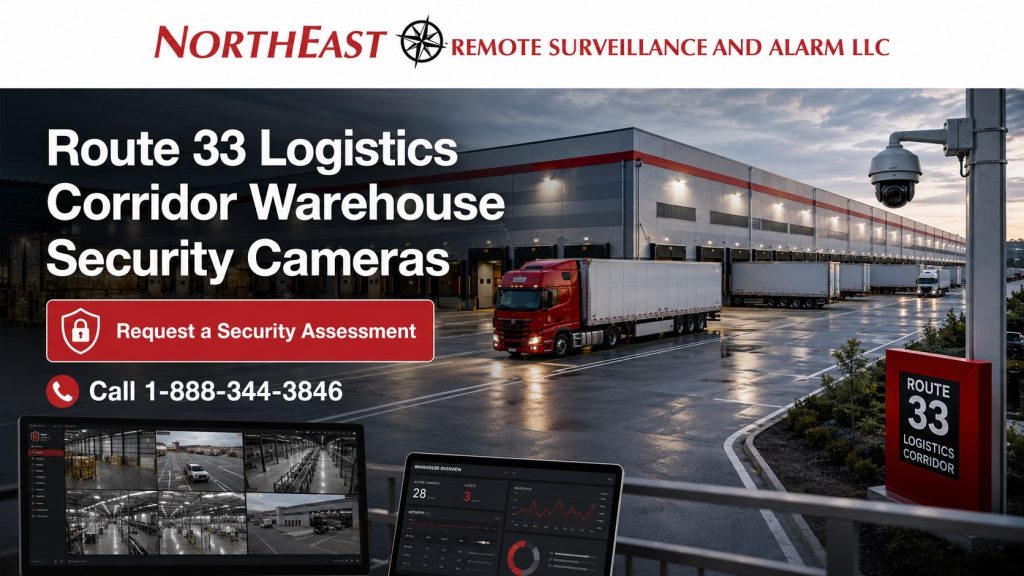
Route 33 logistics corridor warehouse security cameras help warehouses, distribution centers, freight terminals, cold storage facilities, manufacturing-connected warehouses, and logistics properties improve visibility around freight movement, truck traffic, loading docks, trailer areas, employee entrances, and after-hours operations.
request a Route 33 warehouse security camera assessment
Industrial Video Surveillance Systems for Warehouses, Distribution Centers, Freight Terminals, and Logistics Facilities
This guide covers only warehouse camera coverage along the Route 33 logistics corridor, including dock views, trailer-yard surveillance, interior warehouse review, vehicle documentation, remote viewing, recording, and incident investigation.
For broader corridor planning involving cameras, access control, alarms, gates, monitoring, and integrated security systems, visit Lehigh Valley Route 33 Industrial Corridor Security Systems.
Where Route 33 Warehouse Cameras Should Focus
A properly designed warehouse camera system should focus on the parts of the property where freight, vehicles, employees, vendors, drivers, and equipment actually move.
Common camera zones include:
- Loading docks
- Trailer backing zones
- Truck courts
- Trailer staging areas
- Warehouse aisles
- Shipping and receiving areas
- Pallet staging areas
- Cargo handling zones
- Employee entrances
- Warehouse office entrances
- Exterior man doors
- Fence lines and side approaches
- Gate lanes and vehicle entrances
- Parking areas
- High-value inventory zones
- After-hours approach points
The goal is not to install cameras randomly. The goal is to capture useful views that help management understand what happened, where it happened, and which activity matters.
Loading Dock Camera Coverage
Route 33 warehouse docks bring freight, pallets, trailers, forklifts, drivers and employees into the same area. Plan camera views around those movements, open overhead doors and the records needed for shipping or receiving.
Dock cameras may help document:
- Trailer arrivals and departures
- Freight loading and unloading
- Forklift activity
- Dock lane movement
- Overhead door activity
- Driver interaction
- Staged product movement
- Product damage claims
- Missing freight disputes
- After-hours dock activity
Poor dock visibility is one of the biggest weaknesses in a warehouse camera design. If a shipment dispute, damage claim, theft concern, or safety incident happens at the dock and the camera view is unusable, the investigation starts at a disadvantage.
For dock-specific corridor planning, visit Loading Dock Security Systems Along the Lehigh Valley Route 33 Industrial Corridor.
Trailer Yard and Truck Traffic Cameras
Route 33 logistics properties may need as much camera planning outside as inside. Review trailer yards, truck courts, fleet areas and drop lots. Side lanes, rear drives and exterior staging areas can also leave gaps in coverage.
Trailer yard and truck traffic camera planning may include:
- Wide-area yard cameras
- Long-range fixed cameras
- Gate-lane cameras
- Trailer-row views
- Fence-line coverage
- Parking lot coverage
- Truck entrance views
- Yard approach views
- Exterior lighting coordination
- PTZ support where appropriate for investigation
Fixed cameras should handle the most important identification and documentation views. PTZ cameras can support investigation and live review, but they should not replace fixed views of critical entrances, dock lanes, or trailer rows.
For yard-focused planning, visit Truck Yard and Trailer Security Systems Along the Lehigh Valley Route 33 Industrial Corridor.
License Plate Recognition for Route 33 Warehouse Properties
Large logistics and distribution properties may need stronger vehicle documentation at truck entrances, service drives, gate lanes, employee parking entrances, visitor entrances, and recurring vehicle approaches.
License plate recognition cameras may help document:
- Vehicle entry and exit
- Truck traffic
- Unauthorized vehicle activity
- Gate-lane movement
- Service vehicle access
- Repeated after-hours activity
- Vehicle history tied to incidents
LPR cameras should be positioned carefully. Plate capture depends on angle, distance, lane speed, lighting, camera height, lens selection, and the location of the vehicle path.
For vehicle identification planning, visit License Plate Recognition Systems Along the Lehigh Valley Route 33 Industrial Corridor.
Interior Warehouse Camera Review
Interior warehouse cameras should support useful review, not just general visibility. Large buildings, tall racking, changing inventory layouts, forklift movement, narrow aisles, shipping lanes, and staging areas can create blind spots if the system is not designed around the actual operation.
Interior camera coverage may support:
- Pallet movement review
- Inventory movement review
- Forklift activity review
- Aisle visibility
- Shipping and receiving documentation
- Employee movement review
- Vendor or contractor activity review
- Restricted area awareness
- Incident investigation
- Workflow review
The system should help managers find the right camera view quickly. A warehouse camera system is only useful if footage can be located, reviewed, exported, and understood when it matters.
Employee Entrances and Restricted Area Visibility
Warehouse security cameras should also support visibility around employee entrances, warehouse office entrances, shipping offices, receiving offices, inventory cages, IT rooms, maintenance rooms, and restricted areas.
Cameras do not replace access control, but they can support access control events by showing what happened before, during, and after a door event. This is especially important for facilities with multiple shifts, employee turnover, contractors, vendors, or high-value inventory areas.
For controlled-entry planning along the corridor, visit Warehouse Access Control Systems Along the Lehigh Valley Route 33 Industrial Corridor.
Remote Viewing and Event-Based Monitoring
Many Route 33 warehouse and logistics facilities need remote access to camera footage because owners, managers, operations teams, and security staff may not always be on-site. Remote viewing can help authorized users check dock activity, confirm truck movement, review exterior areas, investigate incidents, and support multi-site operations.
Some properties may also benefit from event-based monitoring, alert review, or live talk-down around yards, docks, gates, parking lots, and exterior approaches.
Remote viewing and monitoring should be planned with secure user access, role-based permissions, strong passwords, and clear procedures for who can view or export video.
For monitored video and live response planning, visit Remote Video Monitoring and Live Talk-Down.
Recording, Retention, and Evidence Access
Warehouse security camera systems should be designed around how long footage needs to remain available and how quickly management needs to find it.
Retention planning may depend on:
- Facility size
- Camera count
- Recording quality
- Operating hours
- Truck volume
- Dock activity
- Inventory value
- Incident history
- Insurance expectations
- Management review needs
A small warehouse with limited activity may have different retention needs than a large distribution center with multiple shifts, frequent deliveries, trailer staging, and high-value freight. The system should be designed so footage is accessible, searchable, exportable, and useful during an investigation.
Camera Placement Strategy for Large Route 33 Facilities
Designing a camera system for a large warehouse or distribution property requires careful planning. The camera layout should match the building, the yard, and the way the operation actually moves.
NERSA evaluates:
- Building size
- Dock door locations
- Trailer yard layout
- Parking areas
- Gate lanes
- Warehouse aisle layout
- Racking height
- Lighting conditions
- Interior and exterior mounting locations
- Network pathways
- Recording requirements
- Review needs
- Future expansion
The strongest camera systems are designed before equipment is selected. Camera type, lens choice, mounting height, recording platform, remote access, network design, and retention expectations all affect whether the final system will be useful.
Cybersecurity and Network Planning for Warehouse Cameras
Security cameras are part of the facility’s network infrastructure. A warehouse camera system should be planned with cybersecurity, remote access, user permissions, equipment sourcing, and long-term support in mind.
Good planning may include:
- Segmented network design
- Secure remote access
- Strong user permissions
- Proper password practices
- Camera health monitoring
- Firmware management
- UPS and power planning
- Clear documentation
- Responsible access to recorded video
For projects where equipment sourcing, government-sensitive work, or approved camera selection matters, visit NDAA Compliance for Commercial Security Systems.
Route 33 Logistics Areas Served
Northeast Remote Surveillance and Alarm, LLC installs warehouse security camera systems for logistics, warehouse, distribution, freight, and industrial properties along and near the Route 33 corridor.
Common Route 33 corridor areas include:
- Easton
- Palmer Township
- Forks Township
- Nazareth
- Upper Nazareth Township
- Lower Nazareth Township
- Wind Gap
- Pen Argyl
- Bangor
- Nearby Northampton County industrial areas
- Nearby Lehigh Valley logistics properties
These areas include warehouses, distribution centers, trucking terminals, manufacturing-connected warehouse properties, cold storage facilities, and industrial buildings that may need camera coverage around docks, yards, freight movement, employee access, and after-hours activity.
Project Scope and Related Resources
This guide covers warehouse security cameras along the Route 33 logistics corridor.
This resource supports those resources by focusing only on warehouse video surveillance, camera placement, loading dock views, trailer yard visibility, truck traffic documentation, remote viewing, and recorded incident review for Route 33 logistics properties.
Route 33 Warehouse Security Camera Installation
Northeast Remote Surveillance and Alarm, LLC installs warehouse security camera systems for Route 33 logistics corridor properties that need better visibility around docks, yards, truck entrances, warehouse interiors, employee access points, cargo staging areas, and after-hours activity.
A proper camera design starts with the site layout, dock count, trailer flow, truck access points, warehouse aisles, lighting, mounting locations, network pathways, recording needs, and management review process.
The result should be a camera system that supports real warehouse operations instead of a generic camera package.
Request a Route 33 Warehouse Security Camera Assessment
NERSA can assess cameras for warehouses, distribution centers, freight terminals, cold storage, and logistics properties along Route 33. We recommend coverage around the way your facility operates.
Request a security assessment to discuss Route 33 logistics corridor warehouse security cameras.
Frequently Asked Questions About Route 33 Logistics Corridor Warehouse Security Cameras
What types of Route 33 warehouses need security cameras?
Route 33 logistics properties may need cameras at docks, trailer areas, truck routes, warehouse interiors, and employee entrances. Define what staff need to review at each location, including after-hours activity. The same approach applies to distribution centers, freight terminals, cold storage, and warehouses serving manufacturing plants.
What areas should Route 33 warehouse cameras cover?
Warehouse cameras should commonly cover loading docks, trailer backing zones, truck courts, shipping and receiving areas, warehouse aisles, pallet staging areas, employee entrances, parking areas, gate lanes, exterior doors, and trailer-yard views.
Can cameras monitor loading docks continuously?
Yes. Cameras can provide continuous dock visibility when the system is designed around the dock layout, lighting, camera angle, recording platform, and review needs. Dock cameras can help document trailer arrivals, freight transfer, driver activity, forklift movement, and shipment disputes.
Can trailer yards be monitored effectively?
Yes. Trailer yards can be monitored with proper camera placement, lighting coordination, lens selection, mounting height, recording design, and fixed views of trailer rows, gate lanes, yard corners, and truck approaches.
Do Route 33 logistics facilities need license plate recognition cameras?
Some do. LPR cameras can help document vehicle entry and exit, truck traffic, gate activity, service vehicles, recurring traffic, and suspicious vehicle activity. LPR should be designed around the vehicle lane, plate angle, lighting, camera distance, and expected speed.
Can warehouse cameras support access control?
Yes. Cameras can support access control by showing activity around employee entrances, warehouse office doors, restricted rooms, shipping offices, receiving areas, and other controlled openings. Access control manages entry, while cameras provide visual context.
Can cameras support alarm events?
Yes. Cameras can support alarm events by helping management or monitoring teams review what happened around doors, docks, offices, yards, and exterior approaches. The alarm system and camera system should be planned so the event information is useful.
How many cameras does a large Route 33 warehouse need?
Camera count depends on building size, dock count, trailer yard layout, parking areas, warehouse aisles, entrances, exterior exposure, lighting, recording requirements, and the level of detail management needs for review.
Can remote viewing help logistics managers?
Yes. Remote viewing can help authorized users check dock activity, review gate movement, verify truck traffic, inspect yard areas, and investigate incidents without being physically present at the property.
Does NERSA install single-family home camera systems?
No. Northeast Remote Surveillance and Alarm, LLC focuses on commercial, industrial, warehouse, logistics, manufacturing, institutional, municipal, healthcare, and enterprise security systems.
How do I start a Route 33 warehouse camera project?
Call 1-888-344-3846 to request a security assessment. Northeast Remote Surveillance and Alarm, LLC can review the facility layout, dock activity, truck movement, camera coverage, recording needs, remote access requirements, and long-term security goals.
Protect Route 33 Logistics Facilities With Better Warehouse Camera Coverage
Route 33 logistics corridor warehouse security cameras should be designed around real freight movement, not generic camera placement. Loading docks, truck courts, trailer yards, employee entrances, warehouse interiors, restricted areas, parking lots, and after-hours approach points all require specific visibility.
Northeast Remote Surveillance and Alarm, LLC designs warehouse camera systems that help logistics facilities improve incident review, support management visibility, document vehicle activity, monitor dock movement, and protect warehouse operations along the Route 33 corridor.
Call 1-888-344-3846 to request a Route 33 warehouse security camera assessment.
Compliance, Codes & Project Standards
NERSA plans commercial and industrial security work with applicable code, documentation, inspection and authority-having-jurisdiction requirements in mind. Requirements vary by system, property and jurisdiction. These resources support project planning; they do not establish legal compliance, certification or AHJ approval.
Related guidance: Regulatory compliance & inspection readiness · Video surveillance compliance · NERSA project standards