
Route 22 corridor access control manages employee entrances, restricted areas, contractor permissions, shift schedules, and controlled gates for Lehigh Valley businesses.

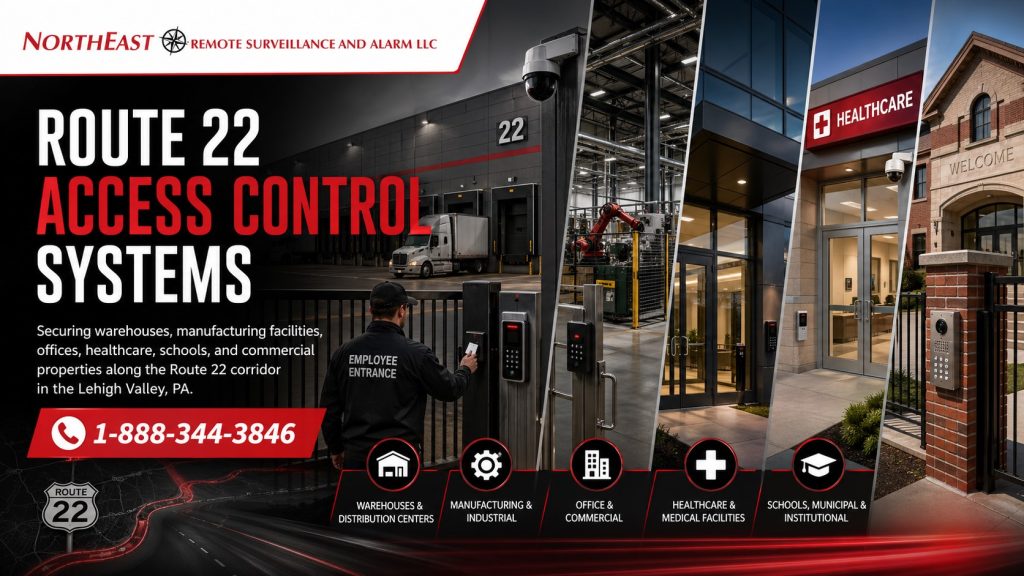
NERSA designs, installs, upgrades, and expands access control along the Route 22 corridor in the Lehigh Valley. We serve warehouses, manufacturing plants, offices, logistics properties, and other businesses and professionally managed facilities.
Access control gives businesses a manageable way to determine who may enter, which controlled openings they may use and when those permissions apply.
NERSA provides scalable access-control solutions for small businesses, mid-sized commercial and industrial facilities, multi-building properties and enterprise environments throughout the corridor.
For broader security planning involving video surveillance, intrusion alarms, fire alarm systems, monitoring and other commercial security infrastructure, visit Route 22 Industrial Corridor Security Systems in the Lehigh Valley, PA.
Complete Hardware Installation and Door Adjustments Included
NERSA installs all access-control hardware specified for your system and fine-tunes the complete door opening as part of the installation. This includes door, hinge, latch and closer adjustments so the door closes, latches and operates reliably with the access-control system.
Before handover, we test credential operation, authorized entry, door closing, latching and required exit operation. Hardware installation and these door adjustments are part of our installation work.
Access Control for Route 22 Commercial and Industrial Properties
Properties along Route 22 can have very different entry requirements from a conventional single-entrance office.
A facility may need to manage:
- Employees
- Supervisors and managers
- Contractors
- Vendors
- Temporary workers
- Maintenance personnel
- Delivery-related personnel
- Tenants
- After-hours staff
The property may also contain employee entrances, administrative areas, warehouse spaces, manufacturing areas, restricted rooms, shipping offices and selected gates.
Traditional keys and shared entry codes can become increasingly difficult to manage as the number of users, shifts and controlled openings grows.
Electronic access control allows authorized administrators to issue and remove individual credentials and assign permissions around actual operating requirements.
The goal is not to control every possible door. It is to identify the openings where individual accountability and managed entry provide meaningful value.
Employee Entrances, Shifts and Restricted Areas
Employee entrances are among the most common access-control applications along the Route 22 corridor.
A controlled entrance can help an organization determine:
- Which employees may enter
- Which entrance each employee may use
- When access is permitted
- Which employees require after-hours access
- How lost credentials are disabled
- When former employees should be removed
This is especially useful for warehouses, manufacturing properties and logistics operations running multiple shifts.
A first-shift employee may require access during daytime operating hours, while an overnight supervisor or maintenance technician may need a different schedule.
Access can also extend beyond the exterior entrance.
Restricted interior areas may include:
- IT and server rooms
- Inventory areas
- Maintenance rooms
- Tool or equipment storage
- Production areas
- Management offices
- Records rooms
- Office-to-warehouse transition doors
- Tenant separation points
A person who is authorized to enter the facility does not automatically need access throughout the entire building.
Permissions should reflect job responsibilities and actual operational requirements.
Warehouses, Manufacturing and Logistics Properties
The Route 22 corridor includes commercial and industrial properties where access-control requirements may involve more than a front office entrance.
Warehouse and industrial openings may serve:
- Employee entrances
- Shipping and receiving offices
- Production areas
- Maintenance departments
- Inventory rooms
- High-value storage
- Staff-only entrances
- Office-to-warehouse transitions
These doors may operate continuously or experience high traffic during shift changes.
Access-control planning should consider how the opening is used, who requires entry, the existing door hardware and whether the system needs to support future users or additional openings.
For logistics and distribution facilities with more specialized workforce, dock-office and multi-site access requirements, visit Access Control for Logistics & Distribution Centers.
Credentials, Permissions and Temporary Access
Commercial access-control systems may use cards, key fobs, mobile credentials, PINs or other supported credential technologies depending on the selected platform and operating requirements.
The credential itself is only one part of the system.
What matters is how the credential is administered.
Permissions can be organized around:
- Employee
- Department
- Job responsibility
- Work shift
- Building area
- Management level
- Contractor status
- Tenant
- After-hours authorization
For example, a warehouse employee may require an employee entrance and operational area but not an IT room.
A maintenance employee may need mechanical or equipment areas that general employees do not.
Temporary workers, vendors and contractors can also receive access that is limited to approved doors and schedules.
Temporary personnel should not automatically receive the same permissions as permanent employees.
When an assignment ends, supported systems can disable the individual credential without affecting access for other authorized users.
Controlled Gates as Part of the Access-Control System
Some commercial and industrial Route 22 properties also use managed credentials at selected vehicle or pedestrian gates.
When the gate is part of the same access-control environment, authorized entry may use compatible cards, fobs, keypads, mobile credentials or other approved methods.
Gate-access planning may consider:
- Authorized users
- Operating schedules
- Credential management
- Gate equipment compatibility
- Communication
- Power
- Safe operation
Coordinate gate credentials and schedules with the contractors responsible for the operator, safety functions, vehicle movement, and surrounding perimeter.
Door Operation and Life-Safety Considerations
An electronic credential does not secure an opening by itself.
The complete controlled door may involve a reader, controller, electric locking hardware, door contact, request-to-exit equipment, power and the physical door itself.
The opening should release when authorized, close properly and return to a secure condition.
Access-control planning must also account for required emergency exit operation, applicable life-safety requirements, accessibility and the hardware installed at the opening.
Entry control should never be designed in a way that improperly interferes with required egress.
Code-sensitive or specialized locking arrangements should be evaluated before equipment is selected.
Single-Door Through Enterprise Access Control
Not every Route 22 property needs a large access-control system.
A small business may need one controlled employee entrance.
A growing commercial property may later add restricted rooms, additional employee doors or another department.
An industrial facility may require multiple controlled openings across offices, warehouses and production areas.
A larger organization may need coordinated administration across multiple buildings or properties.
Planning for reasonable expansion can help avoid unnecessary system replacement as requirements change.
The initial system should therefore be sized around the property’s current needs while considering future controller capacity, users, credentials and additional controlled openings.
The objective is a system that remains manageable whether it serves one important entrance or a multi-building enterprise environment.
Existing Route 22 Access Control Systems
Some Route 22 properties already have access control but require changes to the installed system.
The appropriate path depends on the primary need.
A malfunctioning reader, power supply or controlled door may require repair.
Outdated controllers, unsupported software or obsolete credential technology may require modernization.
A supportable system that needs additional controlled openings may require expansion.
The important first step is evaluating the existing system rather than assuming complete replacement is necessary.
For broader access-control planning beyond this corridor, visit Commercial & Industrial Access Control Systems.
Planning a Route 22 Access Control Project
A commercial access-control project should begin with the property rather than a predetermined equipment package.
NERSA may evaluate:
- Controlled entrances
- User groups
- Employee schedules
- Restricted areas
- Temporary personnel
- Existing door hardware
- Existing access-control equipment
- Gate requirements
- Administration needs
- Available infrastructure
- Reasonable future expansion
The resulting system can then be designed around how the property actually operates.
A small office, multi-shift warehouse and multi-building industrial property should not receive identical access-control designs simply because they are located along the same corridor.
Frequently Asked Questions
What types of Route 22 properties use access control?
Access control can serve warehouses, manufacturing properties, distribution facilities, offices, industrial buildings, contractor facilities, multi-tenant properties, logistics operations and other commercial facilities along the corridor.
Can employees have access to different doors?
Yes. Supported systems can assign different permissions according to employee, department, role, shift, restricted area or other customer-approved requirements.
Can access be limited by employee schedule?
Yes. Access-control schedules can provide permissions during approved shifts, business hours, weekends or after-hours periods.
Can lost cards or key fobs be disabled?
Yes. Supported systems allow authorized administrators to disable credentials without mechanically rekeying every controlled opening.
Can contractors receive temporary access?
Yes. Contractors, vendors and temporary personnel can receive limited credentials based on approved doors, schedules and access periods.
Can access control be used at a commercial gate?
Yes, when the gate equipment and selected access-control platform are compatible and the application can be operated safely.
Can an existing Route 22 access-control system be expanded?
Often. Existing controller capacity, licensing, power, communication and equipment compatibility should be evaluated before additional controlled openings are added.
Does access control need to account for emergency exit?
Yes. Commercial access control should be coordinated with proper egress, door hardware, accessibility and applicable life-safety requirements.
Request a Route 22 Access Control Assessment
NERSA can review access control along the Lehigh Valley Route 22 corridor. We assess staff entrances, restricted areas, contractor access, schedules, credentials and selected gates. The findings guide the recommended approach.
Whether the requirement involves one controlled entrance for a small business or coordinated access across a large industrial or multi-building property, the system can be planned around the way the organization actually operates.
Request a Security Assessment.
Small Business – Enterprise Scalable Solutions
Commercial & Industrial Systems Only • New Installations • Upgrades • Expansions
Compliance, Codes & Project Standards
NERSA plans commercial and industrial security work with applicable code, documentation, inspection and authority-having-jurisdiction requirements in mind. Requirements vary by system, property and jurisdiction. These resources support project planning; they do not establish legal compliance, certification or AHJ approval.
Related guidance: Regulatory compliance & inspection readiness · Access control & door hardware standards · NFPA 101 & egress planning · ADA access-control planning