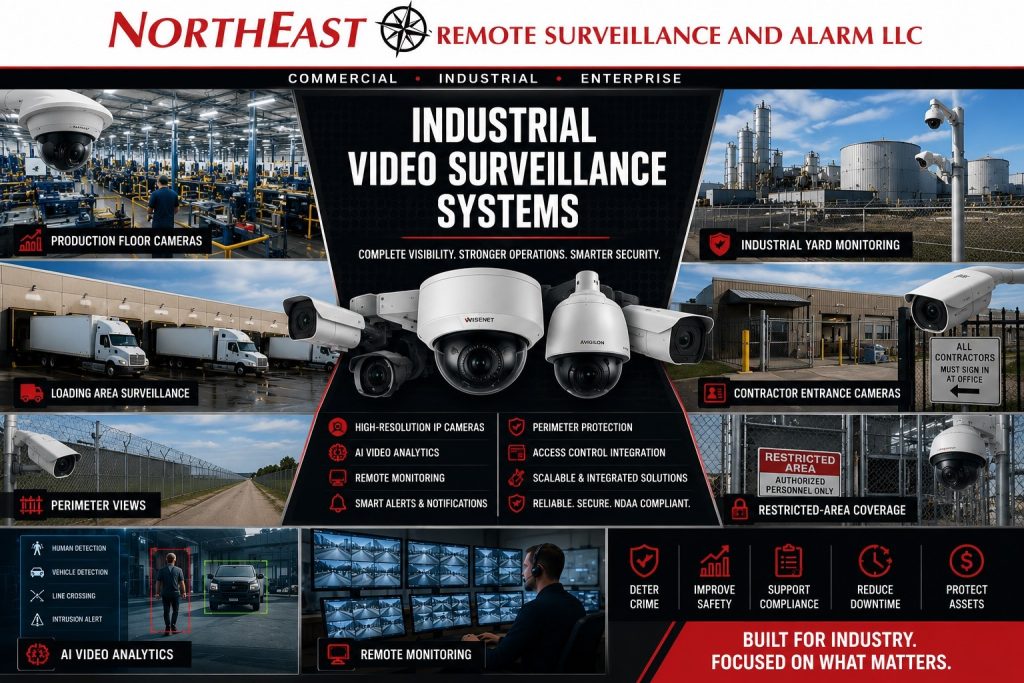
Industrial video surveillance systems help manufacturing plants, industrial buildings, production facilities, equipment yards, loading areas, utility zones, and restricted spaces maintain visibility across high-risk operating environments. Northeast Remote Surveillance and Alarm, LLC designs industrial camera systems around production activity, employee movement, contractor access, exterior yards, gate activity, perimeter risk, after-hours movement, and long-term video retention across Pennsylvania and the Mid-Atlantic. For broader camera system planning, start with Commercial & Industrial Video Surveillance Systems.
Industrial Video Surveillance Planning for Real Operating Conditions
Industrial properties need more than generic camera placement. A strong system must account for machinery, forklift traffic, employee shift changes, contractor access, overhead doors, dock activity, service gates, yard movement, utility areas, lighting changes, weather exposure, network infrastructure, and long-term evidence needs.
The goal is not simply to install more cameras. The goal is to build a usable surveillance system that helps managers review incidents, document activity, reduce blind spots, support investigations, improve accountability, and strengthen operational control.
Industrial surveillance should be planned as infrastructure. Camera placement, recording method, retention, analytics, user permissions, remote access, cybersecurity, cabling, mounting conditions, and serviceability all affect whether the system performs when an incident occurs.
Industrial Video Surveillance Spindles
Use the pages below to plan specific industrial camera coverage areas, risk zones, and surveillance use cases.
Video Surveillance for Manufacturing Facilities
Use Video Surveillance for Manufacturing Facilities to plan camera coverage for production floors, machine areas, employee movement, contractor access, restricted spaces, shipping areas, and plant-wide visibility.
Production Floor Surveillance
Use Production Floor Surveillance to plan camera views around production lines, workflow areas, machinery zones, forklift movement, employee activity, and incident review points.
Machine Area Monitoring
Use Machine Area Monitoring to support visibility around equipment zones, machinery areas, process spaces, restricted equipment access, and operational review needs.
Contractor and Vendor Entrance Surveillance
Use Contractor and Vendor Entrance Surveillance to document outside personnel, service vehicles, vendor activity, maintenance access, receiving entrances, contractor gates, and restricted industrial entry points.
Employee Entrance and Shift Change Surveillance
Use Employee Entrance and Shift Change Surveillance to improve visibility around employee doors, badge areas, parking transitions, time clock zones, shift-change congestion, and after-hours staff movement.
Industrial Yard Video Surveillance
Use Industrial Yard Video Surveillance to monitor equipment yards, truck courts, trailer storage areas, outdoor materials, gate activity, vehicle movement, perimeter approaches, and after-hours exterior risk.
Industrial Perimeter Security Cameras
Use Industrial Perimeter Security Cameras to plan coverage around fence lines, rear approaches, utility areas, exterior storage zones, gates, drive lanes, and industrial property boundaries.
Loading Area and Shipping Zone Surveillance
Use Loading Area and Shipping Zone Surveillance to document dock doors, staging areas, freight movement, delivery vehicles, shipping activity, receiving activity, trailer positioning, and product-transfer points.
Restricted Area Video Surveillance
Use Restricted Area Video Surveillance to support visibility around controlled rooms, tool cribs, utility areas, IT rooms, electrical rooms, inventory spaces, production-sensitive zones, and limited-access industrial areas.
Thermal Cameras for Industrial Facilities
Use Thermal Cameras for Industrial Facilities to evaluate low-light, long-range, perimeter, utility, harsh-weather, and exterior detection needs where standard cameras may struggle.
Explosion-Protected and Hazardous-Area Camera Compliance
Use Explosion-Protected and Hazardous-Area Camera Compliance when camera planning involves dust, vapor, chemical exposure, fuel, classified areas, process risk, or hazardous industrial environments.
AI Video Analytics for Industrial Facilities
Use AI Video Analytics for Industrial Facilities to plan people detection, vehicle detection, line crossing, restricted-area alerts, after-hours event filtering, yard alerts, and operational video review.
Industrial Video Retention and Evidence Strategy
Use Industrial Video Retention and Evidence Strategy to plan storage duration, export procedures, incident documentation, authorized access, investigation workflows, and long-term video usability.
Industrial Remote Video Monitoring
Use Industrial Remote Video Monitoring to connect exterior cameras, AI alerts, yard activity, perimeter events, gate activity, restricted-area movement, and after-hours detection to live review and response workflows.
Industrial Surveillance Should Be Designed as Infrastructure
Industrial camera systems should be planned around the property’s operations, not around a standard camera package. Production activity, exterior yard movement, employee access, contractor traffic, loading operations, restricted spaces, lighting, weather, bandwidth, storage, cybersecurity, and serviceability all affect the final system design.
A dependable industrial surveillance system should help management answer practical questions: what happened, where it happened, who was involved, which entrance was used, what vehicle was present, whether a door or gate was accessed, and whether the event requires follow-up.
For industrial facilities, usable footage matters more than camera count. A system with fewer well-placed cameras, clear retention planning, proper lighting review, and organized event access will usually outperform a larger system with poor angles, weak infrastructure, or difficult evidence retrieval.
Common Industrial Camera Coverage Areas
Industrial video surveillance may include coverage for production floors, machine areas, contractor entrances, employee doors, loading docks, shipping zones, exterior yards, equipment storage areas, utility areas, gates, perimeters, restricted rooms, parking areas, and access-controlled doors.
Each area should have a defined purpose. Some views are designed for identification, some for overview, some for vehicle documentation, some for restricted-area awareness, and some for after-hours event verification.
A locked industrial camera plan should separate these purposes clearly so the system supports real investigations instead of producing footage that is hard to use when something happens.
Recording, Retention, and Evidence Review
Industrial facilities often need longer retention, higher camera counts, larger storage capacity, remote access, and stronger evidence workflows than smaller commercial sites. Recording design should account for camera resolution, frame rate, operating hours, incident frequency, export needs, user permissions, and whether footage must be reviewed by managers, safety teams, ownership, or monitoring personnel.
On-premise recording can support large camera counts, local control, longer retention, and deeper integration with access control or alarms. Cloud and hybrid systems can support remote access, centralized management, multi-site oversight, and simplified administration when bandwidth, cybersecurity, and retention are planned correctly.
The recording method should match the facility’s operational needs. Industrial video should be easy to search, export, protect, and review when an incident, claim, access event, theft concern, safety issue, or after-hours event needs investigation.
AI Video Analytics for Industrial Risk Areas
AI video analytics can help industrial facilities reduce false alerts, identify important activity, and improve event review. Analytics may support people detection, vehicle detection, line crossing, restricted-area alerts, after-hours movement, yard activity, and perimeter awareness.
AI should not be treated as a generic feature that gets turned on everywhere. It should be planned around specific risks such as fenced yard movement, unauthorized access near equipment, after-hours activity near loading areas, contractor gate activity, or vehicle movement near restricted spaces.
When paired with monitoring or alert workflows, analytics can help turn video surveillance from passive recording into a more proactive security tool.
Integration With Access Control, Alarms, and Monitoring
Industrial video surveillance is strongest when it works with the rest of the security system. Cameras can support access control events, intrusion alarms, gate activity, intercom calls, visitor entry, remote monitoring, and incident review.
Access control can show who used a door. Video can show what happened at that door. Intrusion alarms can identify a triggered area. Video can help verify whether the event is real.
For door and credential planning, use Commercial & Industrial Access Control Systems. For active response, use 24/7 Commercial Security Monitoring & Live Talk-Down.
Compliance-Aware Industrial Camera Planning
Industrial video surveillance does not make a facility compliant by itself, but it can support documentation, incident review, access accountability, restricted-area awareness, safety review, inspection readiness, and operational oversight.
Camera planning may need to account for wiring pathways, mounting conditions, fire/life-safety coordination, hazardous-area concerns, cybersecurity policy, retention requirements, user-permission control, and documentation practices.
For broader industrial compliance planning, use Industrial and Warehouse Security Compliance.
Industrial Facilities NERSA Supports
Northeast Remote Surveillance and Alarm, LLC designs industrial video surveillance systems for manufacturing plants, production facilities, industrial buildings, warehouses connected to industrial operations, equipment yards, contractor entrances, loading areas, utility zones, exterior perimeters, restricted spaces, and multi-building commercial sites.
These environments often involve high-value equipment, safety-sensitive operations, shift-based employee movement, outside contractors, vehicle traffic, and after-hours exposure. The surveillance system should reflect those conditions instead of relying on a generic camera layout.
NERSA focuses on commercial and industrial environments only. The system design is built around operational visibility, long-term support, scalable infrastructure, and practical incident review.
Request an Industrial Video Surveillance Assessment
If your facility needs better camera coverage, clearer recording, stronger retention, AI analytics, exterior yard visibility, production-floor documentation, contractor entrance visibility, restricted-area monitoring, or better integration with access control and monitoring, Northeast Remote Surveillance and Alarm, LLC can help design the system around the way your industrial property actually operates.
Call 1-888-344-3846 or use the Request a Security Assessment page to begin an industrial video surveillance review.
Frequently Asked Questions
What is an industrial video surveillance system?
An industrial video surveillance system is a camera system designed for manufacturing plants, production areas, industrial yards, utility areas, loading zones, contractor entrances, restricted spaces, and harsh commercial environments. It is planned around visibility, documentation, incident review, retention, infrastructure, and long-term reliability.
How is industrial video surveillance different from regular commercial surveillance?
Industrial surveillance usually involves more complex conditions, including machinery, forklift traffic, exterior yards, contractor access, production activity, restricted areas, harsh environments, and higher documentation needs. These conditions require careful camera placement, recording design, infrastructure planning, and integration.
What areas should industrial camera systems cover?
Common coverage areas include production floors, machine areas, employee entrances, contractor entrances, loading docks, shipping zones, exterior yards, perimeter approaches, utility areas, restricted rooms, parking areas, and access-controlled doors.
Can industrial video surveillance support safety review?
Yes. Cameras can support incident review, forklift activity review, restricted-area awareness, loading dock documentation, and post-incident investigation. They do not replace safety programs, supervision, training, written procedures, or OSHA responsibilities.
Should industrial camera systems use AI video analytics?
AI analytics can help industrial facilities identify people, vehicles, restricted-area movement, line crossing, after-hours activity, and yard events. AI works best when it is tied to specific risks, camera placement, alert rules, and response procedures.
Can industrial video surveillance integrate with access control?
Yes. Video can be integrated with access control so management can compare credential use, door activity, gate access, contractor entry, and restricted-area access with recorded footage.
Can industrial video surveillance support remote monitoring?
Yes. Cameras can support remote monitoring, video verification, live talk-down, after-hours review, and management notification when the system is designed with proper views, analytics, alert rules, and response procedures.
What recording method is best for industrial video surveillance?
The best recording method depends on camera count, retention needs, network conditions, cybersecurity requirements, remote access needs, and management structure. Many industrial facilities benefit from hybrid systems that combine local recording with remote visibility.
Does video surveillance make an industrial facility compliant?
No. Video surveillance does not make an industrial facility compliant by itself. It can support documentation, incident review, access accountability, workplace review, restricted-area awareness, and inspection readiness when it is designed as part of a broader operational security program.
What is the next step for planning an industrial camera system?
The next step is a site-specific security assessment. NERSA reviews the facility layout, operating conditions, camera views, existing infrastructure, access points, exterior risks, retention needs, and integration goals before recommending a system design.