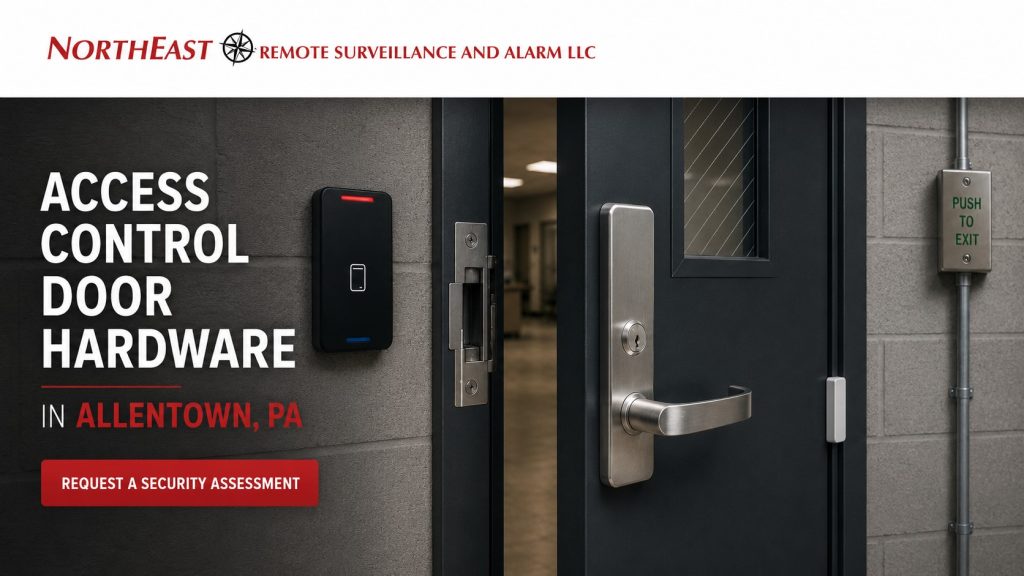
Access Control Door Hardware in Allentown, PA

Access control door hardware in Allentown, PA must do more than release when a card, fob, mobile credential, or PIN is accepted. The physical opening must remain secure when locked, permit required exit, withstand daily traffic, report useful door activity, and return to a secure condition after every authorized entry.

Northeast Remote Surveillance and Alarm, LLC plans, installs, upgrades, expands, and evaluates access control door hardware for commercial and industrial properties throughout Allentown and the surrounding Lehigh Valley. Applications include employee entrances, office suites, warehouse personnel doors, manufacturing areas, tenant entrances, restricted rooms, healthcare spaces, municipal facilities, institutional buildings, and other non-residential openings.

For complete controlled-door planning involving credentials, readers, controllers, permissions, schedules, monitoring, programming, and system administration, visit Commercial Door Access Control Systems in Allentown, PA.

This page focuses specifically on the physical equipment installed at or supporting the door: electric strikes, electrified trim, electrified locksets, exit-device hardware, magnetic locks where appropriate, request-to-exit devices, door-position contacts, power transfer, access-control power supplies, release interfaces, and opening-specific installation requirements.

Commercial and Industrial Properties Only • New Installations • Existing-Door Retrofits • Hardware Corrections • System Takeovers • Single Door Through Enterprise

Access control door hardware in Allentown PA showing electric strike, card reader, electrified trim, request-to-exit device, and commercial security planning by Northeast Remote Surveillance and Alarm LLC.

The Door Is the Final Security Device

A credential reader determines whether a person is authorized. The door hardware performs the actual locking and releasing operation.

A controlled opening may include:

  • Electric strike, electrified trim, electrified lockset, or other approved locking hardware
  • Existing mortise lock, cylindrical lock, or exit device
  • Door-position contact
  • Request-to-exit device
  • Electrified hinge, concealed power transfer, or protected door loop
  • Access-control power supply
  • Backup battery
  • Lock-control relay
  • Fire alarm or emergency-release interface where required
  • Automatic operator or accessible-entry equipment
  • Reader and controller connections
  • Protected and labeled wiring
  • Door closer and coordinated latching hardware

Each component affects the others. A properly programmed controller cannot correct a door that fails to close. A strong electric strike cannot overcome severe latch misalignment. A capable reader cannot confirm that the opening returned to a secure condition unless door monitoring is installed and functioning.

Reliable access control begins with the complete physical opening—not with the reader alone.

Commercial Openings That May Require Electrified Hardware

Allentown commercial and industrial facilities may need access control hardware at:

  • Main employee entrances
  • Rear and side employee doors
  • Office and tenant-suite entrances
  • Shared commercial-building entrances
  • Warehouse personnel doors
  • Office-to-warehouse transition doors
  • Shipping and receiving offices
  • Manufacturing and production entrances
  • Service and contractor entrances
  • Management offices
  • IT and telecommunications rooms
  • Inventory and records rooms
  • Tool and equipment storage areas
  • Medication and supply rooms
  • Mechanical and electrical rooms
  • Stairwell doors
  • Restricted interior spaces
  • After-hours entrances

These openings do not all require the same hardware. A lightly used interior office door may need a different solution from a high-cycle warehouse entrance, exterior manufacturing door, fire-rated stairwell opening, public-facing medical entrance, or door equipped with panic hardware.

The correct selection depends on the complete opening and its intended operation.

Evaluating the Existing Door and Frame

Before electrified hardware is selected, the physical opening should be inspected.

The review may include:

  • Door material and construction
  • Frame material and condition
  • Existing lock and latch
  • Mortise, cylindrical, or rim-exit hardware
  • Panic or fire-exit hardware
  • Door handing and swing
  • Door and frame alignment
  • Hinge condition
  • Closer condition and adjustment
  • Latch engagement
  • Fire-rating labels
  • Exterior exposure
  • Weather stripping and thresholds
  • Traffic volume
  • Required emergency exit
  • Accessible-entry operation
  • Automatic door operators
  • Available wiring pathways
  • Power-transfer options
  • Reader placement
  • Door-position monitoring
  • Required release operation

A door that drags, sags, slams, rebounds, binds, fails to latch, or requires excessive force should not simply receive electronic hardware and be considered complete. Existing mechanical problems can create unreliable locking, repeated door-held-open events, premature hardware wear, damaged wiring, employee complaints, and unnecessary service calls.

Where an opening requires structural repair, specialized fire-door work, extensive mechanical correction, or other work outside the access-control scope, that condition should be identified and coordinated with the appropriate door or hardware professional.

Electric Strikes for Commercial Doors

An electric strike is installed in the door frame and releases the latch when access is authorized. It can often work with an existing cylindrical or mortise lock while preserving normal mechanical exit from the secure side.

Electric strikes are commonly considered for:

  • Office entrances
  • Employee doors
  • Tenant-suite entrances
  • Interior restricted rooms
  • Warehouse personnel doors
  • Service entrances
  • Doors using compatible latch hardware
  • Selected doors equipped with rim exit devices

The strike must match the existing lock, latch, frame, door function, traffic, security level, and required operation.

Planning should consider:

  • Frame preparation
  • Latch dimensions
  • Keeper depth
  • Door preload
  • Latch alignment
  • Fail-safe or fail-secure operation
  • Fire-rated conditions
  • Exterior exposure
  • Holding strength
  • Monitoring options
  • Available power
  • Required listing or hardware compatibility

An electric strike should not be selected simply because it is familiar or easy to purchase. A strike that does not match the latch or frame can create weak engagement, excessive movement, binding, noisy operation, failed release, or an opening that appears locked without being properly secured.

Electric Strikes and Door Preload

Door preload occurs when pressure is placed against the latch or strike before the door is released. Weather seals, building pressure, door alignment, closer adjustment, people pulling on the door, or an improperly fitted strike can increase preload.

Excessive preload may prevent a strike from releasing even when the access-control system has correctly granted entry.

A proper evaluation considers:

  • Whether the door sits naturally in the frame
  • Whether the latch binds
  • Whether weather stripping pushes against the door
  • Whether air pressure affects operation
  • Whether the closer pulls the door fully into the frame
  • Whether the selected strike is suitable for the opening

Correcting the source of the preload is usually more dependable than increasing unlock time or repeatedly replacing electronic components.

Electrified Trim and Exit-Device Hardware

Many commercial doors use panic hardware or an exit device rather than a standard cylindrical lock. On these openings, electrified trim may control the outside lever while the interior push pad continues to provide normal exit.

Electrified trim may be appropriate for:

  • Exterior employee entrances
  • Warehouse personnel doors
  • Manufacturing entrances
  • School or institutional doors
  • Municipal buildings
  • High-traffic commercial openings
  • Doors already equipped with compatible exit devices

The specific trim must be compatible with the installed exit device. The design should account for the manufacturer, model, mechanical condition, fire-rating requirements, power requirements, and how power will be transferred into the moving door.

Electrified trim can provide a clean, durable solution because the locking function is integrated with the door hardware rather than relying entirely on a frame-mounted release. However, it normally requires power through the door and careful coordination with the existing exit device.

Panic Hardware Is Not Interchangeable

Exit devices vary by manufacturer, model, age, door type, function, and rating. Electrified trim, latch retraction, monitoring switches, and replacement components are not universally interchangeable.

Before existing panic hardware is reused, the opening should be reviewed for:

  • Manufacturer and model
  • Current mechanical condition
  • Available electrification options
  • Trim compatibility
  • Fire-exit designation
  • Door width and construction
  • Power requirements
  • Wire-transfer method
  • Request-to-exit monitoring
  • Required release behavior
  • Replacement-part availability

Older, damaged, unsupported, or heavily worn exit devices may require additional correction before electronic access is added.

Electrified Locksets

An electrified lockset places the controlled locking function within the lock itself. Depending on the lock design, authorization may control the outside lever while preserving unrestricted exit from the inside.

Electrified locksets may be considered for:

  • Office doors
  • Restricted interior rooms
  • Management areas
  • Records rooms
  • Medical or supply rooms
  • Selected tenant entrances
  • Openings where an integrated hardware appearance is preferred

Because the locking component is located in the moving door, an appropriate power-transfer method is required. The lock function, door construction, fire rating, traffic, available cable pathway, and long-term service requirements should be evaluated before selection.

An electrified lockset should not be confused with a consumer smart lock. Commercial access control requires supportable hardware, appropriate system interfaces, managed power, protected wiring, dependable egress, and compatibility with the facility’s access-control platform.

Magnetic Locks Where Appropriate

A magnetic lock uses an electromagnet and armature plate to secure an opening while power is applied. Magnetic locks can provide strong holding force and have fewer moving locking components than some mechanical arrangements, but they require careful release and egress planning.

A magnetic lock should not be treated as the automatic answer whenever an electric strike is difficult to install.

Depending on the opening and required operation, planning may involve:

  • Request-to-exit sensing
  • Manual release devices
  • Emergency release
  • Fire alarm interaction
  • Door-position monitoring
  • Lock-status monitoring
  • Power-supply supervision
  • Accessible operation
  • Signage or operating instructions
  • Required inspection and approval
  • Safe behavior during power loss

Magnetic locks are fail-safe devices because removing power releases the magnetic bond. Whether that behavior is appropriate depends on the opening, building operation, security requirement, and applicable conditions.

Where a conventional latching solution can provide dependable security and safe exit, it may be preferable to adding the additional release devices and coordination associated with a magnetic lock.

Fail-Safe and Fail-Secure Operation

Fail-safe and fail-secure describe how electrified locking hardware behaves when power is removed.

Fail-safe hardware releases or unlocks when power is removed.

Fail-secure hardware remains secure from the controlled side when power is removed, while the opening must still preserve required exit through the appropriate mechanical hardware.

The correct operation depends on:

  • Door purpose
  • Locking method
  • Egress arrangement
  • Fire-rated conditions
  • Security requirements
  • Emergency-release requirements
  • Fire alarm coordination
  • Building use
  • Owner and project requirements
  • Applicable approval or inspection conditions

Fail-safe does not automatically mean safer, and fail-secure does not mean people are trapped inside. The terms describe the powered locking function and must be considered together with the complete door and exit arrangement.

Request-to-Exit Devices

A request-to-exit device helps the access-control system recognize or permit authorized exit.

Depending on the opening, request-to-exit operation may use:

  • Exit-device monitoring
  • Lock-integrated switches
  • Lever or handle contacts
  • Motion-based request-to-exit sensors
  • Push-to-exit buttons
  • Touch-sensitive release devices
  • Other approved releasing arrangements

The request-to-exit function may be used to:

  • Shunt a forced-door event during normal exit
  • Signal that a person is leaving
  • Release selected fail-safe locking hardware
  • Coordinate door timing
  • Support event reporting
  • Distinguish normal exit from unauthorized opening

A motion sensor should not be installed casually without considering the field of view, door swing, nearby movement, air currents, ceiling height, pedestrian traffic, and whether unintended motion could release the door.

Push-to-exit devices should be positioned and selected around the opening’s intended use and required operation. The device should not be hidden, confusing, or placed where normal facility activity makes it difficult to use.

Door-Position Contacts and Door Monitoring

A door-position contact reports whether the door is physically open or closed. It does not necessarily confirm that the latch is engaged or that an electric lock has achieved secure status.

Door-position monitoring can help identify:

  • Door opened after valid access
  • Door closed after entry
  • Door forced open
  • Door held open beyond the permitted period
  • Door that failed to return to the closed position
  • Repeated propping or operational misuse

A complete event sequence may include:

  1. Credential accepted
  2. Lock released
  3. Door opened
  4. Request-to-exit or authorized passage recognized
  5. Door closed
  6. Opening returned to its normal secure state

Without door-position monitoring, the system may know that access was granted but not whether the person entered, whether the door remained open, or whether it closed afterward.

Door Position Is Not Lock Status

A closed-door contact does not prove that every locking component is fully engaged. Certain openings may benefit from additional lock, latch, bolt, exit-device, or magnetic-bond monitoring when compatible equipment and project requirements justify it.

Monitoring should be selected because the information will be used—not simply because another input is available.

Power Transfer Into the Door

Electrified trim, electrified locksets, latch-retraction devices, and door-mounted monitoring may require wiring to pass from the stationary frame into the moving door.

Common power-transfer methods include:

  • Electrified hinges
  • Concealed power-transfer devices
  • Protected armored door loops
  • Manufacturer-specific transfer components

Selection should consider:

  • Door and frame construction
  • Cable quantity and conductor size
  • Current requirements
  • Traffic volume
  • Fire-rated conditions
  • Appearance
  • Exposure to damage
  • Door swing
  • Existing hinge preparation
  • Future serviceability

An exposed door loop may be practical for selected applications, but it can be vulnerable to impact, snagging, tampering, or repeated flexing. High-cycle and public-facing doors may benefit from a more protected transfer method when the opening supports it.

Wiring should not be pinched, stretched, scraped, routed across sharp metal, or left unsupported inside the frame or door.

Access-Control Power Supplies and Backup Power

Electrified door hardware requires properly planned power.

The design may need to account for:

  • Device voltage
  • Lock current
  • Initial inrush current
  • Holding current
  • Number of connected doors
  • Simultaneous release
  • Cable distance
  • Voltage drop
  • Battery capacity
  • Fire alarm or emergency-release interfaces
  • Output protection
  • Lock-control relays
  • Enclosure size
  • Future expansion

A supply that appears adequate based only on the number of doors may still be undersized if it does not account for inrush current, long cable runs, latch-retraction devices, automatic operators, or simultaneous operation.

Each output should be protected and organized so a fault at one opening does not unnecessarily disable unrelated doors. Power supplies, batteries, relays, and termination points should be mounted in serviceable locations and labeled for future testing.

Backup power should be selected around the required operating objective. Battery capacity, lock behavior during power loss, controller operation, communication, and emergency-release requirements must be considered together.

Door Closers, Latching, and Secure Relatching

An access-controlled door is not secure merely because the software displays a locked status. The physical opening must close and latch after each use.

Recurring problems may be caused by:

  • Worn hinges
  • Loose hinge screws
  • Door or frame misalignment
  • Weak or leaking closers
  • Incorrect closer adjustment
  • Latch binding
  • Damaged panic hardware
  • Improper strike position
  • Weather stripping
  • Threshold interference
  • Building air pressure
  • Warped doors
  • Debris in the opening
  • Employees propping the door open

High-traffic doors should be tested through repeated operating cycles. A door that works once during installation may still fail during shift changes, high wind, temperature changes, deliveries, or periods of heavy traffic.

The objective is not simply to produce an unlock signal. The objective is a door that releases when authorized, opens normally, closes consistently, and relatches securely.

Fire-Rated Openings, Emergency Exit, and Accessible Entry

Access-control hardware can affect emergency egress, fire-rated door assemblies, fire alarm interaction, accessible routes, automatic operators, stairwell conditions, and inspection-sensitive openings.

Security should not be added in a way that interferes with:

  • Required exit
  • Fire-door closing and latching
  • Panic or fire-exit hardware
  • Emergency release
  • Fire alarm operation
  • Accessible building entry
  • Automatic operator sequencing
  • Required door clearances
  • Approved opening function

Projects involving fire-rated doors, magnetic locks, automatic operators, stairwell doors, delayed release, emergency interfaces, or significant hardware changes may require additional coordination.

For broader planning around egress, accessibility, fire alarm interaction, documentation, and inspection-sensitive security conditions, visit Compliance-Aware Security Planning in Allentown, PA.

Final hardware selection and door operation should be coordinated with the property owner, project team, appropriate design professionals, door-hardware representatives, fire alarm contractor, electrical contractor, and authorities responsible for the property when the scope requires their involvement.

Automatic Door Operators and Accessible Entrances

A credentialed entrance may also use an automatic door operator, accessible push plate, intercom release, or other entry-assistance equipment.

The sequence may need to:

  1. Confirm authorization
  2. Release the locking hardware
  3. Allow sufficient time for the lock to disengage
  4. Activate the automatic operator
  5. Monitor the door movement
  6. Allow the door to close
  7. Confirm that the opening returned to a secure condition

Incorrect sequencing can cause the operator to pull against a locked door, create delayed entry, damage hardware, or leave the opening unsecured.

Planning should consider:

  • Lock-release timing
  • Operator activation
  • Door-position feedback
  • Accessible controls
  • Safety sensors
  • Closing force
  • Weather and wind exposure
  • Power requirements
  • Emergency operation
  • Normal manual use

The operator, access-control system, locking hardware, closer, and safety devices should be treated as one coordinated opening.

Warehouse and Manufacturing Door Hardware

Warehouse and manufacturing entrances often experience conditions that are different from a typical interior office door.

Potential factors include:

  • High daily cycle counts
  • Shift-change traffic
  • Exterior temperature changes
  • Dust and debris
  • Rough handling
  • Cart and equipment movement
  • Delivery activity
  • Doors near loading areas
  • Large employee populations
  • Temporary labor
  • Contractor access
  • Repeated credential changes
  • Office-to-production separation
  • Restricted inventory or tool areas

Hardware should be selected for the actual traffic and environment. The opening should also be positioned and protected so readers, door loops, contacts, and request-to-exit devices are not repeatedly damaged by carts, pallets, equipment, or normal warehouse activity.

Employee entrances should be tested under realistic traffic conditions rather than only during a quiet commissioning period.

Office, Tenant, Healthcare, and Institutional Doors

Public-facing and multi-user facilities may place greater emphasis on appearance, quiet operation, accessible entry, tenant separation, administrator responsibility, and predictable visitor movement.

Planning may include:

  • Shared exterior entrances
  • Individual tenant suites
  • Staff-only doors
  • Records or medication rooms
  • IT and telecommunications rooms
  • Management offices
  • Common-area doors
  • Stairwell openings
  • Public-to-private transition points
  • After-hours entrances

The hardware should support security without making routine entry confusing for employees, tenants, visitors, patients, vendors, or authorized service personnel.

Existing-Door Retrofits and System Takeovers

Access control can often be added to an existing commercial door, but reuse should be based on condition and compatibility—not only on reducing initial cost.

An existing opening may need review for:

  • Worn or unsupported hardware
  • Poor latch alignment
  • Damaged frames
  • Weak closers
  • Improvised wiring
  • Unprotected door loops
  • Missing door contacts
  • Unreliable request-to-exit devices
  • Incorrect lock power
  • Undersized power supplies
  • Unlabeled relays
  • Abandoned components
  • Nonfunctional fire alarm interfaces
  • Incomplete documentation
  • Unknown fail-safe or fail-secure behavior

A takeover should identify what can be retained, what needs correction, and what should be replaced. Existing hardware that is compatible, supportable, and operating correctly may be reusable. Proprietary, damaged, insecure, unsupported, or poorly installed equipment may require another approach.

Common Access Control Door Problems

Commercial facilities may request hardware review when they experience:

  • Credential accepted but door does not release
  • Door releases intermittently
  • Electric strike buzzes but remains bound
  • Door closes without latching
  • Door must be pulled or pushed while presenting a credential
  • Repeated forced-door events
  • Repeated held-open events
  • Exit motion releases the door unexpectedly
  • Door loop wiring breaks repeatedly
  • Lock loses power
  • Automatic operator pulls against the lock
  • Panic hardware sticks or fails to reset
  • Exterior door operation changes with weather
  • Door remains unsecured after entry
  • Employees prop the door because normal operation is inconvenient
  • Access events appear correct while the physical opening is unreliable

These conditions should be diagnosed at the opening. Replacing a reader, increasing unlock time, or repeatedly resetting the controller may not correct a mechanical, power, alignment, wiring, or release-sequence problem.

NERSA’s Commercial Door Hardware Process

Opening and Operational Review

NERSA reviews the door, frame, lock, latch, closer, exit device, traffic, users, environmental conditions, normal entry, normal exit, emergency operation, and known problems.

Hardware Selection

Electric strikes, electrified trim, electrified locksets, magnetic locks, monitoring devices, request-to-exit equipment, power transfer, and power supplies are selected around the actual opening.

Coordination

Hardware requirements are coordinated with the access-control platform, reader, controller, fire alarm interface, automatic operator, accessible-entry equipment, and other project responsibilities.

Installation

Equipment is installed with protected wiring, supportable terminations, serviceable enclosures, appropriate power, and opening-specific preparation.

Functional Testing

Testing may include:

  • Valid credential entry
  • Invalid credential denial
  • Door release
  • Mechanical exit
  • Request-to-exit operation
  • Door-position reporting
  • Door-held-open event
  • Door-forced event
  • Closing and relatching
  • Power-loss behavior
  • Backup-power operation
  • Automatic operator sequencing
  • Selected emergency interfaces
  • Repeated operating cycles

Documentation and Turnover

Door names, hardware functions, power-supply locations, controller assignments, monitored inputs, release conditions, and relevant equipment information are documented for authorized facility personnel.

Why Allentown Businesses Choose NERSA

Since 2008, Northeast Remote Surveillance and Alarm, LLC has focused on commercial and industrial security systems rather than residential alarm packages or consumer door products.

NERSA evaluates the complete controlled opening, including:

  • Door and frame condition
  • Existing mechanical hardware
  • Electric locking method
  • Exit-device operation
  • Request-to-exit equipment
  • Door-position monitoring
  • Lock or latch monitoring where appropriate
  • Power transfer
  • Power supplies and batteries
  • Reader and controller coordination
  • Fire alarm and emergency interfaces
  • Accessible-entry operation
  • Wiring pathways
  • Documentation
  • Future expansion

NERSA supports:

  • Single-door small-business installations
  • Multi-door commercial buildings
  • Warehouses and distribution facilities
  • Manufacturing properties
  • Offices and tenant buildings
  • Healthcare and institutional properties
  • Municipal facilities
  • Enterprise campuses
  • Multi-building and multi-location organizations
  • New installations
  • Existing-system expansions
  • Hardware corrections
  • System takeovers
  • Phased upgrades

The objective is a reliable and supportable controlled opening that works with the facility’s daily operation—not merely a reader beside a door.

Request Access Control Door Hardware Planning in Allentown, PA

Northeast Remote Surveillance and Alarm, LLC can evaluate employee entrances, warehouse personnel doors, office and tenant openings, manufacturing doors, restricted rooms, exit-device applications, automatic operators, electric strikes, electrified trim, door contacts, request-to-exit devices, power transfer, and access-control power supplies.

Request a Commercial Security Assessment or call 1-888-344-3846 to discuss your Allentown commercial property.

Frequently Asked Questions About Access Control Door Hardware in Allentown, PA

What is access control door hardware?

Access control door hardware is the physical locking, releasing, monitoring, power-transfer, and door-operation equipment used at a controlled commercial opening. It may include electric strikes, electrified trim, electrified locksets, magnetic locks where appropriate, exit-device hardware, request-to-exit devices, door contacts, power-transfer devices, relays, and power supplies.

Is door hardware different from the card reader and controller?

Yes. The reader identifies the credential, and the controller determines whether access should be granted. The door hardware physically locks or releases the opening. Door-position and request-to-exit devices report what happened at the door.

Is an electric strike or electrified trim better?

Neither is automatically better. The correct choice depends on the door, frame, existing lock, exit device, traffic, fire-rated conditions, security requirement, power pathway, egress operation, and long-term maintenance needs.

Can an electric strike be installed on an existing commercial door?

Often, yes. The existing frame, latch, lock, alignment, fire rating, closer, traffic, and wiring pathway should be evaluated before a strike is selected.

Can an existing panic bar be connected to access control?

Sometimes. The manufacturer, model, age, mechanical condition, fire-exit designation, available electrification options, trim compatibility, and power-transfer requirements should be reviewed first.

What is electrified trim?

Electrified trim controls the outside lever or trim associated with compatible exit-device hardware. Authorized users can enter from the outside while the interior push pad preserves the intended exit function.

What is the difference between fail-safe and fail-secure hardware?

Fail-safe hardware unlocks or releases when power is removed. Fail-secure hardware remains secure from the controlled side when power is removed while required mechanical exit must still be preserved. The correct operation depends on the opening and required emergency behavior.

Are magnetic locks appropriate for every access-controlled door?

No. Magnetic locks require careful planning around release devices, emergency operation, fire alarm interaction, power loss, accessible use, and applicable approval conditions. A conventional latching solution may be preferable where it can provide dependable security and safe exit.

What does a request-to-exit device do?

A request-to-exit device helps the system recognize or permit authorized exit. It may shunt a forced-door event, release selected locking hardware, coordinate timing, or document that someone exited normally.

What does a door-position contact monitor?

A door-position contact reports whether the door is open or closed. It can help identify forced openings, doors held open too long, and doors that failed to close after authorized entry.

Does a closed-door contact prove that the door is locked?

Not always. A door contact usually reports door position, not complete latch or lock status. Some openings may require additional monitoring when the project requires confirmation of another hardware condition.

Why does an electric strike sometimes buzz without opening?

Possible causes include door preload, latch binding, frame misalignment, incorrect strike positioning, inadequate voltage, excessive voltage drop, hardware incompatibility, or a mechanical problem with the opening.

Can access control work with an automatic door operator?

Yes, when the operator, locking hardware, access-control system, safety devices, accessible controls, timing, power, and emergency operation are properly coordinated.

Can access control hardware be installed on a fire-rated door?

Possibly, but the door assembly, hardware, required listings, latching, closing, exit function, fire alarm interaction, and applicable approval conditions must be considered before the opening is modified.

Do warehouse doors need different hardware from office doors?

Often, yes. Warehouse and manufacturing doors may experience higher traffic, rougher handling, temperature changes, dust, exterior exposure, delivery activity, and shift-change use. Hardware and wiring protection should be selected around those conditions.

Can NERSA correct an existing access-controlled door that does not work properly?

NERSA can evaluate compatible access-control hardware, power, monitoring, release sequencing, wiring, reader and controller interaction, and opening operation. Mechanical, structural, fire-door, or specialized hardware corrections outside the access-control scope may need coordination with the appropriate trade.

Does NERSA support both small businesses and enterprise properties?

Yes. NERSA supports single-door commercial systems, multi-door buildings, warehouses, manufacturing facilities, institutional properties, enterprise campuses, and multi-location organizations.

Who installs commercial access control door hardware in Allentown, PA?

Northeast Remote Surveillance and Alarm, LLC plans and installs commercial access control door hardware for Allentown offices, warehouses, manufacturing facilities, tenant properties, healthcare sites, municipal buildings, institutional facilities, and other non-residential properties.

Scroll to Top
1-888-344-3846