
Northeast Remote Surveillance and Alarm, LLC (NERSA) provides commercial alarm monitoring services for businesses in Pennsylvania and selected Mid-Atlantic markets.

request a commercial alarm monitoring assessment
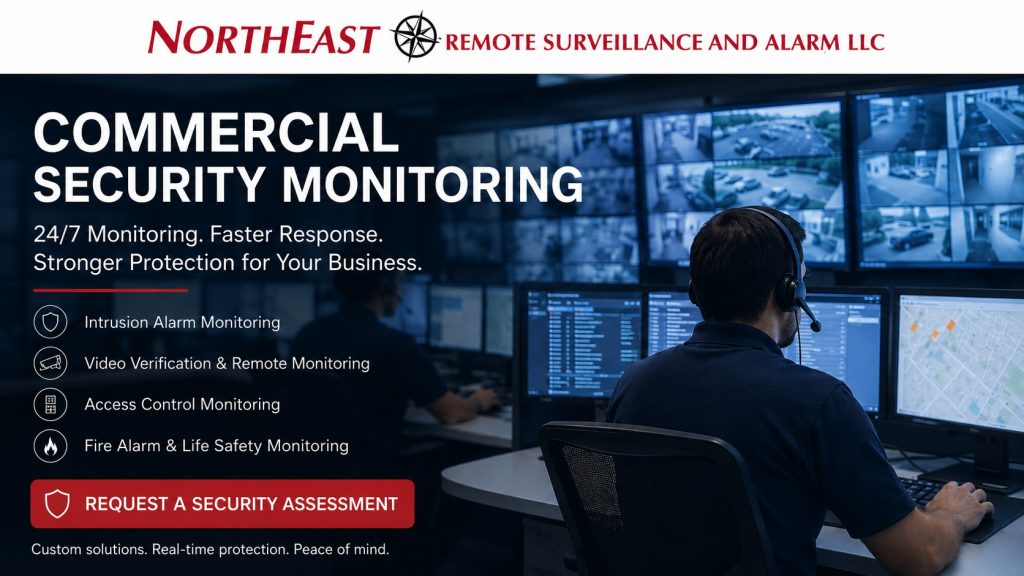
We assess intrusion panels, signal communications, alarm verification, response contacts and existing-system monitoring takeovers. Before a commercial alarm monitoring service starts or changes providers, we review account ownership, communicator compatibility, primary and backup signaling paths, contact and dispatch instructions, and successful end-to-end test signals. The goal is straightforward: when your business sends an alarm, the equipment and monitoring instructions should support an appropriate, documented response.
Commercial alarm monitoring connects a compatible business alarm system to a contracted signal-receiving and response service. The provider follows the account’s specified verification, contacts and escalation process. A phone notification alone does not equal staffed central-station monitoring. NERSA can coordinate professional around-the-clock monitoring where covered by the agreement; live camera observation, video verification and speaker intervention are separate services, not automatic features of every alarm account.
How Business Alarm Monitoring Works
A working monitoring program is more than a siren, keypad or monthly subscription. Each monitored signal must match a defined site, zone and response instruction. The facility’s keyholder list should remain current, and the account should be tested with the receiving service before anyone relies on it.
- Detection. An armed door, glass-break, motion, panic or other supported device reports an alarm or supervised condition. The panel identifies the correct area and event type.
- Transmission. A compatible communicator sends the event through the configured IP, cellular or other approved path. Any backup arrangement and supervision interval should be explicitly documented.
- Verification and contact. The contracted service handles the signal according to account status, priority, site instructions and the included method of verification.
- Escalation and documentation. Authorized contacts or emergency services may be notified as appropriate to the event and agreement. The customer should know how the event record and follow-up are handled.
For a new system, begin with commercial intrusion alarm installation to plan alarm zones, keypad use, communications and acceptance testing alongside the monitoring agreement.
What Commercial Alarm Monitoring Can Cover
Different monitoring functions require different equipment, coverage terms and response responsibilities.
NERSA evaluates the following in a site-specific scope rather than assuming every item belongs in a single package.
- Commercial intrusion monitoring: protected perimeter doors, interior intrusion zones, windows and restricted rooms, with a documented alarm response plan.
- Panic and duress: supported employee-safety devices with clear triggering and emergency procedures, where included.
- System supervision: panel power, battery, communications, tamper and other trouble signals where the installed platform and plan support reporting.
- Opening and closing: supported arm/disarm history, late closing exceptions, scheduling and authorized user management.
- Video verification: compatible footage linked to certain alarms to assist an agreed verification process; it is not full-time camera observation.
- Remote video response: operator review of selected camera activity and potentially live talk-down under a separate arrangement.
- Fire and life safety: a separate regulated service requiring the proper fire-alarm equipment, provider qualifications, documentation, inspection and site-specific requirements.
Commercial Monitoring for Warehouses, Industrial Plants and Offices
For a distribution center, the receiving docks may operate after the office is closed. One set of doors may be used by late-shift employees while another protects stored freight. NERSA reviews overhead doors, pedestrian entrances, yard access and alarm partitions so authorized work and protected spaces can coexist. Zone names and contact instructions should help the responding people understand exactly where an event occurred.
Manufacturing facilities add shift changes, maintenance access, tool rooms, utility spaces and restricted inventory. Offices and managed commercial buildings often need different permissions for tenant suites, shared entrances and after-hours contractors. These details affect how a panel is programmed, when it is armed, and who receives a call—not just how many sensors are installed.
A site’s monitoring plan also needs practical administration. Who is allowed to change user codes? Who responds after a manager leaves the company? How will an alarm be handled during planned renovation or maintenance? A simple account review can prevent contact-list errors from becoming response problems.
Alarm Communicators, IP, Cellular and Reliability
An alarm is only useful remotely if its intended event reaches the receiving service. NERSA checks the installed panel, communicator and available reporting path, including network, cellular service and power. Some facilities warrant a second reporting path or battery backup; those capabilities must be supported, installed and included rather than presumed.
Compare communication supervision, path-loss reporting, coverage, equipment compatibility and recurring service charges. If the office internet fails, an alarm panel using that connection without an alternate path may not be able to communicate. A proper assessment explains what the actual system will do when primary power or network access is interrupted.
Commissioning includes testing representative alarm, trouble and restoration signals. The receiving service should confirm the correct account, protected site, zone descriptions and contacts before the business depends on monitoring after hours.
Monitoring Takeovers: Keep What Works, Replace What Is Necessary
Changing alarm monitoring providers does not automatically require replacing a functioning security system. For takeovers, NERSA evaluates the existing panel, zones, sensors, communicator, programming credentials, account ownership and receiving-provider compatibility. A locked or unsupported product may require repair or replacement, but that decision should follow an equipment review.
- Document existing equipment. Record panel and communicator models, keypads, alarm partitions, signals, open faults and account information.
- Confirm customer authority. Verify who owns the hardware, programming access, monitoring agreement and service records.
- Determine the transition work. Separate reprogramming, new communication equipment, sensor repairs and optional system upgrades.
- Test the replacement service. Send representative events to the new receiving arrangement and confirm the call list and account details.
- Approve the handover. Keep the current monitoring arrangement active until the replacement has been properly tested and the changeover is agreed.
For existing-system administration, see commercial monitoring setup and account management.
Cameras or access-control equipment may be upgraded in the same overall project, but their installation scope should be itemized separately.
Professional Monitoring, Video Verification and Remote Video: Key Differences
- Self-monitoring: an employee or owner receives a push message and must decide whether and how to respond.
- Professional alarm monitoring: a contracted receiving service handles qualifying intrusion or other supported alarm-panel signals under agreed instructions.
- Video-verified alarm: camera evidence assists with review of a triggered alarm, when the system and contract support that function.
- Remote video monitoring: selected camera events are reviewed by an operator according to configured rules and coverage times.
- Live intervention: a suitably equipped and contracted service may use an onsite IP speaker to communicate during qualifying events.
Simply recording surveillance video does not mean an operator watches it.
NERSA can plan commercial camera systems and recording separately from a monitored alarm response so both the customer and receiving provider understand their roles.
What Should Commercial Alarm Monitoring Cost?
The best comparison is a written scope with separate setup charges and ongoing fees, not a headline monthly number. Price varies with the monitoring functions, panel compatibility, communication path, number of properties, optional video review, service hours and contract requirements.
- Equipment and activation: communicator, panel programming, site labor, testing, licenses and any hardware upgrades.
- Recurring services: monitoring, cellular or IP transmission, optional video response, account administration and support.
- Receiving-center details: the monitoring provider’s actual credentials, redundancy, outage procedures and event-handling process.
- Coverage commitments: which signals are received, the monitoring hours, call order, verification, dispatch and reporting.
- Agreement terms: contract length, renewal, early termination, cancellation, transfer, ownership and customer responsibilities.
Ask a bidder to demonstrate how a representative intrusion alarm and communication trouble event would be handled. Confirm the provider’s claimed certifications with documentation; do not assume NERSA itself operates a monitoring center or that a particular listing automatically applies to every arrangement. Any claimed insurance savings or response time also needs individual verification.
Commercial Alarm Monitoring Communications, Account Ownership and Handover
Professional commercial alarm monitoring is an ongoing signal and response service—not simply an alarm panel or a phone notification. For a manufacturing plant, distribution center, office or professionally managed property, NERSA first separates what is monitored from what is only recorded or locally alerted. A monitoring agreement should identify the covered hours, qualifying event types, account and location identifiers, applicable verification steps, authorized contact hierarchy, escalation instructions, trouble reporting and the party responsible for updating them. Video verification, live remote observation and speaker talk-down require their own defined scope; they are not automatically included with standard intrusion alarm monitoring.
Build signaling reliability into the service transition. NERSA can review panel and communicator compatibility, available IP and cellular reporting paths, supervision, approved backup arrangements, power requirements, signal-test procedures and responsibility for customer network changes. For a warehouse with multiple shifts or a campus with separate buildings, the receiving service needs accurate facility addresses, zone names, partitions and exception instructions. A cellular connection or second communication path is useful only when the chosen equipment, coverage, account and supervision requirements support it. A takeover should verify programming access, service ownership and monitored signals before the former provider is discontinued.
Request proof of the accepted monitoring account.
Before relying on service, witness representative intrusion, trouble and restoration signals under the agreed testing procedure, confirm what the receiving service displays, and review notification and escalation for an unreachable keyholder or an authorized overnight delivery.
Keep contact-change procedures, account numbers, user administration, outstanding limitations, service contacts and test results with the owner’s records.
For changes limited to customer lists and account administration, use the separate commercial monitoring setup and account-management guide; this page remains the primary overview of commercial alarm monitoring services, communications and response.
Practical Alarm Response Tests Before Accepting Service
Instead of comparing brochures alone, ask each monitoring provider to describe the outcome of several realistic events at your own building. These examples expose gaps in equipment setup, response instructions and responsibility before those gaps matter during an actual alarm.
- An intrusion signal at 2 a.m.: which contact is called first, what verification applies and what happens if that person cannot be reached?
- Loss of a reporting path: how is the failure detected, who gets notified and what alternate communication is actually installed?
- An authorized late delivery: can the site safely accommodate a shift change or service call without leaving other protected zones disarmed?
- A former manager still on the account: who owns the contact list and how quickly can access, codes and notification authority be updated?
- More than one property: will the receiving provider see the correct building address, zone name and local keyholder rather than a shared generic account label?
A good handover includes a witnessed signal test and written contact, programming and service details. These are questions to settle in the monitoring agreement and commissioning plan, not promises of a particular response time or emergency outcome.
Documented NERSA Commercial Alarm Project Experience
NERSA’s Midea warehouse managed-alarm project covers 76 overhead doors and 27 personnel doors in the Lehigh Valley.
This documented 103-door scope illustrates the value of carefully identified openings, warehouse operations and account responsibilities.
It is project evidence, not a promise that every building needs the same system, monitoring provider or service package.
One Business Location or a Multi-Site Monitoring Program
A business with several sites needs accurate receiving addresses, named local contacts, consistent reporting and documented exceptions. NERSA can establish common equipment and account-management practices while preserving the different shift patterns, alarm partitions and emergency response instructions at each facility. A multi-site plan should never confuse one property’s zone or keyholder with another’s.
NERSA serves commercial and industrial sites throughout the Lehigh Valley, Reading and Berks County, Northeast Pennsylvania, Harrisburg and Central Pennsylvania, Greater Philadelphia and selected Mid-Atlantic markets.
See Pennsylvania and Mid-Atlantic commercial security systems for regional project planning.
What Happens During a Monitoring Assessment and Handover?
- Review the property: operating hours, entrances, high-value areas, shifts, tenants, current concerns and the people responsible for security.
- Inspect the system: alarm panel, sensors, communicators, programming access, current defects and required signal types.
- Define the response: hours of service, verification, test mode, primary and backup keyholders, escalation and service exclusions.
- Commission: confirm signal transmission, correct account and event names, call-list information and trouble reporting with the receiving service.
- Handover: give authorized staff account instructions, contact-change procedures, service numbers, administrator responsibilities and outstanding limitations.
For larger industrial facilities, a physical plant security assessment can coordinate alarm monitoring with controlled doors, camera coverage and network infrastructure.
These are separate technical decisions that should support one workable facility plan.
Commercial Alarm Monitoring Frequently Asked Questions
Can a commercial burglar alarm be monitored 24/7?
Yes. Professional around-the-clock central-station monitoring is a service option, but verify the actual coverage hours and service obligations in the agreement. A mobile app notification by itself is not a staffed response service.
Can NERSA take over an existing business alarm system?
NERSA can assess the takeover. Whether existing panels, sensors and communicators can remain depends on their condition, programming access, signal compatibility and the receiving provider. An equipment review and controlled activation test come before any reliable transition.
What happens when a business alarm activates?
A compatible panel transmits the event to the configured receiving provider. That provider uses the account’s specified verification and contact instructions, with escalation according to the event, agreement and relevant procedures. Test conditions and false alarms have to be handled as part of that plan.
Does monitoring include somebody watching our cameras?
Not automatically. Intrusion alarm monitoring, video verification and remote video monitoring are different services. Camera recording and phone alerts do not establish that an operator is watching or responding. Confirm any operator review or talk-down coverage in writing.
Can the alarm report if the business internet is unavailable?
That depends on the communicator and installed communication services. Cellular, dual-path or other supported arrangements can be considered; confirm coverage, supervision and backup power rather than assuming the alarm will report during any outage.
Can a warehouse have different alarm zones and employee schedules?
Many commercial panels support partitions, unique user codes and time-based arrangements. NERSA checks the installed panel, staff routines and protected areas before recommending a configuration. The account’s opening, closing and contact procedures must match the actual operation.
Is commercial fire alarm monitoring included?
Fire alarm monitoring is a separate life-safety service with distinct code, installation, inspection and monitoring responsibilities. Do not treat a basic intrusion contract as confirmation that fire alarm requirements are met. The correct scope is determined for the property and jurisdiction.
What information is useful for an alarm monitoring quote?
Provide the address, building type, current provider, panel or communicator models if known, hours, protected doors and areas, keyholder contacts, service concerns and desired changeover. NERSA can identify which additional equipment and account details need confirmation.
How do we compare monitoring contract prices?
Separate one-time takeover or installation charges from recurring monitoring, transmission, license and optional video fees. Compare response procedures, station credentials, contract length, renewal or cancellation rules and what happens when equipment fails.
How often should a commercial monitoring account be reviewed?
Review contacts, zones and instructions when staff, operating hours, tenants or equipment change. Also establish a regular account-review schedule with responsible personnel so obsolete phone numbers and permissions do not remain in place.
Compliance and Project Standards
Monitoring requirements vary by system type, property and authority having jurisdiction. NERSA plans commercial and industrial security work with relevant equipment documentation and testing needs in mind. These educational resources do not independently establish certification, regulatory approval or a guarantee of emergency response.
Related guidance: regulatory and inspection readiness · NERSA project standards · system documentation and testing.
Request a Commercial Alarm Monitoring Assessment
Tell NERSA whether you need a new monitored intrusion system, a takeover of existing alarm equipment, or a coordinated alarm and video response plan. Include the property address, operating hours, current panel details if available and the alarm events you need addressed.
Call 1-888-344-3846 or request a commercial alarm monitoring assessment.
We can review equipment compatibility, monitoring communications, response instructions, installation or takeover work and ongoing service terms before preparing a defined proposal.