Healthcare security planning considers patients, staff, visitors, records, medication areas, equipment and restricted spaces.
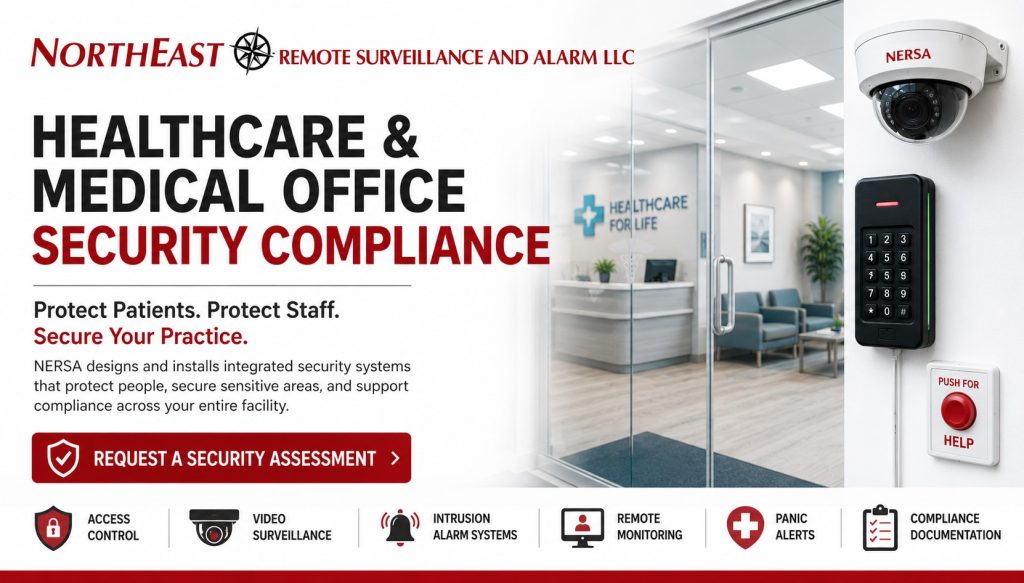
Cameras, access control, alarms and monitoring are parts of that plan.
NERSA supports regulatory compliance and inspection readiness for commercial security systems for medical offices, clinics, outpatient and healthcare support spaces.
We also serve dental, therapy and specialty practices and multi-tenant medical buildings.
This guide covers entrances, staff areas, access control, cameras, alarms, intercoms, cybersecurity, records, life-safety coordination and ongoing service.
Healthcare and Medical Office Security Compliance Planning for Healthcare and Medical Offices
Healthcare properties are different from standard commercial offices. They may include patients, visitors, staff, vendors, delivery drivers, records areas, medication rooms, exam areas, reception spaces, waiting rooms, staff entrances, medical equipment, and sensitive information.
A compliance-aware security plan looks at how the medical office actually operates before selecting cameras, readers, locks, alarm devices, or monitoring services. The plan should consider who enters the building, where patients and visitors are allowed, which rooms are staff-only, how records and equipment are protected, how footage is managed, and how access events are documented.
Security systems do not create HIPAA compliance, OSHA compliance, ADA compliance, fire code compliance, or inspection approval by themselves. They can support better physical security, access accountability, event documentation, emergency response, and long-term system management when they are planned correctly.
Healthcare and medical office security planning may involve:
- Patient entrance video surveillance
- Waiting room and reception area visibility
- Staff entrance access control
- Records room access control
- Medication room or supply room protection
- IT room and network closet protection
- Panic and duress alerts
- Intrusion alarm systems
- Video intercoms
- Visitor entry control
- Door-forced-open alerts
- Door-held-open alerts
- Access schedules and user permissions
- Video retention and evidence export planning
- Fire alarm monitoring coordination
- Environmental monitoring and facility alerts
- Cybersecurity-aware system administration
- Inspection-ready documentation
The goal is a security system that supports the healthcare environment without creating privacy problems, accessibility barriers, egress issues, staff confusion, or documentation gaps.
Healthcare Security Is Not One-Size-Fits-All
A small medical office, dental practice, outpatient clinic, urgent care space, specialty practice, and multi-tenant healthcare building may all require different security planning. A patient entrance is not the same as a staff entrance. A reception camera is not the same as a parking lot camera. A records room door is not the same as a public waiting room door.
NERSA reviews the property, workflow, entrances, restricted spaces, staff access needs, visitor process, camera locations, alarm requirements, and service expectations before recommending a system design.
Healthcare security should support the way the practice operates. It should help protect people and property while keeping the building practical, usable, and manageable.
Patient Entrances, Reception Areas, and Visitor Flow
Patient-facing areas need careful security planning because they are used by people who may not be trained users of the building. Patients, family members, vendors, visitors, and delivery drivers may all enter through the same public-facing area.
Security planning for patient-facing spaces may involve:
- Main entrance cameras
- Reception area visibility
- Waiting room coverage
- Video intercoms
- Controlled interior doors
- Staff-only access points
- Visitor instructions
- Door status monitoring
- Panic or duress buttons
- Remote door release
- After-hours entry procedures
- Parking lot visibility
- Accessible entrance coordination
Camera placement should be intentional. The system should provide useful visibility without placing cameras in privacy-sensitive areas or creating unnecessary exposure.
Access Control for Healthcare and Medical Offices
Access control helps healthcare facilities separate public areas from staff-only areas. Instead of relying only on keys, medical offices can use credentials, schedules, user permissions, and event history to better manage access.
Access control may be useful for:
- Staff entrances
- Reception-to-clinical area doors
- Records rooms
- Medication rooms
- Supply rooms
- IT rooms
- Electrical rooms
- Lab areas
- Employee break areas
- Storage rooms
- Manager offices
- Tenant suites
- After-hours entrances
- Multi-tenant medical building entrances
For complete access control system planning, visit commercial access control systems.
Access control is strongest when users are managed properly. Shared codes, old credentials, unclear schedules, and unremoved former employees can weaken accountability.
Controlled Doors, Egress, and Accessibility
Healthcare access control must be planned around safe exit, emergency release, fire-rated openings, door hardware, visitor usability, and accessibility. A secure door should not create a barrier for lawful use or an issue during emergency exit.
Controlled door planning may involve:
- Card readers
- Keypad readers
- Mobile credentials
- Electric strikes
- Electrified locks
- Door contacts
- Request-to-exit devices
- Emergency release buttons
- Fire alarm interface
- Door position monitoring
- Access control power supplies
- Door release timing
- Automatic operator coordination
- Intercom door release
For egress-specific planning, visit access control egress and life safety compliance.
For accessibility-focused entry planning, visit ADA and Commercial Access Control Planning.
Medical office entrances, patient routes, visitor doors, and staff-only transitions should be planned so the access control system supports both security and building usability.
Records, Medication, Supply, and Restricted Room Protection
Healthcare facilities often have areas that should not be open to every patient, visitor, vendor, or employee. These spaces may require access control, cameras, alarms, or stronger documentation.
Restricted areas may include:
- Medical records rooms
- Billing offices
- IT rooms
- Server closets
- Medication rooms
- Supply rooms
- Lab areas
- Staff-only corridors
- Equipment storage rooms
- Procedure support spaces
- Electrical rooms
- Mechanical rooms
- Manager offices
- After-hours access points
Security systems can help document who entered these areas, when access occurred, whether access was denied, whether a door was forced, and whether related video footage is available for review.
Video Surveillance for Healthcare Properties
Video surveillance can support medical office security by improving visibility around entrances, reception spaces, parking lots, hallways, exterior doors, and staff-only access points. The system should be designed for useful footage and responsible use.
Healthcare video surveillance planning may include:
- Main entrance cameras
- Reception area views
- Waiting room visibility
- Hallway coverage
- Parking lot cameras
- Exterior door cameras
- Staff entrance cameras
- Delivery entrance cameras
- Records room exterior views
- Medication room entrance views
- Multi-tenant hallway views
- After-hours activity review
For permanent camera system design, visit commercial video surveillance systems.
Camera placement should avoid privacy-sensitive areas and should be planned with clear user permissions, retention expectations, and export procedures.
HIPAA-Aware Security System Planning
Healthcare security systems should be planned with privacy and data protection in mind. Cameras, access control software, remote viewing, mobile apps, cloud platforms, user accounts, and exported footage all need responsible administration.
HIPAA-aware security planning may involve:
- User permissions
- Administrator access
- Remote viewing controls
- Video export procedures
- Access control logs
- Staff account management
- Former employee removal
- Vendor administration
- Mobile app access
- Cloud platform review
- Network segmentation
- Password practices
- Incident documentation
- Storage and retention procedures
For cybersecurity planning, visit cybersecurity and data protection standards for commercial security systems.
Security systems should support privacy-conscious operations. NERSA does not provide HIPAA legal compliance certification, but we can help plan security technology in a way that supports better access control, system administration, documentation, and data protection practices.
Panic, Duress, and Workplace Violence Awareness
Healthcare and medical office environments can involve stressful situations, patient disputes, after-hours staffing, reception desk concerns, parking lot issues, and staff safety concerns. Panic and duress options can provide staff with another way to request help when a situation escalates.
Panic and duress planning may support:
- Reception desks
- Billing counters
- Staff work areas
- Nurse stations
- Exam support areas
- Pharmacy or medication areas
- After-hours staff entry
- Parking lot concerns
- High-stress patient-facing spaces
- Silent alert procedures
- Manager notification
- Monitoring response
Panic and duress systems should be planned with clear procedures. Staff should know what the device does, who receives the alert, how the event is handled, and what response is expected.
Intrusion Alarms and After-Hours Protection
Medical offices often need after-hours protection for entrances, records rooms, medication areas, equipment rooms, storage rooms, and multi-tenant spaces. Alarm systems should be designed around the way the practice operates.
Intrusion detection may protect:
- Main entrances
- Staff entrances
- Rear doors
- Suite doors
- Records rooms
- IT rooms
- Medication rooms
- Supply rooms
- Storage rooms
- Hallways
- Interior trap areas
- Multi-tenant entrances
- Detached office areas
For alarm system planning, visit commercial alarm systems.
A medical office alarm system should account for cleaning crews, early staff arrivals, late appointments, vendors, multi-tenant building access, and authorized after-hours use.
Visitor Entry, Intercoms, and Remote Door Release
Medical offices may need controlled entry at main doors, suite doors, back entrances, or restricted interior transitions. Video intercoms can help staff see and speak with visitors before releasing a door.
Intercom and visitor entry planning may include:
- Main entrance intercoms
- Suite entrance intercoms
- Back door communication
- Delivery door communication
- Remote door release
- Reception desk control
- Camera views of the visitor
- Visitor instructions
- Staff call routing
- After-hours access procedures
- Integration with access control
- Integration with video surveillance
Visitor entry should be clear and manageable. A system that is hard for visitors to understand or difficult for staff to operate can create frustration and service issues.
Fire Alarm Monitoring and Life-Safety Coordination
Healthcare and medical office properties may have fire alarm systems, sprinkler monitoring, fire alarm communicators, emergency communication equipment, elevator interfaces, or other life-safety systems that require careful coordination.
Security work may need fire alarm awareness when it involves:
- Fire alarm monitoring changes
- Fire alarm communicator upgrades
- Legacy phone line replacement
- Cellular or IP monitoring paths
- Access-controlled door release
- Maglock release
- Fire alarm interface relays
- Monitoring account changes
- Documentation for inspection
- Testing after system changes
For fire alarm monitoring and inspection support, visit fire alarm monitoring, testing, and inspection.
For AHJ-sensitive projects, visit AHJ coordination for commercial security and fire alarm projects.
Fire alarm communication and access-controlled door changes should be planned, tested, and documented so the facility does not create avoidable trouble conditions, missed signals, or inspection confusion.
Environmental Monitoring and Facility Alerts
Healthcare offices may need alerts for facility conditions that can affect operations, equipment, records, medications, supplies, comfort, or continuity. Environmental monitoring can provide an added notification layer when certain conditions require attention.
Facility alerts may support:
- Temperature monitoring
- Water leak detection
- Power loss alerts
- Equipment room alerts
- Cooler or refrigerator temperature alerts
- Server room alerts
- Sump pump alerts
- Door-left-open alerts
- Communication trouble alerts
- Remote notifications
For facility condition alerts, visit environmental monitoring and facility alerts.
Environmental monitoring does not replace maintenance, clinical procedures, product handling requirements, or facility inspections. It can help notify authorized users when a monitored condition needs attention.
Cybersecurity, Remote Access, and User Administration
Modern healthcare security systems may include cloud video, mobile apps, remote access, access control databases, video management software, network video recorders, intercom platforms, and monitoring accounts. These systems should be administered carefully.
Cybersecurity-aware planning may involve:
- User account controls
- Administrator permissions
- Remote viewing access
- Mobile credential management
- Camera network separation
- Firmware management
- Password practices
- Vendor access control
- Network segmentation
- Audit trails
- Deactivation of former users
- Role-based permissions
Security systems should not create unnecessary technology risk. Cameras, access control platforms, remote monitoring tools, and cloud services should be managed as part of the facility’s broader technology environment.
Video Retention, Export, and Evidence Documentation
Healthcare properties may need footage for incident review, workplace documentation, patient or visitor disputes, parking lot events, theft investigation, staff safety concerns, insurance review, or law enforcement support when appropriate.
Video retention and evidence planning should consider:
- How long footage is retained
- Which cameras are most important
- Who can view footage
- Who can export footage
- How exports are named and stored
- Whether time and date settings are accurate
- Whether managers can locate incidents quickly
- Whether footage quality is sufficient
- Whether privacy-sensitive areas are avoided
- Whether incident review procedures are documented
For evidence-focused planning, visit video surveillance documentation and evidence retention planning.
The best time to plan retention and export procedures is before an incident happens.
Documentation for Inspection and Long-Term Support
Healthcare and medical office security systems are easier to inspect, service, troubleshoot, and upgrade when documentation is clean. Documentation also helps practice managers, facility managers, IT teams, and ownership understand what the system covers and how it is configured.
Useful documentation may include:
- Camera location list
- Camera view descriptions
- Access-controlled door list
- Alarm zone list
- Door hardware notes
- Panic button locations
- Intercom locations
- Panel locations
- Power supply locations
- Network equipment locations
- Monitoring information
- Fire alarm interface notes
- Communication path notes
- User permission structure
- Access schedules
- Video retention settings
- Response procedures
- Testing records
- Service notes
- As-built information when applicable
- Warranty and support details
Documentation should support future service, inspections, tenant changes, ownership changes, renovations, insurance review, and system expansion.
Common Healthcare and Medical Office Security Compliance Problems
Many healthcare security problems happen because equipment is installed without reviewing the full operation.
Common issues include:
- Cameras placed in privacy-sensitive areas
- Poor reception area visibility
- No camera view of public entrances
- Records rooms protected only by keys
- Shared alarm codes
- Former employees not removed from access control
- Unclear user permissions
- No panic or duress procedure
- Intercoms placed where visitors cannot find them
- Access-controlled doors installed without egress review
- Fire alarm communication changes without testing
- Camera systems installed without cybersecurity planning
- No video retention plan
- No evidence export process
- No documentation for controlled doors or alarm zones
- No clear after-hours response instructions
A better plan starts with the movement of patients, staff, visitors, vendors, records, doors, systems, and information across the property.
Related Planning
Coordinate physical security with the facility’s clinical, privacy, safety, and accessibility responsibilities.
- regulatory compliance and inspection readiness for commercial security systems — Review project requirements, documentation and inspection coordination.
- commercial access control systems — Plan controlled entry and permissions for approved users.
- commercial video surveillance systems — Review camera coverage, recording and incident-review needs.
- access control egress and life safety compliance — Coordinate controlled openings with egress and life-safety requirements.
Why Healthcare and Medical Offices Choose Northeast Remote Surveillance and Alarm
Northeast Remote Surveillance and Alarm, LLC designs commercial security systems for medical offices, clinics, healthcare support spaces, specialty practices, and multi-tenant medical buildings where privacy, access, documentation, and dependable support matter.
Our team helps clients evaluate cameras, access control, intrusion alarms, panic buttons, intercoms, monitoring, door hardware, low-voltage infrastructure, network needs, user permissions, video retention, and documentation before the system is installed.
Healthcare and medical offices choose NERSA because we provide:
- Commercial and healthcare security planning experience
- Patient-facing entrance review
- Staff-only area access control
- Camera planning with privacy awareness
- Alarm and panic alert options
- Intercom and visitor entry support
- Fire alarm coordination awareness
- Cybersecurity-aware system administration
- Documentation for service and inspection readiness
- Long-term support after installation
A healthcare security system should help protect the property, support staff, guide visitor access, and provide useful documentation when events need to be reviewed.
Request a Healthcare and Medical Office Security Compliance Assessment
NERSA can help plan security for your medical office, clinic, specialty practice, healthcare support space, or multi-tenant medical building. We review cameras, access control, alarms, panic alerts, intercoms, monitoring, and facility alerts. We can also address fire alarm coordination, cybersecurity, and documentation within the project scope.
Call 1-888-344-3846 or request a security assessment to review your facility, entrances, staff-only areas, patient flow, camera coverage, access-control doors, alarm needs, monitoring procedures, and documentation gaps.
We support healthcare and medical office security compliance planning throughout the Lehigh Valley, Northeastern Pennsylvania, Central Pennsylvania, Greater Philadelphia, New Jersey, Delaware, and the Mid-Atlantic region.
Frequently Asked Questions about Healthcare and Medical Office Security Compliance
Does a security system make a medical office HIPAA compliant?
No. A security system does not make a medical office HIPAA compliant by itself. Cameras, access control, alarms, and monitoring can support physical security, access accountability, and documentation, but they do not replace HIPAA policies, privacy procedures, legal review, staff training, or administrative controls.
How can access control support medical office security?
Access control can help protect staff entrances, records rooms, medication rooms, supply rooms, IT rooms, and restricted clinical support areas. It can also document which users accessed controlled openings and when access occurred.
Where should cameras be placed in a healthcare facility?
Common camera locations include entrances, reception areas, waiting rooms, hallways, parking lots, staff entrances, delivery doors, and exterior areas. Cameras should avoid privacy-sensitive areas and should be planned with clear retention and access permissions.
Can panic buttons be used in medical offices?
Yes. Panic and duress buttons can support reception desks, staff areas, after-hours spaces, and other locations where staff may need a fast way to request help during a security concern.
Can intercoms help with healthcare visitor entry?
Yes. Video intercoms can help staff see and speak with visitors before releasing a controlled door. This can support patient entry, vendor access, delivery doors, and after-hours procedures.
Why does cybersecurity matter for healthcare security systems?
Healthcare security systems may include cloud cameras, mobile apps, access control software, remote viewing, user accounts, and exported footage. Cybersecurity-aware planning helps protect system access, permissions, and remote administration.
Can medical office access control affect ADA or egress requirements?
Yes. Controlled doors, readers, intercoms, automatic operators, maglocks, and door release systems should be planned with accessibility, safe egress, emergency release, and inspection readiness in mind.
Can environmental monitoring support healthcare operations?
Yes. Environmental monitoring can alert authorized users to temperature issues, water leaks, power loss, cooler or refrigerator problems, equipment room conditions, and other facility events that may require attention.
What documentation should be kept for a healthcare security system?
Useful documentation may include camera locations, access-controlled doors, alarm zones, panic button locations, intercom locations, monitoring information, user permissions, video retention settings, response procedures, testing records, and service notes.
What is the best next step for healthcare security compliance planning?
The best next step is a site-specific assessment. NERSA can review entrances, patient flow, staff-only areas, restricted rooms, camera coverage, access-control doors, alarm needs, monitoring procedures, cybersecurity concerns, and documentation requirements before recommending a system design.