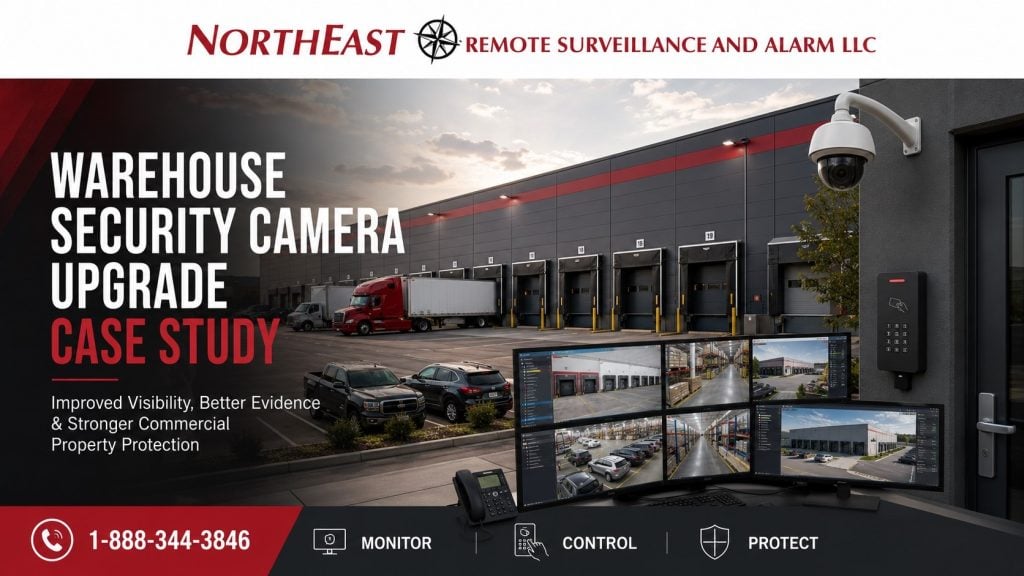
Warehouse Security Camera Upgrade Case Study by Northeast Remote Surveillance and Alarm, LLC shows how a commercial warehouse can improve visibility, incident review, access accountability, and after-hours protection by upgrading an outdated camera system. This case study focuses on the real security planning issues that often appear inside warehouse and logistics facilities: poor camera angles, weak dock visibility, limited parking lot coverage, outdated recording equipment, blind spots around exterior doors, and limited management visibility after an incident occurs. For broader warehouse security planning, visit Lehigh Valley Warehouse Security Systems.
To view our case studies hub to review more information on services that pertain to your organization.
Case Study Overview
A warehouse security camera upgrade is usually needed when an existing system still “works” but no longer gives management the evidence, visibility, or reliability required to protect the property.
In this case study, the facility needed better camera coverage across dock doors, warehouse entrances, parking areas, shipping and receiving activity, and exterior approach points. The existing system had cameras in place, but the views were not strong enough to support modern warehouse operations, after-hours review, employee accountability, or incident documentation.
Northeast Remote Surveillance and Alarm, LLC designed the upgrade around how the warehouse actually operated instead of simply replacing old cameras with new ones in the same weak locations.
For broader commercial video planning, visit Commercial Video Surveillance Systems.
Facility Type
This project was designed for a commercial warehouse environment with a mix of interior operations, loading dock activity, exterior doors, employee access points, parking areas, and after-hours exposure.
Typical areas reviewed during the upgrade included:
- Main warehouse entrances
- Employee entry doors
- Shipping and receiving areas
- Loading dock doors
- Trailer-adjacent areas
- Warehouse aisles
- Inventory zones
- Parking lots
- Exterior building corners
- Office-to-warehouse transition points
- Network and recording equipment locations
The goal was not just to add more cameras. The goal was to improve usable visibility at the locations where incidents, disputes, theft, damage, or access issues were most likely to occur.
The Security Challenge
The warehouse had a camera system, but the existing design created several problems.
Common issues included:
- Cameras placed too high for identification
- Wide views that showed activity but not usable detail
- Limited coverage at dock doors
- Poor visibility around parking and exterior areas
- Weak review of employee entrances
- Limited ability to verify after-hours activity
- Older recording equipment with limited search and export capability
- Inconsistent camera angles caused by building layout changes
- Blind spots around doors, corners, and warehouse transition areas
- Limited ability for management to review events quickly
This is a common problem in warehouse environments. A system can appear complete on a screen, but still fail when management needs to identify a person, confirm a vehicle, review a dock incident, verify a door event, or export video for an investigation.
For dock-specific security planning, visit Loading Dock Security Systems.
Why the Existing Camera Layout Was Not Enough
Warehouse camera systems often fail because the original layout was built around coverage instead of evidence.
A wide-angle camera can show that something happened, but it may not show who was involved, which vehicle entered, which dock door was used, what direction a person came from, or what happened before and after the event.
In this case study, the upgrade focused on improving:
- Identification-level views at key entrances
- Better dock door visibility
- Exterior approach coverage
- Parking lot awareness
- Warehouse interior activity review
- Camera placement based on actual workflow
- Recording reliability
- Easier video search and export
- Better management access to video
The design was built around incident review, not just live viewing.
Upgrade Goals
The camera upgrade was planned around clear operational goals.
The system needed to help management:
- Review activity at loading docks
- See who entered key areas
- Improve visibility around employee entrances
- Monitor exterior doors and building approaches
- Review parking lot activity
- Document incidents involving vehicles, employees, vendors, or deliveries
- Improve video retention and export capability
- Reduce blind spots around high-risk areas
- Support future expansion
- Improve system reliability and remote review
For industrial video design, visit Industrial Video Surveillance Systems.
NERSA’s Design Approach
Northeast Remote Surveillance and Alarm, LLC approached the upgrade as a system redesign, not a simple equipment swap.
The review included:
- Walking the building layout
- Reviewing entrance and exit points
- Identifying dock activity patterns
- Reviewing lighting conditions
- Checking camera mounting heights
- Evaluating existing cable pathways
- Reviewing recorder and network conditions
- Identifying blind spots
- Understanding what management needed to review
- Planning future expansion points
This process helped separate cameras that were useful from cameras that were only giving a general overview.
Camera Placement Strategy
The upgraded camera layout focused on the most important warehouse evidence points.
Dock Door Coverage
Loading docks were treated as a priority because they are high-activity areas where trucks, employees, drivers, staged product, paperwork, and open doors come together.
Dock camera planning included:
- Exterior views of dock approaches
- Interior views of dock activity
- Door-specific visibility where needed
- Trailer-adjacent coverage
- Shipping and receiving support
- Better review of after-hours activity
Employee Entrance Coverage
Employee entrances were reviewed for identification and access accountability. Cameras were positioned to support clear review of people entering and leaving the facility.
These views can help management investigate unauthorized entry, policy issues, after-hours access, workplace incidents, and employee safety concerns.
For access accountability planning, visit Commercial & Industrial Access Control Systems.
Parking Lot and Exterior Coverage
Parking lots and exterior building areas often become weak points in warehouse security. The upgrade reviewed exterior approaches, parking areas, side doors, and building corners to improve visibility around the property.
Parking lot cameras can help support:
- Vehicle incident review
- Employee safety
- Vendor activity review
- After-hours monitoring
- Exterior door activity
- Suspicious vehicle documentation
For vehicle documentation, visit License Plate Recognition Camera Systems.
Interior Warehouse Coverage
Interior warehouse cameras were planned around operations, not just open space.
The system reviewed views for:
- High-value storage areas
- Warehouse aisles
- Staging areas
- Shipping and receiving zones
- Office-to-warehouse transitions
- Restricted areas
- Forklift and pedestrian movement areas
- Incident review points
The goal was to create useful video coverage without overwhelming management with unnecessary views.
Recording, Retention, and Remote Review
A camera system is only useful if recorded video can be found, reviewed, and exported when needed.
The upgrade considered:
- Recording capacity
- Video retention needs
- Camera resolution
- Search capability
- Remote access for authorized users
- Export workflow
- User permissions
- System health monitoring
- Future camera expansion
For many warehouses, retention is not just a technical setting. It affects claims, disputes, HR investigations, safety reviews, insurance documentation, and law enforcement support.
Remote Monitoring and After-Hours Awareness
Warehouses often have after-hours exposure from deliveries, cleaning crews, maintenance vendors, weekend access, parked trailers, exterior doors, and parking areas.
The upgraded system was planned so the facility could better review after-hours activity and support monitoring options if needed.
Remote monitoring may be useful when a property has:
- Repeated trespassing
- Unattended exterior areas
- Trailer or yard exposure
- After-hours deliveries
- Parking lot issues
- Gate or dock activity after closing
- Alarm events that need video verification
For monitored cameras and live deterrence, visit Remote Video Monitoring and Live Talk-Down.
Integration With Access Control and Alarm Events
A warehouse camera upgrade becomes stronger when video can support access control and alarm events.
In many warehouse environments, cameras should be coordinated with:
- Access-controlled employee entrances
- Door position monitoring
- Intrusion alarm events
- Overhead door contacts
- Shipping office access
- Restricted room access
- After-hours alarm signals
- Panic or duress events when required
Video helps management understand what happened. Access control and alarms help show when an event occurred and which door, user, or zone was involved.
For alarm planning, visit Commercial & Industrial Alarm Installation.
Network and Infrastructure Considerations
A warehouse camera upgrade depends on reliable low-voltage infrastructure. Poor cabling, overloaded switches, weak power backup, unlabeled wiring, or unmanaged network equipment can make even a strong camera design unreliable.
Infrastructure planning may include:
- New cable pathways
- PoE switching
- Network rack cleanup
- Patch panel labeling
- UPS backup
- Surge protection
- Fiber or wireless bridge planning where needed
- Camera network segmentation
- Secure remote access
- System documentation
For cabling, PoE switching, fiber, racks, and low-voltage support, visit Commercial & Industrial Infrastructure and Cabling.
Results of the Warehouse Security Camera Upgrade
The upgraded camera system provided stronger visibility across the warehouse and improved management’s ability to review security and operational events.
The upgrade helped improve:
- Loading dock visibility
- Employee entrance review
- Parking lot awareness
- Exterior door coverage
- Warehouse interior visibility
- Incident documentation
- After-hours activity review
- Video search and export
- System reliability
- Future expansion planning
The facility moved from a basic camera layout to a more purposeful security system designed around evidence, accountability, and operational control.
What This Case Study Shows
This case study shows why warehouse camera upgrades should be planned around workflow, risk, and evidence.
A warehouse does not need cameras placed randomly throughout the building. It needs the right views at the right locations, with enough detail to support real investigations and daily management needs.
The best camera upgrade answers practical questions:
- Can management see who entered?
- Can dock activity be reviewed?
- Can parking lot incidents be documented?
- Can after-hours activity be verified?
- Can video be found quickly?
- Can video be exported when needed?
- Are important areas still blind?
- Is the system reliable enough for long-term use?
If the answer is no, the camera system needs to be redesigned, not just replaced.
Related NERSA Case Study and Planning Pages
Use these related NERSA pages for broader planning:
- Commercial & Industrial Security Case Studies
- Lehigh Valley Warehouse Security Systems
- Commercial Video Surveillance Systems
- Industrial Video Surveillance Systems
- Loading Dock Security Systems
- Commercial & Industrial Access Control Systems
- Commercial & Industrial Alarm Installation
- Remote Video Monitoring and Live Talk-Down
- Commercial & Industrial Infrastructure and Cabling
- Request a Commercial Security Assessment
FAQs: Warehouse Security Camera Upgrade Case Study
When should a warehouse upgrade its security camera system?
A warehouse should consider a camera upgrade when existing cameras no longer provide usable evidence, when footage is difficult to review, when dock areas are not clearly visible, when parking lots have blind spots, or when the system cannot support remote viewing, retention, or export needs.
Is replacing old cameras enough?
Not always. Replacing old cameras in the same weak locations can repeat the same mistakes. A proper upgrade should review camera angles, lens selection, mounting height, lighting, retention, network reliability, and the actual incidents management needs to investigate.
What are the most important warehouse camera locations?
Important locations usually include employee entrances, loading docks, shipping and receiving areas, exterior doors, parking lots, truck courts, trailer-adjacent areas, warehouse aisles, restricted rooms, and high-value storage areas.
Should loading docks have their own cameras?
Yes. Loading docks are major risk points because freight, drivers, employees, staged product, and open doors all come together there. Dock cameras help support theft investigations, claims review, delivery disputes, and after-hours activity review.
Can warehouse cameras help with employee accountability?
Yes. Properly placed cameras can help document entry points, warehouse activity, dock operations, parking lot incidents, restricted area access, and operational events. Cameras should be used as part of a broader security and management process.
Can warehouse cameras work with access control?
Yes. Cameras and access control work well together. Access logs show who used a door and when. Video can help management verify what happened at that door.
Can warehouse cameras work with intrusion alarms?
Yes. Video verification can help management or monitoring teams determine whether an alarm event was caused by unauthorized entry, employee activity, vendor activity, a door issue, or a false alarm.
Should warehouse cameras be monitored remotely?
Some warehouses benefit from remote video monitoring, especially when they have exterior exposure, after-hours deliveries, trailer areas, parking lot issues, or repeated trespassing. Remote monitoring works best when cameras, analytics, and response procedures are designed together.
How long should warehouse video be retained?
Retention depends on the facility’s risk, insurance requirements, internal policy, incident review needs, and budget. Many warehouses need enough retention to review delayed claims, HR issues, freight disputes, or after-hours incidents.
Does NERSA install residential camera systems?
No. Northeast Remote Surveillance and Alarm, LLC focuses on commercial, industrial, institutional, logistics, municipal, healthcare, and enterprise security systems. NERSA does not install residential security systems.
Request a Warehouse Security Camera Assessment
If your warehouse camera system is outdated, difficult to review, missing key views, or failing to provide usable evidence, Northeast Remote Surveillance and Alarm, LLC can help design an upgraded system around the way your facility actually operates.
NERSA designs and installs commercial and industrial camera systems for warehouses, distribution centers, logistics facilities, manufacturing buildings, contractor yards, truck courts, and multi-site commercial properties.
To request a site review, visit Request a Commercial Security Assessment or call 1-888-344-3846.