Allentown door hardware access control retrofits are part of NERSA’s Allentown retrofits and services program for commercial and industrial properties that need existing doors, locks, frames, exit devices, readers, credentials, and controlled openings upgraded for modern access control. Northeast Remote Surveillance and Alarm, LLC designs these retrofits around the actual door, frame, lockset, traffic pattern, egress condition, and long-term security goal so businesses can add electric strikes, electrified trim, mobile credentials, card readers, door monitoring, request-to-exit devices, and cleaner controlled entry without replacing every opening. For broader citywide planning, start with Allentown Commercial Security Systems; for the local upgrade path, use Access Control System Upgrades in Allentown, PA; for service-level planning, use Commercial & Industrial Security Services and Commercial & Industrial Access Control Systems.
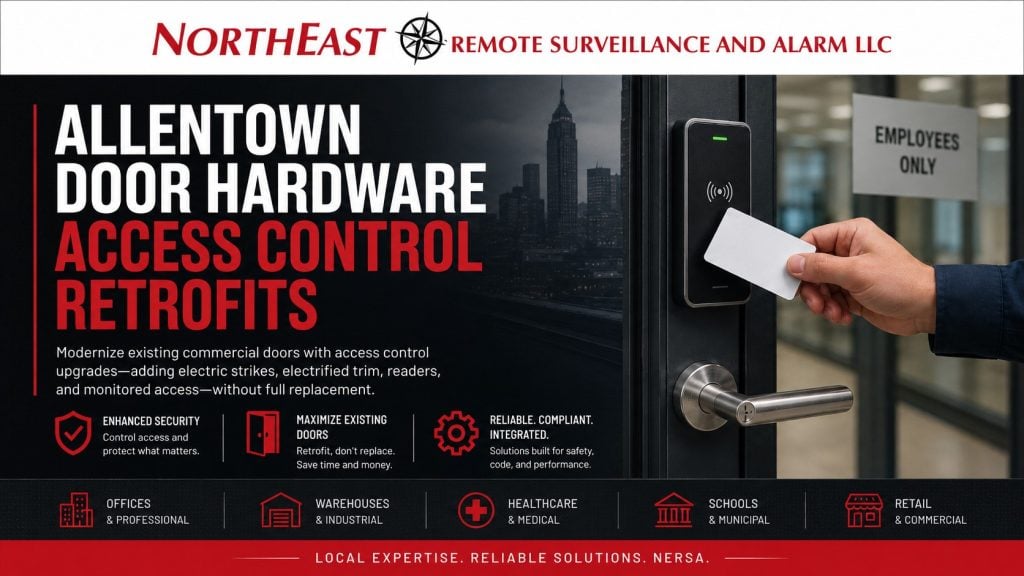
Access Control Retrofits for Existing Commercial Doors in Allentown
Many Allentown businesses already have doors, locks, closers, panic bars, strikes, keys, and mechanical hardware in place. The challenge is turning those existing openings into controlled access points without creating unreliable operation, unsafe egress, poor latch engagement, or unnecessary door replacement.
A proper retrofit starts with the opening, not the reader. The door, frame, latch, exit device, closer, traffic level, fire rating, cabling path, power requirement, and user workflow all affect the correct access control hardware choice.
NERSA helps commercial and industrial properties in Allentown retrofit existing doors for controlled access where it makes sense. That may include employee entrances, office doors, rear service doors, warehouse doors, restricted rooms, IT rooms, records rooms, mechanical rooms, medical staff areas, production-adjacent doors, tenant entrances, and shared commercial openings.
For full access-control planning across credentials, readers, controllers, schedules, user permissions, and door activity, visit Commercial Access Control Systems in Allentown, PA.
What This Page Covers
This page is specifically about retrofitting door hardware so an existing commercial opening can work with an access control system.
It is not the main Allentown access control hub. It is not a general locksmith page. It is not a gate access control page. It is not a broad security upgrade page. It is focused on the physical opening where access control either works correctly or fails.
Use this page when the issue is:
- Adding card access to an existing commercial door
- Retrofitting electric strikes into existing frames
- Converting exit devices for access control
- Adding electrified trim or electrified lever sets
- Correcting poorly matched access control hardware
- Adding door contacts and request-to-exit devices
- Improving unreliable latching or door status monitoring
- Replacing hardware that does not support controlled entry
- Planning access control around egress, fire alarm, and door safety requirements
For broader upgrade planning beyond the door hardware itself, use Access Control System Upgrades in Allentown, PA.
Why Door Hardware Matters in Access Control
Access control is often sold as readers, cards, software, and controllers. In the field, the door hardware is where the system succeeds or fails.
A reader can approve a credential, and a controller can send the correct signal, but the opening still depends on the mechanical and electrified hardware. If the strike is wrong, the latch does not align, the door closer is weak, the exit device is not compatible, the frame is damaged, or the request-to-exit device is poorly selected, the system can become frustrating, unreliable, or unsafe.
A strong access control retrofit should answer practical questions before equipment is installed:
Can the existing door and frame support the hardware?
Will the latch engage correctly after the door closes?
Does the door need an electric strike, electrified trim, electrified lockset, or another solution?
Will occupants still have safe egress?
Does the opening need fire alarm release coordination?
Is the door fire-rated?
Can the hardware support daily traffic?
Can the business monitor whether the door is open, closed, forced, or held?
Can the system be serviced later without rebuilding the opening?
The goal is not just to make the door unlock electronically. The goal is to make the controlled opening dependable, manageable, and appropriate for the building.
Common Door Hardware Retrofit Problems
Many Allentown commercial buildings have existing doors that were never originally planned for electronic access control. That does not mean they cannot be upgraded, but it does mean the hardware should be evaluated carefully.
Common retrofit problems include weak door closers, worn hinges, sagging doors, poor latch alignment, hollow metal frames that need proper preparation, aluminum storefront openings with limited hardware space, panic bars that do not support electrification, fire-rated openings that require extra review, and older locksets that are not a good fit for modern access control.
Other problems are caused by previous installations. A building may have a reader installed but no reliable door position monitoring. A door may unlock but not latch consistently. A system may allow entry but fail to show whether the door was held open. A maglock may have been installed without enough planning around egress and release behavior. A strike may have been cut into a frame without clean hardware coordination.
NERSA looks at the opening as a complete system. The reader, controller, power supply, wiring, electrified hardware, door position switch, request-to-exit device, fire alarm relationship, and mechanical door condition all need to make sense together.
Door Hardware Retrofit Options
Different doors need different retrofit strategies. The right choice depends on the door type, frame type, existing lock, security goal, traffic level, egress requirement, and whether the opening is part of a life-safety path.
Electric Strikes
Electric strikes are commonly used when a business wants to control entry while keeping existing mechanical door hardware in place. The strike is installed in the frame and releases the latch when access is granted.
Electric strikes can be a good fit for many office doors, employee entrances, service doors, interior restricted rooms, and selected storefront applications. They must be matched to the latch, frame, voltage, fail-safe or fail-secure requirement, traffic level, and door function.
A poorly selected or poorly installed electric strike can create latch problems, door rattling, forced-door issues, or unreliable locking. The retrofit should include a door and frame review before the strike is selected.
Electrified Trim
Electrified trim is often used with exit devices when the business wants controlled entry from the outside while preserving free egress from the inside. This can be useful for commercial doors with panic hardware, rear employee doors, warehouse entrances, school support doors, office building entrances, and other openings where exit hardware is already part of the door.
Electrified trim must be selected around the existing exit device, door prep, power transfer method, egress needs, and access control platform. It is not just a cosmetic trim change. The hardware must be compatible with the door, the exit device, the wiring path, and the way the opening is supposed to operate.
Electrified Lever Sets and Locksets
Some openings are better served by an electrified lever set or electrified lockset. This may apply to office doors, restricted rooms, IT closets, records rooms, storage rooms, utility rooms, or interior commercial doors where a complete access-controlled lockset is a cleaner option than cutting a strike into the frame.
The choice depends on door condition, required function, credential workflow, power needs, latch behavior, and whether the door must remain locked, unlocked, scheduled, or controlled during specific business hours.
Exit Device Retrofits
Many commercial and industrial properties have doors with panic bars or exit devices. These openings require extra planning because the door must still support proper exit while allowing access control on the entry side.
A retrofit may include electrified trim, latch retraction in selected applications, door position monitoring, request-to-exit monitoring, power transfer hardware, power supply coordination, and access control integration. Exit-device retrofits should be planned carefully, especially on high-traffic doors, public-facing doors, institutional doors, warehouse personnel doors, and doors tied to emergency egress.
Door Position Switches
A door position switch helps the access control system know whether the door is open or closed. This is important because a credential event only tells part of the story.
Door position monitoring can help identify forced doors, propped doors, held-open doors, doors that failed to close, or doors that need service. This is especially useful at employee entrances, rear doors, warehouse doors, medical staff doors, shared tenant entrances, and restricted rooms.
Request-to-Exit Devices
Request-to-exit devices help the system understand when someone is leaving through a controlled opening. Depending on the opening, this may involve a motion-based REX sensor, request-to-exit button, exit-device switch, electrified hardware monitoring, or another method.
The correct request-to-exit method depends on the door type, hardware, egress path, security goal, nuisance alarm risk, and compliance-sensitive conditions. REX planning should never be treated as an afterthought.
Power Supplies and Backup Power
Access control door hardware requires dependable power. A retrofit may need a dedicated access control power supply, battery backup, fire alarm interface, lock power distribution, fused outputs, supervised wiring, or proper separation from other low-voltage equipment.
Power planning matters because a door that behaves correctly during normal use may behave differently during power loss, fire alarm activation, or equipment failure. NERSA plans lock power, controller power, backup power, and release behavior around the opening and the building conditions.
Retrofit vs Full Door Replacement
Not every access control project requires a new door. Many existing commercial doors can be retrofitted successfully when the door, frame, hinges, closer, latch, and hardware are in serviceable condition.
A retrofit may be the right path when:
The door closes and latches properly.
The frame can accept the correct electrified hardware.
The existing exit device can support access control hardware.
The opening is not damaged beyond practical repair.
The hardware function can support the security goal.
The retrofit can be completed without compromising egress or fire-door requirements.
A full door or frame replacement may need to be considered when the opening is damaged, misaligned, heavily worn, improperly modified, incompatible with the needed hardware, or part of a rated assembly that cannot be modified in the intended way.
The best answer is not always the cheapest hardware. The best answer is the one that creates a reliable controlled opening without creating long-term service problems.
Access Control Retrofits for Allentown Property Types
Warehouses and Logistics Facilities
Warehouse access control retrofits often involve employee entrances, shipping offices, dock-adjacent doors, inventory rooms, tool rooms, IT rooms, maintenance areas, and office-to-warehouse transition points.
These doors may see heavy use, shift changes, temporary labor, vendor movement, and after-hours activity. Door hardware should be selected for durability, clean monitoring, and long-term manageability.
Manufacturing and Industrial Buildings
Manufacturing facilities may need access control at production-adjacent doors, utility rooms, tool storage areas, maintenance spaces, electrical rooms, compressor rooms, employee entrances, contractor doors, and restricted process areas.
The retrofit plan should account for traffic flow, safety-sensitive areas, supervisor permissions, contractor access, and the need to keep operations moving without exposing restricted spaces.
Office Buildings and Professional Properties
Office buildings may need access control at lobby doors, tenant entrances, employee doors, server rooms, records rooms, HR areas, conference suites, and after-hours entrances.
Retrofits should balance security with daily convenience. The hardware should support clean user management, scheduled unlocking where appropriate, after-hours restrictions, and tenant or department-level control.
Healthcare and Medical Office Properties
Medical offices and healthcare support properties may need controlled access for staff-only areas, records rooms, medication or supply areas, employee entrances, IT rooms, and administrative spaces.
Door hardware selection should support controlled access without interfering with patient flow, staff movement, emergency procedures, or privacy-aware operations.
Municipal, Institutional, and School Facilities
Institutional properties may have public entrances, staff doors, administrative areas, storage rooms, mechanical rooms, gyms, meeting spaces, and service entrances that require different access rules.
Door hardware retrofits in these environments should be planned with special attention to egress, public use, staff access, emergency procedures, visitor entry, and long-term maintenance.
Egress, Fire Alarm, and Door Safety Coordination
Access control should improve security without creating unsafe exit conditions. Controlled doors may involve egress requirements, fire alarm release, emergency operation, accessible entry, door hardware listing, fire-rated openings, and authority having jurisdiction review.
This is especially important when the retrofit involves maglocks, delayed egress, stair doors, exit devices, public-facing entrances, healthcare spaces, school buildings, institutional facilities, fire-rated openings, or doors used as part of a required exit path.
For life-safety and egress planning around electrified locking and controlled openings, visit NFPA 101, Door Hardware, and Access Control Egress Compliance.
For fire-rated openings, listed hardware, and rated door assembly concerns, visit NFPA 80 Fire Doors, Opening Protectives, and Door Hardware.
NERSA does not treat access control as a shortcut around safe building operation. Door hardware retrofits should support security, but they also need to respect how the building is supposed to function during normal use, emergency exit, power loss, and fire alarm conditions.
How NERSA Evaluates an Access Control Door Retrofit
A proper retrofit assessment begins at the opening.
NERSA reviews the door type, frame type, existing lock, hinges, closer, latch condition, exit hardware, door swing, user flow, operating schedule, credential plan, available wiring path, controller location, power supply needs, camera coverage, alarm relationship, and compliance-sensitive conditions.
The assessment may include:
Door and frame condition review
Existing hardware identification
Latch and strike alignment review
Exit device compatibility review
Reader placement planning
Door position monitoring options
Request-to-exit method planning
Lock power and backup power review
Controller and cabling path review
Fire alarm or egress coordination concerns
User workflow and schedule planning
Long-term serviceability review
This process helps prevent the common mistake of installing access control equipment on a door that was never properly evaluated.
When a Retrofit Makes the Biggest Difference
Door hardware access control retrofits are especially valuable when a business is trying to move away from uncontrolled keys, improve employee entry management, restrict sensitive areas, document door activity, remove former users quickly, manage after-hours access, or integrate door events with cameras and alarms.
A retrofit can also be part of a larger modernization project. A business may keep serviceable doors and frames while upgrading readers, credentials, controllers, electrified hardware, permissions, schedules, monitoring, and reporting.
For broader access control service planning outside the Allentown market, visit Commercial & Industrial Access Control Systems.
Related NERSA Resources
For the main Allentown access-control planning page, visit Commercial Access Control Systems in Allentown, PA.
For broader citywide commercial security planning, visit Allentown Commercial Security Systems.
For existing-system modernization beyond door hardware, visit Access Control System Upgrades in Allentown, PA.
For regional and service-level access control planning, visit Commercial & Industrial Access Control Systems.
For egress and controlled-opening planning, visit NFPA 101, Door Hardware, and Access Control Egress Compliance.
Request an Allentown Door Hardware Access Control Retrofit Assessment
If your Allentown commercial or industrial property needs existing doors retrofitted for access control, Northeast Remote Surveillance and Alarm, LLC can evaluate the openings and recommend a practical path forward.
NERSA can review existing locks, strikes, exit devices, closers, frames, readers, controllers, credentials, door contacts, request-to-exit devices, power supplies, cabling, fire alarm coordination, and long-term access-control management needs.
Call 1-888-344-3846 or use Request a Commercial Security Assessment to schedule an access control door hardware retrofit review.
Frequently Asked Questions About Allentown Door Hardware Access Control Retrofits
What is a door hardware access control retrofit?
A door hardware access control retrofit upgrades an existing commercial door so it can work with an electronic access control system. This may include electric strikes, electrified trim, electrified locksets, card readers, door position switches, request-to-exit devices, power supplies, and access control integration.
Can existing commercial doors be converted to card access?
Yes, many existing commercial doors can be converted to card access if the door, frame, hardware, latch condition, egress function, and wiring path can support the correct equipment. The opening should be evaluated before hardware is selected.
Do I need to replace every door to add access control?
No. Many projects can reuse serviceable doors and frames while upgrading the hardware, readers, controllers, credentials, and monitoring. Door replacement may be needed when the opening is damaged, incompatible, heavily worn, or not appropriate for the intended access control function.
What is better for a retrofit, an electric strike or electrified trim?
It depends on the door. Electric strikes are often used when the existing latch and frame can support the strike. Electrified trim is often used with exit devices where controlled entry is needed from the outside while free egress remains available from the inside.
Can access control be added to a door with a panic bar?
Yes, access control can often be added to a door with a panic bar or exit device, but the hardware must be compatible. The retrofit may require electrified trim, power transfer, door monitoring, request-to-exit planning, and egress review.
What is a door position switch?
A door position switch lets the access control system know whether the door is open or closed. This helps identify held-open doors, forced doors, doors that did not close properly, and door activity that needs review.
What is a request-to-exit device?
A request-to-exit device helps the system recognize when someone is exiting through a controlled door. Depending on the door, this may involve a motion sensor, push button, exit-device switch, or another approved release or monitoring method.
Can access control door hardware work with cameras?
Yes. Access control door events can often be paired with nearby camera footage so a business can review who used a door and what happened around the opening. This is useful at employee entrances, rear doors, restricted rooms, warehouse doors, and after-hours access points.
Are fire-rated doors different when adding access control?
Yes. Fire-rated openings require additional care because hardware changes, field modifications, latching, closing, and listed components may affect the rated door assembly. Rated openings should be reviewed before access control hardware is added.
Does access control have to allow emergency exit?
Yes. Access control can manage entry, but it should not prevent required egress where the door is part of an exit path. Egress, fire alarm release, power loss behavior, emergency operation, and AHJ expectations should be considered when planning controlled openings.
Who installs commercial access control door hardware in Allentown, PA?
Northeast Remote Surveillance and Alarm, LLC installs and retrofits commercial access control door hardware for Allentown businesses, warehouses, industrial properties, healthcare facilities, offices, institutional buildings, and multi-site commercial facilities.
How do I know if my doors can be retrofitted?
The best way is to schedule a site assessment. NERSA can review the door, frame, lock, exit device, closer, latch condition, cabling path, power needs, egress requirements, and access-control goals to determine whether retrofit, repair, hardware replacement, or full opening replacement is the right path.