
Allentown office building access control manages entry through shared doors, tenant suites, and restricted rooms.

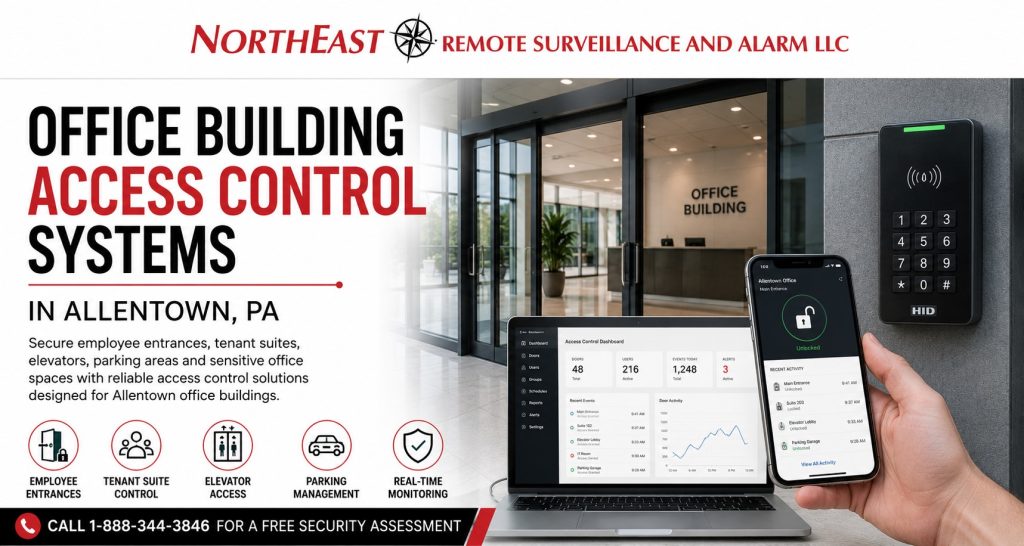
Coordinate tenant, visitor and shared-area needs through Allentown office-building security.
NERSA plans permissions around the people responsible for each part of the property.
Define Shared and Tenant-Controlled Doors
Create a door schedule showing the main entrance, tenant suites, service entrances, and restricted rooms. Identify which openings the property manager controls and which each tenant administers. That boundary should guide both user permissions and service responsibilities.
A person who can enter the building should not automatically receive access to every suite. Document the route each user group needs and the hours that apply. Include cleaners, contractors, and staff who work outside normal office hours.
Plan Office Access Changes
Name the administrator who adds staff, removes departed users, and approves temporary access. Establish how tenant move-ins and move-outs affect shared credentials. Time-limited access should have an owner and a defined end date.
If remote administration is needed, use the cloud-access guide for platform and account considerations. The office-specific decision is who may make changes for each tenant and which shared doors those changes affect.
Test Allentown Office Building Access Control
Review how staff, visitors, and service personnel enter during open and closed periods. Identify the person who handles an unexpected arrival or a door held open. Keep location names consistent so event records and service reports refer to the same opening.
Assess existing hardware and door condition before adding readers. A working permission rule cannot correct a door that fails to release or close. The door-hardware guide covers that physical assessment.
Prepare an Office Access Assessment
Bring the door list, tenant responsibilities, opening hours, and current system details. Include planned leases, renovations, and recurring entry problems.
NERSA can define a practical scope and handover checks for shared access, tenant permissions, schedules, and removal of users. Confirm that the designated administrators can perform those tasks before the project is closed.
Separate landlord-controlled and tenant-controlled doors
In an Allentown multi-tenant office, identify who owns the lobby entrance, stair and service doors, tenant suites, shared conference rooms, parking entry and any elevator access. A landlord should not have to reissue every occupant’s credentials when one tenant moves, and a tenant administrator should not automatically gain authority over another suite. Write the administrator matrix before choosing reader or software products.
Tenant turnover and shared-building schedules
Test new employee enrollment, lost-card deactivation, guest or contractor expiration, late-night entry and tenant move-out. Plan common-door schedules separately from tenant-specific work hours and document who can authorize special events or emergency access. During remodeling, make sure contractors can reach approved work areas without creating permanent bypass credentials. Coordinate security changes with access agreements and building-management policies.
Door, elevator and recovery checklist
- Record the existing door, frame, closer, lock and any rated-opening restrictions.
- Test any elevator or parking credential permissions with the actual interface, not just a vendor compatibility claim.
- Verify that people can exit as required during power, server and network interruptions.
- Demonstrate separate owner, tenant and service-provider permission scopes.
- Handover administrator ownership, tenant rosters, system backups, point names and service procedures.
For existing properties, compare equipment reuse with phased upgrades so a new reader at one suite does not accidentally disrupt the base-building system.
Separate base-building doors from tenant-controlled suites
Office access control begins with a responsibility chart showing the landlord’s lobby doors, stair or garage entrances, elevators, common rooms, tenant-suite doors and shared service spaces. Identify who pays for hardware, who administers each permission set and how a tenant moves out without disabling access for neighboring occupants. A platform can support multiple administrators, but tenant privileges should not give unrestricted visibility or control across the entire building. Document whether separate systems can share credentials without sharing sensitive user records.
Manage office hours, meetings and visitors
Review opening hours, employee arrivals, cleaning schedules, deliveries, evening meetings and visitor check-in. Scheduled unlocks should match staffing and reception coverage; a door left unlocked after the last receptionist leaves may create a gap. An intercom or visitor pass can assist admission, but the person approving release needs a consistent identification process. For coworking and changing tenants, require time-limited permissions and owner-approved group assignments rather than untracked shared PINs.
Coordinate hardware at the real opening
Survey narrow-stile storefront doors, fire-rated corridor doors, stair doors, automatic operators and glass entries separately. Determine whether existing locks, strikes, electrified exit devices, readers and power supplies can be retained. Confirm positive latching, accessible operation and emergency egress under the correct approved sequence. Network and cloud interruptions should be documented by function—cached credentials may work even when remote administration is unavailable. Verify the building’s after-hours mechanical access and emergency responder procedure.
Tenant turnover and handover tests
Before acceptance, demonstrate issuing a staff credential, issuing a visitor pass, limiting a cleaner to defined hours, removing a departing tenant administrator and revoking credentials without interrupting other suites. Check event naming and permissions at common-area entrances. Record building versus tenant ownership of the platform, controller cabinets, backup power, licenses and service accounts. Handover should include a repeatable procedure for the next leasing change, not just a one-time cardholder list.
Related Allentown Services
Review these services to coordinate tenant permissions with building security, remote administration, and the condition of each controlled door.
Office building security systems in Allentown, PA
Commercial access control systems in Allentown, PA
Cloud-based access control systems in Allentown, PA
Access control door hardware in Allentown, PA
Request an Assessment
Discuss your property, existing equipment, and intended operating process with NERSA.
Request a security assessment.
Compliance, Codes & Project Standards
NERSA plans commercial and industrial security work with applicable code, documentation, inspection and authority-having-jurisdiction requirements in mind. Requirements vary by system, property and jurisdiction. These resources support project planning; they do not establish legal compliance, certification or AHJ approval.
Related guidance: Regulatory compliance & inspection readiness · Access control & door hardware standards · NFPA 101 & egress planning · ADA access-control planning