
Allentown biometric access control verifies enrolled users at selected restricted entrances.

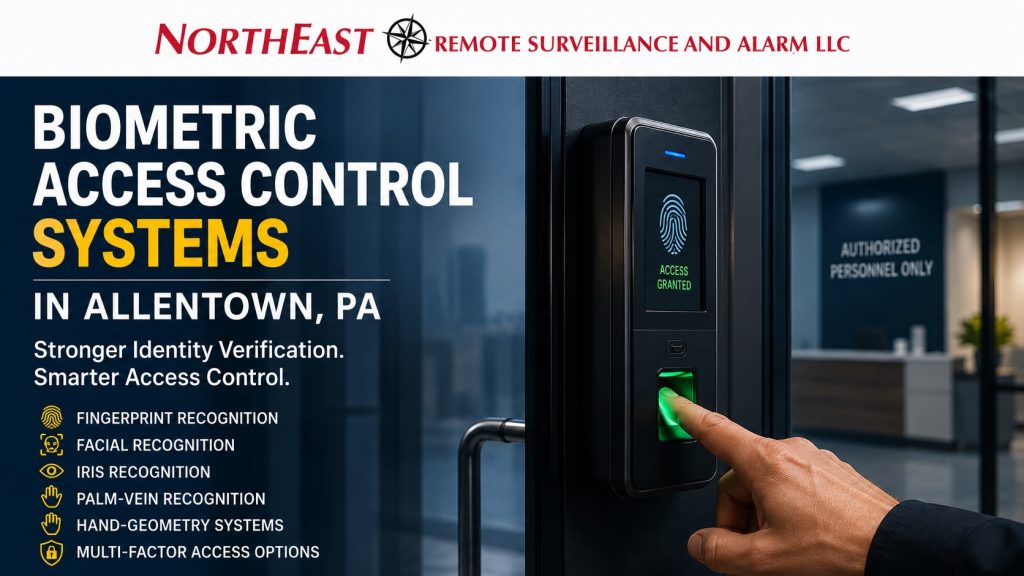
Coordinate doors, permissions and administration with Allentown access control systems.
NERSA evaluates whether the added identity check fits the opening, the people using it, and the organization’s administration process.
Plan Allentown Biometric Access Control
Start with the area that needs stronger identity verification and the problem a shared or transferable credential creates. A biometric reader should serve a defined purpose at that opening. List the user population, expected traffic, and the person responsible for approving enrollment.
Plan Enrollment and Alternate Access
Decide how users are enrolled, who manages their records, and how access is removed when it is no longer needed. The organization should establish its privacy and retention decisions before deployment. Authorized staff also need a practical alternative when a user cannot complete the normal verification process.
Test the selected method with representative users and normal site conditions. Placement, lighting, environmental exposure, and the way people approach the reader can affect day-to-day use. Confirm that the process is workable during the busiest entry periods.
Check the Reader and Door Together
Review compatibility with the installed controller and access platform. Document how the reader’s decision reaches the opening and how authorized staff review an entry event. The physical door must still perform its intended entry and exit functions.
For locks, power transfer, and the physical opening, use the dedicated door-hardware guide. Keeping that work in the opening assessment helps distinguish a recognition problem from a door that fails to release or relatch.
Prepare the Biometric System Handover
Bring the protected-door list, current platform details, user groups, and the reason biometrics are being considered. Include the administrators and organization contacts who will approve the operating process.
NERSA can assess the proposed approach and define acceptance checks for enrollment, authorized entry, denied entry, alternate access, and record administration. Staff should receive clear instructions for daily use and reporting problems.
Biometric suitability and alternatives for commercial workplaces
At an industrial or medical facility, the first decision is whether a biometric identifier solves a problem that secure cards, a supported mobile credential or card-plus-PIN cannot. Facial and fingerprint systems have both false accepts and false rejects; lighting, gloves, dust, skin condition, protective equipment and physical approach can affect performance. A successful demonstration in a showroom is not enough to establish reliable performance at the intended Allentown entrance.
Privacy and credential lifecycle review
Identify which biometric information is captured, whether matching occurs on the device or on a server, who can access templates, how long records remain and how enrollment ends when employment or tenancy changes. Determine applicable privacy, notice and consent requirements with the organization’s advisers. Provide a safe, dignified alternative for people who cannot or do not use the chosen method, and a recovery process for enrollment or device failures.
Acceptance tests before broad enrollment
- Test representative workers in the actual lighting, weather and shift conditions.
- Verify unauthorized, expired and revoked users are denied without confusing an enrollment failure with a hardware fault.
- Confirm anti-spoofing claims against the named device and firmware; do not describe biometrics as impossible to bypass.
- Verify that the controller, lock, reader and required egress work independently of the recognition application when appropriate.
- Document authorized administrators, retention, deletion, fallback access and training.
Begin with the identity-assurance problem
A biometric reader should be specified only after identifying what risk ordinary secure cards or mobile credentials cannot reasonably address. A higher-risk lab may need evidence that the person presenting a credential is the authorized individual, while a standard office entrance may gain little from storing biometric data. Document the claimed performance for the exact equipment, the reader’s liveness or anti-spoof functions, how it works with glasses, masks or gloves, and whether a second factor is required. “Biometric” is a category, not a guarantee against false acceptance or impersonation.
Design a lawful enrollment and fallback process
Establish who approves enrollment, who handles notice and any required consent, where templates are processed or stored, how long they remain, and how they are deleted. Keep sensitive data out of ordinary access reports. Staff with poor fingerprint readability, mobility restrictions, accessibility needs, or a failed reader must have a defined alternate entry process that does not become a permanent uncontrolled bypass. Document what occurs when a staff member transfers roles or leaves the employer; revoke both access privileges and any stored biometric representation according to the approved policy.
Verify the reader as part of the complete opening
Check mounting approach, reach, lighting, environmental exposure, power, communications, controller compatibility, and lock operation. A reader recognizing a face or fingerprint is not proof that the latch released, that access was granted by the right rule, or that the door properly resecured. Validate multiple authorized and unauthorized users with the real working conditions. Report failed enrollments and false rejects without claiming that one short trial establishes a universal error rate.
Commissioning and owner control
Test enrollment, denied identity, expired permissions, lost communications, administrator removal, audit retention, and the approved emergency operation. Confirm the retention and export settings meet the owner’s policy and the provider’s actual capabilities. Require a written service path for hardware replacement and template or account recovery; transferring a site should not depend on one former installer holding the only account. Recheck privacy requirements before moving the system into another facility or using records for a new purpose.
Related Allentown Services
Commercial access control systems in Allentown, PA
Access control door hardware in Allentown, PA
Request an Assessment
Discuss your property, existing equipment, and intended operating process with NERSA.
Request a security assessment.
Compliance, Codes & Project Standards
NERSA plans commercial and industrial security work with applicable code, documentation, inspection and authority-having-jurisdiction requirements in mind. Requirements vary by system, property and jurisdiction. These resources support project planning; they do not establish legal compliance, certification or AHJ approval.
Related guidance: Regulatory compliance & inspection readiness · Access control & door hardware standards · NFPA 101 & egress planning · ADA access-control planning