
Allentown daycare access control supports a supervised entrance process for staff, families, and visitors.

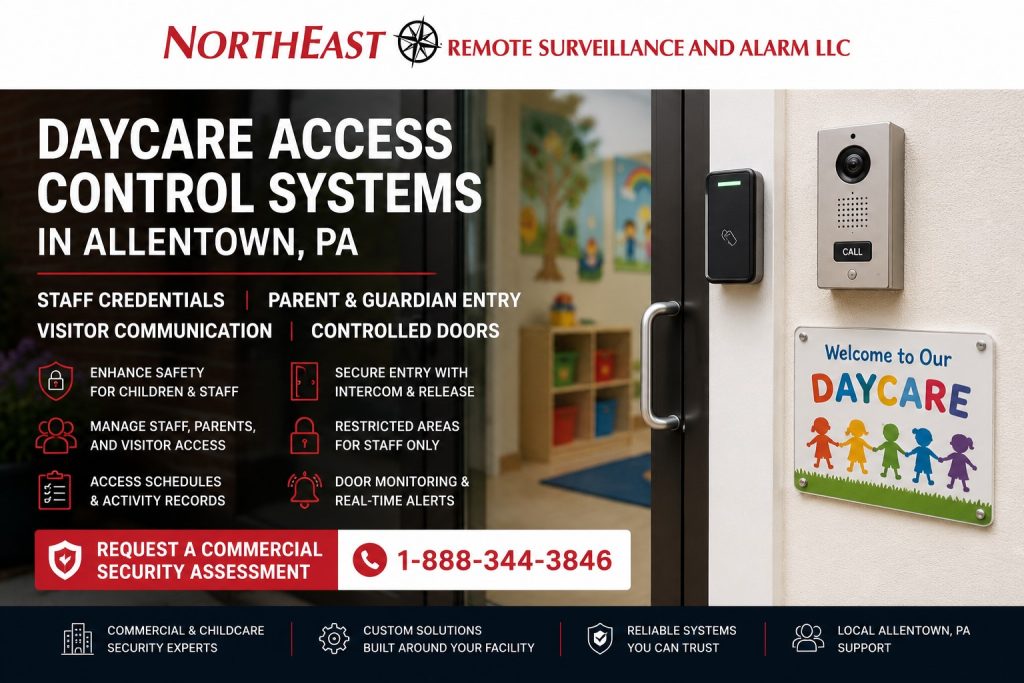
Coordinate doors, permissions and administration with Allentown access control systems.
NERSA plans the system around the facility’s arrival and dismissal procedures and the people responsible for managing access.
Start With the Arrival Procedure
Identify the entrance used during normal arrival and pickup, the staff member supervising it, and the process for unexpected visitors. The facility should define who may enter and how exceptions are handled. A credential identifies an authorized system user; staff still follow the facility’s release and supervision procedures.
Map staff entrances and any interior doors that separate public arrival from other areas. Document the route each group needs so the system supports daily routines without granting unnecessary access.
Manage Users and Temporary Permissions
Assign an administrator to add approved users, remove access, and review changes. Keep staff permissions separate from other approved entry arrangements. Temporary access should have a named approver and an end date.
Review schedules for early opening, late pickup, cleaning, and maintenance visits. Changes to those routines should prompt a review of access permissions and staff instructions. Clear responsibilities are as important as the chosen credential type.
Plan Allentown Daycare Access Control
Use visitor communication when staff need to answer a caller before releasing an entrance. Decide where calls go and what happens if the normal contact is unavailable. The dedicated visitor-entry guide covers those choices.
Evaluate the existing door, closer, lock, and wiring path before selecting electronic hardware. The complete opening must retain its intended entry and exit functions. Include the people responsible for approving the door work in the assessment.
Test the Agreed Routine
Bring the entrance list, operating hours, user groups, current equipment, and written arrival procedures. NERSA can then define a scope around the facility’s actual needs.
Before handover, check approved entry, denied credentials, schedules, communication, and reliable closing. Staff should know who manages access and how to report a fault. Document those responsibilities with the final system records.
Arrival, authorized pickup and staff-only doors
At a daycare or early-childhood facility, front-door access control should support a documented arrival and pickup procedure rather than determine who is allowed to collect a child on its own. Map the reception vestibule, classroom-side door, staff entrance, outdoor play-area gate and deliveries. Establish who checks visitor identity, who approves pickup authorization and how staff respond to an unexpected or disputed arrival. Do not assume a credential event establishes the identity of a visitor without the center’s own verification process.
Access control must preserve safety and accessibility
Choose door hardware and permitted operating sequences based on the applicable occupancy, egress, fire-rating and accessible-entry requirements. Controlled doors should not obstruct required evacuation, and an electronic lock must not replace supervised procedures for children moving between areas. Confirm how the entrance works when staff are busy, a phone or intercom connection fails, or building power is lost.
Daycare commissioning and administration
- Demonstrate normal parent and visitor check-in, denied access and after-hours entry with responsible staff.
- Verify staff permissions, temporary contractor expiration and prompt revocation when employment changes.
- Test door closing, latching and required inside egress with the approved hardware.
- Confirm intercom call routing, reception backup and any authorized remote-release procedure.
- Give the operator clear administrator, privacy, fault reporting and emergency procedures.
Separate staff entrance control from child release procedures
A daycare or early-learning center may need access-controlled staff entrances, visitor vestibules and restricted utility rooms. Those functions are different from verifying the adult authorized to collect a child. A valid door credential or intercom release does not itself prove a pickup authorization. Document who checks identification, how custody or pickup restrictions are kept current, and which staff member authorizes visitor movement. Access technology should support—not replace—the facility’s documented child release and supervision procedures.
Design predictable arrival and pickup flows
Walk the building during opening, morning drop-off, midday deliveries, and closing. Map where families queue, which doors can be opened by parents, who handles deliveries, and how visitors are kept out of staff-only rooms. Avoid designing an entrance that becomes so inconvenient that staff routinely prop the door. Where a receptionist or intercom operator admits people, verify that the camera identifies the visitor under real lighting and that remote release has an audible or visible confirmation.
Keep life-safety, accessibility and daily use in agreement
The controlled entry side of a doorway must be coordinated with the required egress operation, panic hardware where applicable, door closing and latching, accessible entry and any automatic operator. Staff must be able to explain what the system does during power loss, evacuation, emergency services access and fire-alarm conditions. The approved sequence depends on the actual opening and local requirements; new electronic locks do not justify trapping occupants or altering rated door assemblies without appropriate review.
Credential turnover, privacy and acceptance
Use individually assigned staff credentials, scheduled visitor permissions only where appropriate and prompt deactivation after employment changes. Protect student and family information; access logs and video should follow approved retention and viewing limits. Test a staff member arriving before opening, a terminated credential, an unauthorized pickup visitor at reception, and the facility’s actual emergency procedure. Record who maintains accounts, door schedules, reader power and contact monitoring, and who responds when an entrance is held open.
Related Allentown Services
Commercial access control systems in Allentown, PA
Visitor entry and intercom access control in Allentown, PA
Access control door hardware in Allentown, PA
Request an Assessment
Discuss your property, existing equipment, and intended operating process with NERSA.
Request a security assessment.
Compliance, Codes & Project Standards
NERSA plans commercial and industrial security work with applicable code, documentation, inspection and authority-having-jurisdiction requirements in mind. Requirements vary by system, property and jurisdiction. These resources support project planning; they do not establish legal compliance, certification or AHJ approval.
Related guidance: Regulatory compliance & inspection readiness · Access control & door hardware standards · NFPA 101 & egress planning · ADA access-control planning