
Commercial door access and electrified hardware in Reading, PA must be selected around the complete opening—including the door, frame, lock, exit device, hinges, closer, power transfer, wiring, access-control system, required egress operation, and daily traffic through the entrance.
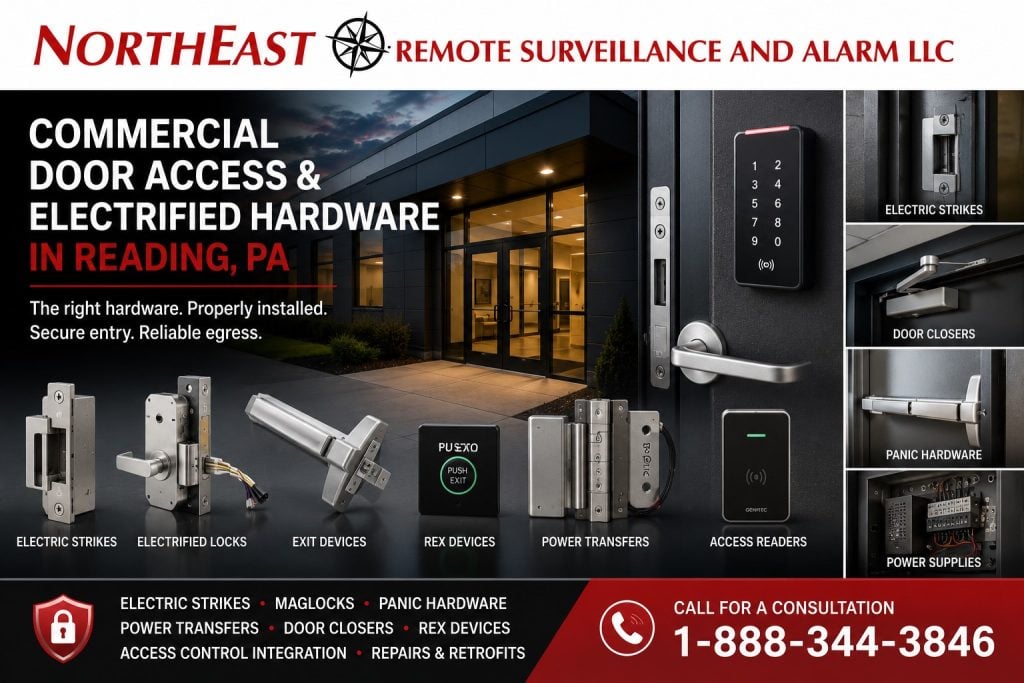
Northeast Remote Surveillance and Alarm, LLC installs and upgrades commercial electrified door hardware for businesses, warehouses, manufacturing plants, offices, schools, healthcare properties, municipal facilities, industrial buildings, and multi-site organizations throughout Reading and Berks County.
For credential management, readers, controllers, schedules, audit records, and complete system planning, visit our commercial access control systems in Reading, PA page.
Call 1-888-344-3846 to schedule a commercial door and electrified-hardware assessment in Reading, Pennsylvania.
The Controlled Opening Must Work as One System
A dependable controlled door requires every mechanical and electronic component to operate together rather than expecting a card reader or electric lock to correct an existing door problem.
A complete opening may include:
- Commercial door and frame
- Hinges or continuous hinge
- Mechanical lockset
- Electric strike
- Electrified mortise or cylindrical lock
- Electrified exit device
- Magnetic lock where appropriate
- Door closer
- Automatic operator
- Power-transfer hinge or door loop
- Access-control reader
- Door-position contact
- Request-to-exit device
- Emergency release hardware
- Access-control panel
- Lock power supply
- Backup batteries
- Intercom release control
- Fire alarm interface where required
- Associated low-voltage wiring
A system can appear to work during a brief credential test while still being unreliable because the door drags, the latch does not align, the closer does not fully secure the opening, the frame moves, or the selected lock is not suited to the existing hardware.
Commercial Door and Frame Assessment
Every project should begin with an opening-by-opening assessment because two doors in the same building can require completely different electrified hardware.
NERSA evaluates:
- Door material
- Frame material
- Door swing
- Handing
- Existing lock type
- Existing exit device
- Latch and strike alignment
- Door and frame condition
- Hinge wear
- Closer operation
- Available frame depth
- Glass and storefront conditions
- Fire-rating labels
- Existing wire pathways
- Power availability
- Required entry method
- Required egress method
- Traffic volume
- Environmental exposure
- Security level
- Accessibility requirements
- Existing access-control equipment
The assessment determines whether the opening can be electrified as it exists, requires mechanical repair, needs different locking hardware, or should be referred for door or frame replacement before electronic equipment is installed.
Electric Strike Installation
Electric strikes provide controlled entry by electrically releasing the latch or exit-device hardware while allowing the existing mechanical lock to continue performing its normal door-securing function.
NERSA installs commercial electric strikes for applications involving:
- Cylindrical locksets
- Mortise locksets
- Rim exit devices
- Selected vertical-rod exit devices
- Aluminum storefront doors
- Hollow-metal frames
- Wood frames
- Office entrances
- Warehouse personnel doors
- Tenant suites
- Shipping offices
- Restricted storage rooms
- Employee entrances
Electric-strike selection must account for the latch type, frame profile, door handing, required voltage, duty rating, preload conditions, monitoring requirements, environmental exposure, fire rating, and intended power-loss behavior.
ANSI/BHMA A156.31 establishes operational and testing requirements for electric strikes and frame-mounted actuators, while actual performance also depends on installation, maintenance, alignment, and environmental conditions. (Builders Hardware)
Fail-Secure Electric Strikes
A fail-secure strike normally remains locked from the entry side when electrical power is lost while the mechanical hardware can still provide the required method of egress from the protected side.
Fail-secure operation may be appropriate for:
- Exterior employee entrances
- Warehouse personnel doors
- Inventory rooms
- Tool cribs
- Office suites
- Server rooms
- Records storage
- Other openings that should remain secured during a power interruption
The exact configuration must be matched to the occupancy, door hardware, fire rating, emergency procedures, and applicable requirements for the opening.
Fail-Safe Electric Strikes
A fail-safe strike unlocks when power is removed and may be selected when the opening’s approved operation requires release during a power failure or another defined condition.
Fail-safe hardware is not automatically the correct choice for every exit or emergency door, and the appropriate power-loss behavior must be determined from the complete opening and applicable requirements.
Electrified Mortise and Cylindrical Locks
Electrified locksets place the powered locking function within the door rather than releasing the latch through equipment mounted in the frame.
These locks may be appropriate for:
- High-traffic employee entrances
- Office corridors
- Healthcare areas
- School administrative spaces
- Manufacturing departments
- Restricted interior rooms
- Openings where frame preparation is limited
- Doors requiring a clean architectural appearance
- Applications where mechanical free egress is desired
Available configurations can include electrically locked or electrically unlocked functions, request-to-exit monitoring, latch-bolt monitoring, door-position monitoring, and compatibility with access-control systems.
Door-mounted electrified hardware generally requires a suitable pathway for power and signal wiring between the stationary frame and moving door.
Electrified Panic and Exit Hardware
Electrified exit devices provide controlled entry while preserving the panic or fire-exit hardware used by occupants leaving the building.
Potential applications include:
- Main commercial entrances
- School exterior doors
- Warehouse employee entrances
- Manufacturing exits
- Municipal buildings
- Assembly spaces
- Healthcare facilities
- High-occupancy commercial properties
- Exterior doors equipped with rim exit devices
- Selected vertical-rod exit-device openings
Electrification options may include:
- Electric latch retraction
- Electric dogging where permitted
- Request-to-exit switches
- Latch-bolt monitoring
- Touch-pad monitoring
- Door-position monitoring
- Remote locking or unlocking
- Access-control release
- Scheduled unlocking
- Lockdown functions where properly designed
The selected exit device and electrification method must remain compatible with the door, frame, occupancy, fire-door requirements, traffic volume, existing hardware, and approved means of egress.
Electric Latch Retraction
Electric latch retraction uses powered hardware to retract the exit-device latch so an authorized opening can be released without relying on a frame-mounted strike.
Latch retraction may be used for:
- High-use building entrances
- Doors connected to automatic operators
- Scheduled daytime unlocking
- School and institutional entrances
- Vestibule doors
- Openings where quiet operation is important
- Doors requiring coordinated access and accessibility operation
These devices can have significant inrush and holding-power requirements, making correct power-supply sizing, wire selection, voltage-drop planning, and manufacturer-compatible controls essential.
Magnetic Lock Applications
Magnetic locks secure an opening by energizing an electromagnet mounted at the door or frame, but their use requires particularly careful planning because the locking force depends on electrical power and the door must release through an approved arrangement.
Magnetic locks may be considered for:
- Selected glass entrances
- Gates
- Specialty openings
- Retrofit conditions where compatible mechanical electrification is impractical
- Controlled interior areas
- Openings specifically designed for electromagnetic locking
A magnetic lock should not be treated as a universal shortcut for a difficult door because the completed installation may require compatible request-to-exit hardware, independent power interruption, emergency release, signage, fire alarm coordination, and other opening-specific measures.
The International Building Code contains separate provisions for sensor-released electrical locking systems and electromagnetically locked egress doors, confirming that the release method and complete opening arrangement—not merely the magnet itself—determine the applicable requirements. (ICC Codes)
Request-to-Exit Devices
Request-to-exit devices tell the access-control system that an authorized person is leaving so the system can release or supervise the door without creating an unnecessary forced-door event.
Available devices may include:
- Exit-device switches
- Lever-handle switches
- Mortise-lock request-to-exit contacts
- Motion-based request-to-exit sensors
- Push-to-exit buttons
- Touch-sensitive release devices
- Emergency release stations
- Automatic-operator activation devices
The correct request-to-exit method depends on the lock type, egress arrangement, occupancy, security risk, door traffic, system design, and applicable requirements.
A motion sensor positioned without considering traffic outside the secure area, nearby hallways, glass reflections, or activity around the door may release the opening unintentionally.
Door-Position and Lock-Status Monitoring
Door and lock monitoring help the system distinguish between an authorized credential event, an open door, a forced opening, a held-open condition, and hardware that failed to secure properly.
Monitoring options can include:
- Recessed door contacts
- Surface door contacts
- Lock-status sensors
- Latch-bolt monitoring
- Magnetic-bond sensors
- Exit-device monitoring
- Request-to-exit status
- Door-held-open timers
- Forced-door alarms
- Local sounders
- Remote notifications
- Camera-event association
Door-position monitoring should be installed and programmed around the opening’s actual travel and operating time so normal employee entry does not generate repeated nuisance events.
Power Supplies and Battery Backup
Electrified door hardware requires a properly sized and supervised power source rather than assuming every lock can be powered directly from the access-control panel.
Power planning should account for:
- Lock operating voltage
- Continuous current
- Activation current
- Latch-retraction inrush current
- Number of connected locks
- Wire length
- Wire gauge
- Voltage drop
- Battery capacity
- Fire alarm release interfaces
- Automatic-operator interfaces
- Lock sequencing
- Power-supply location
- Expansion capacity
- Equipment listings
- Required monitoring
Commercial power supplies may include separate outputs, fire alarm interface terminals, battery charging, lock-control relays, fault reporting, and output supervision.
BHMA maintains separate standards covering electromagnetic locks, electrified locking systems, electric strikes, and power supplies for electronic access control, reflecting the need to treat these components as engineered hardware rather than interchangeable accessories. (Builders Hardware)
Power-Transfer Hinges, Door Loops, and Concealed Wiring
Door-mounted locks and exit devices require a protected method of carrying power and signals from the stationary frame into the moving door.
Common methods include:
- Electrified hinges
- Concealed power-transfer devices
- Surface-mounted armored door loops
- Factory-prepared door cores
- Manufacturer-approved wiring channels
- Existing reusable pathways after inspection
The correct method depends on the door construction, frame condition, fire rating, wire count, current requirements, appearance, hinge configuration, environmental exposure, and ability to service the wiring later.
Loose wire routed across an unprotected hinge side is not an acceptable substitute for a proper commercial power transfer.
Fire-Rated Doors and Listed Openings
Electrifying a labeled fire door requires confirmation that the proposed lock, strike, exit device, power transfer, preparation, and field modification are permitted for that opening.
UL identifies locks, latches, electric strikes, exit hardware, closers, operators, and related components as certified fire-door hardware categories, making product compatibility and the preservation of the listed assembly important parts of the installation. (UL Solutions)
Before modifying a labeled opening, the project should consider:
- Visible door and frame labels
- Existing fire-exit hardware
- Required positive latching
- Manufacturer preparations
- Approved field modifications
- Strike cutout limitations
- Door-core preparation
- Power-transfer compatibility
- Required release operation
- Inspection and approval responsibilities
- Applicable authority requirements
A door should not lose its required function because an installer selected the easiest hardware to fit.
Automatic Door Operator Integration
Compatible automatic door operators can be coordinated with access control so an authorized credential or approved activation device unlocks the opening before the operator begins moving the door.
A coordinated sequence may involve:
- A user presents an approved credential.
- The access-control system authorizes entry.
- The electrified lock releases.
- The automatic operator receives an activation signal.
- The door opens and remains open for the programmed time.
- The door closes, latches, and returns to secure status.
- The access-control system confirms the final door condition.
The sequence must prevent the operator from attempting to move a door that remains mechanically locked.
Aluminum Storefront Door Hardware
Aluminum storefront doors require hardware selected around narrow frames, shallow jambs, glass panels, existing pivots, concealed closers, and limited space for strike preparation.
Potential hardware can include:
- Narrow-stile electric strikes
- Electrified mortise locks
- Electrified Adams Rite-style hardware
- Header-mounted locks
- Concealed door contacts
- Narrow reader mounting
- Storefront-compatible power transfer
- Request-to-exit devices
- Automatic operator coordination
Existing storefront doors frequently require correction of sagging, rubbing, damaged pivots, loose glass framing, worn locks, or poor alignment before dependable access control can be achieved.
Hollow-Metal Door and Frame Hardware
Hollow-metal openings can support a wide range of commercial electrified hardware when the existing frame preparation, reinforcement, hinges, lockset, exit device, and door condition are suitable.
Possible solutions include:
- Mortise electric strikes
- Cylindrical-lock electric strikes
- Rim-exit-device strikes
- Electrified mortise locks
- Electrified cylindrical locks
- Electrified panic hardware
- Concealed door contacts
- Electrified hinges
- Power-transfer devices
- Heavy-duty closers
Field cutting should be accurate and controlled because excessive frame removal, poor reinforcement, exposed wiring, or incorrect strike depth can weaken operation and create alignment problems.
Wood Door Hardware
Commercial wood doors can be electrified through properly selected locks, strikes, exit devices, power transfers, and wiring methods that preserve the opening’s construction and required rating.
The assessment should determine:
- Door composition
- Existing core preparation
- Fire-rating status
- Lock and exit-device compatibility
- Available wire path
- Hinge and closer condition
- Risk of splitting or damage
- Required reinforcement
- Traffic level
- Environmental conditions
A door-mounted lock should not be specified until a dependable and permitted wiring route has been confirmed.
Warehouse and Industrial Door Access
Warehouse and industrial properties require durable door hardware capable of handling frequent use, vibration, dirt, temperature changes, shift traffic, and impact around production or loading operations.
Typical controlled openings include:
- Employee entrances
- Warehouse-to-office doors
- Shipping offices
- Loading-dock personnel doors
- Tool cribs
- Parts rooms
- Maintenance departments
- Production areas
- Mechanical rooms
- Electrical rooms
- Information-technology rooms
- Exterior utility buildings
- High-value inventory storage
The hardware should be selected around the actual door and operating environment rather than using light-duty equipment intended for a low-traffic office suite.
Offices and Multi-Tenant Buildings
Office properties require electrified hardware that supports employees, tenants, visitors, cleaning crews, property managers, shared entrances, and after-hours schedules.
Common applications include:
- Main lobby doors
- Tenant suites
- Employee entrances
- Server rooms
- Records rooms
- Executive areas
- Fitness centers
- Shared amenity rooms
- Management offices
- Service entrances
- Parking vestibules
Tenant permissions can remain separate while the building owner retains control of common doors and emergency procedures.
Schools, Healthcare, and Municipal Properties
Institutional openings require careful coordination among access control, electrified hardware, emergency procedures, accessibility, fire alarm functions, and facility administration.
Potential applications include:
- Secure-entry vestibules
- Staff entrances
- Administrative offices
- Records rooms
- Medication storage
- Information-technology rooms
- Public counters
- Restricted departments
- Maintenance spaces
- Exterior gates
- Multi-building campuses
Lockdown or emergency-release functions should be based on an approved operational plan rather than added as an isolated relay or software button.
Existing Door Hardware Retrofits
Many existing commercial doors can be upgraded without replacing the entire access-control platform or every component at the opening.
NERSA can evaluate:
- Existing electric strikes
- Magnetic locks
- Electrified locksets
- Exit devices
- Door contacts
- Request-to-exit devices
- Power supplies
- Batteries
- Door loops
- Electrified hinges
- Access-control relays
- Fire alarm interfaces
- Automatic operator controls
- Damaged wiring
- Unlabeled conductors
- Recurring forced-door events
- Doors that fail to latch
- Unsupported hardware
Properties experiencing unreliable locks, damaged frames, poor door alignment, obsolete components, exposed wiring, or repeated service calls can review our Reading access control upgrades and door hardware retrofits page.
Reusable equipment should remain only when it is compatible, supportable, appropriately listed, correctly installed, and dependable enough for the opening.
Integration With Readers, Intercoms, Cameras, and Alarms
Electrified hardware can work with compatible access-control, intercom, surveillance, and intrusion systems to create a more complete entry-management process.
Potential functions include:
- Card, fob, mobile, biometric, or PIN entry
- Intercom-authorized door release
- Remote visitor entry
- Scheduled unlocking
- Door-held-open alerts
- Forced-door alarms
- Associated camera recording
- Access-event video review
- Intrusion alarm coordination
- Lockdown functions
- Automatic operator activation
- Multi-site remote administration
Integration should be confirmed during design because the lock, power supply, controller, software, intercom, and automatic operator may have different interface requirements.
Our Electrified Door Hardware Process
A commercial door-access project should move through a documented assessment, design, installation, testing, and handover process.
1. Opening Assessment
NERSA evaluates each door, frame, lock, exit device, closer, hinge, wire path, fire label, access requirement, and existing electronic component.
2. Hardware Selection
The appropriate strike, lock, exit device, magnetic lock, power transfer, contact, release device, power supply, and interface components are selected.
3. Operational Coordination
Entry permissions, egress behavior, schedules, intercom release, fire alarm interfaces, automatic operators, and emergency procedures are reviewed.
4. Installation and Wiring
Approved hardware is installed, wired, terminated, labeled, protected, and connected to the compatible access-control equipment.
5. Door-by-Door Testing
Each opening is tested for credential entry, mechanical egress, request-to-exit operation, door status, latching, power-loss behavior, alarm conditions, and applicable interface functions.
6. Customer Handover
Authorized personnel receive operating information, equipment documentation, administrator guidance, and recommendations for maintenance or future expansion.
Small Commercial Openings Through Enterprise Facilities
NERSA supports electrified door projects ranging from one controlled employee entrance to multi-building organizations with numerous door types and operating requirements.
A smaller project may involve:
- One exterior door
- One electric strike
- One credential reader
- One door contact
- One request-to-exit device
- One lock power supply
A larger project may include:
- Multiple buildings
- Numerous controlled openings
- Several lock and exit-device types
- Automatic operators
- Centralized access control
- Visitor intercoms
- Video integration
- Enterprise power supplies
- Multiple administrator levels
- Standardized hardware schedules
- Phased door conversions
Each opening should receive the same level of evaluation regardless of the total project size.
Why Reading Businesses Choose NERSA
NERSA treats electrified door hardware as part of the complete commercial security environment rather than as a disconnected lock or reader installation.
Our approach includes:
- Commercial and industrial specialization
- Door-by-door assessment
- Electric strike installation
- Electrified lock installation
- Exit-device electrification
- Magnetic-lock planning
- Request-to-exit devices
- Door-position monitoring
- Power-transfer installation
- Lock power-supply design
- Automatic operator coordination
- Existing-system retrofits
- Fire-rated-opening awareness
- Access-control integration
- Intercom and camera coordination
- Small-business through enterprise scalability
- Clear labeling and documentation
Northeast Remote Surveillance and Alarm, LLC has served commercial clients since 2008 and focuses on non-residential security and low-voltage system requirements.
Reading and Berks County Service Area
NERSA supports qualifying commercial door-access and electrified-hardware projects throughout Reading and surrounding Berks County business and industrial markets.
Coverage includes:
- Reading
- West Reading
- Wyomissing
- Shillington
- Sinking Spring
- Muhlenberg Township
- Exeter Township
- Spring Township
- Bern Township
- Fleetwood
- Kutztown
- Hamburg
- Birdsboro
- Douglassville
- Boyertown
- Surrounding Berks County communities
Services are intended for commercial, industrial, municipal, institutional, educational, healthcare, and multi-location facilities rather than residential smart-lock installations.
Frequently Asked Questions
What is electrified commercial door hardware?
Electrified door hardware uses electrical power and compatible controls to lock, unlock, release, monitor, or operate a commercial opening through an access-control, intercom, or approved building system.
What is the difference between an electric strike and an electrified lock?
An electric strike is generally installed in the frame and releases the latch, while an electrified lock places the powered locking function within the door-mounted lockset.
Is an electric strike better than a magnetic lock?
Neither device is universally better because the correct choice depends on the door, frame, existing lock, required egress, fire rating, traffic, security level, and approved power-loss operation.
Does a card reader include the electric lock?
No, the reader identifies the credential, while the controller, power supply, lock, wiring, door contact, release devices, and mechanical opening perform separate functions.
Can an existing commercial door be converted to card access?
Many existing openings can be converted, but the door, frame, lock, hinges, closer, fire rating, wiring route, and hardware compatibility should be evaluated first.
Can NERSA electrify an existing panic bar?
Many compatible commercial exit devices can be electrified or replaced with an electrified model, but the device type, door construction, rating, condition, and required function must be confirmed.
What happens to an electrified door when power fails?
The result depends on whether the hardware is configured as fail-secure or fail-safe and how the approved power supply, battery backup, access control, fire alarm, and egress functions are designed.
Can a magnetic lock be installed on any commercial door?
No, magnetic-lock applications require careful review of the opening, occupancy, release method, egress operation, power interruption, fire alarm coordination, and applicable approval requirements.
Can access control work with an automatic door opener?
Yes, compatible systems can unlock the door before activating the operator so an authorized user can enter through an accessible automated opening.
Can an intercom remotely release an electrified door?
Yes, a compatible commercial intercom can send an authorized release command through the access-control or lock-control equipment.
Can cameras be associated with controlled doors?
Compatible systems can connect access events, forced-door conditions, or held-open alerts with nearby camera views and recorded video.
Do fire-rated doors require different hardware?
Fire-rated openings require compatible listed hardware and permitted preparation so the door continues providing its required latching, closing, and protective functions.
Can NERSA repair an unreliable access-controlled door?
NERSA can evaluate the electrified hardware, wiring, power supplies, contacts, release devices, programming, and door operation to identify the likely source of the problem.
Can NERSA handle one controlled door?
Yes, NERSA supports focused commercial projects involving one or several important doors when the installation is appropriate for a professional commercial access-control system.
Can NERSA support a large multi-building facility?
Yes, electrified hardware can be standardized across multiple buildings, door types, departments, access groups, and locations through a properly planned system.
Does NERSA install residential smart locks?
No, NERSA focuses on commercial, industrial, institutional, municipal, educational, healthcare, and other non-residential properties.
How much does commercial electrified door hardware cost?
Cost depends on the door and frame condition, selected locking hardware, exit device, power transfer, power supply, wiring, access-control equipment, fire rating, automatic operator, and required integrations.
Schedule a Commercial Door Assessment
A commercial door assessment can determine which electrified hardware is appropriate, whether the existing opening can be reused, which repairs are necessary, how wiring will reach the door, and how the opening should operate during normal use, emergencies, and power interruptions.
Request a commercial access-control assessment to discuss electric strikes, electrified locks, panic hardware, magnetic locks, door retrofits, automatic operator integration, or multi-door access-control projects.