
I-78 access control planning helps Lehigh Valley facilities manage employee entrances, delivery access, shift permissions and restricted areas.

schedule a security and life safety assessment
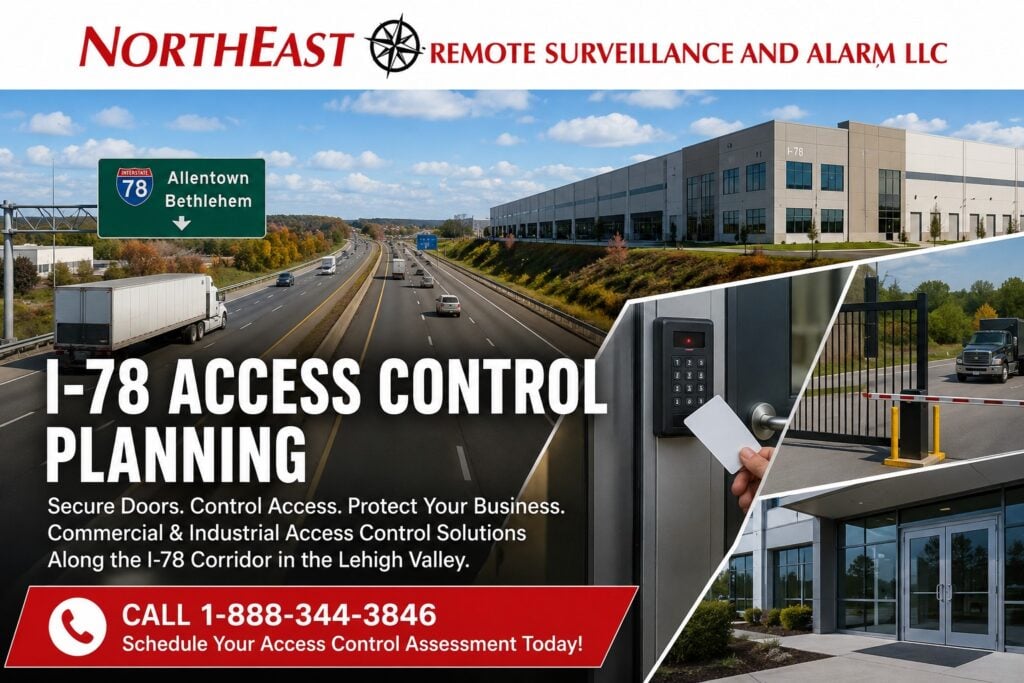
Use the I-78 corridor security guide to coordinate controlled entry with cameras, truck yards and the wider facility plan.
For the full installation scope—door hardware, readers, controllers, wiring, adjustments, commissioning and user handover—see commercial access control installation in the Lehigh Valley.
Northeast Remote Surveillance and Alarm, LLC (NERSA) provides access control planning, installation, upgrades, and integration for warehouses, logistics facilities, manufacturing plants, commercial buildings, contractor facilities, and industrial properties throughout the I-78 corridor.
Facilities in Allentown, Bethlehem, Upper Macungie, Lower Macungie, Breinigsville, Fogelsville, Hellertown, Williams Township, and surrounding Lehigh and Northampton County industrial areas often operate differently from traditional office environments.
A successful access control system must therefore do more than unlock a door.
It should establish:
- Who can enter
- Which doors or gates they can use
- When access is permitted
- Which areas require elevated permissions
- How access events are documented
- How lost credentials are disabled
- How visitors and contractors are handled
- How access control integrates with video surveillance
- How the system can expand as the facility grows
NERSA approaches I-78 access control as part of the facility’s overall commercial security architecture.
Complete Hardware Installation and Door Adjustments Included
NERSA installs all access-control hardware specified for your system and fine-tunes the complete door opening as part of the installation. Standard hinge adjustments, latch and strike alignment, and door-closer adjustments needed for reliable closing and latching are included at no additional labor charge with access-control installation. Major repairs, damaged doors or frames, and replacement hardware are separately scoped and quoted.
Before handover, we test credential operation, authorized entry, door closing, latching and required exit operation. Hardware installation and these door adjustments are part of our installation work.
Access Control for the I-78 Industrial Corridor
The I-78 corridor contains some of the Lehigh Valley’s most important warehouse, logistics, manufacturing, distribution, and commercial facilities.
These properties frequently include multiple security zones rather than a single controlled entrance.
Common controlled areas include:
- Employee entrances
- Main office entrances
- Warehouse entrances
- Shipping and receiving offices
- Loading-dock access points
- Manufacturing areas
- Inventory rooms
- Tool rooms
- IT and server rooms
- Maintenance areas
- Administrative offices
- Exterior pedestrian gates
- Vehicle gates
- Contractor entrances
- High-value storage areas
Planning these openings as one coordinated system provides better control than adding independent readers and locks over time.
Start With the Facility
NERSA access control planning begins with the building and its operating environment.
Before recommending equipment, the planning process evaluates:
- Number and type of controlled openings
- Existing door hardware
- Employee traffic patterns
- Shift changes
- Warehouse workflows
- Visitor entry
- Vendor access
- Truck and delivery activity
- Restricted interior areas
- Exterior gates
- Network availability
- Existing access control equipment
- Existing video surveillance
- Existing intrusion detection
- Expansion requirements
This approach helps prevent one of the most common access control mistakes: selecting hardware before understanding how the facility actually operates.
Warehouse Access Control Along I-78
Warehouse and distribution facilities along I-78 often operate around the clock and may involve hundreds of employees, drivers, contractors, vendors, and temporary workers.
Access permissions may need to differ significantly between departments and shifts.
A warehouse access control system can be designed to manage:
- Employee entrances
- Shipping offices
- Receiving offices
- Warehouse floors
- High-value inventory areas
- Supervisor offices
- Maintenance rooms
- IT rooms
- Equipment storage
- Loading areas
- Exterior pedestrian entrances
Permissions can be assigned by:
- Employee
- Department
- Shift
- Door
- Building
- Schedule
- Job responsibility
This allows management to control access without relying on large numbers of mechanical keys.
Manufacturing Facility Access Control
Manufacturing environments often require stronger separation between operational areas.
Access control may be used to protect:
- Production areas
- Engineering departments
- Quality-control rooms
- Tool rooms
- Material storage
- Maintenance departments
- Server rooms
- Offices
- Restricted machinery areas
- Exterior entrances
The objective is to allow employees to reach the areas required for their jobs while limiting unnecessary access to restricted sections of the facility.
Employee and Shift-Based Access
Many I-78 facilities operate multiple shifts.
Access control can be structured around scheduled permissions so that a credential is only valid at appropriate doors and times.
Examples include:
- First-shift employees
- Second-shift employees
- Overnight personnel
- Management
- Maintenance staff
- Contractors
- Temporary employees
- Delivery personnel
If an employee leaves the company or loses a credential, access can typically be disabled without rekeying the facility.
This provides significantly more control than traditional key-based access.
Access Control for Truck and Vehicle Gates
Industrial facilities along the I-78 corridor often require controlled vehicle entry as well as controlled doors.
Gate access control may be appropriate for:
- Truck terminals
- Distribution centers
- Fleet yards
- Contractor yards
- Equipment storage facilities
- Manufacturing campuses
- Employee parking areas
- Restricted industrial compounds
Depending on the application, a gate system may incorporate:
- Card readers
- Mobile credentials
- Keypads
- Video intercoms
- Remote release
- Vehicle detection
- Cameras
- License plate recognition
Gate planning should account for truck stacking, employee traffic, visitor access, emergency access, and the distance between the gate and the primary building.
Use the I-78 truck yard security guide to map waiting areas, trailer movements and gate response before selecting entry equipment.
Visitor and Contractor Entry
Visitors, vendors, contractors, and delivery personnel may require access without receiving permanent credentials.
For these applications, access control can be coordinated with:
- Video intercoms
- Visitor entry stations
- Remote door release
- Reception personnel
- Video surveillance
A visitor can be identified and verified before access is granted.
This is especially useful at industrial properties where the main office is separated from the employee entrance, warehouse, or vehicle gate.
Commercial Door Hardware Planning
Access control depends on properly selected door hardware.
The electronic platform cannot compensate for a poorly functioning door.
Planning may include evaluation of:
- Electric strikes
- Electrified locksets
- Electrified panic hardware
- Magnetic locks
- Request-to-exit devices
- Door-position switches
- Door closers
- Power supplies
- Transfer hinges
- Existing mechanical hardware
Door construction, frame type, traffic volume, egress requirements, and existing hardware should all be reviewed before equipment is selected.
Credential Planning
Different facilities require different credential strategies.
Commercial access control systems may use:
- Cards
- Key fobs
- Smart credentials
- Mobile credentials
- PINs
- Multi-factor authentication
Credential selection should consider:
- Number of employees
- Employee turnover
- Security requirements
- Number of buildings
- Future expansion
- Management preferences
- Existing credential technology
The goal is to use a credential strategy that can remain practical as the organization grows.
Modern Reader Infrastructure
New installations and major upgrades should evaluate current reader communication standards.
Many older systems use legacy reader technologies, while newer systems may support more secure supervised communication between readers and controllers.
When appropriate, NERSA evaluates whether existing infrastructure should be retained, upgraded, or replaced based on:
- System age
- Reader compatibility
- Wiring condition
- Expansion requirements
- Security objectives
- Long-term support
The objective is not to replace usable equipment unnecessarily.
It is to avoid building a new access control system around components that will become an expansion or support problem.
Access Control and Video Surveillance Integration
Access control becomes more useful when door and gate events can be associated with video.
Integrated systems may help operators investigate events such as:
- Door forced open
- Door held open
- Invalid credential
- After-hours access
- Restricted-area entry
- Gate activation
- Employee entry
- Visitor entry
Instead of searching through video manually, operators may be able to review footage associated with the access event.
Use I-78 video surveillance planning to define the recorded view needed for each door or gate event.
Test the relationship between the event timestamp and the footage before relying on it for investigations.
Access Control and Intrusion Detection
Access control can also be planned alongside commercial intrusion detection.
The two systems may support coordinated workflows involving:
- Authorized entry
- After-hours access
- Restricted areas
- Alarm events
- User identification
- Security verification
The exact integration depends on the security platforms being used and the operating requirements of the property.
Existing Access Control System Upgrades
Many I-78 facilities already have access control but are dealing with older equipment or systems that have become difficult to manage.
Common upgrade reasons include:
- Unsupported software
- Failed controllers
- Obsolete readers
- Limited expansion capacity
- Lost administrator access
- Poor documentation
- Difficult credential management
- Multiple disconnected systems
- Expansion into additional buildings
An upgrade assessment should determine what can reasonably be reused.
NERSA can evaluate:
- Existing controllers
- Readers
- Wiring
- Door hardware
- Power supplies
- Credentials
- Network infrastructure
- Software
- Existing databases
A properly planned upgrade can often retain usable infrastructure while replacing the components that are creating operational problems.
Access Control Takeovers
Facilities do not always need to replace an existing access control system when changing security providers.
NERSA can evaluate whether an existing system can be:
- Serviced
- Reprogrammed
- Expanded
- Integrated
- Upgraded
- Migrated
This can be particularly valuable in older industrial buildings where multiple contractors have modified the system over many years.
Multi-Building and Campus Access Control
Large I-78 properties may include multiple buildings, warehouses, offices, maintenance structures, and exterior gates.
Access control planning should determine whether these areas should be managed from one centralized platform.
A unified system can simplify:
- Credential administration
- Employee permissions
- Event review
- Lost credential removal
- Multi-building access
- Expansion
This is especially useful for companies operating industrial campuses or multiple nearby facilities.
Planning for Expansion
I-78 industrial facilities frequently expand.
A company may add:
- Employees
- Controlled doors
- Warehouse space
- Gates
- New departments
- Additional buildings
- Additional facilities
Access control should be designed with enough capacity to support reasonable future growth.
Planning should evaluate:
- Controller capacity
- Reader capacity
- Panel locations
- Power supplies
- Network infrastructure
- Credential strategy
- Licensing
- Expansion paths
A system designed only for today’s requirements can become expensive to replace when the facility expands.
New Construction and Renovations
Access control should be included early in the planning process for new industrial construction and major renovations.
Early coordination helps address:
- Door hardware
- Conduit
- Cabling pathways
- Power requirements
- Controller locations
- Network connections
- Gate infrastructure
- Fire alarm interfaces
- Future expansion
Access control becomes more difficult and expensive when these requirements are considered after construction is substantially complete.
Life Safety and Egress
Access-controlled doors must continue to support required emergency egress and life-safety operation.
Depending on the application, coordination may be required between:
- Access control
- Fire alarm systems
- Panic hardware
- Locking hardware
- Request-to-exit devices
- Emergency release functions
- Building requirements
The specific requirements depend on the door, occupancy, locking method, and local authority having jurisdiction.
I-78 Access Control Planning Process
NERSA uses a structured planning approach for commercial and industrial access control projects.
1. Identify Controlled Openings
Determine which doors, gates, and restricted areas require electronic control.
2. Review Facility Operations
Understand employee movement, shifts, visitors, deliveries, warehouse operations, and restricted areas.
3. Evaluate Existing Hardware
Inspect locks, doors, frames, exit hardware, readers, wiring, and existing access-control equipment.
4. Define Access Levels
Determine which users should have access to specific doors and during which schedules.
5. Plan Infrastructure
Determine controller locations, power requirements, network connectivity, cabling, and expansion capacity.
6. Coordinate Security Systems
Identify opportunities to integrate access control with video surveillance, intrusion detection, gates, and visitor entry.
7. Plan for Growth
Allow capacity for additional employees, doors, buildings, and operational changes.
Facilities Served Along I-78
NERSA provides access control planning for:
- Warehouses
- Distribution centers
- Manufacturing facilities
- Logistics operations
- Truck terminals
- Contractor yards
- Fleet facilities
- Industrial parks
- Corporate offices
- Multi-tenant commercial properties
- Healthcare facilities
- Professional buildings
The system design should match the operational requirements of the specific facility rather than using the same access control package for every property.
Access Control Planning Throughout the I-78 Lehigh Valley Corridor
The I-78 corridor connects major commercial and industrial areas throughout the Lehigh Valley.
For broader corridor security planning, visit the I-78 Lehigh Valley Corridor Security Systems guide.
Businesses comparing complete-door installation, readers, locks, wiring and user administration across the region can also review commercial access control installation in the Lehigh Valley, PA.
This I-78 guide remains focused on warehouse, logistics and corridor-specific access planning.
Facilities located along the Route 33 industrial corridor can review Lehigh Valley Route 33 Industrial Corridor Access Control Systems for corridor-specific planning.
The service focuses on:
planning commercial and industrial access control systems for facilities operating along the I-78 corridor in the Lehigh Valley.
Why I-78 Access Control Planning Matters
A strong access control system is not defined by the number of card readers installed.
It is defined by how well the system supports the facility.
Poor planning can result in:
- Incorrect door hardware
- Inadequate controller capacity
- Poor credential management
- Unnecessary mechanical keys
- Difficult visitor entry
- Disconnected gate systems
- Limited expansion capability
- Weak video integration
- Inconsistent employee permissions
- Poor system documentation
Correct planning addresses these issues before installation begins.
Test shift changes and temporary access before handover
Prepare a small set of representative users with the property manager: an employee on a normal shift, a supervisor, a contractor with an expiry date and a person whose access has ended. Confirm that each can use only the agreed entrances and schedules. Include an approved exception for overtime so staff know who can authorize a change.
Test a lost credential, a denied entry and the process for finding the related event record. Confirm how the selected system behaves during a network interruption, and document the supported fallback with the installer. Review doors and gates with the responsible facilities personnel; the electronic permission test does not replace required hardware or life-safety checks.
Handover should identify the account owner, authorized administrators, entrance names, access groups and service contact. Have staff demonstrate adding a temporary user, changing a schedule and removing access. A clear operating routine makes the installation useful after the original project team leaves.
Frequently Asked Questions
How should I-78 facilities plan access around employee shifts and deliveries?
Start with the controlled openings, actual shifts, users, drivers, and restricted areas. Define employee permissions separately from visitor and delivery workflows. Review existing door hardware and infrastructure before selecting credentials or copying schedules.
What should an I-78 access-control handover test include?
Test representative shift changes, temporary access, and the agreed door behavior with responsible facility staff. Include the relevant records and supported system integrations. Document limits and future expansion needs before repeating the design elsewhere.
Plan Access Control for Your I-78 Facility
NERSA can evaluate access control for your commercial or industrial property along the I-78 corridor in the Lehigh Valley. We plan around how employees, contractors, and vehicles use the facility.
NERSA can evaluate:
- Doors and gates
- Existing access control equipment
- Door hardware
- Employee and shift requirements
- Visitor entry
- Warehouse access
- Restricted areas
- Video integration
- Network infrastructure
- Expansion requirements
Northeast Remote Surveillance and Alarm, LLC
Commercial & Industrial Security Systems
1-888-344-3846 or schedule a security and life safety assessment
Build the access control system around the facility, employee workflow, and future expansion requirements before equipment is installed.
Compliance, Codes & Project Standards
NERSA plans commercial and industrial security work with applicable code, documentation, inspection and authority-having-jurisdiction requirements in mind. Requirements vary by system, property and jurisdiction. These resources support project planning; they do not establish legal compliance, certification or AHJ approval.
Related guidance: Regulatory compliance & inspection readiness · Access control & door hardware standards · NFPA 101 & egress planning · ADA access-control planning