
Healthcare campus security coordinates building access, camera coverage, visitor entry, alarms, and response responsibilities across medical facilities and shared outdoor areas.

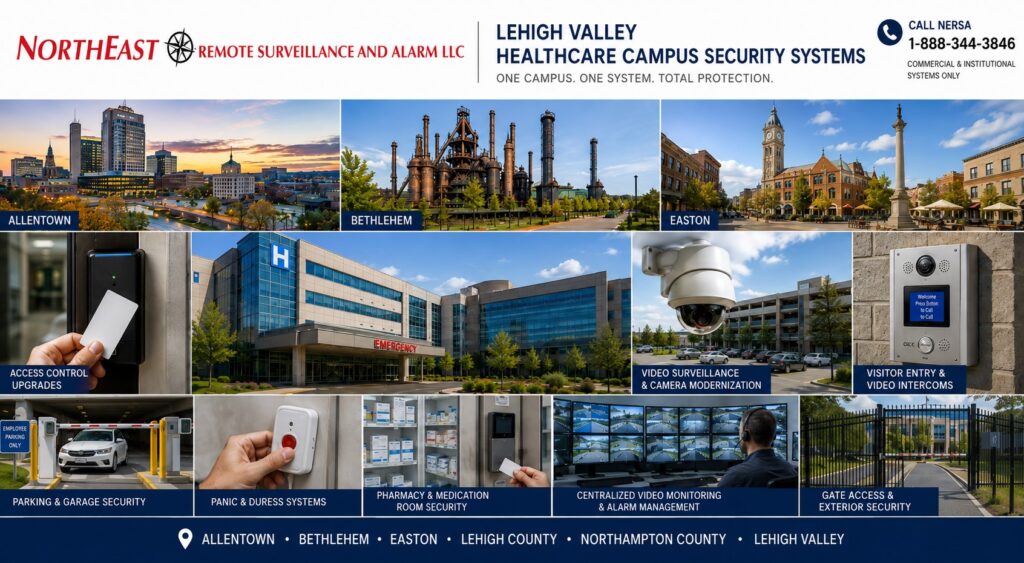
Hospitals, outpatient buildings, behavioral-health facilities, medical offices, laboratories, pharmacies, parking facilities, administrative buildings and support areas may all need to operate as part of one coordinated security environment.
Northeast Remote Surveillance and Alarm, LLC (NERSA) designs, installs, upgrades, integrates and supports healthcare campus security systems throughout Allentown, Bethlehem, Easton, Lehigh County, Northampton County and the surrounding Lehigh Valley.
Healthcare campus security may include:
- centralized access control;
- multi-building credential management;
- video surveillance;
- visitor entry;
- video intercoms;
- panic and duress systems;
- pharmacy and medication-room security;
- intrusion detection;
- parking and garage security;
- exterior security;
- gate access;
- remote video monitoring;
- centralized alarm management;
- network and fiber infrastructure;
- unified security administration.
For broader healthcare-security planning, visit Lehigh Valley Healthcare Security Systems.
Commercial and institutional systems only.
Call NERSA: 1-888-344-3846
Healthcare Campus Security Starts with the Entire Property
A healthcare campus should not be planned one building at a time without considering how the buildings, parking areas, entrances and support systems relate to each other.
A campus may include:
- hospital buildings;
- outpatient centers;
- medical office buildings;
- behavioral-health facilities;
- laboratories;
- pharmacies;
- administrative offices;
- parking garages;
- surface parking lots;
- central utility buildings;
- loading and receiving;
- maintenance facilities;
- data and communications rooms;
- staff-only areas;
- satellite buildings;
- remote entrances.
Each building may have different security requirements.
The objective is to allow individual buildings to operate independently where necessary while still supporting centralized administration, consistent standards and coordinated security response.
Centralized Healthcare Access Control
A campus-wide access-control platform can help healthcare organizations manage permissions across multiple buildings from a consistent administrative environment.
Access may be assigned by:
- employee;
- department;
- job role;
- shift;
- building;
- floor;
- door;
- schedule.
Credential options may include:
- cards;
- key fobs;
- mobile credentials;
- PIN credentials;
- supported multi-factor methods.
Confirm the readers, credentials, controllers, and door hardware needed at each building before standardizing campus-wide permissions.
Standardized Credentials Across Multiple Buildings
Healthcare organizations can become difficult to administer when every building uses a different credential or access-control platform.
Where appropriate, a standardized credential architecture may allow authorized employees to use one credential across:
- employee entrances;
- clinical buildings;
- administrative offices;
- laboratories;
- pharmacies;
- maintenance buildings;
- parking facilities.
Centralization does not mean giving everyone access everywhere.
Users should receive only the permissions required for their job responsibilities.
Department-Based Access Permissions
Healthcare campuses commonly include departments with very different access requirements.
Permissions may be organized around:
- clinical teams;
- pharmacy staff;
- laboratory personnel;
- administration;
- facilities;
- IT;
- security;
- contractors;
- environmental services;
- management.
Department-based access groups can simplify administration.
They should also be reviewed periodically so employees do not retain permissions that are no longer required.
Multi-Building Video Surveillance
Healthcare campuses may require video coverage across:
- building entrances;
- employee entrances;
- public areas;
- parking lots;
- parking garages;
- pedestrian approaches;
- loading areas;
- service roads;
- exterior equipment;
- controlled corridors;
- appropriate common areas.
Centralized video management can allow authorized personnel to review cameras across multiple buildings through one consistent interface.
Centralized Video Management
A multi-building video platform may provide:
- consistent camera naming;
- shared user permissions;
- common retention standards;
- centralized live viewing;
- incident review across multiple buildings;
- standardized camera configurations;
- system-health monitoring.
A healthcare campus should avoid becoming a collection of unrelated recorders that require different logins, naming conventions and maintenance procedures.
Healthcare Parking and Garage Security
Parking can represent a significant portion of a healthcare campus.
Security planning may include:
- employee parking;
- visitor parking;
- parking garages;
- remote lots;
- pedestrian approaches;
- vehicle gates;
- entrances and exits;
- emergency-access lanes;
- service roads.
For detailed exterior-security planning, visit Lehigh Valley Healthcare Parking & Exterior Security Systems.
Review parking areas, pedestrian routes, entrances, and after-hours activity as part of the campus assessment.
Coordinate exterior cameras, controlled entrances, alerts, and staff response with the systems serving the rest of the healthcare campus.
Healthcare Visitor Entry Across Multiple Buildings
A healthcare campus may contain many different entrance types.
Examples include:
- main hospital entrances;
- outpatient entrances;
- behavioral-health entrances;
- employee entrances;
- administrative entrances;
- pharmacy entrances;
- loading entrances;
- after-hours entrances.
Visitor-entry systems may include:
- video intercoms;
- receptionist release;
- remote answering;
- controlled door release;
- visitor verification;
- access-control integration.
For dedicated visitor-entry planning, visit Lehigh Valley Healthcare Visitor Entry Systems.
Centralized Visitor Entry
Larger campuses may benefit from centralized answering for selected entrances.
A designated reception or security location may handle calls from:
- remote buildings;
- after-hours entrances;
- parking gates;
- service entrances;
- satellite facilities.
The organization should define:
- who answers;
- which doors may be released;
- how missed calls are handled;
- how responsibility transfers after hours.
Remote release authority should be limited to appropriately authorized personnel.
Panic and Duress Across a Healthcare Campus
Healthcare campuses may contain many staff locations where a defined emergency-signaling method is appropriate.
Potential locations may include:
- reception desks;
- pharmacies;
- behavioral-health areas;
- administrative offices;
- security posts;
- isolated workspaces;
- after-hours locations.
For detailed planning, visit Lehigh Valley Healthcare Panic & Duress Systems.
Campus-wide standardization may include:
- consistent device types;
- common zone naming;
- monitoring procedures;
- testing standards;
- employee training standards.
Behavioral Healthcare Buildings on a Campus
Behavioral-health facilities may require additional consideration for:
- controlled entrances;
- visitor movement;
- staff-only areas;
- panic and duress;
- appropriate video coverage;
- medication areas.
Coordinate behavioral-health entry and response procedures with the responsible clinical and facility teams before applying shared campus settings.
Pharmacy and Medication-Room Security Across Multiple Buildings
Healthcare campuses may include:
- central pharmacies;
- satellite medication rooms;
- outpatient pharmacies;
- controlled clinical storage;
- medication areas in several buildings.
Campus-wide standardization may include:
- credential policies;
- event naming;
- door-hardware standards;
- panic-device standards;
- reporting procedures;
- camera practices.
Intrusion Detection Across Multiple Buildings
Not every building on a healthcare campus operates around the clock.
Administrative offices, storage facilities, laboratories, maintenance buildings and satellite structures may close while other portions of the campus remain occupied.
A campus intrusion design may allow different buildings or departments to operate as separate partitions.
Detection may include:
- door contacts;
- motion detection;
- glass-break detection;
- perimeter detection;
- environmental sensors.
Centralized Alarm Monitoring
A healthcare campus can generate security events from many buildings and systems.
Monitoring documentation should use clear descriptions.
For example:
Outpatient Building A — Pharmacy Rear Door
is more useful than:
Zone 147
Campus monitoring records should clearly establish:
- building names;
- area names;
- device descriptions;
- event types;
- escalation procedures;
- responsible contacts.
Consistency becomes increasingly important as the environment grows.
Unified Healthcare Security Management
A healthcare campus may benefit from selective coordination among:
- access control;
- video surveillance;
- intrusion detection;
- panic and duress;
- visitor entry;
- gate access;
- monitoring.
Useful workflows may include:
- forced-door events associated with nearby video;
- panic events associated with relevant cameras;
- visitor-entry calls tied to controlled openings;
- alarms identifying the correct building and nearby cameras.
Integration should improve response or administration.
It should not create unnecessary complexity.
Campus Security Administration
Larger healthcare organizations may require one or more designated security-administration locations.
Depending on the operation, these areas may support:
- live video viewing;
- alarm review;
- access-control administration;
- visitor-entry answering;
- event investigation;
- multi-building reporting.
Permissions should be role-based.
Not every employee who can view cameras should automatically have authority to:
- issue credentials;
- release doors;
- change alarm programming;
- administer every building.
Healthcare Campus Network Infrastructure
Campus security may rely heavily on network infrastructure.
Systems can depend on:
- Ethernet;
- fiber;
- PoE switches;
- managed switches;
- VLANs;
- servers;
- cloud connectivity;
- wireless bridges;
- UPS systems;
- cybersecurity controls.
Large healthcare sites should plan network architecture before expanding physical-security systems across multiple buildings.
Fiber Between Healthcare Buildings
Fiber can be especially useful for:
- connecting separate buildings;
- long-distance camera links;
- parking garages;
- central security locations;
- remote equipment rooms.
Campus planning should consider:
- available pathways;
- strand count;
- redundancy;
- switch locations;
- future expansion.
Installing only enough fiber for the immediate project can make future expansion significantly more difficult.
Wireless Bridges for Remote Campus Areas
Some healthcare campus locations may not have practical underground pathways.
Point-to-point wireless connectivity may be considered for:
- remote parking lots;
- detached buildings;
- temporary facilities;
- difficult exterior links.
Wireless design should account for:
- line of sight;
- mounting;
- interference;
- weather;
- bandwidth;
- network security.
Wireless should be selected because it solves an infrastructure problem, not simply because cabling is inconvenient.
Campus Gate Access Control
Healthcare campuses may contain vehicle-controlled areas such as:
- employee parking;
- service roads;
- maintenance areas;
- secured garages;
- loading areas.
Gate access may incorporate:
- card readers;
- mobile credentials;
- keypads;
- intercoms;
- cameras;
- license-plate recognition;
- remote release.
Gate systems should remain part of the larger campus access architecture rather than being managed as isolated devices.
License-Plate Recognition
License-plate recognition may support defined vehicle-identification requirements at:
- parking entrances;
- service roads;
- employee lots;
- controlled garages;
- campus gates.
Reliable plate capture requires dedicated positioning and design.
A general overview camera should not automatically be expected to provide dependable LPR performance.
Remote Video Monitoring
Selected campus areas may benefit from remote video monitoring during defined periods.
Potential applications include:
- remote parking areas;
- exterior equipment;
- loading areas;
- closed buildings;
- service entrances.
Remote monitoring should be designed around:
- clearly defined events;
- appropriate camera coverage;
- escalation procedures;
- reliable communication infrastructure.
Healthcare Campus Security Standards
One of the strongest benefits of campus-level planning is the ability to establish consistent security standards.
A healthcare organization may standardize:
- reader models;
- credential formats;
- controller architecture;
- camera naming;
- video-retention practices;
- panic-device standards;
- door hardware;
- event descriptions;
- network requirements;
- monitoring procedures.
Standardization can simplify:
- training;
- maintenance;
- troubleshooting;
- administration;
- future expansion.
Multi-Site Healthcare Security Beyond One Campus
Some healthcare organizations operate multiple facilities across the Lehigh Valley.
These may include:
- hospitals;
- medical offices;
- outpatient centers;
- behavioral-health facilities;
- administrative buildings;
- specialty clinics.
A multi-site architecture can provide centralized administration while maintaining local operational independence.
Potential capabilities include:
- centralized credentials;
- common user records;
- location-specific permissions;
- centralized video access;
- shared monitoring standards;
- consistent naming conventions.
This service covers the multi-building and multi-site healthcare coordination purpose.
Existing Healthcare Campus Security Upgrades
Large healthcare sites often contain systems installed during different construction phases.
The result may include:
- several access-control platforms;
- multiple recorder brands;
- inconsistent credentials;
- unsupported cameras;
- older alarm panels;
- unrelated intercom systems;
- undocumented cabling.
NERSA can evaluate existing infrastructure to determine what can be:
- retained;
- standardized;
- upgraded;
- integrated;
- migrated;
- replaced.
Healthcare Campus Security Takeovers
A multi-building security takeover should begin with an inventory.
NERSA can evaluate:
- buildings;
- access-control platforms;
- credentials;
- controlled doors;
- video systems;
- recorders;
- cameras;
- alarms;
- panic devices;
- intercoms;
- network architecture;
- fiber links;
- monitoring;
- user administration;
- documentation.
The objective is to establish a clear migration path instead of replacing equipment without understanding the environment.
New Healthcare Campus Construction
New healthcare campuses provide an opportunity to establish security standards before individual buildings are completed.
Early planning can determine:
- security equipment rooms;
- fiber pathways;
- network architecture;
- controlled-door standards;
- reader locations;
- camera poles;
- camera mounting;
- visitor-entry locations;
- panic infrastructure;
- parking-security infrastructure;
- gate systems;
- conduit;
- future expansion capacity.
Campus infrastructure should be designed for the expected long-term environment, not only the first construction phase.
Healthcare Campus Expansion
Existing campuses continue to change.
Expansion may include:
- new outpatient buildings;
- parking garages;
- medical office buildings;
- additions;
- new entrances;
- renovated departments.
Before adding another independent security system, the organization should determine whether the new area can become part of the existing campus architecture.
Healthcare Campus Security Assessment
A campus-wide security assessment should examine the entire environment before equipment is selected.
Buildings
How many buildings exist and how each one operates.
Users
Which employees require access to which locations.
Existing Systems
Which access-control, video, alarm and intercom platforms are already installed.
Parking
How patients, employees and visitors move between parking areas and buildings.
Visitor Entry
Which entrances require verification or controlled release.
Emergency Signaling
Where panic or duress protection may be appropriate.
Network Infrastructure
How buildings are connected.
Security Administration
Who manages credentials, cameras, alarms and events.
Monitoring
How security events are handled.
Expansion
What future buildings, doors, cameras or locations may need to be supported.
The result should become a practical campus security plan rather than a collection of unrelated product recommendations.
Plan Healthcare Campus Security in the Lehigh Valley
NERSA can assess security for one medical campus or several healthcare facilities in the Lehigh Valley. We review access control, cameras, visitor entry, panic and duress alerts, parking, intrusion detection, and network infrastructure. Planning also considers centralized administration.
The goal is to create a healthcare security architecture that can support multiple buildings, multiple departments and future expansion without becoming a collection of disconnected systems.
Northeast Remote Surveillance and Alarm, LLC
Commercial & Institutional Security Systems
Allentown • Bethlehem • Easton • Lehigh County • Northampton County
Call 1-888-344-3846
Plan Your Next Security Improvement
Tell NERSA about your commercial facility, existing systems, and project priorities. We can help you plan an installation, evaluate an upgrade, or coordinate security across multiple locations.
Compliance, Codes & Project Standards
NERSA plans commercial and industrial security work with applicable code, documentation, inspection and authority-having-jurisdiction requirements in mind. Requirements vary by system, property and jurisdiction. These resources support project planning; they do not establish legal compliance, certification or AHJ approval.
Related guidance: Regulatory compliance & inspection readiness · Healthcare security compliance · NERSA project standards