
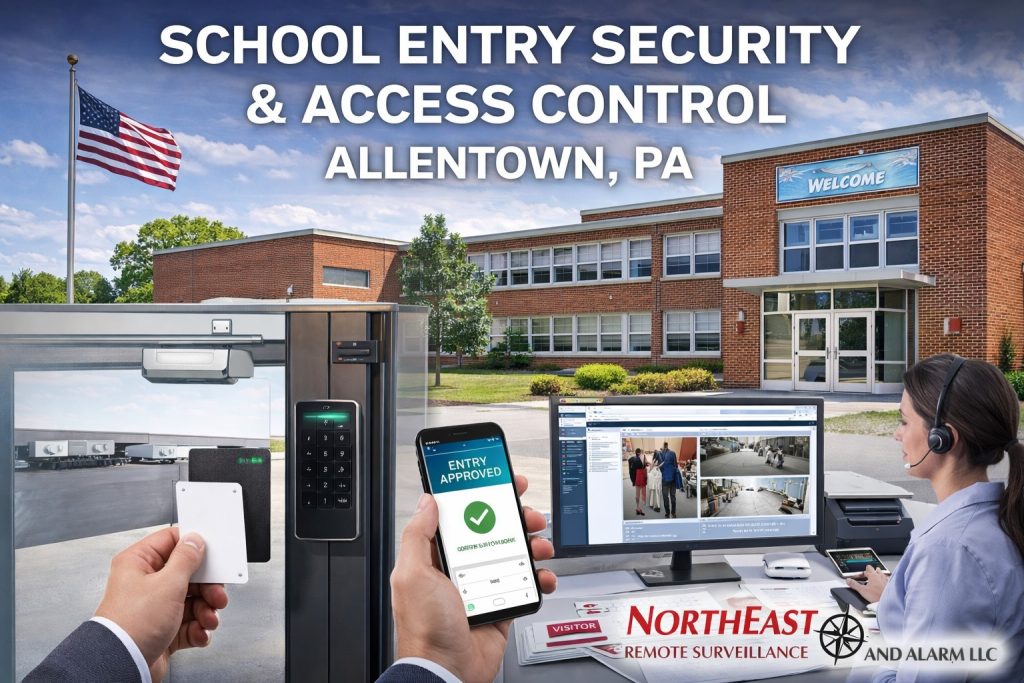
School entry security and access control systems in Allentown, PA manage staff credentials, visitor entry, selected interior doors, schedules, and after-hours access for private, charter, and institutional education facilities.

Request a school entry and access-control assessment in Allentown
Coordinate cameras, doors, alarms and monitoring through commercial security installation in Allentown, PA.
For related public-building planning, Municipal & Government Building Security Systems in Allentown, PA covers how entry controls fit with other security systems.
School Entry Security and Access Control Systems in Allentown, PA
Northeast Remote Surveillance and Alarm, LLC designs controlled entry for educational properties that need clear public access and dependable staff-only boundaries. First, we map arrival, daytime use, dismissal, after-hours programs, staff access, visitors, deliveries, and service entry. Then we define the doors, credentials, communication, schedules, hardware, and procedures that support the plan.
A system can support one small administrative building or a common enterprise standard across a multi-building campus.
Managed Entry at the Main Entrance
In practice, the main entrance should show visitors where to request access and where staff receive them. For example, a compatible intercom or video-intercom can support communication before an approved release. Door monitoring can also report held or forced conditions when the platform supports those events.
Equipment must follow the school’s entry policy rather than replace it. Staff roles, operating hours, exceptions, and response steps should be clear before programming begins.
Staff Credentials and Permissions
Individual credentials can reduce reliance on copied, lost, or unreturned keys. Each approved person can receive access to selected doors during an assigned schedule. An administrator can change or remove access without rekeying every controlled opening.
- Teachers and instructional staff.
- Administrative and front-office personnel.
- Facilities, maintenance, and custodial teams.
- Approved service providers and contractors.
- Temporary or event users with expiration dates.
- Department or building managers with broader responsibility.
Shared credentials reduce accountability. Inactive users and broad permissions should receive regular review.
Interior Doors and Restricted Areas
Not every interior door needs the same control. However, administrative offices, records rooms, IT spaces, staff areas, storage, and service rooms may need stronger separation from public or student circulation. The opening’s use and life-safety role should guide the design.
For broader platform, credential, and permission planning, visit Commercial Access Control Systems in Allentown, PA.
Complete Door Hardware and Safe Operation
Most importantly, a reader alone does not create a secure opening. NERSA reviews locks, latches, closers, frames, exit devices, door-position switches, request-to-exit devices, power, wiring, egress, and backup behavior. Final door operation must follow approved building, fire, accessibility, and life-safety requirements.
For the complete opening, visit Commercial Door Access Control Systems in Allentown, PA.
Visitor Communication and Front-Office Control
A visitor entry process should state who answers, what staff verify, when a door may release, where the visitor goes, and what happens if no one responds. Delivery and service entry may need separate instructions during busy arrival or dismissal periods.
For visitor and facility communication, visit Commercial Intercom and Paging Systems in Allentown, PA.
Schedules, Events, and After-Hours Use
School access changes across the day. For instance, morning arrival, classroom hours, dismissal, sports, meetings, and evening programs may need different rules. Access levels can follow approved roles and schedules while keeping restricted areas controlled.
The system can record valid entries, denied attempts, forced doors, held doors, and controller troubles. Accurate names and system time make those events easier to review.
Coordinate Entry Security with Facility Requirements
School entry work may involve accessibility, fire and life safety, door hardware, building conditions, emergency procedures, IT, and administrative policy.
The facility and responsible parties should confirm final requirements before installation.
See Compliance-Aware Security Planning in Allentown, PA.
A Scalable School Entry Plan
- Map activity: document arrivals, dismissal, staff, visitors, programs, deliveries, and after-hours use.
- Define boundaries: identify public, staff, student, service, and restricted areas.
- Set permissions: assign users, doors, schedules, exceptions, and expiration rules.
- Select openings: match readers, controllers, locks, sensors, intercoms, and power to each door.
- Test: verify entry, egress, relocking, alerts, communication, schedules, and backup behavior.
- Document: record door names, credentials, settings, accounts, contacts, and service information.
For instance, a smaller facility may begin at the main entrance and priority staff doors. By comparison, a campus may use common naming, roles, reports, and support across several buildings. The platform should leave capacity for added doors, users, and locations.
School Entry FAQs
Can staff have different door permissions?
Yes. The platform can assign doors, schedules, locations, and expiration by user or role.
Can one system support after-hours programs?
Often, yes. First, the school should define approved users, doors, schedules, exceptions, and supervision.
Does access control replace emergency procedures?
No. Equipment supports the entry plan, while policy, training, communication, response, and oversight remain essential.
Request a School Entry Assessment
Bring the entrance and door schedule, arrival and dismissal times, after-hours uses, visitor procedures, and existing equipment details.
Identify who approves access changes and who will administer credentials after handover.
Request a school entry and access-control assessment in Allentown.
Compliance, Codes & Project Standards
NERSA plans commercial and industrial security work with applicable code, documentation, inspection and authority-having-jurisdiction requirements in mind. Requirements vary by system, property and jurisdiction. These resources support project planning; they do not establish legal compliance, certification or AHJ approval.
Related guidance: Regulatory compliance & inspection readiness · Access control & door hardware standards · NFPA 101 & egress planning · ADA access-control planning