
Estimate commercial intrusion alarm installation costs around detection zones, equipment, cabling, communication paths, programming, testing, and the condition of existing infrastructure.

request a commercial intrusion alarm assessment
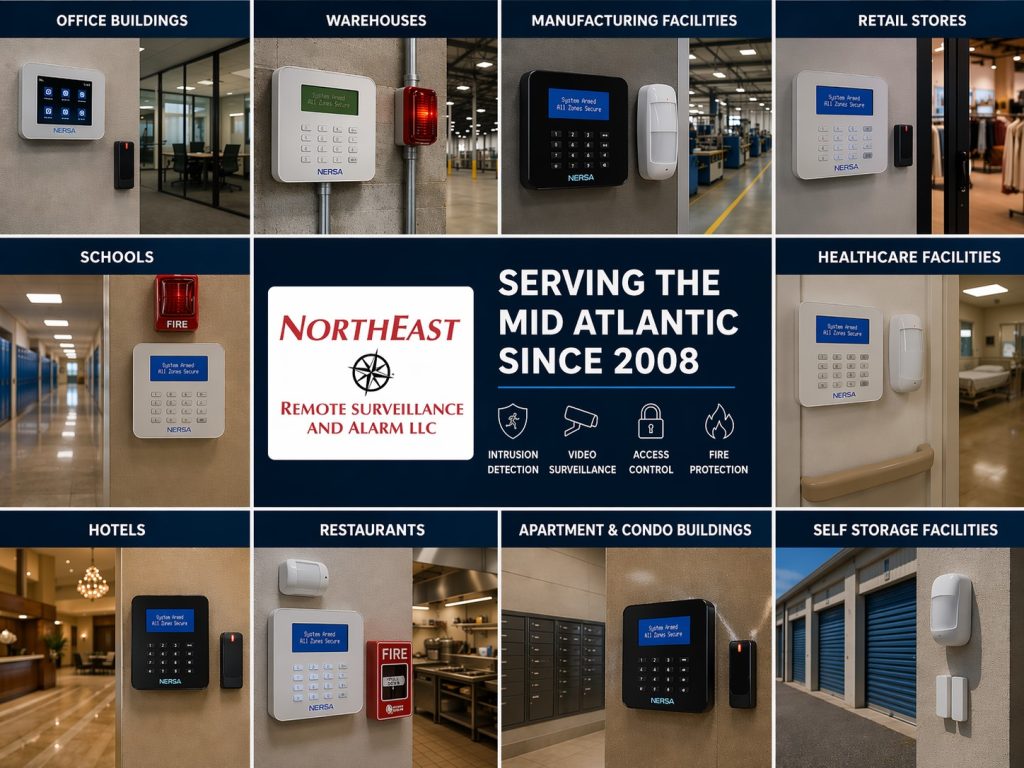
What Businesses Should Budget for Sensors, Monitoring, Wiring, Environmental Alerts and Long-Term Reliability
A real business alarm system has to protect the building, match the property layout, support the right communications path, document activity, connect to monitoring, and remain reliable after the installation is complete.
Northeast Remote Surveillance and Alarm, LLC designs commercial and industrial intrusion alarm systems for offices, warehouses, logistics facilities, manufacturing plants, schools, healthcare buildings, municipal properties, contractor yards, self-storage facilities, hotels, restaurants, commercial multifamily common areas, and multi-site business operations throughout Pennsylvania and the Mid-Atlantic.
For broader service planning, businesses can start with NERSA’s commercial and industrial alarm systems page. This cost guide focuses specifically on what affects intrusion alarm pricing and how to budget for a system that matches the building instead of relying on a generic package.
Typical Commercial Intrusion Alarm Cost Ranges
There is no single flat price for a commercial alarm system because every building has different openings, layouts, risks, wiring conditions, monitoring expectations, and sensor requirements.
As a practical planning range:
- Smaller commercial alarm systems may start around $1,500 to $3,500 installed.
- Standard business alarm systems often fall around $3,500 to $7,500.
- Warehouse, industrial, multi-tenant, or larger commercial systems may fall around $7,500 to $25,000+.
- Large integrated, multi-site, or specialty systems can exceed $25,000 depending on scope.
These are planning ranges, not final quotes. A small office with two doors and one motion detector is very different from a warehouse with overhead doors, office-to-warehouse transitions, trailer-yard exposure, inventory cages, environmental sensors, panic buttons, and after-hours monitoring.
The most accurate number comes from a property-specific assessment.
What Drives the Cost of a Commercial Alarm System?
Commercial alarm pricing is usually shaped by the building, not just the equipment list. A proper budget should account for:
- Number of exterior doors
- Number of interior protected zones
- Glass exposure
- Warehouse or production floor layout
- Overhead doors and dock areas
- Panic or duress requirements
- Wired, wireless, or hybrid design
- Communication path
- Monitoring type
- Environmental sensors
- System integration
- User training
- Documentation and testing
- Long-term service needs
A low-cost package may appear attractive online, but it often leaves out the items that matter in real commercial facilities: more zones, better communications, central station monitoring, cellular backup, environmental alerts, video verification, or integration with access control and cameras.
Small Commercial Intrusion Alarm Projects
A small office, storefront, professional suite, or light commercial space may only need a commercial control panel, keypad, communicator, several door contacts, one or two motion detectors, siren, battery backup, programming, and monitoring setup.
These projects often stay in the lower planning range when the building is simple, the wiring path is accessible, and the alarm design is limited to basic intrusion detection.
Even small systems should still be designed professionally. Businesses need reliable communication, clean zone naming, proper keypad placement, correct entry and exit delays, user training, and a clear process for monitoring and response.
Standard Business Alarm Systems
A standard commercial alarm project usually includes more openings, more zones, more users, and more operational requirements than a basic office system.
These projects may include:
- Multiple entry doors
- Interior motions
- Glass break detectors
- Panic buttons
- Multiple keypads
- Cellular communication
- Central station monitoring
- Basic environmental sensors
- User codes by employee or manager
- Separate areas or partitions
This is common for offices, retail locations, restaurants, medical office spaces, mixed-use commercial buildings, and smaller warehouse-office combinations.
Warehouse and Industrial Intrusion Alarm Systems
Warehouse and industrial alarm systems often cost more because the design is more complex. These facilities may have larger square footage, high ceilings, more exterior exposure, multiple shifts, receiving areas, dock doors, warehouse-to-office transitions, inventory cages, mechanical rooms, fenced yards, and after-hours activity.
Warehouse alarm systems may include:
- Man-door contacts
- Overhead door protection
- Motion detection
- Office-to-warehouse zone separation
- Dock office protection
- Inventory cage sensors
- Trailer-yard or gate inputs
- Sirens or sounders
- Cellular or dual-path communication
- Remote app management
- Monitoring escalation rules
- Environmental alerts
For larger facility planning, NERSA can connect intrusion detection with warehouse security systems, warehouse security camera systems, access control, and remote monitoring.
Wired vs Wireless Intrusion Alarm Cost
One of the biggest budget decisions is whether the system should be wired, wireless, or hybrid.
Wired Intrusion Alarm Systems
Wired systems usually cost more upfront because of labor, cabling, pathways, and installation time. The benefit is long-term reliability, lower battery maintenance, and strong supervision when the wiring is installed correctly.
Wired alarm systems are often a good fit for:
- Owned commercial buildings
- Warehouses with long-term occupancy
- Industrial facilities
- Renovation projects
- Buildings with accessible pathways
- Facilities where long-term maintenance matters
The tradeoff is installation labor. Running wire through finished offices, masonry, high-bay spaces, occupied buildings, or long warehouse paths can increase cost.
Wireless Intrusion Alarm Systems
Wireless intrusion alarms can reduce installation disruption because each device does not need a wire back to the panel. This can make wireless systems useful in finished offices, tenant spaces, older buildings, phased retrofits, and projects where speed matters.
Wireless systems may be a good fit for:
- Finished commercial interiors
- Tenant improvements
- Historic or hard-to-wire spaces
- Small businesses
- Temporary or changing layouts
- Environmental add-ons
- Remote sensor points
The tradeoff is maintenance. Wireless devices need batteries, proper signal strength, supervision, and thoughtful placement. Large or difficult buildings may need repeaters or hybrid design.
Hybrid Intrusion Alarm Systems
Many commercial and industrial buildings are best handled as hybrid systems. Core doors and key infrastructure can be wired, while harder-to-reach areas, add-ons, or specialty points can be wireless.
Hybrid design is often practical for Mid-Atlantic commercial buildings because many properties are not clean-sheet new construction. They may have a mix of offices, warehouse areas, freezers, mechanical rooms, finished spaces, and remote problem points.
Common Intrusion Alarm Sensors
A commercial intrusion alarm system may include several types of sensors depending on the property.
Door and Window Contacts
Door and window contacts supervise openings. They are usually the first layer of perimeter protection and are commonly used on exterior doors, office doors, warehouse man doors, and certain windows.
Motion Detectors
Motion detectors protect interior zones after the building is armed. Commercial systems may use wall-mounted motions, ceiling-mounted motions, curtain motions, or dual-technology motion detectors depending on the space.
Glass Break Detectors
Glass break detectors are used where windows, storefront glass, vestibules, side lites, or entry glazing create after-hours risk. They add another layer of detection beyond a simple door contact.
Panic and Duress Devices
Panic buttons may be used in reception areas, offices, healthcare-adjacent spaces, cash-handling locations, schools, and public-facing business areas. These devices can affect monitoring procedures and training.
Overhead Door and Specialty Opening Sensors
Warehouses, service bays, truck terminals, and industrial buildings often need protection for overhead doors, roll-up doors, gate status, or other specialty openings. These devices can increase cost because they require more careful installation and programming.
Shock, Vibration and Perimeter Devices
Some higher-risk facilities may use shock sensors, beam detection, or other perimeter-focused devices. These are less common in basic office systems but may be useful for harder commercial or industrial environments.
Environmental Monitoring and Alarm Cost
Many businesses need more than burglary detection. Environmental monitoring can protect products, equipment, mechanical systems, and continuity.
Environmental sensors may monitor:
- Freezer temperature
- Cooler temperature
- Low temperature
- Furnace or heat failure risk
- Water leaks
- Humidity
- Power conditions
- Equipment-room conditions
- Server-room or telecom-room conditions
Environmental monitoring can raise the project cost, but it may prevent losses that are far more expensive than the sensor itself.
Freezer, Cooler and Temperature Monitoring
Freezer and cooler temperature monitoring is one of the most valuable alarm add-ons for businesses with temperature-sensitive inventory.
This may apply to:
- Restaurants
- Food-service businesses
- Food distribution
- Healthcare facilities
- Labs
- Pharmaceutical support spaces
- Commercial kitchens
- Cold storage rooms
- Walk-in coolers and freezers
A commercial alarm system may use a temperature sensor, freezer probe, or dedicated environmental monitoring device to alert designated contacts when temperatures move outside an acceptable range.
For businesses with product-loss risk, freezer and cooler alerts should not be treated as an afterthought. They should be part of the alarm design from the beginning.
Furnace and Low-Temperature Monitoring
Furnace monitoring is often really low-temperature protection. If a heating system fails, the building may face frozen pipes, water damage, equipment damage, inventory risk, or operational shutdown.
Low-temperature alerts are useful for:
- Mechanical rooms
- Seasonal buildings
- Lightly staffed facilities
- Warehouses
- Offices closed overnight
- Utility rooms
- Buildings with water-line exposure
- Remote commercial properties
A low-temperature alarm can notify the right people before a heating failure becomes a much larger problem.
Water Leak and Flood Detection
Water detection can be just as important as intrusion detection in some facilities. A water leak after hours can damage flooring, inventory, IT equipment, electrical areas, tenant spaces, and mechanical systems.
Water sensors may be useful near:
- Water heaters
- Sump pumps
- Mechanical rooms
- Janitorial closets
- Breakrooms
- Server rooms
- Refrigeration equipment
- Utility spaces
- Basement areas
- HVAC equipment
When water detection is part of the alarm design, the system can help notify contacts before the damage spreads.
Monitoring Cost: Self-Notification vs Professional Monitoring
Monitoring is a separate cost from installation and should be treated as part of total ownership.
Self-Notification
Self-notification may lower the monthly cost, but it places responsibility on the business owner, manager, or employee receiving the alert. Someone must notice the notification, understand it, decide whether it is serious, and respond.
Self-notification may work for limited applications, but it is usually weaker for after-hours intrusion, panic, freezer loss, water damage, or larger commercial facilities.
Professional Monitoring
Professional monitoring adds recurring cost, but it provides a structured response path. A central station can receive signals, follow call lists, process alarms, and help escalate events based on the account instructions.
Professional monitoring may be used for:
- Intrusion alarms
- Panic alarms
- Environmental alarms
- Video verification
- After-hours activity
- Commercial facility protection
More advanced monitoring, video verification, or custom environmental escalation can cost more than basic signal monitoring.
Video Verification and Alarm Integration
Intrusion alarms become more valuable when they are integrated with video surveillance. A motion alarm or door alarm tells you something happened. Video helps show what happened.
Video integration can help review:
- Forced-door events
- After-hours entries
- Motion alarms
- Warehouse activity
- Gate activity
- Dock-area events
- Alarm verification
- False-alarm reduction
- Incident timelines
Businesses that need broader visibility can pair intrusion detection with commercial video surveillance systems and remote monitoring.
Access Control and Intrusion Alarm Integration
Access control can also affect intrusion alarm design. A door event, credential event, forced-door signal, or after-hours access event becomes more useful when it is connected to the alarm strategy.
Integrated access control and alarms can help determine whether an event was caused by an authorized user, an expired credential, a cleaning crew, a contractor, or a possible intrusion.
This is especially useful for warehouses, offices, schools, healthcare buildings, industrial facilities, and multi-tenant commercial properties.
Fire Alarm and Life-Safety Coordination
Commercial intrusion alarms are not the same as fire alarm systems, and they should not be treated as replacements for required life-safety systems.
Some projects require coordination around fire alarm interface, emergency egress, controlled doors, elevator areas, sprinkler monitoring, or AHJ requirements. Intrusion alarm planning should remain code-aware, especially when the project touches access control, door locking, monitoring, or life-safety pathways.
For life-safety planning, businesses should review NERSA’s commercial fire alarm and life safety systems services separately.
Cost by Property Type
Office Buildings
Office alarm projects may include exterior door contacts, interior motions, panic buttons, glass break detection, and monitoring. Simpler offices may stay in the lower commercial range, while larger offices, multi-suite spaces, and medical offices may require more zones and monitoring logic.
Warehouses and Distribution Centers
Warehouse alarm systems usually cost more because of larger layouts, overhead doors, dock areas, office-to-warehouse transitions, inventory zones, exterior yards, and after-hours exposure.
Manufacturing Facilities
Manufacturing and industrial sites may require more careful zoning, ruggedized placement, restricted-area protection, environmental alerts, and coordination with operations.
Restaurants and Food-Service Businesses
Restaurants may need intrusion detection, panic buttons, freezer or cooler temperature alerts, back-door protection, office protection, and after-hours monitoring.
Healthcare and Medical Office Properties
Healthcare and medical office properties may require controlled access, panic capability, storage-room protection, temperature monitoring, and clear alarm-response procedures.
Schools and Institutional Properties
Schools and institutional sites may require perimeter protection, interior zones, panic or duress capability, monitoring procedures, and coordination with facility leadership.
Self-Storage and Contractor Yards
Self-storage, equipment yards, and contractor properties often require perimeter thinking, gate activity review, office protection, cameras, and after-hours response planning.
Common Budgeting Mistakes
The biggest alarm-budgeting mistakes usually come from underestimating the real scope.
Common mistakes include:
- Budgeting only for hardware
- Ignoring monitoring cost
- Forgetting cellular or backup communications
- Assuming wireless is always cheaper long term
- Ignoring freezer, furnace, or water alerts
- Underbuilding warehouse and dock protection
- Not separating office and warehouse zones
- Forgetting panic or duress needs
- Treating alarms, cameras, and access control as separate projects
- Skipping documentation and training
A business should not buy an intrusion alarm system only by sensor count. It should budget for the full path: detection, communication, monitoring, response, service, and future growth.
How to Build a Better Intrusion Alarm Budget
The best alarm budget starts with a clear site review.
A proper assessment should answer:
- What is being protected?
- Which doors and openings matter most?
- Which areas need motion detection?
- Does the site need panic or duress capability?
- Are freezers, coolers, furnaces, water areas, or mechanical spaces at risk?
- Is the building wired-friendly, wireless-friendly, or hybrid?
- What monitoring response is expected?
- Does the system need to connect with cameras or access control?
- How many users need access to the alarm system?
- Will the system need to expand later?
That process produces a more realistic number than a generic online package.
Are Commercial Intrusion Alarm Systems Worth It?
For many businesses, yes. A properly planned intrusion alarm system can support after-hours protection, stronger perimeter awareness, faster notification, environmental risk reduction, panic response, operational continuity, and better incident review.
The value is not just the alarm panel. The value is the complete security plan around the building.
A good commercial alarm system should help the business know what happened, where it happened, when it happened, which response path applies, and whether the system needs cameras, access control, or environmental monitoring to complete the protection strategy.
Why Businesses Choose NERSA
Northeast Remote Surveillance and Alarm, LLC focuses on commercial and industrial security systems, not single-family home alarm work. NERSA designs intrusion alarm systems for businesses that need dependable protection, clear planning, practical monitoring options, and long-term support.
Businesses choose NERSA for:
- Commercial and industrial alarm experience
- Wired, wireless, and hybrid system planning
- Warehouse and industrial sensor design
- Environmental monitoring options
- Video and alarm integration
- Access control coordination
- Monitoring-path planning
- Code-aware and compliance-aware design
- Long-term service support
- Practical recommendations based on facility operations
NERSA evaluates the building layout, openings, operating hours, risk areas, environmental concerns, communication path, monitoring expectations, and future expansion needs before recommending a system.
Request a Commercial Intrusion Alarm Assessment
If your business is budgeting for a new intrusion alarm system, replacing an older panel, upgrading from self-notification to monitored service, or adding freezer, furnace, water, or environmental alerts, NERSA can help design a clearer plan.
Northeast Remote Surveillance and Alarm, LLC provides commercial and industrial intrusion alarm systems for businesses across Pennsylvania and the Mid-Atlantic.
Call 1-888-344-3846 or request a commercial intrusion alarm assessment.
FAQ: Commercial and Industrial Intrusion Alarm Installation Cost
How much does a commercial intrusion alarm system cost?
A small commercial intrusion alarm system may start around $1,500 to $3,500 installed, while standard business systems often fall around $3,500 to $7,500. Larger warehouse, industrial, multi-site, or integrated systems may cost $7,500 to $25,000+ depending on scope.
Why do warehouse and industrial alarm systems cost more?
Warehouse and industrial systems often involve more openings, overhead doors, larger spaces, specialty sensors, office-to-warehouse transitions, after-hours exposure, environmental alerts, and integration with cameras or access control.
Is wired or wireless cheaper?
Wireless systems may reduce upfront labor in finished or difficult spaces, but they require battery maintenance and careful signal planning. Wired systems often cost more upfront but may reduce long-term maintenance. Many commercial sites use hybrid designs.
What sensors are normally included?
Common commercial intrusion sensors include door contacts, motion detectors, glass break detectors, panic buttons, overhead door sensors, specialty opening sensors, and environmental sensors when needed.
Can an alarm system monitor freezer temperature?
Yes. Commercial alarm and environmental monitoring systems can support freezer and cooler temperature alerts using sensors or probes designed for temperature-sensitive spaces.
Can an alarm system monitor furnace failure or low temperature?
Yes. Low-temperature monitoring can help detect heating failure risk in mechanical rooms, warehouses, offices, seasonal spaces, and buildings with frozen-pipe exposure.
Does monitoring cost extra?
Yes. Professional monitoring is usually a recurring monthly cost. The price depends on whether the system uses basic signal monitoring, environmental alerts, video verification, custom call lists, or more advanced response workflows.
Can intrusion alarms connect to cameras and access control?
Yes. Intrusion alarms can be integrated with video surveillance and access control so managers can review alarm activity, door events, camera footage, and incident timelines more clearly.