Manufacturing plant security camera and access control systems help industrial facilities improve visibility, control entry, protect restricted areas, document production activity, manage employee movement, and support after-hours security. This anonymous case study shows how Northeast Remote Surveillance and Alarm, LLC approaches a manufacturing facility security project when a plant needs stronger camera coverage, cleaner access control, better incident review, and a practical system layout built around how the facility actually operates. For the full proof library, visit Commercial and Industrial Security Case Studies.
Call 1-888-344-3846 to request a manufacturing plant security assessment.
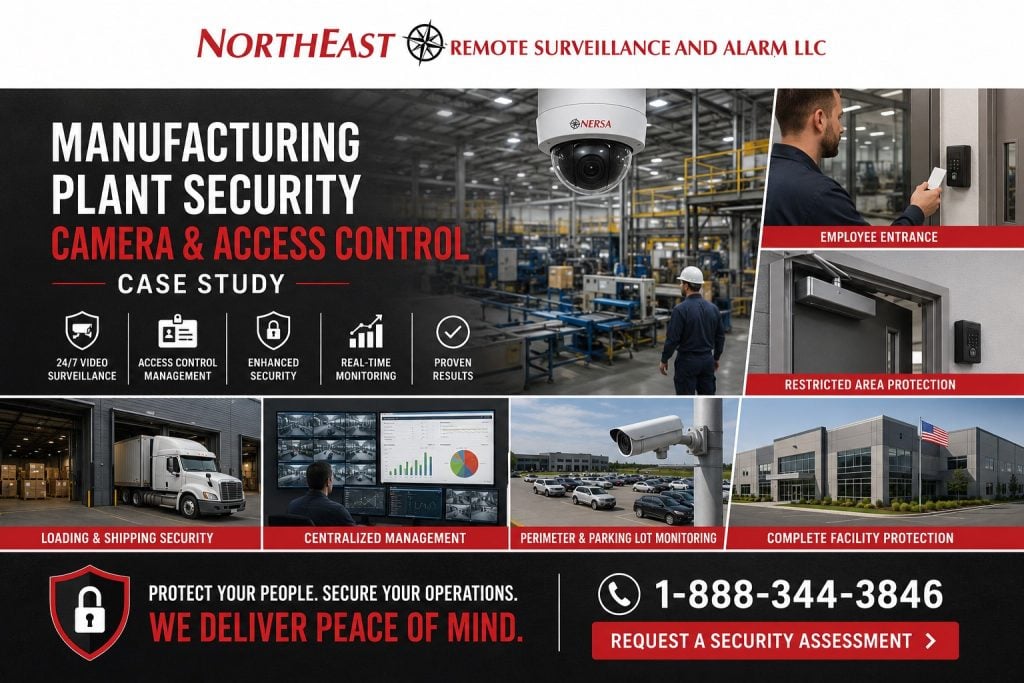
Case Study Overview
This case study is based on a common manufacturing facility security challenge: the property had multiple employee entrances, production areas, shipping and receiving activity, parking lot exposure, restricted rooms, contractor access, and after-hours concerns, but management needed a more coordinated security layout.
The facility did not need a generic camera package or a few standalone electronic locks. It needed a combined camera and access control strategy that supported plant operations, employee movement, restricted-area protection, incident review, and long-term facility management.
The goal was to improve security around:
- Employee entrances
- Production floor areas
- Restricted rooms
- Maintenance areas
- Tool rooms
- IT or control rooms
- Shipping and receiving areas
- Loading dock approaches
- Contractor access points
- Parking lot activity
- Exterior building approaches
- After-hours entry
- Door event review
- Incident documentation
- Remote management visibility
This page focuses only on the manufacturing plant security camera and access control case study. For broader manufacturing facility planning, visit Manufacturing Security Systems. For broader access control planning, visit Commercial and Industrial Access Control Systems. For broader camera planning, visit Commercial Video Surveillance Systems.
Property Type
The property was an anonymous manufacturing facility with active production areas, employee entrances, industrial work zones, restricted rooms, shipping and receiving areas, exterior parking, and after-hours exposure.
The site included:
- Production floor activity
- Employee entrances
- Administrative areas
- Shipping and receiving areas
- Loading dock activity
- Maintenance and utility spaces
- Restricted rooms
- IT or control-related areas
- Parking lot exposure
- Exterior approaches
- Contractor and vendor movement
- Existing camera coverage that needed improvement
- Existing key-control concerns
- A need for better event documentation
Like many manufacturing plants, the security challenge was not limited to one door or one camera. The issue was how cameras, access control, operations, employees, contractors, vehicles, and restricted areas worked together across the facility.
The Security Challenge
The main challenge was combining visibility with controlled access.
The plant needed a better way to manage who entered the building, which areas they could access, and how management could review events around production areas, employee entrances, shipping activity, and restricted spaces.
Common concerns included:
- Employee entrances with limited access accountability
- Production areas needing better visibility
- Restricted rooms requiring tighter control
- Contractor and vendor movement inside the facility
- Shipping and receiving areas needing better documentation
- Loading dock activity needing stronger review
- Parking lot and exterior approach exposure
- Existing cameras that did not support incident review well
- Keys or informal access habits creating management concerns
- After-hours activity needing better documentation
- Management needing remote review capability
This is a common issue in manufacturing security. A plant may have cameras and locks, but if those systems are not planned around workflow, access points, risk areas, and incident review, they may not provide enough control when something happens.
For broader industrial security planning, visit Industrial Security Systems.
Why Manufacturing Plants Need Cameras and Access Control Together
Manufacturing facilities have movement patterns that are different from standard offices, retail properties, or small commercial buildings.
A plant may have:
- Shift changes
- Employee entrances
- Production areas
- Office-to-plant transitions
- Shipping and receiving areas
- Dock activity
- Tool rooms
- Maintenance rooms
- Mechanical rooms
- Contractor access
- Vendor access
- Forklift movement
- Equipment areas
- Parking lots
- After-hours activity
Access control helps manage who can enter specific openings. Cameras help show what happened around those openings and throughout key operational areas.
Together, cameras and access control help answer:
- Who entered the facility?
- Which door was used?
- Was the access authorized?
- Was the event during an approved schedule?
- Was someone following behind an authorized user?
- What happened before or after the door event?
- Was the activity related to production, maintenance, shipping, or after-hours movement?
- Can management review the event quickly?
The value comes from designing both systems together instead of treating them as separate projects.
Site Conditions Reviewed
Before recommending the final layout, Northeast Remote Surveillance and Alarm, LLC reviewed how the manufacturing plant operated.
The review focused on:
- Employee entrance locations
- Shift-change movement
- Production floor visibility
- Office-to-plant transitions
- Restricted room locations
- Maintenance and utility rooms
- Shipping and receiving workflow
- Loading dock activity
- Contractor and vendor access
- Parking lot exposure
- Exterior building approaches
- Existing cameras
- Existing keys and door hardware
- Network and low-voltage pathways
- Fire alarm and egress-sensitive openings
- ADA considerations
- Remote management needs
- Future expansion planning
The design started with the plant’s workflow, not a fixed camera count or a one-size-fits-all access control package.
Access Control Design Strategy
The recommended access control layout focused on the openings where accountability mattered most.
The goal was to give management control over employee entry, restricted spaces, and after-hours access while keeping the system practical for daily plant operation.
Employee Entrance Control
Employee entrances were treated as priority openings because they controlled daily movement into the facility.
Employee entrance access control can help manage:
- Shift-based access
- Early arrivals
- Late departures
- Employee offboarding
- Contractor entry
- Vendor entry
- Door event history
- Door-held-open events
- Door-forced-open events
- After-hours access
A controlled employee entrance helps reduce unmanaged keys and creates a stronger record of building access.
Production Area Access Control
Some manufacturing areas may need controlled access based on safety, process, equipment, inventory, or operational sensitivity.
Production-area access control may help restrict:
- Specialized production zones
- Sensitive process areas
- Equipment rooms
- Tooling areas
- Maintenance areas
- Quality control rooms
- Engineering spaces
- Chemical or material storage rooms
- Control rooms
Not every production area needs controlled access, but the areas that affect safety, operations, materials, or sensitive processes should be reviewed carefully.
Restricted Room Protection
Manufacturing plants often include rooms that should not be available to every employee, contractor, vendor, or visitor.
Restricted rooms may include:
- IT rooms
- Server rooms
- Controls rooms
- Mechanical rooms
- Electrical rooms
- Maintenance rooms
- Tool rooms
- Parts rooms
- Chemical storage rooms
- Quality control rooms
- Records rooms
- Management offices
Access control helps limit these areas to authorized users and creates an event history when access occurs.
Contractor and Vendor Access
Manufacturing plants often have contractors, service vendors, delivery personnel, maintenance providers, and outside technicians moving through the property.
A stronger access control plan can help manage:
- Vendor entry
- Contractor schedules
- Temporary credentials
- Restricted-area limits
- After-hours work
- Access expiration
- Door event review
- Escort-sensitive areas
A contractor should not automatically have the same access as an employee. Permissions should match the work being performed.
Camera Coverage Strategy
The camera layout was planned to support production visibility, access control review, shipping activity, exterior awareness, and incident documentation.
Employee Entrance Cameras
Employee entrance cameras can help document:
- Credential use
- Employee arrival
- Employee departure
- Shift-change movement
- Tailgating
- Visitor or contractor entry
- Door-held-open activity
- After-hours access
- Events before and after entry
These views provide visual context around access control events.
Production Floor Cameras
Production floor cameras should be designed carefully around operational visibility, safety awareness, process review, and incident documentation.
Production camera views may support:
- Workflow review
- Equipment-area visibility
- Incident investigation
- Safety event review
- Contractor activity review
- Material movement review
- Restricted-zone awareness
- Management visibility
The goal is not to watch employees unnecessarily. The goal is to provide useful operational visibility where safety, production, materials, equipment, or incident review matters.
Shipping and Receiving Cameras
Shipping and receiving areas often need camera coverage because materials, vendors, carriers, forklifts, and staged product all move through the same space.
Cameras may help document:
- Dock activity
- Trailer loading
- Trailer unloading
- Forklift movement
- Product staging
- Vendor activity
- Shipment disputes
- Damage claims
- After-hours dock activity
For dock-specific planning, visit Loading Dock Surveillance Cameras.
Parking Lot and Exterior Cameras
Parking lot and exterior cameras can help document:
- Employee arrival and departure
- Visitor parking
- Contractor vehicles
- Building approaches
- Exterior doors
- Side and rear areas
- After-hours activity
- Vehicle incidents
- Pedestrian movement
For parking lot-specific proof, visit Commercial Parking Lot Security Camera Case Study.
Restricted Area Camera Support
Some restricted areas may benefit from camera views near the controlled opening.
These cameras can help show:
- Who approached the door
- Whether someone tailgated
- Whether a door was propped open
- Whether the activity matched the access event
- What happened before or after a denied access attempt
- Whether a contractor or visitor entered a sensitive area
Camera support is especially useful near IT rooms, control rooms, tool rooms, maintenance areas, and other restricted spaces.
Door Hardware and Life-Safety Considerations
Access control in a manufacturing facility must be designed around the door, the work environment, and the life-safety requirements.
Manufacturing access control may involve:
- Electric strikes
- Electrified trim
- Electrified locks
- Exit devices
- Request-to-exit devices
- Door contacts
- Door position switches
- Door closers
- Power supplies
- Fire alarm release where required
- Free egress requirements
- ADA accessibility
- Harsh environment conditions
- Authority Having Jurisdiction expectations
A controlled door must not trap people inside or interfere with required egress. Door hardware, access control behavior, and fire alarm coordination must be reviewed before installation.
For broader life-safety planning, visit Commercial and Industrial Fire Alarm Installation and NFPA Standards and Commercial Security, Fire Alarm, and Life Safety Systems.
Remote Management and Review
Manufacturing plant managers, facility directors, owners, and operations leaders may need remote access to cameras and access control events.
Remote management may help authorized users:
- Review employee entrance events
- Check camera footage
- Review after-hours access
- Remove users quickly
- Adjust access schedules
- Review restricted-room access
- Check parking lot activity
- Support multi-site operations
- Investigate incidents
- Coordinate with internal leadership
Remote access should be planned with strong credentials, role-based permissions, cybersecurity awareness, and clear internal procedures.
For broader security standards and cybersecurity context, visit ISO Standards and Their Application to Commercial and Industrial Security.
Alarm and Monitoring Coordination
Manufacturing plant access control and cameras may also support intrusion alarm and monitoring workflows.
Depending on the facility, the system may coordinate with:
- Door-forced-open events
- Door-held-open alerts
- After-hours access alerts
- Restricted room alarms
- Exterior door alarms
- Overhead door alarms
- Video verification
- Remote monitoring workflows
- Management notifications
- Central station monitoring where appropriate
For alarm planning, visit Commercial and Industrial Alarm Installation. For monitoring planning, visit Commercial and Industrial Security Monitoring.
Operational Result
The manufacturing plant security design helped the facility move from disconnected visibility and key-based access toward a more accountable camera and access control layout.
The system supported:
- Better employee entrance control
- Better production area visibility
- Better restricted room protection
- Better shipping and receiving review
- Better parking lot and exterior awareness
- Better video context around door events
- Better after-hours activity review
- Better remote management capability
- Better support for incident review
- Better long-term scalability
No sensitive customer information, exact camera maps, door schedules, access permissions, production processes, alarm zones, passwords, or security weaknesses are published in this case study.
The value of the project was the combined security strategy, not just the hardware.
What This Case Study Does Not Cover
This page is focused specifically on a manufacturing plant security camera and access control case study.
It is not the main manufacturing security page. It is not the main access control page. It is not the main commercial video surveillance page. It is not the main alarm page. It is not the main loading dock page. It is not a fire alarm page. It is not a city hub.
For manufacturing security planning, visit Manufacturing Security Systems.
For access control planning, visit Commercial and Industrial Access Control Systems.
For camera system planning, visit Commercial Video Surveillance Systems.
For alarm system planning, visit Commercial and Industrial Alarm Installation.
For the full case-study hub, visit Commercial and Industrial Security Case Studies.
Lessons From This Manufacturing Plant Security Case Study
This case study highlights several practical lessons for industrial security planning.
Manufacturing Security Must Follow the Workflow
The strongest system is designed around employee movement, production activity, shipping and receiving, contractor access, restricted rooms, and after-hours conditions.
Cameras and Access Control Should Work Together
Access control shows who used a door. Cameras show what happened around that door and throughout key operational areas.
Production Areas Need Practical Visibility
Manufacturing camera coverage should support safety, operations, incident review, material movement, and restricted-zone awareness without creating unnecessary or poorly planned coverage.
Door Hardware Must Be Reviewed Before Installation
A reader cannot be selected properly until the door, frame, lock, exit hardware, environment, egress path, and life-safety requirements are reviewed.
Remote Management Helps Industrial Facilities
Manufacturing leaders often need to review activity, remove users, check cameras, and manage access without being physically present at every door or building.
Recommended Manufacturing Plant Security Assessment
A manufacturing plant security camera and access control assessment should review the full facility before final recommendations are made.
Northeast Remote Surveillance and Alarm, LLC may review:
- Employee entrances
- Visitor entrances
- Production areas
- Office-to-plant transitions
- Restricted rooms
- IT rooms
- Control rooms
- Tool rooms
- Maintenance rooms
- Mechanical rooms
- Shipping and receiving areas
- Loading docks
- Parking lots
- Exterior approaches
- Contractor access
- Vendor access
- Existing cameras
- Existing keys
- Existing door hardware
- Fire alarm release needs
- Egress-sensitive openings
- ADA considerations
- Network infrastructure
- Remote management needs
- Alarm integration needs
- Future expansion
The goal is to design a system that fits the way the manufacturing plant actually operates.
Frequently Asked Questions About Manufacturing Plant Security Cameras and Access Control
What is a manufacturing plant security camera and access control system?
A manufacturing plant security camera and access control system combines video surveillance and credential-based entry control to help manage employee entrances, production areas, restricted rooms, shipping areas, parking lots, and after-hours activity.
Why do manufacturing plants need access control?
Manufacturing plants need access control to manage employee entry, contractor access, restricted rooms, production areas, tool rooms, IT rooms, maintenance spaces, and after-hours access.
Why should cameras be paired with access control?
Cameras provide visual context around access control events. They can help show who approached a door, whether someone tailgated, whether a door was propped open, and what happened before or after access occurred.
What areas should manufacturing plant cameras cover?
Common camera areas include employee entrances, production areas, shipping and receiving areas, loading docks, parking lots, exterior approaches, restricted room entrances, maintenance areas, and warehouse-adjacent spaces.
Can cameras help review production floor incidents?
Yes. Properly placed cameras can help support incident review, safety event documentation, workflow review, contractor activity review, and material movement review when designed around the facility’s operational needs.
What doors should be controlled in a manufacturing facility?
Common controlled doors include employee entrances, office-to-plant doors, IT rooms, control rooms, tool rooms, maintenance rooms, chemical or material storage rooms, quality control rooms, and restricted production areas.
Can access control reduce key problems?
Yes. Access control can reduce lost-key, copied-key, shared-key, and rekeying problems because credentials can be added, removed, or changed electronically.
Can manufacturing security systems be managed remotely?
Yes. Many modern systems allow authorized users to review camera footage, manage access credentials, adjust schedules, and review activity remotely.
Does access control need to coordinate with fire alarm systems?
Some doors may require fire alarm release or life-safety coordination. Access control must be designed so it does not interfere with required egress or local Authority Having Jurisdiction expectations.
Can a manufacturing plant security system integrate with alarms?
Yes. Access control and cameras can support intrusion alarm workflows, door-forced-open alerts, door-held-open alerts, after-hours activity review, restricted-room alarms, and video verification.
Can existing cameras or readers be reused?
Sometimes. Existing equipment may be reused if it is compatible, reliable, properly positioned, serviceable, and aligned with the new design. A site assessment should determine what can remain.
Does NERSA publish exact customer manufacturing layouts?
No. Northeast Remote Surveillance and Alarm, LLC does not publish sensitive customer camera maps, access schedules, door permissions, production details, passwords, alarm zones, or security weaknesses in public case studies.
Does NERSA install residential cameras or access control?
No. Northeast Remote Surveillance and Alarm, LLC focuses on commercial, industrial, warehouse, logistics, manufacturing, institutional, municipal, healthcare, and enterprise security systems.
How do I request a manufacturing plant security assessment?
Call 1-888-344-3846 or request a security assessment. Northeast Remote Surveillance and Alarm, LLC can review your entrances, production areas, doors, cameras, restricted rooms, parking areas, user needs, life-safety requirements, and long-term security goals.
Request a Manufacturing Plant Security Camera and Access Control Assessment
Manufacturing plant security cameras and access control should be designed around real industrial operations. Employee entrances, production areas, restricted rooms, shipping areas, docks, parking lots, contractor access, door hardware, access schedules, remote management, alarms, and life-safety requirements all affect the final system design.
If your manufacturing facility, industrial plant, production building, warehouse-connected plant, food processing facility, fabrication shop, or commercial industrial property needs better camera coverage and access control, Northeast Remote Surveillance and Alarm, LLC can evaluate the property and recommend a practical security layout.
Call 1-888-344-3846 or request a security assessment.