Remote video monitoring and live talk-down can help commercial and industrial properties move beyond passive recording by adding live event review, operator response, audio deterrence, and stronger after-hours awareness. This anonymous case study shows how Northeast Remote Surveillance and Alarm, LLC approaches a monitored video project when a property needs better exterior visibility, verified activity review, live talk-down capability, and practical documentation around after-hours security events. For the full proof library, visit Commercial and Industrial Security Case Studies.
Call 1-888-344-3846 to request a remote video monitoring and live talk-down assessment.
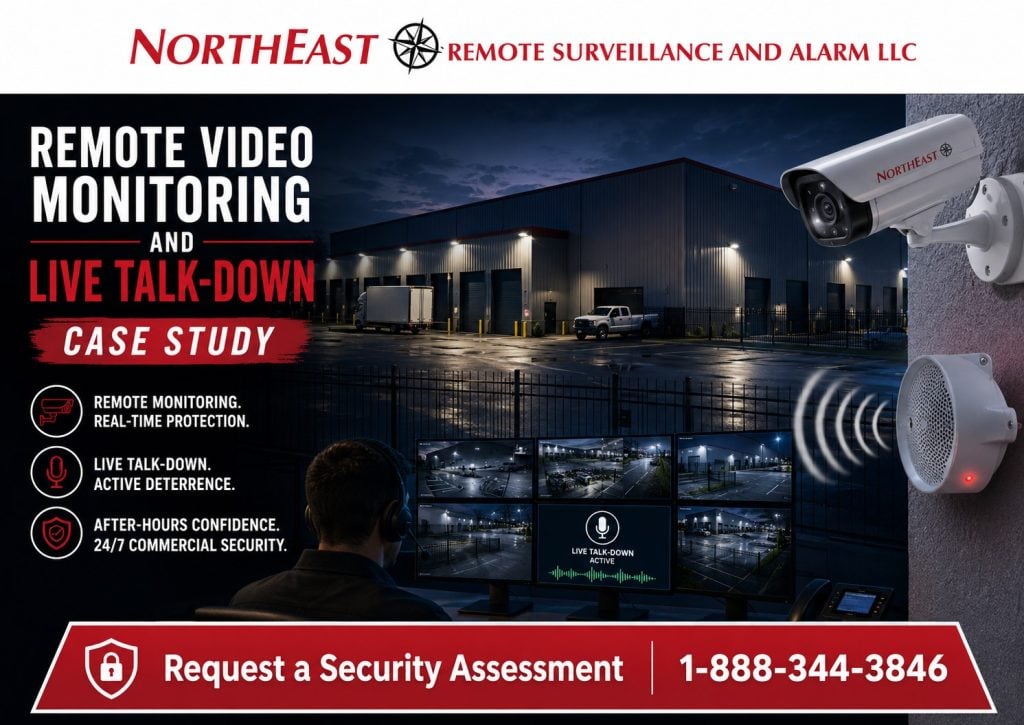
Case Study Overview
This case study is based on a common commercial property challenge: the site had camera coverage, but management needed a more active way to address suspicious after-hours activity around exterior areas, parking lots, gates, fenced storage zones, loading areas, and building approaches.
The property did not need only recorded video. It needed a monitored video strategy designed around where suspicious activity actually occurred, which camera views were useful, when monitoring should be active, and how live talk-down could support deterrence.
The goal was to improve security around:
- Parking lots
- Building approaches
- Fenced exterior areas
- Trailer or equipment zones
- Gate entrances
- Loading dock approaches
- Side and rear exterior areas
- After-hours vehicle activity
- Loitering concerns
- Trespassing concerns
- Suspicious movement near assets
- Remote operator review
- Live talk-down warnings
- Event documentation
This page focuses only on the remote video monitoring and live talk-down case study. For the main service page, visit Remote Video Monitoring and Live Talk-Down. For broader commercial camera planning, visit Commercial Video Surveillance Systems.
Property Type
The property was an anonymous commercial and industrial-style site with exterior exposure, after-hours activity concerns, existing camera needs, and areas where passive recording alone was not enough.
The site included:
- Exterior parking areas
- Building entrances
- Rear or side approaches
- Outdoor storage exposure
- Gate or driveway activity
- Low-staff periods
- After-hours vulnerability
- Camera views that needed monitoring review
- A need for clearer response procedures
- A need for better incident documentation
This type of challenge can apply to warehouses, contractor yards, truck yards, distribution centers, office buildings, industrial sites, healthcare properties, multi-tenant buildings, parking lots, and commercial campuses.
The Security Challenge
The main challenge was that recorded video helped after an incident, but it did not create a real-time response while suspicious activity was happening.
Common concerns included:
- People entering exterior areas after hours
- Vehicles stopping in unusual locations
- Loitering near buildings or fenced areas
- Repeated suspicious activity in parking areas
- Unverified motion events
- Poor awareness around side and rear areas
- Exterior activity happening when staff was not present
- Management discovering problems after the fact
- No live audio warning when activity was verified
- No clear operator workflow for monitoring events
- Limited documentation around after-hours incidents
This is a common weakness in commercial security. A camera system may record everything, but if nobody is watching the right views at the right time, the business may only learn what happened after the incident is already over.
For broader monitored response planning, visit Commercial and Industrial Security Monitoring.
Why Live Monitoring Is Different From Recorded Video
Recorded video is reactive. It helps management investigate after an incident.
Remote video monitoring is more active. It can help detect, verify, warn, notify, and document activity while the event is happening.
Recorded video can answer:
- What happened?
- When did it happen?
- Which camera captured the event?
- Can footage be exported?
- What did the incident look like after the fact?
Remote video monitoring can help answer:
- Is suspicious activity happening now?
- Does the event need a live warning?
- Should a contact be notified?
- Should the event be escalated?
- Is the activity authorized or unauthorized?
- Does the event require documentation?
Live talk-down adds another layer by allowing an operator to issue a real-time voice warning when suspicious activity is verified.
Site Conditions Reviewed
Before recommending a monitored video layout, Northeast Remote Surveillance and Alarm, LLC reviewed how the property operated.
The review focused on:
- Where after-hours activity occurred
- Which exterior areas had the most exposure
- Which camera views were useful
- Which camera views were too wide, too dark, or poorly angled
- Where speakers could be heard effectively
- Whether existing lighting supported monitoring
- Whether the network could support remote video
- Which hours required monitoring
- Which contacts should receive notifications
- Which events should be escalated
- Which areas should only be recorded
- Which areas should be actively monitored
- Whether gate, alarm, or access control events should support monitoring
- How incident documentation should be handled
The monitoring design started with the property’s actual risk areas, not a generic camera list.
Monitoring Strategy
The recommended monitoring strategy focused on the most exposed exterior areas.
The goal was not to monitor every camera equally. The goal was to identify the camera views where operator review and live talk-down could provide the most value.
Parking Lot Monitoring
Parking lots were reviewed because they often involve after-hours vehicles, pedestrian movement, employee arrivals, visitor activity, and exterior incidents.
Parking lot monitoring may help review:
- Suspicious vehicles
- Vehicles stopping after hours
- People walking between vehicles
- Loitering near entrances
- Activity near employee parking
- Exterior incident patterns
- Pedestrian movement near buildings
- After-hours parking lot exposure
For parking lot proof, visit Commercial Parking Lot Security Camera Case Study.
Gate and Entrance Monitoring
Gate and entrance areas were reviewed because they control how people and vehicles approach the property.
Monitoring these areas can help evaluate:
- After-hours gate activity
- Vehicles approaching a controlled entrance
- Tailgating
- People waiting near an entrance
- Unauthorized access attempts
- Vendor or driver activity
- Vehicles circling the property
- Gate-left-open concerns
For vehicle gate planning, visit Commercial Gate Access Control Systems.
Fenced Yard and Exterior Storage Monitoring
Fenced yards and exterior storage areas were reviewed because they often contain valuable assets that remain outside the building.
Monitoring can help protect:
- Contractor yards
- Equipment storage areas
- Trailer rows
- Outdoor materials
- Fleet vehicles
- Tools and supplies
- Yard lanes
- Fence-line approaches
- Side and rear exterior areas
For a related proof page, visit Contractor Yard Security Camera and Gate Case Study.
Loading Dock and Building Approach Monitoring
Loading docks and building approaches may require monitoring when after-hours activity, freight exposure, vendor movement, or exterior door activity creates risk.
Monitoring may support review around:
- Dock doors
- Shipping and receiving areas
- Trailer positions
- Dock aprons
- Exterior man doors
- Rear building approaches
- After-hours freight movement
- Activity near overhead doors
For dock-specific proof, visit Loading Dock Camera Coverage Case Study.
Live Talk-Down Strategy
Live talk-down was considered for areas where an audio warning could be heard and where operator review could confirm suspicious activity.
Live talk-down may be used when:
- A person is trespassing
- Someone is loitering near the building
- A vehicle is stopped after hours in a restricted area
- A person enters a fenced yard
- Someone approaches equipment or trailers
- Activity appears suspicious and unauthorized
- An operator can verify the event through camera views
A live talk-down warning should be targeted and purposeful. The goal is not to generate constant noise. The goal is to deter suspicious activity after it is verified.
Camera Placement for Monitoring
Remote monitoring depends on clear camera views.
The system design reviewed whether camera views were strong enough for operators to make decisions.
Camera placement considered:
- Field of view
- Mounting height
- Distance to target areas
- Night visibility
- Lighting conditions
- Headlight glare
- Weather exposure
- Obstructions
- Fence-line angles
- Gate-lane visibility
- Parking lot coverage
- Speaker coverage
- Remote video quality
- Camera naming and organization
A camera that works for general recording may not be good enough for live operator review. Monitoring cameras must help the operator understand what is happening quickly.
Lighting and Night Visibility
After-hours monitoring depends heavily on nighttime image quality.
The property review considered:
- Existing pole lights
- Dark corners
- Glare from vehicle headlights
- Shadows near buildings
- Lighting near gates
- Lighting near fenced areas
- Infrared camera performance
- Low-light camera performance
- Speaker placement relative to monitored areas
If the monitored view is too dark or too washed out, live review becomes less effective. Lighting, camera selection, and camera angle must work together.
Notification and Escalation Procedures
Remote video monitoring is only effective when the response process is clear.
The monitoring plan reviewed:
- Which events should trigger operator review
- Which events should receive live talk-down
- Which contacts should be notified
- When escalation should occur
- Whether law enforcement notification may be appropriate
- Which events should be documented
- Which events should be reported to management
- Whether different rules are needed by day, night, weekend, or holiday
- Whether alarms, gates, or access events should support the monitoring process
The monitoring workflow must match the property’s risk and staffing pattern.
Alarm and Access Control Coordination
Remote video monitoring can support other security systems.
Depending on the property, monitoring may coordinate with:
- Intrusion alarms
- Door contacts
- Gate access control
- Door-forced-open events
- Door-held-open events
- After-hours access events
- Yard motion alerts
- Parking lot alerts
- Restricted-area activity
- Video verification workflows
When cameras, alarms, access control, gates, and monitoring are planned together, management has better context and a stronger response process.
For alarm planning, visit Commercial and Industrial Alarm Installation. For access control planning, visit Commercial and Industrial Access Control Systems.
Operational Result
The remote video monitoring and live talk-down design helped the property move from passive recording toward a more active after-hours security posture.
The system supported:
- Better exterior awareness
- Better after-hours event review
- Better parking lot visibility
- Better gate and entrance review
- Better fenced area protection
- Better live deterrence capability
- Better management notification procedures
- Better event documentation
- Better support for incident review
- Better confidence around low-staff periods
No sensitive customer information, exact camera maps, monitoring schedules, response rules, passwords, alarm zones, access rules, or security weaknesses are published in this case study.
The value of the project was the monitored response strategy, not just the cameras or speakers.
What This Case Study Does Not Cover
This page is focused specifically on a remote video monitoring and live talk-down case study.
It is not the main remote monitoring service page. It is not the main commercial video surveillance page. It is not the main alarm page. It is not the main access control page. It is not the main gate access page. It is not a truck yard-only page. It is not a city hub.
For direct service planning, visit Remote Video Monitoring and Live Talk-Down.
For camera system planning, visit Commercial Video Surveillance Systems.
For alarm planning, visit Commercial and Industrial Alarm Installation.
For gate planning, visit Commercial Gate Access Control Systems.
For the full case-study hub, visit Commercial and Industrial Security Case Studies.
Lessons From This Remote Video Monitoring and Live Talk-Down Case Study
This case study highlights several practical lessons for monitored commercial security.
Recorded Video Alone Is Not Active Deterrence
Recorded video helps after an incident. Remote video monitoring can help evaluate activity while it is happening.
Live Talk-Down Requires Usable Camera Views
Operators need clear views before issuing warnings. Camera placement, lighting, and monitoring rules must work together.
Not Every Camera Needs Live Monitoring
Monitoring should focus on high-risk views such as gates, parking lots, exterior storage areas, fenced yards, dock approaches, and after-hours building approaches.
Speaker Placement Matters
Live talk-down works best when speakers are positioned near the monitored area and can be heard clearly.
Monitoring Procedures Must Be Defined
The system should define what activity gets reviewed, when warnings are issued, who is notified, and how events are documented.
Recommended Remote Video Monitoring Assessment
A remote video monitoring and live talk-down assessment should review the property before monitoring rules are finalized.
Northeast Remote Surveillance and Alarm, LLC may review:
- Parking lots
- Gates
- Building approaches
- Fenced yards
- Exterior storage areas
- Trailer areas
- Loading docks
- Side and rear exterior zones
- Lighting conditions
- Existing cameras
- Existing network infrastructure
- Speaker locations
- Monitoring hours
- Contact lists
- Escalation expectations
- Alarm integration needs
- Access control integration needs
- Remote access needs
- Recording and retention needs
- Future expansion
The goal is to create a monitoring layout that matches how the property actually operates.
Frequently Asked Questions About Remote Video Monitoring and Live Talk-Down
What is remote video monitoring?
Remote video monitoring uses cameras, software, event review, and operator workflows to help watch selected property areas during defined monitoring periods.
What is live talk-down?
Live talk-down allows an operator to issue a real-time audio warning through speakers when suspicious activity is verified on camera.
How is remote video monitoring different from recorded video?
Recorded video helps investigate after an event. Remote video monitoring can help review, warn, notify, and document activity while it is happening.
What types of properties benefit from live talk-down?
Truck yards, contractor yards, warehouses, parking lots, distribution centers, industrial sites, fenced storage areas, commercial buildings, and properties with after-hours exposure may benefit from live talk-down.
Can remote monitoring help deter trespassing?
Yes. Remote monitoring can support deterrence when suspicious activity is verified and a live audio warning is issued through properly placed speakers.
Do all cameras need to be monitored?
No. Monitoring should focus on priority views such as gates, parking lots, exterior storage, fenced yards, dock approaches, and other high-risk areas.
Can existing cameras be used for remote monitoring?
Sometimes. Existing cameras may be used if they provide clear, reliable, properly angled views with usable night performance and remote access capability.
Does live talk-down require speakers?
Yes. Live talk-down requires audio speakers or compatible audio devices positioned where warnings can be heard by the person in the monitored area.
Can remote monitoring work with alarms?
Yes. Remote monitoring can support alarm verification, door events, gate events, after-hours alerts, and intrusion detection workflows when the systems are planned together.
Can remote monitoring work with gate access control?
Yes. Cameras and monitoring can provide visual context around gate access, vehicle activity, tailgating, and after-hours gate movement.
Can remote monitoring help reduce false alarms?
Video review can help determine whether activity appears suspicious, authorized, weather-related, animal-related, or false, which may support better response decisions.
Is remote video monitoring the same as hiring an on-site guard?
No. Remote video monitoring is not the same as an on-site guard. It is a monitored video and response workflow designed to support selected areas during defined times.
Does NERSA publish exact customer monitoring procedures?
No. Northeast Remote Surveillance and Alarm, LLC does not publish sensitive customer camera maps, monitoring schedules, response procedures, passwords, alarm zones, access rules, or security weaknesses in public case studies.
Does NERSA install residential remote monitoring systems?
No. Northeast Remote Surveillance and Alarm, LLC focuses on commercial, industrial, warehouse, logistics, manufacturing, institutional, municipal, healthcare, and enterprise security systems.
How do I request a remote video monitoring and live talk-down assessment?
Call 1-888-344-3846 or request a security assessment at. Northeast Remote Surveillance and Alarm, LLC can review your cameras, exterior areas, lighting, speaker locations, monitoring needs, escalation procedures, and after-hours security goals.
Request a Remote Video Monitoring and Live Talk-Down Assessment
Remote video monitoring and live talk-down should be designed around real property exposure. Parking lots, gates, fenced yards, loading areas, exterior storage, truck courts, building approaches, lighting conditions, camera views, speakers, monitoring hours, and escalation procedures all affect the final design.
If your warehouse, truck yard, contractor yard, distribution center, parking lot, commercial building, industrial facility, or exterior commercial property needs better after-hours visibility and active deterrence, Northeast Remote Surveillance and Alarm, LLC can evaluate the site and recommend a practical monitored video layout.
Call 1-888-344-3846 or request a security assessment.