
Plan remote video monitoring around the after-hours activity at your Scranton property and the people responsible for responding.

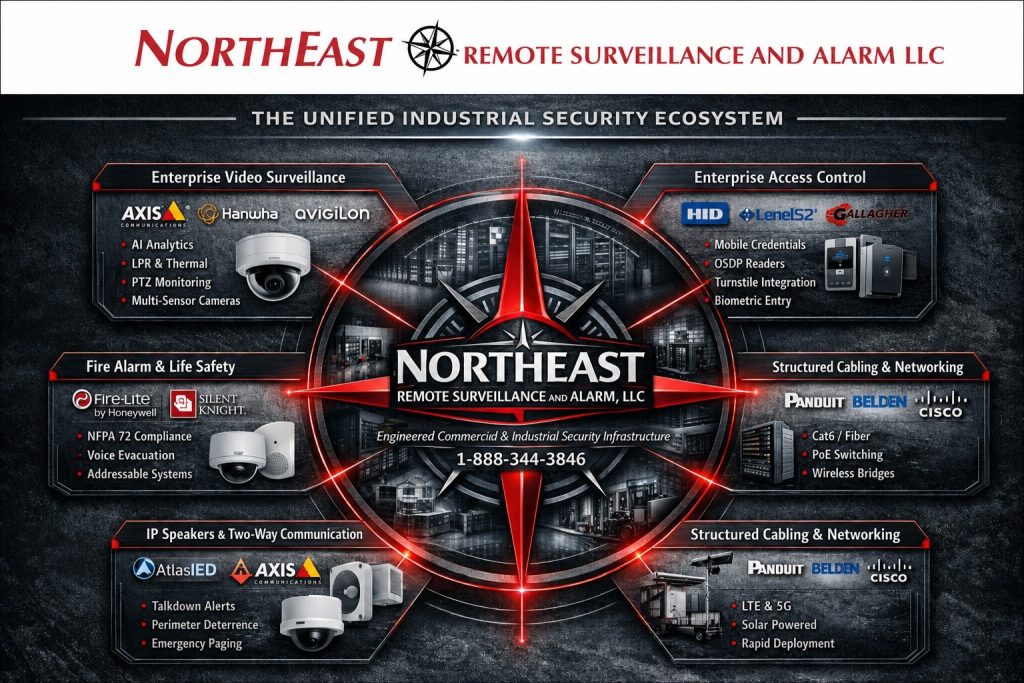
For the broader system plan and related facility applications, visit the Scranton commercial and industrial security guide.
Northeast Remote Surveillance and Alarm, LLC (NERSA) designs, integrates, upgrades, and supports commercial remote video monitoring systems throughout Scranton, Lackawanna County, and the surrounding Northeastern Pennsylvania market.
Remote monitoring can be especially valuable for:
- Warehouses
- Distribution centers
- Manufacturing facilities
- Contractor yards
- Equipment yards
- Truck and trailer yards
- Commercial parking lots
- Industrial properties
- Loading docks
- Vehicle gates
- Outdoor storage
- Multi-building facilities
- Commercial campuses
- Other properties with significant after-hours exposure
The objective is not to have someone continuously watch every camera.
The stronger approach is to use properly positioned cameras, analytics, schedules, and defined rules to identify activity that deserves attention.
For broader surveillance planning:
Commercial Video Surveillance Systems in Scranton, PA →
Explore this guide: What Is Remote Video Monitoring? · Remote Monitoring vs.
Recorded Video Surveillance · Remote Video Monitoring and AI Analytics · Why Camera Placement Matters · Remote Video Monitoring FAQs
What Is Remote Video Monitoring?
Remote video monitoring uses a commercial surveillance system to identify selected events and make relevant camera footage available for remote review.
A typical workflow may look like:
Detection → Video Event → Operator Review → Verification → Defined Response
Depending on the system design and monitoring arrangement, the event may begin with:
- AI person detection
- Vehicle detection
- Restricted-zone activity
- Line crossing
- Perimeter detection
- Alarm activation
- Scheduled after-hours activity
The goal is to focus attention on specific security events instead of asking an operator to continuously watch dozens of camera views.
Remote Monitoring vs. Recorded Video Surveillance
Traditional video surveillance primarily answers:
What happened?
Remote video monitoring can help address:
What is happening now, and does it require attention?
Recorded surveillance remains essential for:
- Investigation
- Documentation
- Incident reconstruction
- Evidence review
Remote monitoring adds an active layer for selected events.
The two functions should work together.
Remote Video Monitoring and AI Analytics
Modern commercial surveillance platforms can use analytics to identify defined activity before video is presented for review.
Potential analytics include:
- Person detection
- Vehicle detection
- Line crossing
- Restricted-zone intrusion
- Loitering
- Direction-of-travel detection
- Vehicle classification
Analytics can help reduce nuisance events that would otherwise be created by ordinary motion detection.
For deeper intelligent-video planning:
AI Video Surveillance Systems in Scranton, PA →
Why Camera Placement Matters
Remote monitoring cannot compensate for poor camera placement.
An operator can only verify what the camera can actually see.
A successful monitored camera should provide sufficient detail to determine:
- Whether a person is present
- Whether a vehicle entered a restricted area
- Where activity is occurring
- Whether the event appears authorized or suspicious
- Which additional camera should be reviewed
Cameras mounted excessively high, aimed too broadly, or blocked by equipment can reduce verification value even when analytics detect activity correctly.
Remote Monitoring for Scranton Warehouses
Warehouses frequently operate across large properties with multiple exterior risk areas.
Remote monitoring may support:
- Loading docks
- Employee entrances
- Trailer yards
- Shipping and receiving
- Exterior storage
- Vehicle gates
- Parking areas
- Fence lines
For broader warehouse-camera planning:
A warehouse monitoring strategy should distinguish normal operational activity from activity occurring outside expected schedules.
Remote Video Monitoring for Contractor Yards
Contractor yards are particularly strong candidates for remote video monitoring because high-value assets may remain outdoors after employees leave.
Potential monitored areas include:
- Work trucks
- Heavy equipment
- Trailers
- Tools
- Materials
- Fuel areas
- Storage containers
- Gates
- Fence lines
For contractor-yard planning:
AI analytics can help identify people or vehicles entering designated areas during selected hours.
Remote Monitoring for Manufacturing Facilities
Manufacturing properties can contain large exterior areas, loading docks, employee entrances, production buildings, warehouses, and equipment yards.
Remote monitoring may provide another security layer around:
- Exterior storage
- Employee entrances
- Contractor entrances
- Loading docks
- Vehicle gates
- Parking areas
- Restricted exterior zones
The monitored areas should be selected according to actual after-hours risk rather than simply enabling alerts on every camera.
Parking Lot Remote Video Monitoring
Commercial parking areas can remain exposed outside normal business hours.
Monitoring may focus on:
- Vehicle entrances
- Building approaches
- Restricted parking areas
- Employee entrances
- After-hours pedestrian activity
For dedicated parking-lot design:
Parking Lot Video Surveillance Systems in Scranton, PA →
A parking overview camera may provide situational awareness while more focused cameras provide verification around entrances or chokepoints.
Loading Dock Monitoring
Loading docks can remain vulnerable after shipping operations stop.
Potential monitored events include:
- People approaching closed docks
- Vehicles entering restricted dock areas
- Activity around trailers
- Movement near shipping entrances
- After-hours loading activity
A loading-dock system may combine:
- Exterior overview cameras
- Dock-door cameras
- AI analytics
- Intrusion detection
- Lighting
- Remote monitoring
Truck and Trailer Yard Monitoring
Trailer yards can cover large areas with limited staffing.
Remote video monitoring may support detection around:
- Trailer rows
- Yard entrances
- Tractor parking
- Fence lines
- Fuel areas
- Remote property boundaries
A monitored trailer-yard design should prioritize predictable access routes and high-value areas rather than attempting to create identical analytic zones across the entire property.
Perimeter Remote Video Monitoring
AI-enabled cameras can establish virtual surveillance zones along selected portions of a commercial perimeter.
Potential monitored areas include:
- Fence lines
- Rear property boundaries
- Equipment yards
- Exterior storage
- Remote parking
- Restricted outdoor areas
The system should account for:
- Vegetation
- Wildlife
- Road traffic
- Weather
- Lighting
- Adjacent properties
Proper configuration can help reduce nuisance events while preserving meaningful detection.
Vehicle Gate Monitoring
Vehicle gates are strong monitoring points because traffic naturally passes through controlled locations.
Monitoring may be combined with:
- Access control
- Video intercom
- Vehicle cameras
- License plate capture
- Gate-position monitoring
For vehicle-identification planning:
A gate camera should provide enough context to understand the event rather than merely showing the gate mechanism.
Video Verification of Alarm Events
Video surveillance can provide additional context around selected intrusion events.
For example, a commercial alarm may detect:
- Door activity
- Interior motion
- Perimeter activity
Associated video can help determine what occurred around the event.
A verified workflow may help authorized personnel distinguish between:
- Actual activity
- Authorized personnel
- Environmental conditions
- Other events requiring review
Video verification should complement the intrusion system rather than replace properly designed alarm detection.
Live Video Review
When an event is generated, relevant cameras may be reviewed to determine what is occurring.
A useful system should make it easy to understand:
- Which camera triggered
- Where the event occurred
- What object was detected
- Whether surrounding cameras provide additional context
Clear camera naming and site documentation become particularly important in monitored environments.
Names such as:
West Trailer Yard
Gate 1 Overview
Dock 04 Exterior
North Employee Entrance
are more useful than:
Camera 14
Camera 27
Audio Talk-Down
Some monitored surveillance systems can incorporate IP speakers or other audio equipment that allows an operator to communicate with people on the property.
Potential uses can include:
- Announcing that an area is monitored
- Requesting that an individual leave
- Providing site-specific instructions
Audio intervention should only be deployed where it is appropriate for the property, system architecture, monitoring procedures, and customer requirements.
Cameras, speakers, analytics, and response procedures should be designed together.
Defining the Response Before an Event Occurs
Remote video monitoring is most useful when the customer determines in advance what should happen after a verified event.
Potential response procedures may include:
- Continue observing
- Contact a designated customer representative
- Use approved audio intervention
- Follow predetermined escalation procedures
The system should not rely on improvisation after an incident occurs.
Response instructions should reflect:
- Site schedules
- Authorized personnel
- Expected activity
- Areas being monitored
- Business procedures
Monitoring Schedules
A manufacturing facility operating three shifts requires a different monitoring schedule from a contractor yard that closes at 5:00 PM.
Analytics and monitoring schedules may need to reflect:
- Business hours
- Shift changes
- Cleaning personnel
- Delivery schedules
- Maintenance
- Weekend operations
- Holidays
- Approved contractor access
A poorly defined schedule can generate unnecessary events and reduce monitoring effectiveness.
Reducing Nuisance Video Events
Remote video monitoring becomes difficult to manage if every movement generates an event.
Potential nuisance sources include:
- Trees
- Rain
- Snow
- Shadows
- Headlights
- Animals
- Flags
- Road traffic
- Steam
- Moving equipment
AI object classification and carefully configured detection zones can help reduce unnecessary activity.
However, analytics still require testing and adjustment.
Nighttime Remote Video Monitoring
Many monitored events occur after dark.
Nighttime performance therefore needs to be evaluated specifically.
Important factors include:
- Existing lighting
- Infrared
- Low-light performance
- Headlight glare
- Camera angle
- Distance
- Weather
A camera that looks excellent at noon may provide limited verification value at midnight.
Monitoring design should be tested under actual nighttime conditions.
Lighting for Remote Monitoring
Lighting can significantly improve monitored-video performance.
Proper illumination can improve:
- Person classification
- Vehicle classification
- Identification
- Video verification
- Recorded evidence
Exterior security planning should consider whether existing site lighting supports the required camera views.
Network Reliability
Remote monitoring depends on dependable system connectivity.
Network design may include:
- Managed switches
- PoE
- Fiber
- Ethernet
- Wireless bridges
- UPS backup
- Internet connectivity
- Network segmentation
A camera event is only useful if video can be transmitted and reviewed reliably.
Fiber for Large Monitored Properties
Large warehouses, industrial facilities, and commercial campuses may require cameras located far from the primary network room.
Fiber can support:
- Long-distance camera connections
- Remote buildings
- Gate systems
- Parking areas
- Exterior network cabinets
- High-bandwidth uplinks
A properly designed network can make future surveillance expansion easier.
System Health Monitoring
An actively monitored security system should not depend on cameras that have been offline for weeks without anyone noticing.
Depending on the platform, system-health features may help identify:
- Offline cameras
- Recorder problems
- Storage issues
- Network failures
- Device communication problems
Health monitoring is different from security-event monitoring, but both contribute to a dependable system.
Remote Monitoring and Existing Camera Systems
An existing surveillance system may be a candidate for monitoring if the cameras and infrastructure provide sufficient performance.
NERSA can evaluate:
- Camera positioning
- Image quality
- Nighttime performance
- Analytics capability
- Network reliability
- Recorder or VMS compatibility
- Lighting
Some systems may require upgrades before remote monitoring can be used effectively.
For modernization planning:
Video Surveillance System Upgrades & Takeovers in Scranton, PA →
Remote Monitoring for Multi-Site Organizations
Organizations operating multiple facilities may want monitored video from several properties managed through a consistent architecture.
Potential benefits include:
- Standard camera naming
- Consistent monitoring schedules
- Common response procedures
- Centralized administration
- Easier expansion
This can be particularly useful for companies operating facilities across Scranton, Pittston, Wilkes-Barre, Hazleton, and other Pennsylvania markets.
Remote Video Monitoring Is Not Just More Cameras
Adding cameras does not automatically improve monitored security.
A stronger monitored design asks:
- What activity should trigger an event?
- Where should detection occur?
- What camera provides verification?
- What happens after verification?
- When should the rule be active?
- What legitimate activity should be excluded?
- Does lighting support the camera?
- Is the network reliable?
- Can the operator quickly understand the scene?
Those questions should shape the system.
Common Remote Video Monitoring Mistakes
Monitoring Every Camera
Not every camera requires event-driven monitoring.
Using Basic Motion Detection Outdoors
Traditional pixel-motion detection can generate excessive nuisance events.
Ignoring Nighttime Conditions
Monitoring should be tested when the property is actually most vulnerable.
Using Cameras Mounted Too High
Wide overview views may provide limited verification detail.
No Defined Response Procedure
Detection has limited value if nobody knows what should happen next.
Poor Camera Naming
Operators must be able to understand the site quickly.
Ignoring Connectivity
Monitoring depends on reliable network communication.
Adding Monitoring to an Unreliable Camera System
Existing surveillance problems should be corrected before layering additional services onto the system.
Remote Video Monitoring for Scranton Commercial Properties
NERSA can evaluate remote monitoring applications for commercial and industrial properties throughout Scranton and the surrounding Lackawanna County market.
Potential services may include:
- Site assessment
- Camera-system design
- AI analytics
- Exterior surveillance
- Perimeter detection
- Parking-lot monitoring
- Contractor-yard monitoring
- Warehouse monitoring
- Loading-dock monitoring
- Gate monitoring
- Video verification
- Audio integration
- Network infrastructure
- System upgrades
- Multi-site planning
Remote monitoring should be designed as part of the overall security architecture rather than added as an isolated service.
Remote Video Monitoring FAQs
What is remote video monitoring?
Remote video monitoring uses commercial surveillance cameras, analytics, and defined procedures to identify selected events and make relevant video available for review.
Is remote video monitoring the same as watching cameras continuously?
Not necessarily. Modern systems can use event-driven analytics to focus attention on selected activity rather than requiring continuous observation of every camera.
Can AI cameras be used for remote monitoring?
Yes. Supported analytics may detect people, vehicles, line crossing, restricted-zone activity, and other defined events.
Can remote video monitoring work at a contractor yard?
Yes. Contractor yards are strong applications because equipment, trucks, trailers, and materials may remain exposed after hours.
Can warehouses use remote video monitoring?
Yes. Warehouse monitoring can focus on loading docks, exterior entrances, trailer yards, parking, gates, and other after-hours areas.
Can video be used to verify an intrusion alarm?
Depending on the system design and integration, relevant camera footage may provide additional context around selected alarm events.
Can remote monitoring use speakers?
Some systems can incorporate compatible audio equipment for approved talk-down or communication workflows.
Can an existing surveillance system be upgraded for remote monitoring?
Possibly. Cameras, analytics, network connectivity, lighting, recording equipment, and system compatibility should be evaluated first.
Does every camera need AI analytics?
No. Analytics should be applied where they provide meaningful operational value.
Can multiple commercial properties be monitored through one platform?
Depending on the selected architecture, multi-site organizations can use centralized surveillance and monitoring workflows across multiple properties.
Add an Active Security Layer to Scranton Video Surveillance
Recorded video helps explain what happened after an event.
Remote video monitoring can add another layer by helping identify selected activity while it is occurring.
The strongest systems combine:
Camera Placement
AI Detection
Video Verification
Reliable Networking
Defined Response Procedures
For broader Scranton camera planning:
Commercial Video Surveillance Systems in Scranton, PA →
For intelligent analytics:
AI Video Surveillance Systems in Scranton, PA →
For contractor yards:
For warehouses:
For system modernization:
Video Surveillance System Upgrades & Takeovers in Scranton, PA →
For Scranton-area logistics properties:
Northeast Remote Surveillance and Alarm, LLC
Commercial & Industrial Security Systems
Call 1-888-344-3846
Plan Your Next Security Improvement
Tell NERSA about your commercial facility, existing systems, and project priorities. We can help you plan an installation, evaluate an upgrade, or coordinate security across multiple locations.
Compliance, Codes & Project Standards
NERSA plans commercial and industrial security work with applicable code, documentation, inspection and authority-having-jurisdiction requirements in mind. Requirements vary by system, property and jurisdiction. These resources support project planning; they do not establish legal compliance, certification or AHJ approval.
Related guidance: Regulatory compliance & inspection readiness · NERSA project standards · Documentation, testing & inspection readiness