
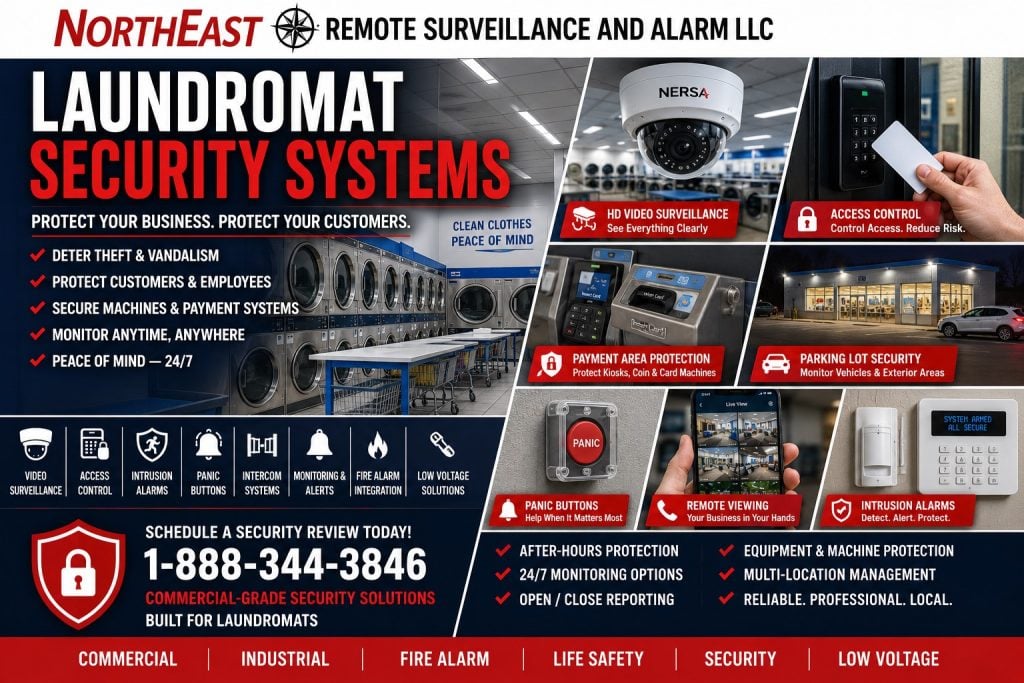
NERSA designs and installs laundromat security systems to help protect customers, employees, washers, dryers, payment equipment, entrances, rear doors, utility rooms, vending areas, parking areas and after-hours activity without making the business more difficult to operate.
Request a Laundromat Security Assessment
Northeast Remote Surveillance and Alarm, LLC designs, installs, integrates, monitors, upgrades, takes over and supports commercial laundry security. We serve qualifying coin and card-operated laundries, self-service stores, wash-and-fold businesses and unattended retail locations. We also support laundry businesses with several locations.
Many laundromats open early, close late, or operate with limited staff. Customers, machines, and payment equipment may remain active for long periods. Security planning should also account for cleaning crews, deliveries, unattended hours, and parking areas.
For broader small-business security planning, visit Small Business Security Systems.
Commercial Security Planning for Laundromats
A laundromat security system should be designed around how customers, employees, attendants, cleaners, vendors, payment equipment, machines, and owners use the property.
Planning may consider:
- Front entrances
- Rear entrances
- Laundry-floor areas
- Washer and dryer rows
- Folding areas
- Payment kiosks
- Coin machines
- Card-reload stations
- Vending equipment
- Wash-and-fold counters
- Restroom entrances
- Utility-room entrances
- Employee-only spaces
- Parking areas
- Exterior approaches
- After-hours activity
- Automated opening and closing requirements
The objective is not to install the greatest possible number of cameras, alarm devices, or controlled doors.
The objective is to provide useful visibility, dependable after-hours protection, appropriate restricted-area control, practical remote management, and better documentation when an incident occurs.
Laundromat Security Risks
Laundromats may need to address:
- Vandalism
- Payment-machine tampering
- Coin or card-machine attacks
- Customer disputes
- Machine damage
- Theft
- Loitering
- Rear-door activity
- Utility-room access
- Employee-only room access
- Parking-lot incidents
- After-hours break-ins
- Doors failing to secure at closing
- Unauthorized after-hours access
- False alarms
- Limited owner visibility
A properly planned system should help ownership determine what happened, where it occurred, when it happened, and whether the activity was normal customer use or a security concern.
Video Surveillance for Laundromats
Laundromat cameras should focus on the areas where useful evidence matters most.
Common camera locations may include:
- Front entrances
- Rear entrances
- Laundry-floor areas
- Washer and dryer rows
- Folding areas
- Payment equipment
- Vending areas
- Customer-service counters
- Restroom entrances
- Utility-room entrances
- Employee-only doors
- Parking areas
- Exterior approaches
Camera placement should be based on the intended result.
Wide views may help document general customer activity, while more focused views may be appropriate at payment equipment, entrances, rear doors, or other areas where detail matters.
Cameras should not be installed inside restrooms or other private areas.
For broader small-business camera planning, visit Small Business Security Camera Systems.
Payment Equipment Protection
Payment equipment is often one of the most important security concerns in a laundromat.
This may include:
- Coin machines
- Bill changers
- Card-reload stations
- Payment kiosks
- Vending machines
- Unattended transaction equipment
Security planning should provide enough visibility to understand who approached the equipment, when the activity occurred, and what happened before and after a reported incident.
The goal is to document legitimate use and suspicious activity without interfering with customer transactions.
Customer and Laundry-Floor Security
The laundry floor is the primary public area of the business.
Security planning should account for:
- Customer movement
- Machine rows
- Folding areas
- Seating
- Walkways
- Vending areas
- Employee or attendant activity
- Visibility between equipment
- Customer disputes
- Incident documentation
Camera coverage should support useful review while keeping the system appropriate for a public-facing business.
Entrance and Rear-Door Security
Laundromats may have several access points serving customers, employees, cleaning crews, vendors, deliveries, and service personnel.
Security planning may need to address:
- Main customer doors
- Rear service doors
- Employee entrances
- Utility-room doors
- Shared tenant entrances
- Exterior service areas
- After-hours openings
The system should help ownership understand which opening was used, when it was used, and whether the activity was expected.
Automated Opening and Closing for Laundromats
Laundromats with extended hours, limited staffing, or unattended operation may benefit from automated opening and closing functions that help the property follow a consistent daily schedule.
Depending on the installed systems and building requirements, automation may coordinate:
- Scheduled customer-door unlocking
- Scheduled door locking
- Alarm arming and disarming
- Employee access schedules
- Cleaning-crew access windows
- Interior lighting schedules
- Exterior lighting schedules
- Open and close notifications
- Door-status monitoring
- Exception alerts
- Remote verification
- Temporary holiday schedules
- Manager overrides
An opening sequence may automatically place the property into its normal operating condition at the beginning of the business day, including unlocking approved customer entrances and changing compatible intrusion protection to the appropriate state.
Closing should be planned more carefully than simply locking a door at a predetermined time.
A closing sequence may need to give customers time to finish their laundry and allow staff to verify that required areas are clear. It can then secure the appropriate entrances and place the alarm in its required state. The plan should define when to notify ownership if a door or monitored condition does not reach its expected state.
Automation should account for the way the laundromat actually operates.
Cleaning crews, attendants, maintenance technicians, service calls, holidays, weather events, equipment repairs, and changes in business hours may all require temporary schedule adjustments.
Automated locking and security functions should also be coordinated with required egress, emergency operation, applicable life-safety requirements, and the actual door hardware at the property.
For multi-location operators, consistent opening and closing procedures can help ownership standardize access schedules, alarm operation, notifications, and exception reporting across several laundromats.
For a local example, read The Laundry Hub automated laundromat case study in Warminster, PA.
The project combines scheduled entry control that allows customers to leave, automated opening, lights, fans, signs, video surveillance, and intrusion protection.
Utility and Restricted Areas
Utility rooms, equipment rooms, offices, supply areas, and employee-only spaces may contain business-critical equipment or provide access to systems customers should not reach.
Security planning may need to consider:
- Restricted access
- Door status
- Employee permissions
- Alarm coverage
- Nearby camera views
- After-hours access
- Service-vendor entry
The objective is to keep necessary service access practical while reducing uncontrolled entry.
Intrusion and After-Hours Protection
Laundromats may be closed, lightly staffed, or completely unattended during portions of the day.
A commercial intrusion system may protect:
- Front doors
- Rear doors
- Windows
- Interior movement areas
- Offices
- Utility rooms
- Payment-equipment areas
- Employee-only spaces
The system should match the actual operating schedule of the business and coordinate appropriately with automated opening and closing procedures.
For broader commercial after-hours protection, visit Small Business Alarm Systems.
Employee and Restricted-Area Access
Some laundromats may benefit from controlled access to:
- Employee entrances
- Rear doors
- Utility rooms
- Offices
- Supply rooms
- Payment-equipment rooms
- Shared tenant entrances
Access control can help reduce uncontrolled key use and provide individually managed permissions for selected doors.
Access schedules can also support attendants, cleaning personnel, service technicians, and other approved users without requiring every person to have unrestricted access at all times.
For employee credentials, schedules, and restricted-area access, visit Small Business Access Control Systems.
Parking and Exterior Security
Laundromat security extends beyond the building interior.
Exterior planning may need to consider:
- Customer parking
- Employee parking
- Sidewalks
- Rear alleys
- Dumpster areas
- Exterior doors
- Building approaches
- After-hours loitering
- Vehicle activity
For dedicated parking-area camera planning, visit Small Business Parking Lot Security Cameras.
Remote Visibility for Laundromat Owners
Many laundromat owners are not on-site throughout the day.
Secure remote visibility may help ownership review:
- Openings and closings
- Customer activity
- Payment areas
- Cleaning-crew access
- Deliveries
- Door status
- Parking activity
- Alarm events
- After-hours incidents
- Automation exceptions
Remote access should use appropriate individual permissions instead of shared administrator accounts.
Unattended and Late-Hour Operations
Some laundromats remain open when ownership or employees are not physically present.
These properties may need additional attention around:
- Payment areas
- Customer entrances
- Rear doors
- Parking
- Loitering
- After-hours activity
- Door-status exceptions
- Alarm verification
- Remote response
For selected camera events requiring professional review and live audio response, visit Remote Video Monitoring and Live Talk-Down.
Existing Laundromat Security Systems
Many laundromats inherit cameras, alarms, access-control equipment, cabling, administrator accounts, automation schedules, or monitoring arrangements from a previous owner, tenant, installer, or property manager.
Existing systems should be evaluated before complete replacement is recommended.
Potential concerns may include:
- Poor camera placement
- Weak payment-area visibility
- Weak nighttime performance
- Shared passwords
- Old alarm communicators
- Poor rear-door protection
- Unknown administrator ownership
- Incorrect opening or closing schedules
- Unreliable door automation
- Inadequate documentation
- Unsupported equipment
- Unreliable network infrastructure
- Limited expansion capability
The appropriate project may involve repair, reconfiguration, selective replacement, provider takeover, or phased modernization.
Laundromat Security Supporting Resources
For communication with employees, vendors, cleaners, or service personnel at controlled entrances, visit Commercial & Industrial Intercom Systems.
For aging, inherited, unreliable, or poorly documented laundromat security systems, visit Commercial Security System Upgrades, Retrofits & Takeovers.
For owners operating several laundromat locations that need consistent cameras, alarms, access control, permissions, opening and closing schedules, and monitoring, visit Multi-Location Small Business Security Systems.
For structured cabling, PoE, network equipment, power, and supporting security infrastructure, visit Commercial & Industrial Infrastructure and Cabling.
Why Laundromat Owners Choose Northeast Remote Surveillance and Alarm
Northeast Remote Surveillance and Alarm, LLC focuses on commercial and industrial security systems rather than residential-style alarm packages.
NERSA evaluates laundromat properties around:
- Customer flow
- Operating hours
- Payment equipment
- Machine areas
- Rear doors
- Utility rooms
- Restricted spaces
- Parking
- Staffing
- Automated opening and closing
- Remote-owner visibility
- Existing equipment
- Monitoring
- Network infrastructure
- Future growth
The objective is to provide a laundromat security system that remains practical, manageable, supportable, and appropriate for the actual operation of the business.
Frequently Asked Questions About Laundromat Security Systems
What should a laundromat security system include?
The exact system depends on the property, but common components may include video surveillance, intrusion alarms, payment-area camera coverage, remote viewing, entrance protection, restricted-area security, parking cameras, and automated opening and closing functions where appropriate.
Where should cameras be installed in a laundromat?
Common locations include entrances, laundry-floor areas, payment machines, vending areas, folding areas, restroom entrances, utility-room entrances, parking areas, and exterior approaches.
Can cameras be installed inside laundromat restrooms?
No. Cameras should not be installed inside restrooms or other private areas.
Are payment machines important to protect?
Yes. Coin machines, bill changers, card-reload stations, and payment kiosks can be important security points and may warrant focused camera coverage.
Can a laundromat automatically unlock in the morning?
Compatible commercial access and building systems may be configured to unlock approved entrances according to a defined schedule when the property and operating requirements support automation.
Can a laundromat automatically lock at closing time?
Yes, but automated closing should be designed around actual customer occupancy, required egress, life-safety operation, staff procedures, and exception handling rather than relying only on a simple timer.
Can the alarm system coordinate with opening and closing?
Compatible systems may allow access schedules, alarm states, notifications, and other approved functions to coordinate as part of a planned opening or closing procedure.
What happens if a door does not close or lock properly?
A properly designed system may provide a door-status or exception alert so ownership or another responsible party knows the property did not reach its expected secured condition.
Do laundromats need intrusion alarms?
Many do, particularly locations with payment equipment, rear doors, restricted rooms, unattended periods, or overnight closure.
Can laundromat owners view cameras remotely?
Yes. Compatible commercial systems can provide secure remote viewing for approved owners and managers.
Is remote video monitoring useful for laundromats?
It can be useful for laundromats with unattended hours, late-night operation, repeated loitering, parking concerns, or other after-hours exposure.
Can an existing laundromat security system be upgraded?
Yes. Existing cameras, alarms, access control, automation, cabling, monitoring, and administrator ownership can be evaluated to determine what should be retained, corrected, upgraded, or replaced.
Can one security structure support several laundromat locations?
Yes. Multi-location laundromat businesses can use consistent standards for cameras, alarms, access control, opening and closing schedules, monitoring, users, and documentation while accounting for differences between individual properties.
Request a Laundromat Security Assessment
NERSA can assess security for your laundromat, coin or card laundry, wash-and-fold business, or multi-location laundry operation. Tell us about payment-area visibility, customer coverage, rear doors, parking, and remote viewing. We can also review automated opening and closing, after-hours protection, and upgrades to existing equipment.
Request a Laundromat Security Assessment.
Compliance, Codes & Project Standards
NERSA plans commercial and industrial security work with applicable code, documentation, inspection and authority-having-jurisdiction requirements in mind. Requirements vary by system, property and jurisdiction. These resources support project planning; they do not establish legal compliance, certification or AHJ approval.
Related guidance: Regulatory compliance & inspection readiness · NERSA project standards · Documentation, testing & inspection readiness