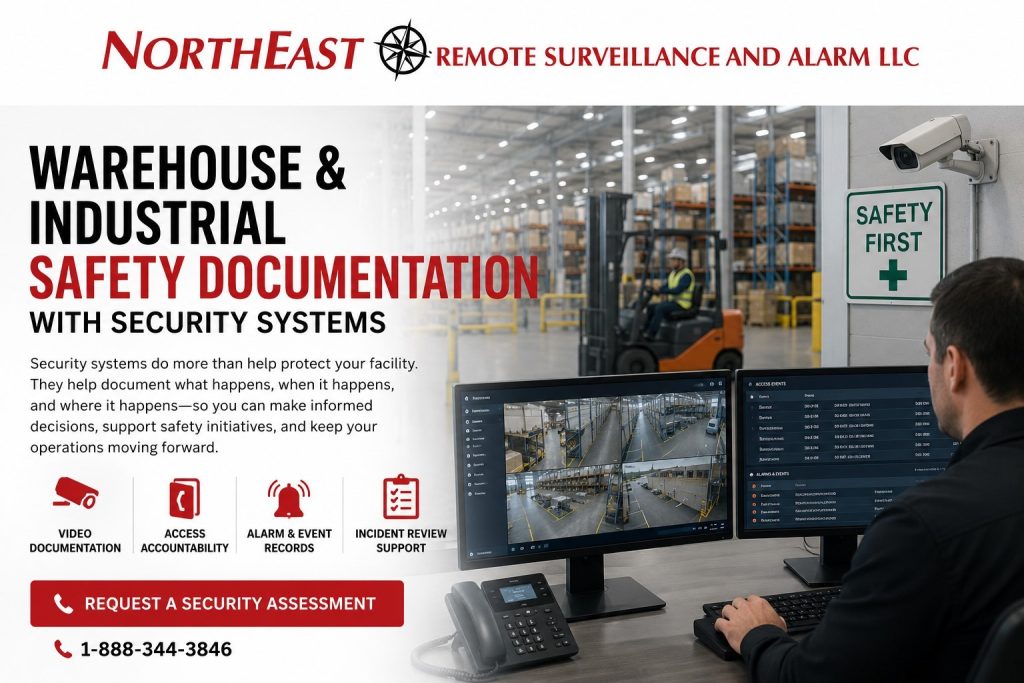
Security systems can support warehouse and industrial safety documentation by improving visibility, accountability, incident review, and after-hours event records.
Northeast Remote Surveillance and Alarm, LLC supports safety documentation planning as part of regulatory compliance and inspection readiness for commercial security systems for warehouses, manufacturing facilities, logistics operations, distribution centers, contractor yards, truck courts, and industrial properties.
Cameras, access control, alarms, monitoring, and facility alerts do not replace safety programs, training, supervision, maintenance, or OSHA responsibilities, but they can help document what happened, where it happened, and who may need to review it.
Using Security Records for Incident Review
Warehouse and industrial properties have moving vehicles, employees, vendors, drivers, contractors, equipment, loading docks, storage areas, restricted rooms, yard gates, and after-hours activity. When something happens, facility managers often need more than a verbal report.
A properly planned security system can help support safety documentation by recording video, logging access events, documenting alarm activity, showing door status, identifying vehicle movement, and helping managers review incidents after they occur.
Security system documentation may help with:
- Loading dock activity review
- Forklift and vehicle movement review
- Employee entrance accountability
- Contractor and vendor access records
- Restricted-area activity review
- Gate and yard entry records
- Trailer yard activity
- Parking lot incident review
- After-hours facility activity
- Door-forced-open events
- Door-held-open conditions
- Alarm activations
- Facility alerts
- Water, temperature, or power events
- Internal investigation support
- Insurance or management review
- Law enforcement support when appropriate
The goal is to give the facility better information. Security technology should help management understand events more clearly without overstating what cameras, alarms, or access control can prove by themselves.
Security Systems Do Not Replace Safety Programs
Security systems can support safety documentation, but they do not make a workplace OSHA compliant by themselves. A camera cannot replace training. Access control cannot replace supervision. A video clip cannot replace written procedures. An alarm cannot replace maintenance, hazard correction, or operational discipline.
NERSA helps facilities design security systems that support visibility and documentation while respecting the limits of the technology.
Security systems may support safety programs by helping document:
- What activity occurred
- Where the activity occurred
- When it occurred
- Which door, gate, dock, or area was involved
- Whether a person or vehicle was present
- Whether a restricted area was accessed
- Whether a door was propped open
- Whether an alarm or alert was triggered
- Whether video footage is available for review
- Whether additional investigation is needed
For OSHA-aware planning around electronic security systems, visit OSHA-Aware Workplace Security Planning.
Video Surveillance for Incident Review
Video surveillance is one of the most useful tools for warehouse and industrial documentation because it can provide visual context after an incident. A written report may describe what happened, but video can help show movement, timing, direction, activity, and conditions around the event.
Warehouse and industrial video surveillance can support review of:
- Loading dock activity
- Forklift movement
- Pedestrian and vehicle interaction
- Truck court activity
- Trailer movement
- Shipping and receiving activity
- Material handling areas
- Employee entrances
- Parking lots
- Yard gates
- Production support areas
- Tool rooms
- Parts rooms
- Exterior storage areas
- After-hours activity
- Security incidents
- Property damage events
For camera system design, visit commercial video surveillance systems.
Video footage is only useful when cameras are placed correctly, timestamps are accurate, retention is planned, permissions are controlled, and footage can be exported when needed.
Loading Dock and Truck Court Documentation
Loading docks and truck courts are high-activity areas where documentation can be especially important. These areas may include backing trucks, pedestrians, forklifts, dock doors, trailers, material handling, drivers, vendors, and after-hours activity.
Security systems can support dock and truck court documentation by recording:
- Truck arrival and departure
- Trailer positioning
- Dock door activity
- Driver entry points
- Yard movement
- Forklift movement near dock areas
- Pedestrian movement near loading zones
- Delivery disputes
- Property damage
- Door-left-open conditions
- After-hours dock activity
- Unauthorized yard access
Camera coverage around docks should be planned to capture useful views, not just wide general images. Good documentation usually requires camera angles that show dock doors, approaches, trailer positions, personnel movement, and key decision points.
Forklift, Vehicle, and Material Movement Review
Warehouses and manufacturing facilities often need to understand how people, forklifts, pallet jacks, carts, trucks, and materials moved before and after an incident. Security cameras can help managers review the sequence of events.
Security system planning may support review of:
- Forklift travel paths
- Cross-aisle movement
- Loading and unloading activity
- Pedestrian traffic
- Product handling
- Pallet staging
- Equipment contact with doors, racks, walls, or vehicles
- Vehicle movement in truck courts
- Yard activity
- Material handling disputes
The system should be planned with realistic expectations. Cameras may help show activity, but they do not replace safe operating procedures, training, employee accountability, or supervisor review.
Access Control and Employee Accountability
Access control can support safety documentation by recording who entered a controlled area and when they entered. This can be useful for employee entrances, restricted rooms, production areas, tool rooms, IT rooms, electrical rooms, maintenance spaces, and contractor access points.
Access control documentation can help review:
- Employee entry
- After-hours access
- Restricted-area access
- Contractor access
- Vendor access
- Door-forced-open events
- Door-held-open events
- Credential use
- Schedule violations
- Unauthorized access attempts
- Access to sensitive rooms
- Gate activity
For controlled entry design, visit commercial access control systems.
Access control records become more useful when they are connected with camera views, alarm events, and clear user permissions. Shared codes, unmanaged credentials, and undocumented access schedules can weaken accountability.
Restricted Areas and High-Risk Zones
Some areas in a warehouse or industrial facility require stronger documentation because they involve safety risk, operational risk, equipment, inventory, or sensitive access.
These areas may include:
- Electrical rooms
- IT rooms
- Mechanical rooms
- Boiler rooms
- Sprinkler rooms
- Tool rooms
- Parts rooms
- Maintenance shops
- Chemical storage areas
- Production support rooms
- Quality control rooms
- Server closets
- Compressor rooms
- Roof access doors
- Yard gates
- Fuel storage areas
- Equipment storage areas
Security systems can help document who accessed the area, when the area was accessed, whether a door was left open, whether an alarm occurred, and whether video footage supports the event review.
Contractor, Vendor, and Driver Activity
Industrial and warehouse facilities often have people on site who are not regular employees. Contractors, vendors, delivery drivers, service technicians, inspectors, temporary workers, and outside carriers may all need limited access.
Security systems can support documentation for:
- Contractor arrival
- Vendor access
- Driver check-in
- Temporary access credentials
- Guard shack activity
- Gate entry
- Delivery doors
- Service entrances
- Restricted zones
- After-hours access
- Visitor movement
- Incident review involving non-employees
A strong documentation plan should identify where non-employees enter, how they are approved, what areas they can access, and which cameras or access logs support the record.
Alarm Events and Facility Alerts
Not every safety documentation event starts with a camera. Alarm systems and facility alerts can create important records for doors, gates, environmental conditions, and after-hours activity.
Security documentation may include:
- Intrusion alarm activations
- Door contact activity
- Overhead door alerts
- Gate alarms
- Panic or duress alerts
- Temperature alerts
- Water leak alerts
- Power loss alerts
- Equipment room alerts
- Communication trouble
- Low battery trouble
- Door-left-open alerts
These records can help facility managers identify patterns, recurring issues, and areas that need operational attention.
Remote Monitoring and Managed Response Documentation
Remote monitoring and managed security response can add another layer of documentation when events happen after hours or when on-site staff are limited.
A managed response process may document:
- Time of event
- Camera view reviewed
- Alarm or analytic trigger
- Audio warning issued
- Manager notification
- Escalation steps
- Authorized contact response
- Emergency response request when appropriate
- Event notes
- Video clip availability
- Follow-up needs
This type of documentation is especially useful for truck yards, contractor yards, loading docks, parking lots, outdoor storage areas, and facilities with repeated after-hours activity.
Video Retention, Export, and Evidence Handling
A camera system is only useful for documentation if the footage is available when needed. Retention planning, export procedures, user permissions, and evidence handling all matter.
A documentation-ready video system should consider:
- Recording duration
- Camera resolution
- Frame rate
- Storage capacity
- Time and date accuracy
- User permissions
- Export process
- Clip naming
- Incident folder structure
- Chain-of-custody expectations when needed
- Who can review video
- Who can export video
- Who can share video
- How long footage is retained
- How management requests footage
For evidence-focused video planning, visit Video Surveillance Documentation and Evidence Retention Planning.
Clear procedures help prevent confusion when management, insurance representatives, attorneys, law enforcement, or internal investigators request footage.
Documentation for Inspections, Insurance, and Internal Review
Warehouse and industrial security documentation may be useful during inspections, management reviews, insurance discussions, incident investigations, workplace safety meetings, and future security upgrades.
Documentation may include:
- Camera location list
- Access-controlled door list
- Alarm zone list
- Door contact locations
- Gate device locations
- Recording equipment details
- Monitoring information
- User permission structure
- Response procedures
- Service notes
- Testing records
- Incident review notes
- Video export records
- Facility alert history
- System diagrams when available
Good documentation helps facility managers know what the system covers, how it operates, who has access, and what information can be reviewed after an event.
Warehouse and Industrial Safety Documentation Planning
Security documentation should be planned around the real facility. A distribution center, manufacturing plant, truck yard, contractor yard, cold storage facility, and multi-building industrial campus may all need different coverage.
NERSA reviews site conditions such as:
- Building layout
- Dock activity
- Truck court layout
- Employee entrances
- Visitor and driver flow
- Production areas
- Yard gates
- Exterior storage
- Restricted rooms
- Camera angles
- Lighting conditions
- Network infrastructure
- Retention needs
- Monitoring needs
- Access control workflow
- Alarm zones
- Facility alert needs
- Management review process
The system should support the way the facility actually operates, not just create more footage and alerts.
Related Planning
Security records support incident review and documentation.
They do not replace workplace safety procedures, training, or management responsibilities.
- OSHA-Aware Workplace Security Planning — Review how security planning relates to workplace operations.
- Regulatory Compliance and Inspection Readiness for Commercial Security Systems — Organize project requirements and review documentation.
- Industrial and Warehouse Security Compliance — Explore security coordination for production and storage facilities.
- Commercial Video Surveillance Systems — Plan camera views and recorded evidence for operational review.
Why Choose Northeast Remote Surveillance and Alarm, LLC (NERSA)
Northeast Remote Surveillance and Alarm, LLC designs commercial and industrial security systems for facilities where documentation matters. We understand that warehouses, manufacturing plants, logistics sites, truck yards, contractor yards, and industrial properties need more than generic cameras and alarms.
Our team helps clients plan security systems around actual risk areas, operating patterns, incident review needs, user permissions, documentation expectations, and long-term service support.
Businesses choose NERSA for warehouse and industrial safety documentation support because we provide:
- Commercial and industrial security experience
- Warehouse and logistics site planning
- Camera placement for useful incident review
- Access control accountability planning
- Alarm and facility alert integration
- Remote monitoring support
- Event documentation planning
- Video retention and export planning
- Site-specific system documentation
- Long-term service and support
A security system should help managers see more, document better, and respond with clearer information.
Request a Warehouse and Industrial Documentation Review
NERSA can help warehouses, manufacturers, logistics sites, truck and contractor yards, and industrial facilities improve security records. We review incidents, access, dock activity, vehicle movement, alarms, restricted areas and after-hours events.
Call 1-888-344-3846 or request a security assessment to review your facility, risk areas, camera coverage, access control needs, alarm events, documentation gaps, and long-term security goals.
We support warehouse and industrial safety documentation planning with security systems throughout the Lehigh Valley, Northeastern Pennsylvania, Central Pennsylvania, Greater Philadelphia, New Jersey, Delaware, and the Mid-Atlantic region.
Frequently Asked Questions about Warehouse and Industrial Safety Documentation
Can security cameras help with warehouse safety documentation?
Yes. Security cameras can help document activity around loading docks, aisles, truck courts, parking lots, employee entrances, restricted areas, and after-hours events. They do not replace safety programs, training, supervision, or OSHA compliance responsibilities.
Do security systems make a workplace OSHA compliant?
No. Cameras, alarms, access control, and monitoring do not make a workplace OSHA compliant by themselves. They can support safety programs by improving visibility, documentation, accountability, and incident review.
What areas should be documented in a warehouse?
Common documentation areas include loading docks, truck courts, employee entrances, parking lots, shipping and receiving areas, restricted rooms, yard gates, material storage areas, equipment zones, and after-hours access points.
Can access control help with safety documentation?
Yes. Access control can help document who entered a controlled area, when they entered, whether access was denied, and whether doors were forced or held open.
Can security systems document contractor and vendor activity?
Yes. Cameras, access control, intercoms, gates, and visitor procedures can help document contractor, vendor, driver, and service-provider activity at commercial and industrial properties.
How long should warehouse video be retained?
Video retention depends on the facility, risk level, camera count, storage capacity, management needs, insurance expectations, and incident review requirements. NERSA can help design a retention approach that matches the property.
Can remote monitoring support documentation?
Yes. Remote monitoring can create event notes, video clips, escalation records, manager notifications, and response documentation when after-hours activity occurs.
What is the difference between safety documentation and security documentation?
Safety documentation focuses on visibility and review of operational incidents, workplace activity, vehicle movement, restricted areas, and event history. Security documentation focuses on unauthorized access, alarms, theft, vandalism, intrusion, and response. In warehouses and industrial facilities, these often overlap.
What should be documented for a security system?
Useful documentation may include camera locations, access-controlled doors, alarm zones, gate devices, monitoring information, user permissions, retention settings, response procedures, service records, and incident review notes.
What is the best next step for improving warehouse safety documentation?
The best next step is a site-specific review. NERSA can evaluate the facility layout, dock activity, vehicle movement, restricted areas, camera coverage, access control needs, alarm events, and documentation gaps before recommending a system design.
Compliance, Codes & Project Standards
NERSA plans commercial and industrial security work with applicable code, documentation, inspection and authority-having-jurisdiction requirements in mind. Requirements vary by system, property and jurisdiction. These resources support project planning; they do not establish legal compliance, certification or AHJ approval.
Related guidance: Warehouse & logistics compliance · NERSA project standards · Documentation, testing & inspection readiness