Enterprise Access Control for Warehouses, Distribution Centers, Industrial Facilities, Docks, Gates and Trailer Yards
Warehouse access control is different from standard office door security. Warehouses, distribution centers, logistics facilities, manufacturing buildings, truck terminals, and industrial flex properties have more movement, more shift changes, more vendor traffic, more exterior exposure, and more restricted areas than a typical commercial office.
Northeast Remote Surveillance and Alarm, LLC designs warehouse access control systems for commercial and industrial facilities across the Lehigh Valley, Pennsylvania, New Jersey, Delaware, Maryland, and the broader Mid-Atlantic. For broader access control planning, start with our commercial and industrial access control systems page.
NERSA designs systems around how the facility actually operates. That includes employee entrances, office-to-warehouse transition doors, dock offices, inventory cages, tool rooms, server rooms, trailer-yard gates, driver entrances, maintenance rooms, management offices, restricted storage areas, and after-hours access points.
A warehouse access control system should do more than unlock doors. It should control movement, document activity, reduce uncontrolled key use, support offboarding, improve accountability, and work with cameras, alarms, intercoms, and monitoring.
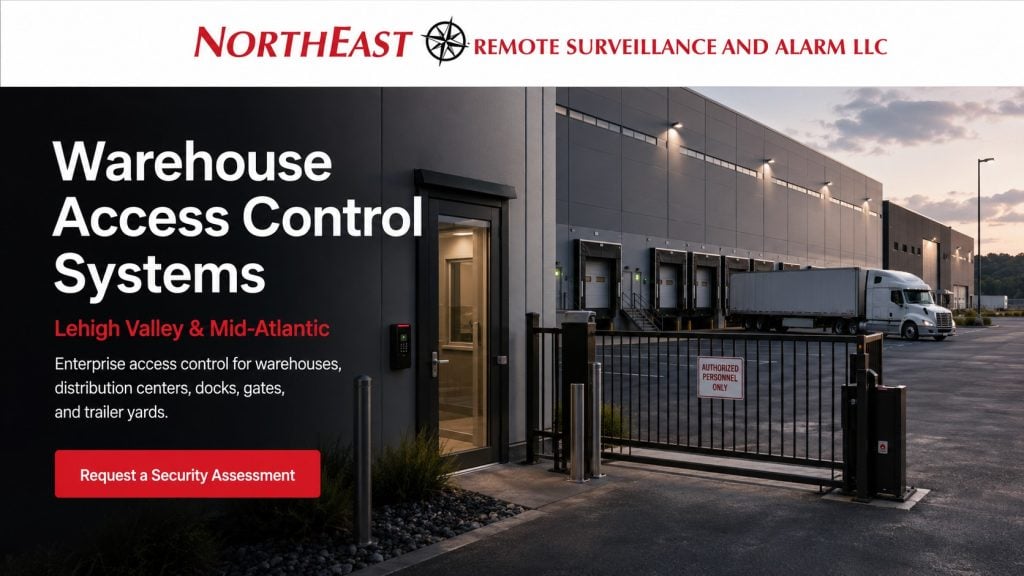
Why Warehouse Access Control Requires a Different Plan
A warehouse is a layered environment. Employees arrive across different shifts. Temporary labor may change frequently. Drivers arrive before sunrise, after hours, and during peak dock activity. Vendors and contractors may need limited access. Supervisors, office staff, warehouse staff, maintenance teams, and outside visitors should not all move through the building the same way.
A strong warehouse access control system helps answer practical questions every day:
- Who can enter the building?
- Which doors can each employee use?
- Can access be limited by shift or schedule?
- Can temporary credentials expire automatically?
- Can contractors be restricted to only the areas they need?
- Can a terminated employee be removed quickly?
- Can a gate event be matched to video footage?
- Can sensitive rooms have separate permissions?
- Can management review door activity after an incident?
When those questions are not addressed, warehouses drift into risk. Shared keys multiply. PIN codes get passed around. Side doors become shortcuts. Former employees may keep access too long. Driver areas become poorly controlled. Yard gates get opened without clear records.
The goal is not to make the building harder to operate. The goal is to create controlled movement that supports productivity while reducing risk.
High-Priority Warehouse Areas to Control
Warehouse access control should be planned around the openings and zones that matter most. Not every door needs the same hardware or the same permissions, but the critical areas should be reviewed carefully.
Employee Entrances
Employee entrances should create clear access events tied to real users. These doors often need schedule-based permissions, shift rules, audit trails, and fast credential removal when staffing changes.
Office-to-Warehouse Transition Doors
Office staff, warehouse employees, supervisors, and visitors may need different movement paths. Controlled office-to-warehouse transition doors help separate administrative areas from active warehouse space, shipping departments, production areas, or restricted zones.
Dock Offices and Receiving Areas
Loading dock environments are busy, noisy, and constantly changing. Dock offices, receiving doors, dispatch spaces, and adjacent personnel doors often need access control because drivers, vendors, supervisors, and warehouse staff may all be moving through the same area.
Inventory Cages and High-Value Storage
Inventory cages, tool rooms, parts rooms, electronics storage, medical storage, controlled inventory, and high-value product areas should often have their own access layer. These are strong locations to connect access events with camera coverage.
Server Rooms, Telecom Rooms and Security Closets
Network closets, server rooms, alarm rooms, camera head-end locations, and access control panels should not rely on shared keys. These spaces support the security and technology infrastructure for the entire facility.
Maintenance, Electrical and Equipment Rooms
Maintenance shops, electrical rooms, forklift charging areas, mechanical spaces, and equipment rooms may create both security and safety concerns if accessed by unauthorized users.
Driver Entrances and Waiting Areas
Driver access should be planned carefully. Many facilities need a clean boundary between driver waiting areas, dispatch windows, restrooms, vestibules, and restricted warehouse space.
Trailer-Yard Gates and Exterior Access Points
For many warehouses, the yard is the weakest area. Trailer yards, truck courts, fenced compounds, vehicle gates, and exterior storage areas often need credentialed entry, video verification, defined schedules, and event logs.
For larger warehouse protection planning, see our warehouse security systems page.
Credential Management for Employees, Temps and Contractors
Warehouses often deal with employee turnover, temporary labor, seasonal staffing, cleaning crews, contractors, vendors, and outside service providers. That makes credential management one of the most important parts of the system.
A well-designed access control system can help management:
- Add new users quickly
- Remove users immediately
- Assign access by role or department
- Limit access by schedule
- Set expiration dates for temporary users
- Separate supervisors from general staff
- Restrict access to high-value areas
- Review historical access activity
- Reduce dependence on physical keys
This is especially valuable for warehouses that operate multiple shifts or rely on temporary staffing. Access should follow the person’s real status. When someone joins, changes roles, finishes a project, or leaves the company, their access should change with them.
Access Control for Visitors, Vendors and Drivers
Warehouse traffic is not limited to employees. A complete access control plan should also address drivers, vendors, contractors, inspectors, cleaners, maintenance providers, and visitors.
Facilities should define how non-employees arrive, where they check in, who can approve entry, which areas they can access, and whether they need an escort, temporary credential, intercom verification, or camera review.
Common visitor and vendor access solutions include:
- Video intercoms
- Driver vestibules
- Temporary credentials
- Time-limited access
- Reception-controlled entry
- Contractor access groups
- Gate release control
- Visitor logs
- Camera verification at entry points
For visitor communication and controlled entry, NERSA also designs commercial and industrial intercom systems that can support warehouse doors, gates, offices, and driver entrances.
Access Control and Video Surveillance Integration
Access control becomes much stronger when it is connected to video surveillance. A door event shows which credential was used and when. Video shows what happened at the door.
When systems are planned together, management can review:
- Forced-door events
- Door-held-open events
- Denied credentials
- After-hours entries
- Contractor access
- Employee access events
- Gate openings
- Inventory cage activity
- Dock office movement
- Driver entrance activity
For warehouse camera coverage, NERSA designs warehouse security camera systems for docks, trailer yards, employee entrances, shipping areas, storage aisles, and exterior building approaches.
A warehouse access event should not leave management searching blindly through footage. The strongest systems make the event and the video easier to review together.
Access Control and Intrusion Alarm Integration
Access control should also be planned with intrusion detection. If a protected area is armed after hours and someone opens a secured door, management needs context fast.
Integrated access control and intrusion detection can help determine whether an event was:
- An authorized supervisor
- A forced door
- A cleaning crew arriving outside schedule
- A contractor using expired access
- An employee entering outside normal hours
- A genuine intrusion attempt
This matters for warehouses, distribution centers, truck terminals, and industrial buildings that are closed, lightly staffed, or partially active after hours.
Gate Access Control for Trailer Yards
Trailer yards and fenced exterior areas often require their own access strategy. These areas may contain loaded trailers, empty trailers, tractors, equipment, containers, materials, and high-value inventory.
A stronger yard access plan may include:
- Credentialed gate entry
- Vehicle gate access control
- Driver-specific permissions
- Time-based access schedules
- Gate event logs
- Video verification
- Intercom communication
- License plate recognition
- Remote monitoring
- After-hours alerts
A fence alone is not a complete yard security plan. Gates, cameras, lighting, access rules, user records, and response procedures should work together.
Access Control by Warehouse Type
Different warehouse environments need different access strategies.
Distribution Centers and 3PL Facilities
Distribution centers and third-party logistics buildings often need high-volume employee entry, dock office control, driver handling, office-to-warehouse separation, gate access, and strong reporting.
Manufacturing Warehouses
Manufacturing warehouses often need layered permissions between production areas, inventory storage, engineering, maintenance, front office, shipping, receiving, and management areas.
Food and Beverage Warehouses
Food and beverage facilities may need controlled access for storage rooms, sanitation-sensitive areas, employee areas, shipping departments, and vendor entry points.
Cold Storage Facilities
Cold storage environments need hardware and system planning that account for harsher conditions, controlled movement, employee flow, and reliable operation.
Pharmaceutical and Medical Storage
Pharmaceutical, medical, and sensitive storage facilities often require tighter access permissions, cleaner audit trails, and better video documentation around restricted rooms.
Multi-Tenant Industrial Buildings
Multi-tenant industrial buildings need shared entrance control, tenant separation, common-area access, vendor access, and maintenance access planning.
Truck Terminals and Transportation Yards
Truck terminals and yard-based operations often need stronger gate control, driver routing, dispatch access, yard visibility, and after-hours procedures.
There is no single warehouse access control template. The system should match the building, the doors, the users, the risk points, and the operating schedule.
Cloud, On-Premise and Hybrid Warehouse Access Control
NERSA can design access control systems using cloud-managed, on-premise, or hybrid architecture depending on the needs of the facility.
Cloud-managed access control can be useful for businesses that want remote administration, mobile access, multi-site management, faster credential changes, and centralized user control.
On-premise access control may be preferred when a facility has specific IT requirements, local management standards, or internal infrastructure policies.
Hybrid access control can be useful for larger or more complex facilities that need a combination of local reliability, remote visibility, and scalable management.
The right platform depends on door count, user count, IT requirements, management workflow, cybersecurity expectations, reporting needs, and long-term expansion plans.
Door Hardware and Life-Safety Planning
Warehouse access control is not just a software project. The door hardware matters.
A proper design should account for:
- Door type
- Frame condition
- Lock type
- Electric strikes
- Electrified locks
- Magnetic locks where code-appropriate
- Door position switches
- Request-to-exit devices
- Power supplies
- Backup power
- Power transfer hardware
- Fire alarm interface where required
- Emergency egress
- AHJ expectations
Access control should improve security without creating unsafe or non-compliant openings. Controlled doors still need to allow required exit, emergency release, and life-safety operation where applicable.
For deeper door hardware planning, see our access control trim and strike resource.
Multi-Site Warehouse Access Control
Warehouse operators with multiple facilities often need centralized access control. A scalable system can help management control users, schedules, permissions, doors, gates, and reporting across more than one property.
Multi-site access control is useful for:
- Regional warehouse operators
- Logistics companies
- Manufacturing groups
- Property management companies
- Industrial landlords
- Distribution networks
- Multi-building campuses
- Businesses expanding across the Mid-Atlantic
A scalable access platform can help reduce administrative work, improve consistency, and make credential changes faster across several locations.
Areas Served
NERSA designs warehouse access control systems across the Lehigh Valley and Mid-Atlantic, including Allentown, Bethlehem, Easton, Route 22, Route 33, I-78, the broader Lehigh Valley industrial corridor, Pennsylvania, New Jersey, Delaware, and Maryland.
Why Businesses Choose NERSA
Northeast Remote Surveillance and Alarm, LLC focuses on commercial and industrial security systems, not residential alarm work. NERSA designs systems for real warehouse environments where access control must support operations, security, accountability, and long-term reliability.
Businesses choose NERSA for:
- Warehouse and industrial access control experience
- Door, dock, gate, and yard planning
- Video and access control integration
- Alarm and access control coordination
- Cloud, on-premise, and hybrid options
- Multi-site access control planning
- Commercial-grade equipment
- Cybersecurity-aware design
- Practical recommendations based on facility workflow
NERSA evaluates the property layout, traffic flow, door conditions, shift structure, user groups, restricted areas, loading dock activity, yard exposure, network requirements, and long-term scalability before recommending a system.
Request a Warehouse Access Control Assessment
If your warehouse, distribution center, manufacturing warehouse, truck terminal, trailer yard, industrial building, or logistics property needs better access control, NERSA can help design a system around your operation.
Your system should control employee entry, manage shifts, protect offices, docks, server rooms, inventory cages, maintenance spaces, and yard gates. It should help remove old access quickly, verify incidents, manage visitors and drivers, and work with your cameras and alarms.
Call 1-888-344-3846 or request a commercial warehouse access control assessment.
FAQ: Warehouse Access Control Systems
What is a warehouse access control system?
A warehouse access control system manages who can enter specific doors, gates, rooms, and zones inside an industrial or distribution facility using credentials, permissions, schedules, and event records.
Why is warehouse access control different from office access control?
Warehouses usually have more shift changes, temporary labor, vendor traffic, dock activity, exterior yards, and restricted operational areas than standard office buildings.
Which warehouse doors should be access controlled first?
Employee entrances, office-to-warehouse transition doors, dock offices, inventory cages, server rooms, telecom rooms, maintenance rooms, and yard gates are common starting points.
Can access control help with temporary workers?
Yes. Temporary workers can receive limited credentials, schedule-based access, and expiration dates so access does not remain active longer than needed.
Can access control be connected to warehouse cameras?
Yes. Access control can be integrated with video surveillance so managers can review footage tied to door events, gate openings, forced-door alarms, or after-hours entries.
Can access control be used on trailer-yard gates?
Yes. Trailer-yard gates can use credentialed entry, gate event logs, intercoms, cameras, license plate recognition, and remote monitoring where appropriate.
Does access control replace alarms or cameras?
No. Access control is one layer of warehouse security. It works best when planned with cameras, intrusion alarms, intercoms, lighting, gate control, and monitoring.
Does access control need to follow life-safety requirements?
Yes. Controlled doors must still support required egress, emergency release, fire alarm interface where required, and applicable AHJ expectations.