
Coordinate loading dock security around freight handoffs, overhead doors, driver visits, staging areas, employee access, and recorded evidence.

request a commercial security assessment
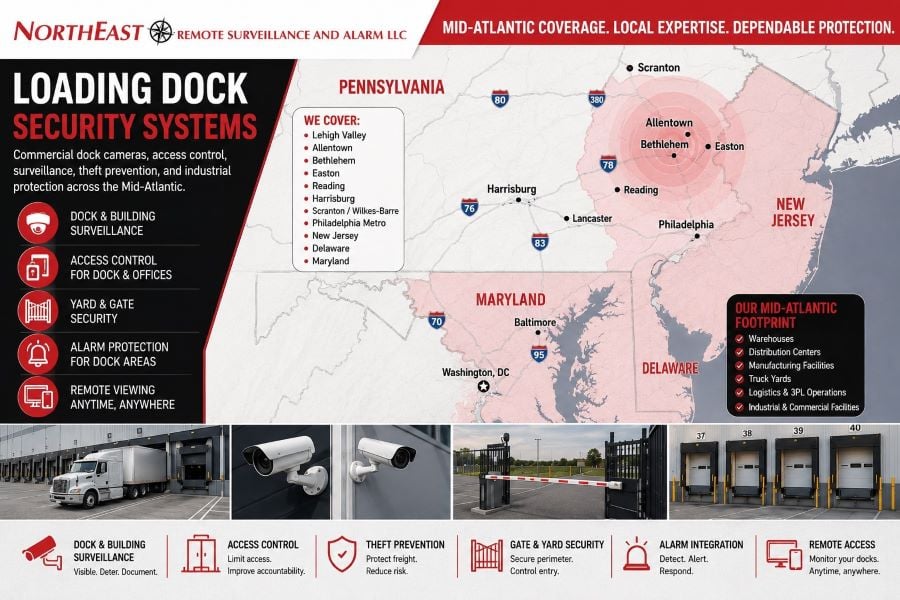
Commercial Dock Cameras, Access Control, Surveillance, and Theft Prevention for Warehouses, Distribution Centers, Truck Yards, and Industrial Facilities
Loading docks are where freight moves, trailers connect, employees and drivers circulate, shipments are received, outbound product is staged, and disputes often begin.
If a facility has weak dock visibility, poor access control, limited documentation, or blind spots around trailer lanes and overhead doors, the loading dock can quickly become a major security liability.
A real loading dock security system is not just a camera pointed at the back of a building. It is a commercial security strategy designed to protect one of the busiest and highest-risk parts of the property. It should help document activity, deter theft, improve accountability, support incident review, and reduce exposure tied to trailers, freight movement, unauthorized access, and after-hours activity.
Northeast Remote Surveillance and Alarm, LLC designs and installs loading dock security for warehouses, distribution centers, truck yards, manufacturers and logistics or industrial facilities. We plan around dock operations, shipment areas, freight movement and property access.
Whether the concern is cargo theft, trailer activity, employee movement, dock disputes, open overhead doors, or overnight trespassing, the goal is the same: secure the dock as part of the larger facility security plan.
For broader facility protection, visit Warehouse Security Systems.
What Is a Loading Dock Security System?
A loading dock security system is a layered commercial security setup designed to protect loading dock areas, overhead doors, trailer lanes, staging zones, shipping and receiving areas, and the people and vehicles moving through them.
Depending on the property, a dock security system may include:
- dock surveillance cameras
- exterior building cameras
- trailer lane visibility
- shipping and receiving office access control
- employee entry control
- intrusion alarms for adjacent areas
- gate and yard access control
- perimeter and trailer-yard camera coverage
- remote viewing for management
- event review tools for claims and investigations
The purpose is not just to watch the dock. The purpose is to create a better record of what happens there.
A properly designed system can document who approached the dock, which vehicle or trailer was present, and when activity occurred. Those records can support review of unauthorized access, shipment disputes, theft, damage, or trespassing.
For industrial properties, the dock is not a side issue. It is often the point where physical security, employee accountability, freight movement, and operational risk overlap.
Why Loading Docks Need Their Own Security Strategy
Many facilities install general building cameras but never truly secure the dock area. That is a mistake.
Loading docks have a different risk profile than offices, parking lots, and standard entrances because they involve open trailer access, repeated overhead door activity, product staging, employee and driver traffic, vendor movement, and overlapping indoor and outdoor activity.
Trailers, walls, dock geometry, parked vehicles, poor lighting, and side approaches can all create blind spots. In many cases, a facility may have cameras at the front entrance while the actual high-risk freight area remains poorly documented.
A loading dock security system should be designed around the specific exposures tied to:
- dock doors
- overhead doors
- trailer positions
- dock aprons
- shipping offices
- receiving offices
- adjacent warehouse aisles
- trailer staging lanes
- employee access near loading areas
- after-hours dock activity
Security at the dock should match how freight, drivers, employees, and inventory actually move through the property.
Who Needs Loading Dock Security Systems?
Loading dock security systems are valuable for commercial and industrial facilities where freight movement, product staging, truck activity, employee access, and shipment documentation matter.
Common property types include:
- warehouses
- distribution centers
- 3PL facilities
- manufacturers with shipping docks
- food and beverage warehouses
- freight terminals
- cross-dock facilities
- industrial parks
- truck yards with dock operations
- contractor supply facilities
- e-commerce fulfillment sites
- logistics facilities
- multi-door commercial buildings
These systems are especially important for properties with multiple dock doors, high-value freight, after-hours exposure, frequent deliveries, outbound shipments, mixed employee and vendor traffic, trailer staging, or recurring shipment disputes.
Dock Surveillance Cameras
Video surveillance is often the core of a loading dock security system, but camera placement matters more than camera count.
Use the loading dock surveillance cameras guide to plan camera views around dock activity and incident review.
Dock cameras should show trailer arrivals and departures, overhead doors, and movement between trailers and the building. Plan views of freight handoffs and dock lanes. Useful footage can help staff review damage, unauthorized entry, or unexpected after-hours activity.
Camera coverage may be needed at:
- exterior dock aprons
- trailer approach lanes
- dock-door rows
- corners of the loading area
- side and rear building elevations
- shipping and receiving office entrances
- adjacent warehouse staging zones
- vehicle approach paths
A weak dock camera layout usually fails in one of two ways. It either captures too wide an area without useful detail, or it misses the most important activity points altogether.
A proper layout should be based on how trucks approach, how trailers line up, where people walk, where product is staged, and what needs to be reviewed after an incident.
For broader camera-system planning, visit Security Camera Systems.
Shipping and Receiving Office Access Control
The shipping and receiving office is often one of the most important control points at a warehouse or industrial facility.
These areas may handle paperwork, shipment processing, scheduling, dock coordination, carrier interaction, restricted records, and access to nearby warehouse zones.
When these offices are left unsecured, it becomes easier for unauthorized people to move into sensitive operational areas.
For the associated records, responsibilities, and compliance coordination, see loading-dock security and compliance planning.
Access control can help secure:
- shipping offices
- receiving offices
- office-to-warehouse transition doors
- employee-only dock access doors
- interior doors near restricted freight areas
- warehouse cages and inventory rooms near the dock
- management or records areas connected to operations
Instead of relying only on keys, facilities can use credentials, keycards, fobs, mobile credentials, schedules, user permissions, and access logs to improve accountability.
For broader door and credential planning, review commercial access control systems.
Exterior Building, Yard, and Trailer Visibility
A loading dock does not operate in isolation. Good dock security depends on what happens immediately around it.
The dock may connect to the trailer yard, truck court, rear drive lane, perimeter fence, employee parking area, gate entry path, or side service road. If the camera system only sees the dock door, it may miss the movement that happened before or after the event.
Many loading dock security projects also need supporting coverage for:
- rear yard areas
- side service lanes
- trailer rows
- gate lanes
- fence lines
- dock approach roads
- vehicle staging zones
- employee and vendor parking near the dock
Without exterior context, even a good dock camera system can leave major questions unanswered.
Did the truck come through the gate? Did someone enter the yard before reaching the dock? Was the vehicle already on site after hours? Did the person approach from the fence line or from inside the operation?
The dock becomes easier to secure when it is connected to yard, gate, and perimeter visibility.
For vehicle entry and yard control, visit Commercial Gate Access Control Systems.
For freight-related security planning, visit Cargo Theft Prevention Systems.
Intrusion Alarm Protection for Dock-Adjacent Areas
Alarm systems are not usually the only dock security tool, but they can play an important supporting role.
Loading docks often connect to shipping offices, receiving offices, warehouse access doors, side man doors, rear entrances, inventory areas, and secondary storage rooms. These areas may be vulnerable after hours when the dock is closed, lightly staffed, or only partially active.
Alarm protection can help support:
- after-hours intrusion detection
- forced-entry awareness
- dock-adjacent door protection
- vulnerable rear-building coverage
- warehouse entry monitoring
- restricted area protection
- video verification when paired with cameras
When alarm events are connected with video review, management can better understand whether an event involved unauthorized entry, staff activity, contractor access, door-prop issues, or suspicious movement near dock areas.
For broader alarm planning, visit Commercial Alarm Systems.
Remote Viewing and Management Review
Loading docks are fast-moving environments. Managers often need to verify events quickly without walking the entire property or relying on secondhand explanations.
Remote access and review tools can help authorized users:
- review dock activity in real time
- verify trailer presence
- inspect shipment disputes
- confirm whether employees or vendors were in the area
- review after-hours movement
- investigate claims tied to loading or unloading
- check dock-door activity from another location
- support multi-site operations
For warehouse and logistics operators, this can save time while improving accountability.
The goal is not constant micromanagement. The goal is to make important dock activity easier to verify when there is a question, claim, incident, or security concern.
Common Loading Dock Security Problems We Solve
Dock Blind Spots
Trailers, dock walls, building corners, poor lighting, and poor camera angles often create blind spots that hide important activity. A better system is planned around real movement patterns, not just available mounting points.
Missing or Unclear Incident Footage
Many facilities technically record the dock, but the footage is not useful when something happens. Cameras may be too far away, aimed too broadly, blocked by trailers, or unable to capture key details.
Uncontrolled Access Near Shipping Areas
Shipping and receiving zones often become mixed-access areas where employees, vendors, drivers, and contractors overlap. Access control can help separate public, employee, and restricted operational areas.
After-Hours Dock Trespassing
Rear dock areas can attract trespassing, tampering, loitering, unauthorized vehicle access, and suspicious activity after operating hours.
Trailer and Freight Disputes
If a site cannot clearly document what happened at the dock, disputes become harder to resolve. Better dock coverage can support review of arrival times, loading activity, damaged product, staged freight, and trailer movement.
Weak Integration with Yard and Gate Security
A dock is only part of the chain. If the yard, gate, and perimeter are not documented, the picture remains incomplete.
Why Loading Docks Matter in Cargo Theft Prevention
Loading docks are one of the most important areas in cargo theft prevention because they connect the building to the outside movement of freight.
A cargo theft event may involve trailer access, freight staging, outbound shipment interference, dock-area surveillance gaps, unauthorized vehicle presence, weak supervision during transition periods, or poor documentation around who was present.
That is why dock security should be tied into broader cargo theft prevention planning.
A strong loading dock security strategy may connect:
- dock cameras
- trailer-row visibility
- gate access control
- perimeter cameras
- after-hours alarm protection
- shipping office access control
- yard monitoring
- management review tools
When these layers work together, the dock stops being a blind spot and becomes a controlled, documented, and defensible part of the operation.
Why a Few Cameras Are Not Enough
Many businesses think loading dock security means adding one or two exterior cameras. That is rarely enough.
A true dock security strategy should consider:
- where trucks approach
- how trailers line up
- where employees move
- which doors connect to the dock
- what happens after hours
- whether the dock is visible from the yard
- whether the shipping office is controlled
- whether footage is usable for claims or investigations
- whether alarms, access control, cameras, and gates work together
Without that planning, the system may look complete on installation day but still fail when an actual problem occurs.
NERSA designs loading dock security systems around real facility conditions, not generic camera placement.
Loading Dock Security for Pennsylvania and Mid-Atlantic Facilities
Northeast Remote Surveillance and Alarm, LLC supports commercial and industrial security projects across Pennsylvania and select Mid-Atlantic markets, with strong experience in warehouse, logistics, industrial, and multi-site commercial environments.
For facilities in the Lehigh Valley and surrounding freight corridors, dock security may also connect to broader planning around I-78, Route 22, Route 33, industrial parks, truck yards, distribution centers, and regional warehouse operations.
For regional coverage, visit Lehigh Valley Commercial and Industrial Security Systems.
Frequently Asked Questions About Loading Dock Security Systems
What is a loading dock security system?
A loading dock security system is a commercial security setup designed to protect dock doors, trailer lanes, shipping areas, receiving areas, and surrounding building access points using cameras, access control, alarms, yard coverage, and management review tools.
Why are loading docks high-risk areas?
Loading docks involve trailer access, freight movement, employee traffic, driver interaction, and shipment handling. That combination makes them frequent locations for theft, disputes, documentation gaps, and after-hours security concerns.
What cameras should cover a loading dock?
Loading docks often need cameras covering dock doors, trailer positions, approach lanes, building corners, side and rear approaches, shipping offices, and adjacent staging areas. The exact layout depends on the building, lighting, dock geometry, trailer activity, and review needs.
Should shipping and receiving offices be on access control?
In many facilities, yes. Shipping and receiving offices are often important control points because they connect paperwork, scheduling, freight coordination, employee access, driver interaction, and nearby warehouse areas.
Can loading dock cameras help with claims and disputes?
Yes. Proper dock footage can help document delivery timing, trailer position, loading and unloading activity, damage events, unauthorized access, and shipment-related disputes.
Does loading dock security connect to cargo theft prevention?
Yes. Loading docks are one of the most important areas in a larger cargo theft prevention strategy because they connect freight movement, trailer access, staging areas, yard activity, and building access.
Do after-hours dock areas need alarm protection?
Often, yes. Dock-adjacent doors, shipping offices, receiving areas, rear entrances, and nearby warehouse spaces may need intrusion detection when the facility is closed, lightly staffed, or operating on limited shifts.
Can a dock security system include yard and gate coverage?
Yes. Many effective dock security systems also include yard cameras, gate access control, trailer-row visibility, perimeter coverage, and vehicle-entry review so the business can understand activity before and after it reaches the dock.
Secure the Loading Dock Before It Becomes the Weak Link
Your loading dock is where the warehouse, yard, trailers, employees, drivers, and freight all come together. It is also where one weak point can create multiple problems at once: stolen product, disputed shipments, unauthorized access, trailer tampering, employee accountability issues, and after-hours incidents that are hard to prove after the fact.
Loading dock security should not stand alone as a few cameras pointed at the back of the building. It should connect the dock to the yard, the gate, the warehouse, the shipping office, the alarm system, and the rest of the property.
Northeast Remote Surveillance and Alarm, LLC designs loading dock security systems for commercial and industrial properties that need better dock visibility, stronger access control, clearer incident documentation, and tighter integration between cameras, alarms, yard coverage, and gate security.
If your warehouse, distribution center, truck yard, manufacturing facility, or industrial property depends on loading docks to move freight, NERSA can design a system around the way your operation actually works.
Call 1-888-344-3846 or request a commercial security assessment.
Compliance, Codes & Project Standards
NERSA plans commercial and industrial security work with applicable code, documentation, inspection and authority-having-jurisdiction requirements in mind. Requirements vary by system, property and jurisdiction. These resources support project planning; they do not establish legal compliance, certification or AHJ approval.
Related guidance: Regulatory compliance & inspection readiness · NERSA project standards · Documentation, testing & inspection readiness