
Loading dock access control systems in Allentown, PA manage authorized entry at dock-area personnel doors, shipping offices, receiving rooms, warehouse transitions, and restricted freight zones.

Request a loading dock access-control assessment in Allentown
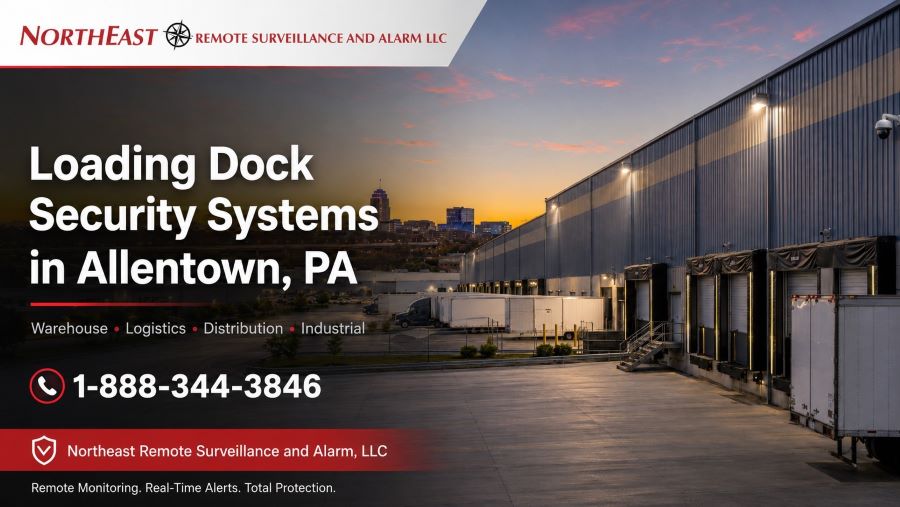
For broader dock-area planning, explore Loading Dock Security Systems in Allentown, PA.
Plan Controlled Entry Around Dock Operations
Northeast Remote Surveillance and Alarm, LLC designs controlled openings around active warehouse and dock operations. First, we map employee, driver, vendor, contractor, and freight movement. Then we define the doors, users, schedules, credentials, hardware, alerts, and records that support daily control.
A system can begin at one dock-area door for a smaller facility and scale across many doors, buildings, or enterprise locations.
For all local security services, visit Commercial Security Systems in Allentown, PA.
Access Control for Active Dock Areas
In practice, loading docks connect exterior traffic with shipping, receiving, inventory, and employee areas. For example, a personnel door beside an overhead door may give direct access to the warehouse floor. A shipping office may also contain records, keys, radios, or release information.
Access control helps define who may enter each opening and when. The facility can reduce unmanaged keys and keep an individual record of credential use.
Dock Doors Commonly Controlled
- Exterior personnel doors near loading positions.
- Warehouse-to-dock transition doors.
- Shipping and receiving office entrances.
- Driver check-in or waiting-area doors.
- Inventory hold, cage, and restricted freight areas.
- Supervisor, records, tool, and equipment rooms.
The opening and traffic determine the right design. In practice, an overhead dock door has different hardware and safety needs from a pedestrian entrance, so it may require separate protection or coordination.
Employee, Driver, Vendor, and Contractor Permissions
Different groups should receive only the access they need. For instance, employees may use assigned entrances during a shift, while a supervisor has wider access. A contractor credential can expire after a service window, and a driver may use a managed entry point without entering the warehouse.
Cards, fobs, mobile credentials, PINs, and other supported methods can follow role, department, shift, location, or expiration date. However, the business still needs a clear issuance, approval, return, and removal process.
Complete Door Hardware and Safe Operation
A reader alone does not control the opening. NERSA reviews the lock, latch, closer, frame, exit device, request-to-exit method, door-position switch, power, wiring, and backup operation. The complete door must close, secure, release, and support egress as required.
For broader door and credential planning, visit Commercial Access Control Systems in Allentown, PA.
Door Events and Dock Accountability
Where configured, the access platform can record valid entries, denied attempts, forced doors, held doors, and controller troubles. Approved managers can review the credential identifier, door, and time recorded for an event; that record alone does not establish who physically carried the credential. Clear names and accurate system time make those records more useful.
Alerts should match a defined response. Otherwise, repeated low-value notifications can hide an urgent held or forced door.
Coordinate Access Control with Dock Video
Meanwhile, video can add context to a compatible door event, but it serves a different purpose from access control.
Access control manages authorization while cameras document activity.
For focused video planning, visit Loading Dock Security Cameras in Allentown, PA.
A Scalable Dock Access Plan
- Survey: inspect openings, hardware, power, wiring, traffic, and operating schedules.
- Define users: document roles, doors, times, exceptions, and expiration rules.
- Select components: match readers, controllers, locks, sensors, and software to each opening.
- Install: complete hardware, protected wiring, programming, and labels.
- Test: verify authorized entry, denied access, egress, relocking, alerts, and backup behavior.
- Document: record door names, users, settings, accounts, and service information.
For instance, a smaller warehouse may protect high-risk personnel doors first.
By comparison, an enterprise may need shared permissions, naming, reports, and support across several facilities.
For the wider property type, visit Warehouse Security Systems in Allentown, PA.
Loading Dock Access FAQs
Can temporary workers receive expiring access?
Often, yes. The platform and policy must support individual credentials, schedules, and expiration.
Can access control manage an overhead dock door?
Sometimes, but overhead doors require separate hardware, safety, control, and operating review.
Can one system cover several loading facilities?
Yes. A common platform can scale when licenses, connectivity, user roles, documentation, and support are planned correctly.
Request a Loading Dock Access Assessment
Bring a door list, shift schedule, driver check-in process, and any existing credential or hardware records.
Identify which doors must remain available during the work and who approves temporary access and final permissions.
Request a loading dock access-control assessment in Allentown.
Compliance, Codes & Project Standards
NERSA plans commercial and industrial security work with applicable code, documentation, inspection and authority-having-jurisdiction requirements in mind. Requirements vary by system, property and jurisdiction. These resources support project planning; they do not establish legal compliance, certification or AHJ approval.
Related guidance: Regulatory compliance & inspection readiness · Access control & door hardware standards · NFPA 101 & egress planning · ADA access-control planning