
Plan warehouse security around freight movement, staff access, and the records needed to review incidents.

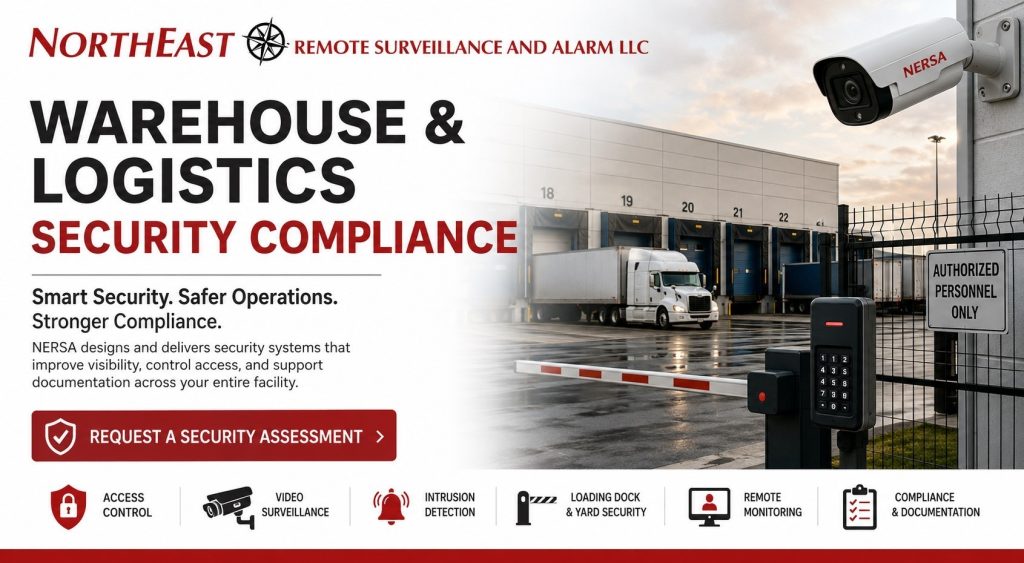
Include docks, truck courts, trailer yards, and shipping and receiving areas.
This guide covers cameras, controlled doors, alarms, monitoring, and supporting infrastructure.
NERSA coordinates those decisions with commercial security compliance and inspection planning, including relevant life-safety requirements.
Security Compliance Planning for Warehouse and Logistics Facilities
Warehouse and logistics facilities operate differently than standard commercial buildings. They often include dock doors, overhead doors, truck courts, trailer staging areas, employee entrances, driver entrances, fenced yards, shipping offices, receiving areas, inventory storage, equipment rooms, and after-hours vehicle activity.
A compliance-aware security plan looks at how the facility actually works before selecting cameras, alarms, access control, monitoring, or intercom equipment. The plan should consider who enters the property, how trucks move, where employees enter, which doors must be monitored, which areas are restricted, how incidents are reviewed, and how documentation will be maintained.
Warehouse and logistics security planning may involve:
- Loading dock camera coverage
- Truck court video surveillance
- Trailer yard monitoring
- Employee entrance access control
- Driver entrance control
- Shipping and receiving area cameras
- Door-left-open alerts
- Dock door monitoring
- Overhead door alarm contacts
- Yard gate access control
- License plate recognition
- Intrusion alarm protection
- Remote video monitoring
- Live talk-down where appropriate
- Intercom and driver communication
- Facility alerts
- Video retention planning
- Access control event records
- Incident documentation
- Low-voltage infrastructure planning
- Inspection-ready documentation
Security systems do not create warehouse compliance by themselves. They can support visibility, accountability, documentation, response, and long-term service readiness when they are planned correctly.
Security Systems Do Not Replace Warehouse Safety Programs
Cameras, alarms, access control, and monitoring can support documentation, but they do not replace safety programs, training, supervision, inspections, maintenance, or employer responsibilities. A camera may show what happened at a dock door, but it does not replace forklift safety procedures. Access control may document who entered a receiving office, but it does not replace management policy or site rules.
Security systems can support warehouse and logistics operations by helping document:
- What happened
- When it happened
- Which door, dock, gate, yard, or aisle was involved
- Whether a person, vehicle, forklift, trailer, or vendor was present
- Whether an alarm, access event, or facility alert occurred
- Whether video footage is available for review
- Whether a door was forced, held open, or left unsecured
- Whether activity occurred after hours
- Whether additional investigation is needed
For broader workplace documentation planning, visit Warehouse and Industrial Safety Documentation with Security Systems.
Loading Dock and Receiving Area Visibility
Loading docks and receiving areas are among the most important security and documentation zones in a warehouse. These areas often involve trucks, trailers, forklifts, drivers, employees, vendors, pallet movement, dock doors, and exterior exposure.
Security planning should support clear visibility around:
- Dock doors
- Trailer positions
- Truck approaches
- Driver entrances
- Shipping and receiving offices
- Staging areas
- Forklift movement
- Pedestrian paths
- Overhead doors
- Exterior dock aprons
- After-hours dock activity
- Door-left-open conditions
- Product movement
- Damage claims
- Delivery disputes
For dock-specific planning, visit Loading Dock Security and Compliance Planning.
A dock camera should not be placed only for general coverage. Useful dock documentation often requires camera angles that show doors, vehicles, trailers, people, and the activity that matters during incident review.
Truck Courts, Trailer Yards, and Yard Activity
Logistics properties often have large exterior areas where visibility is difficult. Truck courts, trailer yards, fenced lots, employee parking, overflow trailer areas, and remote gates can create exposure after hours or during busy periods.
Security planning may support review of:
- Truck arrivals
- Truck departures
- Trailer parking
- Yard truck movement
- Dropped trailer activity
- Gate access
- Vehicle damage claims
- Unauthorized vehicles
- Overnight parking
- Fence-line activity
- Fuel or equipment areas
- Exterior storage
- After-hours movement
- Trailer theft concerns
- Cargo-related incidents
A camera plan for a truck court should match the actual yard layout. A small receiving area, a cross-dock operation, and a large trailer yard may all need different camera positions, lens choices, lighting plans, and monitoring rules.
Warehouse Video Surveillance and Incident Review
Video surveillance can support incident review, management documentation, insurance review, law enforcement support when appropriate, and internal investigations. The value of the system depends on camera placement, lighting, retention, permissions, and the ability to export useful footage.
Warehouse and logistics camera planning may review:
- Dock doors
- Aisles
- Cross-aisles
- Forklift travel paths
- Shipping areas
- Receiving areas
- Inventory storage
- High-value product zones
- Employee entrances
- Driver entrances
- Offices
- Parking lots
- Yard gates
- Trailer areas
- Perimeter approaches
- Restricted rooms
- After-hours activity
For permanent camera system design, visit Commercial Video Surveillance Systems.
Camera coverage should be planned for usable evidence, not just a high camera count. Poor angles, excessive distance, glare, blocked views, weak lighting, or short retention periods can reduce the value of the system when footage is needed most.
Access Control for Warehouse and Logistics Sites
Access control helps warehouses and logistics properties manage employee entrances, driver doors, shipping offices, receiving offices, restricted rooms, gates, and interior transitions. A well-planned access control system can reduce key control problems and improve accountability.
Access control may be useful for:
- Employee entrances
- Driver entrances
- Shipping offices
- Receiving offices
- Warehouse-to-office doors
- Inventory cages
- Tool rooms
- Parts rooms
- IT rooms
- Electrical rooms
- Mechanical rooms
- Yard gates
- Guard shack doors
- Contractor entrances
- Visitor entrances
For complete access control system planning, visit Commercial Access Control Systems.
Access control should be manageable for supervisors and facility managers. Shared codes, outdated users, unclear permissions, unmanaged schedules, and unlabeled doors can weaken accountability and create avoidable service problems.
Controlled Doors, Egress, and Life Safety
Warehouse access control must be planned around safe exit, emergency release, fire-rated openings, door hardware, and inspection expectations. A controlled employee entrance, dock office door, stair door, warehouse-to-office transition, or exterior exit door may serve both security and life-safety purposes.
Controlled door planning may involve:
- Card readers
- Electric strikes
- Electrified locksets
- Electrified trim
- Electrified exit devices
- Door contacts
- Request-to-exit devices
- Emergency release buttons
- Fire alarm interface
- Door position monitoring
- Door-held-open alerts
- Door-forced-open alerts
- Access control power supplies
- Backup power
- Door release sequences
For egress-specific planning, visit Access Control Egress and Life Safety Compliance.
For electronic locking hardware planning, visit Commercial Door Hardware and Electronic Locking Compliance.
A secure warehouse door should not create an egress problem, fire door concern, accessibility issue, or inspection delay.
Intrusion Alarms and After-Hours Protection
Warehouses and logistics sites often have long operating hours, multiple shifts, late trucks, cleaning crews, weekend activity, and large exterior exposure. Alarm systems should be designed around the way the facility actually operates.
Intrusion protection may include:
- Dock door contacts
- Overhead door contacts
- Employee entrance contacts
- Driver door protection
- Yard gate monitoring
- Motion detection
- Glass-break detection
- Interior trap protection
- Restricted room alarms
- Tool room protection
- IT room protection
- Electrical room protection
- Detached building protection
- Alarm partitions
- Schedule-based arming
- Remote notifications
For alarm system planning, visit Commercial Alarm Systems.
A warehouse alarm system should not be programmed like a small office. The design should account for late deliveries, shift schedules, maintenance access, dock activity, and areas that may need to be armed separately.
Remote Monitoring and Managed Response
Remote video monitoring can support warehouse and logistics properties when activity occurs after hours or when staff are limited. Event-based monitoring can help identify suspicious activity around docks, gates, truck courts, exterior doors, parking lots, and trailer yards.
Remote monitoring may support:
- After-hours dock activity
- Yard movement
- Fence-line activity
- Gate activity
- Exterior door alerts
- Parking lot incidents
- Unauthorized vehicles
- Loitering
- Alarm verification
- Live talk-down where appropriate
- Manager notification
- Event documentation
For managed event handling, visit Security Operations Center and Managed Security Response.
Remote monitoring should be tied to site-specific instructions. The facility should define who is contacted, when video is reviewed, when live talk-down may be used, and when escalation is appropriate.
Driver, Vendor, and Contractor Accountability
Warehouse and logistics facilities often rely on people who are not regular employees. Drivers, outside carriers, vendors, service technicians, maintenance contractors, inspectors, temporary workers, and cleaning crews may all need controlled access.
Security planning can help document:
- Driver check-in
- Vendor entrance activity
- Contractor access
- Temporary credential use
- Guard shack activity
- Intercom calls
- Gate entry
- Shipping office access
- Receiving office access
- Restricted area access
- After-hours access
- Visitor movement
The system should help management understand who entered, where they entered, what areas they accessed, and whether camera footage supports the access record.
Restricted Areas and Inventory Accountability
Warehouses and logistics operations may include areas that need more control than general warehouse space. These areas may involve high-value products, tools, parts, IT equipment, records, building systems, or sensitive inventory.
Restricted areas may include:
- Inventory cages
- High-value storage areas
- Tool rooms
- Parts rooms
- IT rooms
- Electrical rooms
- Mechanical rooms
- Sprinkler rooms
- Records rooms
- Shipping offices
- Receiving offices
- Supervisor offices
- Medication or regulated product storage
- Cold storage support areas
- Equipment rooms
Security systems can help document access, denied entries, forced doors, held doors, alarm events, and video footage around restricted areas.
Cold Storage, Food, and Temperature-Sensitive Logistics
Some warehouse and logistics properties handle temperature-sensitive products, food, beverages, pharmaceuticals, medical supplies, or other inventory that may require additional facility alert planning.
Security and facility alert planning may include:
- Cooler temperature alerts
- Freezer temperature alerts
- Door-left-open alerts
- Power loss alerts
- Water leak detection
- Equipment room alerts
- Remote notifications
- Camera coverage of sensitive storage areas
- Access control for restricted storage
- Event documentation
For facility condition alerts, visit Environmental Monitoring and Facility Alerts.
Environmental monitoring does not replace operational checks or product handling requirements, but it can help alert managers when a condition needs attention.
License Plate Recognition and Gate Documentation
Logistics properties with truck traffic, trailer yards, employee parking, and controlled gates may benefit from license plate recognition when vehicle documentation is important.
LPR may support:
- Gate activity review
- Truck entry documentation
- Trailer yard access
- Employee parking review
- Visitor vehicle records
- Unauthorized vehicle investigation
- After-hours vehicle activity
- Law enforcement support when appropriate
- Parking lot incident review
LPR should be planned carefully. Camera angle, mounting height, lighting, vehicle speed, lane position, plate visibility, and retention settings all affect performance.
Low-Voltage Infrastructure and System Reliability
Warehouse and logistics properties can be challenging environments for security infrastructure. Long cable paths, high ceilings, metal structures, exterior gates, large yards, network gaps, dock equipment, and harsh conditions can affect system reliability.
Infrastructure planning may include:
- Camera cabling
- Access control cabling
- Alarm wiring
- Fiber links
- Wireless bridges
- Network switches
- Equipment rooms
- PoE switching
- UPS power
- Cellular backup
- Device labeling
- Cable pathways
- Conduit needs
- Service access
- Surge protection
- Security network segmentation
For infrastructure-specific planning, visit Low-Voltage Infrastructure Compliance for Security Systems.
A warehouse security system should be designed for long-term service. Poor infrastructure can turn a good design into a system that is difficult to maintain, troubleshoot, or expand.
Fire Alarm Coordination and Monitoring Readiness
Warehouse and logistics properties may have fire alarm systems, sprinkler monitoring, fire alarm communicators, emergency communication systems, or alarm monitoring paths that require careful coordination.
Security work may need fire alarm awareness when it involves:
- Fire alarm communicator changes
- Legacy phone line replacement
- Cellular or IP monitoring paths
- Access-controlled door release
- Maglock release
- Emergency communication equipment
- Fire alarm interface relays
- Monitoring account changes
- Inspection documentation
- Final testing after changes
For fire alarm monitoring and inspection support, visit Fire Alarm Monitoring, Testing, and Inspection.
For AHJ-sensitive projects, visit AHJ Coordination for Commercial Security and Fire Alarm Projects.
Fire alarm communication and security system changes should be planned, tested, and documented so the facility does not create avoidable trouble conditions, missed signals, or inspection confusion.
Video Retention, Export, and Documentation
Warehouse and logistics facilities may need footage for incident review, damage claims, delivery disputes, theft investigation, workplace documentation, management review, insurance discussions, or law enforcement support.
Video documentation planning should consider:
- Recording duration
- Important camera views
- Storage capacity
- Time and date accuracy
- User permissions
- Export process
- Clip naming
- Incident notes
- Manager review process
- Who can view footage
- Who can export footage
- How long footage is retained
- How footage is shared
For evidence-focused planning, visit Video Surveillance Documentation and Evidence Retention Planning.
The best time to plan retention and export procedures is before the first incident happens.
Documentation for Inspection and Long-Term Support
A warehouse security system is easier to inspect, service, troubleshoot, and upgrade when documentation is clean. Documentation also helps facility managers understand what the system covers and how it should be maintained.
Useful documentation may include:
- Camera location list
- Camera view descriptions
- Access-controlled door list
- Alarm zone list
- Dock door device list
- Gate device list
- Door hardware notes
- Panel locations
- Power supply locations
- Network equipment locations
- Monitoring information
- Communication path notes
- User permission structure
- Access schedules
- Video retention settings
- Response procedures
- Testing records
- Service notes
- As-built information when applicable
Documentation should support future service, ownership changes, inspections, renovations, insurance review, and system expansion.
Common Warehouse and Logistics Security Compliance Problems
Many warehouse security problems happen because equipment is installed without reviewing the full operation.
Common issues include:
- Cameras that do not show dock activity clearly
- Trailer positions blocking camera views
- Poor nighttime yard visibility
- No door status monitoring
- Unclear alarm schedules
- Shared access credentials
- Unremoved former users
- No camera view for alarm verification
- Weak gate coverage
- No retention plan
- No evidence export procedure
- Poorly documented access-controlled doors
- Door hardware selected without egress review
- Fire alarm communication changes without proper coordination
- Low-voltage wiring installed without long-term service planning
- No clear after-hours response instructions
A better plan starts with the movement of people, vehicles, doors, inventory, and information across the property.
Related Planning
Coordinate warehouse security with workplace safety, freight procedures, and the responsible project professionals.
- Regulatory Compliance and Inspection Readiness for Commercial Security Systems — Review project requirements and inspection coordination.
- Industrial and Warehouse Security Compliance — Explore security planning across production and storage operations.
- Loading Dock Security and Compliance Planning — Coordinate security around freight transfers and dock activity.
- Warehouse and Industrial Safety Documentation with Security Systems — Plan how system records support incident and operational review.
Why Warehouse and Logistics Facilities Choose Northeast Remote Surveillance and Alarm
Northeast Remote Surveillance and Alarm, LLC designs commercial and industrial security systems for facilities where logistics activity matters. We understand that warehouses, fulfillment centers, distribution buildings, freight terminals, cross-dock operations, truck yards, and trailer lots need systems planned around movement, documentation, and response.
Our team helps clients evaluate cameras, access control, intrusion alarms, door monitoring, gate control, remote monitoring, fire alarm coordination, low-voltage infrastructure, user permissions, video retention, and system documentation before recommending a design.
Warehouse and logistics facilities choose NERSA because we provide:
- Commercial and industrial security experience
- Warehouse and logistics site planning
- Loading dock camera design
- Truck court and trailer yard visibility
- Access control for employee and driver entrances
- Intrusion alarm and dock door monitoring
- Remote monitoring and live talk-down support
- Fire alarm coordination awareness
- Low-voltage infrastructure planning
- Documentation for service and inspection readiness
- Long-term support after installation
A warehouse security system should help the facility see more, control access better, document events clearly, and respond with better information.
Request a Warehouse and Logistics Security Compliance Assessment
NERSA can help plan security for your warehouse, distribution center, fulfillment operation, freight terminal, truck yard, or trailer lot. We review cameras, access control, intrusion alarms, monitoring, dock doors, yard gates, and driver entrances. Infrastructure and documentation should support the facility’s compliance and inspection needs.
Call 1-888-344-3846 or request a security assessment to review your facility, dock activity, truck movement, trailer areas, access-control doors, camera coverage, alarm protection, monitoring needs, documentation gaps, and long-term security goals.
We support warehouse and logistics security compliance planning throughout the Lehigh Valley, Northeastern Pennsylvania, Central Pennsylvania, Greater Philadelphia, New Jersey, Delaware, and the Mid-Atlantic region.
Frequently Asked Questions about Warehouse and Logistics Security Compliance
Does a security system make a warehouse compliant?
No. A security system does not make a warehouse compliant by itself. Cameras, access control, alarms, and monitoring can support visibility, documentation, access accountability, and response procedures, but they do not replace safety programs, management policies, training, inspections, or applicable code requirements.
How can cameras support warehouse and logistics compliance planning?
Cameras can support dock activity review, truck court visibility, trailer yard documentation, parking lot review, restricted-area documentation, and after-hours event review when they are placed correctly and footage is retained properly.
Why does access control matter in warehouse and logistics facilities?
Access control helps manage employee entrances, driver doors, shipping offices, receiving offices, restricted rooms, warehouse-to-office transitions, and gates. It can support accountability by showing which users accessed controlled openings and when access occurred.
What areas should be covered in a warehouse security plan?
Common areas include dock doors, truck courts, trailer yards, employee entrances, driver entrances, shipping and receiving offices, parking lots, restricted rooms, yard gates, inventory areas, and after-hours access points.
Can dock doors and overhead doors be monitored?
Yes. Dock doors and overhead doors can often be monitored with door contacts or alarm devices so the system can report after-hours openings, forced openings, or doors left unsecured.
Can remote monitoring support logistics security?
Yes. Remote monitoring can support after-hours awareness, alarm verification, video review, live talk-down where appropriate, manager notification, and event documentation for docks, gates, yards, and exterior areas.
Why does low-voltage infrastructure matter in warehouses?
Warehouses often have long cable paths, high ceilings, metal structures, exterior gates, truck courts, and limited equipment rooms. Infrastructure planning helps cameras, access control, alarms, and monitoring systems remain reliable and serviceable.
How long should warehouse video be retained?
Retention depends on the facility, camera count, risk level, storage capacity, management needs, insurance expectations, and incident review requirements. NERSA can help design a retention approach that matches the property.
What documentation should be kept for warehouse security systems?
Useful documentation may include camera locations, access-controlled doors, dock door devices, alarm zones, gate devices, monitoring information, user permissions, video retention settings, response procedures, testing records, and service notes.
What is the best next step for warehouse and logistics security compliance planning?
The best next step is a site-specific assessment. NERSA can review dock activity, truck movement, trailer areas, employee entrances, driver access, camera coverage, access-control doors, alarm needs, monitoring procedures, infrastructure, and documentation requirements before recommending a system design.