
Fire alarm trouble and supervisory signals identify faults and monitored conditions that need investigation.

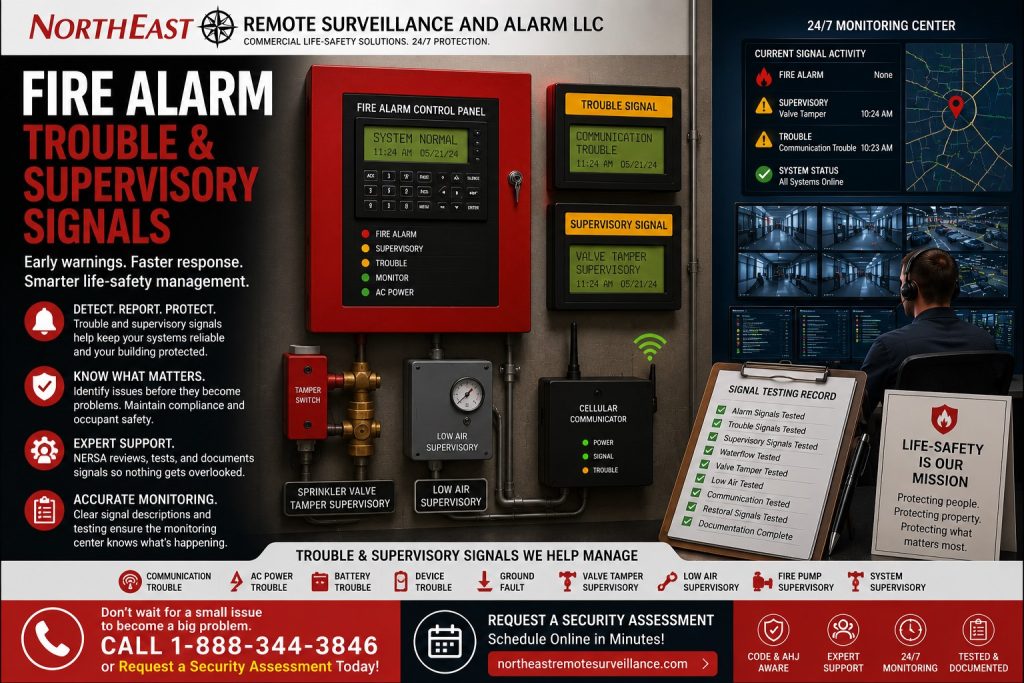
NERSA helps facilities review communication, power and battery trouble, valve tamper and low air supervisory conditions.
We also review account descriptions, signal tests and records.
For broader planning, see Fire Alarm Monitoring and Supervision and Commercial & Industrial Fire Alarm Installation and Life Safety.
Commercial Fire Alarm Trouble and Supervisory Signal Review
A fire alarm panel may show more than alarm conditions.
Commercial fire alarm systems can report alarm, trouble, supervisory, and restoral signals. Each signal type means something different, and each one should be reviewed, documented, and handled properly.
Ignoring trouble or supervisory signals can leave a building owner unsure whether the fire alarm system, sprinkler monitoring, communicator path, power supply, device circuit, or supervised fire protection equipment is operating correctly.
NERSA helps commercial facilities understand what these signals mean, where they are coming from, whether they are reporting correctly, and what should be documented for long-term service and inspection readiness.
Alarm vs. Trouble vs. Supervisory Signals
Fire alarm systems use different signal categories to describe different conditions.
| Signal Type | Common Meaning | Why It Matters |
|---|---|---|
| Alarm Signal | A fire alarm initiating condition has activated | Indicates a possible fire alarm event, waterflow alarm, smoke detector activation, pull station activation, or other alarm input |
| Trouble Signal | The fire alarm system has a fault or condition affecting normal operation | Indicates a system issue such as communication trouble, power trouble, battery trouble, wiring trouble, device trouble, ground fault, or panel problem |
| Supervisory Signal | A monitored fire protection condition needs attention | Indicates a condition such as valve tamper, low air, fire pump supervisory, pressure supervisory, or another supervised fire protection status |
| Restoral Signal | A condition returned to normal | Confirms that an alarm, trouble, or supervisory condition has cleared where applicable |
These signals should not be treated as interchangeable. A trouble signal is not the same as a fire alarm. A supervisory signal is not the same as a trouble. Each signal type should be programmed, transmitted, described, and documented correctly.
What Is a Fire Alarm Trouble Signal?
A fire alarm trouble signal indicates that something in the fire alarm system needs attention.
Trouble signals may involve the fire alarm control panel, devices, circuits, wiring, communication path, backup battery, AC power, notification appliance circuit, initiating device circuit, ground fault, or other monitored system condition.
Common fire alarm trouble conditions may include:
- Communication trouble
- AC power trouble
- Low battery or battery failure
- Ground fault
- Device trouble
- Smoke detector trouble
- Dirty detector condition where supported
- Open circuit
- Short circuit
- Notification appliance circuit trouble
- Initiating device circuit trouble
- Panel trouble
- Expander or module trouble
- Annunciator trouble
- Communicator trouble
- Phone-line trouble
- Cellular or IP path trouble
- Power supply trouble
- Supervision loss on connected equipment where applicable
A trouble signal should be investigated because it may affect how the fire alarm system operates, reports, or supervises the building.
What Is a Fire Alarm Supervisory Signal?
A fire alarm supervisory signal identifies a monitored fire protection condition that requires attention but is not necessarily an active fire alarm.
Supervisory signals often involve sprinkler systems, control valves, air pressure, pump status, pressure conditions, or other supervised building fire protection equipment.
Common supervisory conditions may include:
- Sprinkler valve tamper
- Low air supervisory
- Dry system supervisory condition
- Fire pump supervisory signal where applicable
- Pressure supervisory condition where applicable
- Fire protection system valve condition
- Elevator-related supervisory condition where applicable
- Other supervised fire protection equipment status depending on system design
A supervisory signal should not be ignored. It may indicate that a fire protection system is not in its normal ready condition.
Why Trouble and Supervisory Signals Matter
Trouble and supervisory signals help identify problems before the building owner assumes the system is normal.
A fire alarm panel may still appear powered, but a trouble condition could mean the system has a reporting problem, device issue, communication failure, or circuit fault. A sprinkler system may still be physically present, but a supervisory condition could mean a valve is not in its normal position or a dry system pressure condition needs attention.
Proper signal review helps support:
- Life-safety system reliability
- Monitoring account accuracy
- Faster service response
- Inspection readiness
- Better documentation
- Clearer communication with facility managers
- Better AHJ coordination
- Reduced uncertainty during alarms or service calls
- Cleaner long-term system management
The goal is to understand the signal, identify the cause, correct the issue, and document the result.
Communication Trouble Signals
Communication trouble is one of the most common fire alarm issues in older commercial buildings.
A communication trouble signal may indicate that the fire alarm panel or communicator is not reporting properly to the monitoring path. This can happen when old phone lines fail, cellular signal is weak, IP communication is interrupted, communicator programming is incorrect, or monitoring account information needs review.
Communication trouble may involve:
- Old phone-line service
- Failed POTS lines
- Cellular communicator issue
- IP communicator issue
- Network outage
- Monitoring path supervision failure
- Communicator power issue
- Programming issue
- Account setup issue
- Signal transmission issue
For dedicated communication path planning, see Fire Alarm Communicator Upgrades and Fire Alarm Phone Line Replacement.
AC Power and Battery Trouble
Fire alarm systems rely on primary power and backup battery power.
An AC power trouble condition may indicate that the panel or power supply has lost normal electrical power. A battery trouble condition may indicate that the backup battery is weak, disconnected, failed, undersized, or no longer supporting the system properly.
Power-related trouble review may include:
- Fire alarm control panel power
- Remote power supplies
- NAC power supplies
- Battery age
- Battery condition
- Charging circuit status
- AC power feed
- Dedicated circuit condition
- Power supply trouble
- Annunciator or expander power
- Communicator power
Power and battery trouble conditions should be corrected because the fire alarm system must remain reliable during normal and emergency conditions.
Ground Fault Trouble
A ground fault is a common fire alarm trouble condition that should be investigated.
Ground faults may occur when wiring, devices, conduit, moisture, damaged insulation, or other conditions allow a circuit to reference ground improperly. Ground faults can be difficult to locate and may require careful troubleshooting.
Ground fault review may include:
- Fire alarm initiating circuits
- Notification appliance circuits
- SLC wiring
- Field devices
- Outdoor devices
- Sprinkler monitoring wiring
- Elevator interface wiring
- Junction boxes
- Conduit pathways
- Water intrusion or moisture
- Damaged insulation
Ground faults should not be dismissed. They can affect system reliability and create recurring service problems.
Device Trouble Signals
Device trouble signals may indicate that a specific fire alarm device, module, detector, or supervised input needs attention.
Device trouble may involve:
- Smoke detectors
- Heat detectors
- Duct detectors
- Manual pull stations
- Monitor modules
- Control modules
- Waterflow switches
- Tamper switches
- Low air switches
- Remote annunciators
- NAC power supplies
- Control relays
- Elevator recall relays
- Fire alarm communicators
A clear point description helps technicians identify which device needs attention. Vague labels like “Device Trouble” or “Zone 4” make service harder.
Notification Appliance Circuit Trouble
Notification appliance circuit trouble may indicate a problem with the horns, strobes, horn-strobes, speakers, speaker-strobes, wiring, power supply, or connected notification circuit.
NAC trouble may involve:
- Open circuit
- Short circuit
- Wiring damage
- Strobe circuit trouble
- Horn circuit trouble
- Speaker circuit trouble
- Remote power supply trouble
- End-of-line supervision problem
- Device failure
- Field wiring issue
Notification appliance circuit trouble matters because occupants depend on notification appliances during fire alarm events.
Sprinkler Valve Tamper Supervisory Signals
Sprinkler valve tamper is one of the most important supervisory signals in commercial buildings.
A tamper switch may report when a sprinkler control valve is moved from its normal position or requires attention. If a sprinkler valve is closed or partially closed, the sprinkler system may not be able to protect the building properly.
Tamper signal review may include:
- Valve location
- Tamper switch condition
- Point or zone description
- Supervisory signal reporting
- Restoral reporting
- Monitoring account description
- Testing documentation
- Inspection readiness
For dedicated sprinkler signal planning, see Fire Alarm Waterflow and Tamper Monitoring and Sprinkler System Monitoring.
Low Air Supervisory Signals
Low air supervisory signals are common in dry sprinkler systems and some other fire protection arrangements.
A low air signal may indicate that system air pressure has dropped below the intended level or that a supervised air pressure condition needs attention. This can be important in warehouses, loading dock areas, industrial buildings, unheated spaces, and dry system applications.
Low air supervisory review may include:
- Dry sprinkler system points
- Air pressure supervision
- Signal description
- Monitoring account programming
- Restoral reporting
- Testing documentation
- Trouble history
- Sprinkler contractor coordination where required
A low air signal should be understood clearly so the facility knows whether the condition requires service attention.
Fire Pump Supervisory Signals
Some commercial buildings may have fire pump-related supervisory signals connected to the fire alarm system or monitoring path.
These signals depend on the fire protection system design and may include pump running, pump trouble, power-related conditions, phase reversal, controller status, or other supervised conditions where applicable.
Fire pump supervisory signal review may include:
- Signal descriptions
- Fire pump controller interface
- Monitoring account information
- Fire alarm point descriptions
- Restoral reporting
- Testing documentation
- AHJ expectations
- Fire protection contractor coordination where needed
Fire pump-related signals should be clearly labeled and documented.
Elevator-Related Trouble and Supervisory Signals
Buildings with elevators may have fire alarm interface points related to elevator recall, elevator lobby smoke detection, machine room detection, control room detection, hoistway detection, heat detectors, recall relays, or other elevator-related conditions.
Elevator-related fire alarm signals must be reviewed carefully because they may affect elevator recall operation, testing, inspection, and AHJ acceptance.
Elevator signal review may include:
- Elevator lobby smoke detector descriptions
- Machine room or control room detector descriptions
- Recall relay module documentation
- Control output descriptions
- Trouble or supervisory conditions where applicable
- Monitoring account notes
- Testing records
- Elevator contractor coordination
For dedicated elevator recall planning, see Fire Alarm Elevator Recall Integration.
Monitoring Account Descriptions
Fire alarm trouble and supervisory signals are only useful when the monitoring account descriptions are accurate.
If a signal is received as “Zone 7 Trouble” or “Supervisory 2,” the monitoring center, facility manager, or service provider may not have enough information to understand what condition occurred.
NERSA helps review monitoring descriptions such as:
- Site name
- Site address
- Account information
- Emergency contact list
- Alarm signal descriptions
- Trouble signal descriptions
- Supervisory signal descriptions
- Waterflow descriptions
- Valve tamper descriptions
- Low air descriptions
- Elevator-related descriptions where applicable
- Restoral descriptions
- Signal test records
For dedicated account planning, see Fire Alarm Monitoring Account Review.
Signal Testing and Verification
Trouble and supervisory signals should be tested and verified where applicable.
A signal should be received by the fire alarm panel, transmitted through the communicator, received by the monitoring center, and identified with the correct description.
Testing may include:
- Trouble signal testing
- Supervisory signal testing
- Valve tamper testing
- Low air supervisory testing where applicable
- Communication trouble testing where applicable
- Restoral testing
- Monitoring center receipt confirmation
- Account identification confirmation
- Signal description confirmation
- Documentation of results
Testing should be coordinated properly with the monitoring center, facility staff, service provider, and AHJ requirements where applicable.
Existing Fire Alarm Signal Review
Before correcting fire alarm trouble or supervisory signals, NERSA reviews the existing fire alarm and monitoring setup.
The review may include:
- Fire alarm control panel
- Current trouble conditions
- Current supervisory conditions
- Communicator status
- Monitoring account information
- Device descriptions
- Zone or point labels
- Sprinkler monitoring points
- Elevator interface points where applicable
- Power supplies
- Batteries
- Ground fault history
- Service history
- Available documentation
- AHJ or inspection concerns
- Future upgrade needs
This review helps determine whether the issue is a device problem, wiring problem, communicator problem, account description problem, documentation gap, or broader system condition.
Documentation and Inspection Readiness
Trouble and supervisory signals should be documented clearly.
Documentation may include:
- Fire alarm panel condition
- Trouble signal history
- Supervisory signal history
- Device locations
- Zone or point names
- Monitoring descriptions
- Signal testing records
- Communicator information
- Power and battery notes
- Sprinkler monitoring notes
- Elevator interface notes
- Service recommendations
- AHJ or inspection records where applicable
For related planning, see Fire Alarm Inspection Readiness.
AHJ and Code-Aware Planning
Fire alarm trouble and supervisory signals must be handled with code awareness.
The Authority Having Jurisdiction has final authority over fire alarm approval, inspection, and acceptance. Requirements may vary by municipality, building type, occupancy, adopted code, system design, sprinkler system, elevator interfaces, communicator type, and monitoring arrangement.
NERSA plans fire alarm signal review with attention to:
- AHJ expectations
- Fire alarm panel requirements
- Manufacturer instructions
- Monitoring provider requirements
- Signal descriptions
- Communication path supervision
- Backup power
- Documentation
- Testing and inspection readiness
For broader code planning, see NFPA 72 Fire Alarm Standards for Commercial Buildings.
Trouble and Supervisory Signals vs. Fire Alarm Inspection
Trouble and supervisory signals identify conditions that need review and follow-up.
Signal review does not replace required inspection or system design. Required fire alarm inspection, testing, and maintenance must follow the applicable requirements, accepted procedures, AHJ direction, and qualified service process.
For broader inspection planning, see Fire Alarm Monitoring, Testing, and Inspection Requirements.
Before and After
| Before Signal Review | After Signal Review |
|---|---|
| Trouble signals were ignored or unclear | Trouble conditions can be identified and documented |
| Supervisory signals were vague | Supervisory points can be reviewed and labeled |
| Monitoring account descriptions were outdated | Signal descriptions can be cleaned up |
| Communication trouble was unresolved | Communicator path can be reviewed |
| Sprinkler tamper signals were not clearly identified | Valve tamper points can be documented |
| Low air signals were not understood | Dry system supervisory points can be reviewed |
| Restoral reporting was uncertain | Restoral signals can be tested where applicable |
| Inspection records were limited | Documentation can support service and inspection readiness |
Commercial Facilities That Need Trouble and Supervisory Signal Review
Fire alarm trouble and supervisory signal review is common in:
- Warehouses
- Distribution centers
- Manufacturing facilities
- Industrial buildings
- Office buildings
- Healthcare offices
- Schools and education facilities
- Retail stores
- Industrial parks
- Multi-tenant commercial buildings
- Logistics facilities
- Professional offices
- Municipal buildings
- Institutional properties
- Buildings with sprinkler systems
- Buildings with elevators
- Buildings with monitored fire alarm systems
- Buildings with old phone-line fire alarm communication
Each facility should be reviewed based on its fire alarm system, monitoring requirements, sprinkler equipment, elevator equipment where applicable, communication path, documentation, and AHJ expectations.
Related Planning
Use qualified fire alarm professionals to review signal conditions and coordinate required testing and local authority review.
Why Businesses Choose NERSA for Fire Alarm Signal Review
Northeast Remote Surveillance and Alarm, LLC focuses on commercial, industrial, institutional, and business and facility security and life-safety systems.
Fire alarm trouble and supervisory signal review requires more than clearing a panel message. It requires understanding fire alarm panels, communicators, monitoring accounts, sprinkler supervision, elevator interfaces, signal descriptions, power conditions, documentation, testing, and AHJ-aware planning.
NERSA helps commercial facilities understand what the fire alarm system is reporting and what needs to be corrected before small trouble conditions become larger life-safety problems.
When to Request Fire Alarm Trouble or Supervisory Signal Review
A commercial facility should request signal review if:
- The fire alarm panel shows a trouble condition.
- The fire alarm panel shows a supervisory condition.
- The monitoring center reports unclear signal descriptions.
- Communication trouble is active.
- The system still uses old phone lines.
- The building has valve tamper or low air supervisory signals.
- Trouble or supervisory conditions keep returning.
- Signal testing records are incomplete.
- Inspection documentation is missing.
- The building is preparing for inspection.
- The building is changing tenants, ownership, or monitoring providers.
- The owner wants a clearer long-term fire alarm support path.
Fire Alarm Trouble and Supervisory Signal Checklist
Before reviewing trouble and supervisory signals, evaluate:
- Fire alarm control panel
- Current trouble messages
- Current supervisory messages
- Alarm history
- Restoral history
- Existing communicator
- Current monitoring path
- Phone-line dependence
- Cellular or IP options
- Monitoring account information
- Emergency contact list
- Signal descriptions
- Device descriptions
- Waterflow points
- Valve tamper points
- Low air supervisory points
- Fire pump supervisory points where applicable
- Elevator interface points where applicable
- Power supplies
- Backup batteries
- Ground fault history
- Documentation
- AHJ expectations
- Future system upgrade needs
Request Fire Alarm Trouble and Supervisory Signal Support
NERSA can help review fire alarm trouble, supervisory, and communication signals at your commercial property. We assess valve tamper conditions, low-air signals, monitoring descriptions, and related support needs.
Frequently Asked Questions About Fire Alarm Trouble and Supervisory Signals
What is a fire alarm trouble signal?
A fire alarm trouble signal indicates that something in the fire alarm system needs service attention. It may involve communication trouble, power trouble, battery trouble, wiring trouble, device trouble, ground fault, panel trouble, or another system condition.
What is a fire alarm supervisory signal?
A supervisory signal indicates a monitored fire protection condition that needs attention but is not necessarily an active fire alarm. Examples may include valve tamper, low air, fire pump supervisory, pressure supervisory, or other supervised conditions depending on the building.
Is a supervisory signal the same as a fire alarm?
No. A supervisory signal is different from a fire alarm signal. A fire alarm indicates an alarm event, while a supervisory signal indicates a monitored fire protection condition that requires attention.
Is a trouble signal the same as a supervisory signal?
No. A trouble signal usually indicates a system fault or service condition. A supervisory signal usually indicates a monitored fire protection equipment condition, such as a valve tamper or low air condition.
Should fire alarm trouble signals be ignored if there is no alarm?
No. Trouble signals should be reviewed because they may affect system operation, signal reporting, device supervision, communication, power, or inspection readiness.
What causes communication trouble on a fire alarm panel?
Communication trouble may be caused by old phone lines, cellular signal problems, IP network issues, communicator failure, account programming problems, power issues, or monitoring path trouble.
What causes valve tamper supervisory signals?
Valve tamper supervisory signals may occur when a sprinkler control valve is moved from its normal position or when the tamper switch or wiring needs attention.
What is low air supervisory?
Low air supervisory is commonly associated with dry sprinkler systems and may indicate that air pressure has dropped below the intended level or that the system needs service review.
Can NERSA review fire alarm signal descriptions?
Yes. NERSA can review fire alarm point names, zone descriptions, monitoring account descriptions, trouble signals, supervisory signals, communicator paths, and documentation to identify cleanup or correction needs.
How do we start a fire alarm trouble or supervisory signal review?
Call 1-888-344-3846 or use Request a Security Assessment.
NERSA can review the fire alarm panel, communicator, monitoring account, signal descriptions, trouble history, supervisory points, documentation, and testing needs before recommending the right path.
Compliance, Codes & Project Standards
NERSA plans commercial and industrial security work with applicable code, documentation, inspection and authority-having-jurisdiction requirements in mind. Requirements vary by system, property and jurisdiction. These resources support project planning; they do not establish legal compliance, certification or AHJ approval.
Related guidance: Regulatory compliance & inspection readiness · NERSA project standards · Documentation, testing & inspection readiness