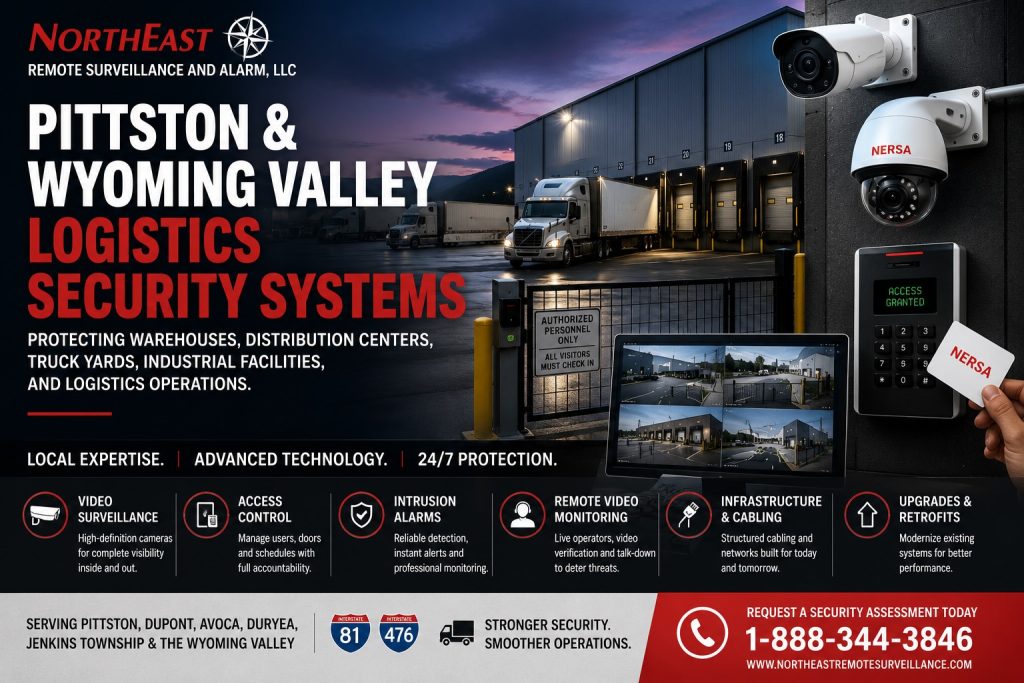
Pittston and Wyoming Valley logistics security systems should be designed around the movement of freight, employees, contractors, trucks, trailers, visitors, equipment, and inventory—not around a generic camera count or residential-style alarm package.
Northeast Remote Surveillance and Alarm, LLC designs, installs, monitors, upgrades, and supports commercial and industrial security systems for Pittston-area warehouses, distribution centers, manufacturing facilities, trucking operations, cold-storage buildings, industrial properties, contractor yards, office-warehouse facilities, and multi-building logistics organizations.
This page is NERSA’s primary local logistics-security hub for Pittston, Pittston Township, Jenkins Township, Dupont, Duryea, Avoca, and nearby north and central Wyoming Valley industrial markets. It focuses on the operating conditions shared by local warehouses, freight facilities, truck yards, industrial parks, distribution properties, manufacturing buildings, and commercial sites connected to the I-81 and I-476 logistics network.
For wider Northeastern Pennsylvania planning, begin with the NEPA Logistics Hub Security Directory. For warehouse-security planning across Pennsylvania and the Mid-Atlantic, use Warehouse and Logistics Security Systems.

A Local Logistics Security Hub Within the NEPA Structure
The Pittston and Wyoming Valley logistics market sits between the broader Scranton and Wilkes-Barre commercial corridors. Properties throughout this area may share freight routes, labor markets, trucking activity, industrial infrastructure, vendors, contractors, and operating conditions, but they still require local security planning based on the individual facility.
This page exists to route Pittston-area businesses into the correct NERSA security resource while maintaining a clear architectural boundary.
It does not replace:
- The regional NEPA logistics directory
- The Greater Scranton logistics hub
- The Wilkes-Barre industrial and logistics hub
- The statewide warehouse-security hub
- Individual video-surveillance, access-control, alarm, monitoring, or infrastructure pages
Facilities centered in Wilkes-Barre proper should remain under the Wilkes-Barre market page. Scranton, Dunmore, Jessup, Dickson City, and Lackawanna County properties should remain under the Greater Scranton hub.
This page owns the tighter Pittston and Wyoming Valley warehouse, distribution, freight, industrial, and logistics market intent.
Logistics Security Built Around Real Facility Operations
A logistics facility cannot be protected effectively without understanding how the property works.
The security assessment should identify:
- Where trucks enter and leave
- How drivers check in
- Which doors employees use
- When shifts begin and end
- Where contractors and vendors enter
- How trailers are staged
- Which docks handle inbound and outbound freight
- Where high-value inventory is stored
- Which rooms require restricted access
- When the property is lightly staffed
- What activity is legitimate after hours
- How alarms and monitored events should be handled
- Which footage management may need after an incident
- How the system will expand with the operation
A system that ignores those conditions may create blind spots, false alarms, unmanaged credentials, unusable video, excessive notifications, or security procedures employees routinely bypass.
NERSA plans Pittston and Wyoming Valley logistics security systems around the operation first and the equipment second.
Core Security Resources for Pittston and the Wyoming Valley
A complete logistics property may use several security layers, but each project should begin with the resource that matches its main requirement.
Commercial Video Surveillance Systems
Commercial cameras should be positioned around the views the organization actually needs to record, retrieve, and understand.
Warehouse and logistics applications may include:
- Truck entrances
- Gate lanes
- Loading docks
- Dock aprons
- Trailer parking
- Shipping and receiving areas
- Employee entrances
- Warehouse aisles
- Inventory cages
- Parking lots
- Fence lines
- Exterior storage
- Restricted rooms
- Office-to-warehouse transitions
Use Commercial and Enterprise Video Surveillance Systems for camera selection, placement, recording, video retention, remote access, AI-supported search, incident exports, user permissions, and multi-site video management.
Commercial and Industrial Access Control
Access control helps logistics facilities manage employees, temporary workers, contractors, vendors, cleaning crews, drivers, visitors, supervisors, and restricted departments without depending entirely on uncontrolled mechanical keys.
Controlled openings may include:
- Employee entrances
- Shipping offices
- Receiving offices
- Warehouse-to-office doors
- IT and communications rooms
- Tool cribs
- Inventory cages
- Maintenance rooms
- Tenant entrances
- Administrative areas
- Vehicle gates
Use Commercial and Industrial Access Control Systems for credentials, card readers, key fobs, mobile access, controllers, schedules, permissions, door hardware, audit trails, gate entry, and multi-location administration.
Commercial and Industrial Intrusion Alarms
Commercial alarm systems should protect vulnerable openings and areas according to the building’s actual operating schedule.
A Pittston-area warehouse may require protection around:
- Exterior personnel doors
- Loading-dock doors
- Overhead doors
- Shipping offices
- Interior warehouse areas
- Restricted storage
- Detached buildings
- Tool and equipment rooms
- Roof hatches
- Utility rooms
- Gates
- Sensitive inventory
Use Commercial and Industrial Alarm Installation for alarm panels, contacts, motion detection, partitions, keypads, user codes, cellular or IP communication, environmental alerts, video verification, monitoring, and documented response procedures.
Remote Video Monitoring and Live Talk-Down
Properties with exterior yards, trailer parking, loading areas, gates, equipment, vehicles, fence lines, and repeated after-hours activity may need more than recorded video.
Remote monitoring can add:
- Analytic-triggered alerts
- Operator event review
- Video verification
- Live audio warnings
- Responsible-party notification
- Escalation procedures
- Event reports
- Camera-health supervision
Use Remote Video Monitoring and Live Talk-Down for monitored truck yards, gates, docks, parking areas, exterior storage, warehouse perimeters, and other selected after-hours activity zones.
Commercial Security Monitoring
Professional monitoring should be designed around the event being received and the response the business expects.
Monitoring may involve intrusion signals, panic or duress alarms, communication failures, environmental conditions, video verification, access events, after-hours activity, and customized contact procedures.
Use Commercial and Industrial Security Monitoring for monitored-event handling, communication supervision, notification workflows, verification, escalation, and documented commercial response procedures.
Low-Voltage Security Infrastructure
Cameras, access-control panels, alarm communicators, intercoms, recorders, network switches, wireless bridges, and monitored systems depend on the infrastructure behind them.
Large Pittston and Wyoming Valley logistics properties may require:
- Structured security cabling
- Fiber between buildings
- Managed PoE switches
- Remote network closets
- Wireless point-to-point bridges
- Equipment racks
- Patch panels
- Outdoor-rated pathways
- Backup power
- Cable and port labeling
- Network documentation
- Expansion capacity
Use Commercial and Industrial Infrastructure and Cabling for security cabling, fiber backbones, network pathways, PoE planning, wireless links, equipment organization, testing, documentation, and future expansion.
Loading-Dock and Shipping-Area Security
Loading docks combine freight, employees, drivers, vendors, forklifts, overhead doors, staged materials, trailers, and unrestricted exterior activity.
A dock-security plan should help management determine:
- Which truck arrived
- Which trailer backed into the dock
- Which overhead door opened
- Who entered the shipping area
- When freight was staged
- Whether a door remained unsecured
- Whether visible damage occurred
- Whether activity happened inside or outside the building
- Whether an event occurred during approved hours
Useful dock protection may involve interior and exterior cameras, overhead-door contacts, door-position monitoring, shipping-office access control, alarm partitions, intercoms, video verification, and after-hours monitored response.
Exterior views can document vehicle approach, trailer position, driver movement, and activity around the building. Interior views can document staging lanes, freight movement, forklift activity, employee actions, and the condition of goods entering or leaving the facility.
The system should be designed around the actual dock line. A wide overview camera alone may not provide enough detail to identify a person, vehicle, trailer, damaged product, or specific door involved in an incident.
Truck Courts, Trailer Yards, and Drop Lots
Truck courts and trailer yards often create the greatest exterior exposure on a logistics property.
Trailers may be:
- Staged temporarily
- Parked overnight
- Loaded or unloaded
- Moved between rows
- Connected to yard tractors
- Awaiting driver pickup
- Positioned away from staffed areas
- Left near remote fence lines
A useful yard-security design may involve overview cameras, long-range identification views, gate cameras, vehicle documentation, analytic zones, lighting coordination, perimeter monitoring, live talk-down, and defined response procedures.
Camera placement should account for the way trailers change position. A clear view during installation may later become blocked by a trailer, container, parked tractor, temporary storage, or construction activity.
The security design should also distinguish between legitimate truck activity and unauthorized movement. Monitoring schedules, delivery information, access records, and property-specific procedures help prevent every late vehicle from being treated as an emergency.
Gate and Vehicle-Entrance Security
A gate is only one part of a controlled vehicle-entry process.
Gate security may include:
- Overview cameras
- Driver and vehicle identification views
- License-plate documentation
- Credential readers
- Keypads
- Intercoms
- Remote release
- Gate-position monitoring
- Vehicle detection
- Access schedules
- Video verification
- Tailgating review
- After-hours alerts
The system should document who or what entered without creating unnecessary delays for approved trucks, employees, contractors, emergency responders, or recurring vendors.
A gate camera should be positioned around the required image objective. A general view may show that a truck entered, while a tighter lane view may be required to document a plate, cab, driver, vehicle number, or credential event.
Access-control and gate procedures must also remain coordinated with required emergency access, safe vehicle movement, accessibility, egress, and life-safety conditions.
Employee, Temporary-Worker, and Contractor Access
Warehouses and distribution centers may experience frequent changes in staffing, shifts, contractors, cleaning crews, temporary employees, vendors, and supervisors.
Mechanical keys and shared credentials make those changes difficult to control.
An access-control plan may provide:
- Individual employee credentials
- Department-based permission groups
- Shift-based schedules
- Temporary contractor access
- Expiring vendor credentials
- Separate office and warehouse permissions
- Restricted-room access
- Door-held-open reporting
- Forced-door alerts
- User activity history
- Rapid credential removal
- Centralized multi-building administration
Individual credentials improve accountability by showing which authorized user presented a credential and when the event occurred.
They do not prove that the credential holder personally entered or prevent every form of credential sharing. Cameras, door-position monitoring, management procedures, and user administration may provide additional context.
The system should remain practical during shift changes. Poorly planned employee entrances can create lines, propped doors, credential sharing, and workarounds that weaken the entire security plan.
Warehouse Intrusion Detection
A warehouse alarm should not be designed like a small office or residential system.
Large buildings may have high ceilings, loading docks, multiple departments, overhead doors, long interior distances, changing storage layouts, forklifts, heating systems, cleaning activity, and employees working outside standard hours.
The alarm design may require separate partitions for:
- Main offices
- Warehouse sections
- Shipping and receiving
- Inventory rooms
- Tool cribs
- Detached buildings
- Maintenance areas
- Restricted storage
- Tenant spaces
- Administrative departments
Partitioning allows one part of the building to remain occupied while other areas are armed.
Overhead doors should use devices and mounting methods appropriate for large moving openings. Motion detection should account for ceiling height, racking, machinery, airflow, temperature, environmental conditions, and expected activity.
The system should use clear descriptions such as “Dock Door 12” or “North Warehouse Employee Entrance,” not generic labels such as “Zone 8” or “Rear Door.”
Video Verification and Alarm Response
A conventional alarm signal identifies a programmed condition. Video verification may provide visual context from the affected area.
For example, a dock-door alarm may be associated with video showing:
- A person entering
- An employee returning after closing
- A door moving because it was not secured
- A vehicle approaching the opening
- Activity near an adjacent dock
- No visible activity in the camera view
Video verification does not replace dependable door contacts, motion detectors, alarm communication, or response procedures.
It provides another layer of information that may help authorized contacts and monitoring personnel understand the event.
The alarm zone, camera, building, and partition should use related names so the correct video can be identified quickly.
Parking Lots and Employee-Vehicle Areas
Employee and visitor parking areas may require coverage for vehicle incidents, vandalism, suspicious activity, after-hours presence, employee-safety concerns, and movement near building entrances.
Parking-lot camera planning should identify the intended result.
Different objectives may require different views:
- General lot visibility
- Building-entrance coverage
- Pedestrian-route coverage
- Vehicle identification
- License-plate capture
- Incident review between parked vehicles
- After-hours analytic monitoring
One camera may not accomplish all of those objectives.
Headlights, weather, snow, rain, wet pavement, lighting, distance, parked trucks, landscaping, and changing vehicle positions can affect image quality.
Remote monitoring may be appropriate in selected closed areas, but analytics should be limited carefully when cameras also view public roads, neighboring properties, or unrestricted activity outside the site.
Interior Warehouse and Restricted-Area Security
Not every logistics-security concern begins at the exterior.
Interior areas may include:
- High-value inventory
- Returns processing
- Tool cribs
- Parts storage
- IT rooms
- Network closets
- Records rooms
- Maintenance areas
- Cage storage
- Finished goods
- Controlled office areas
- Utility rooms
- Sensitive customer property
Protection may involve access-controlled doors, door-position switches, camera coverage, intrusion detection, individual user permissions, event reporting, and documented incident procedures.
The level of protection should reflect the value, sensitivity, operational importance, and number of authorized users associated with the area.
A general warehouse aisle, inventory cage, IT room, tool crib, and shipping office should not automatically receive identical permissions, alarm schedules, camera coverage, or video-retention policies.
Manufacturing and Industrial Properties
The Pittston and Wyoming Valley market includes more than warehouses and distribution facilities.
Manufacturing and industrial properties may need security around:
- Employee entrances
- Production-support areas
- Raw materials
- Finished goods
- Engineering rooms
- Tool storage
- Maintenance departments
- Electrical rooms
- Shipping and receiving
- Exterior equipment
- Contractor entrances
- Parking areas
- Detached buildings
Security equipment must be selected and positioned around actual environmental conditions.
Industrial facilities may include dust, heat, moisture, vibration, machinery, high ceilings, electrical interference, restricted areas, changing production layouts, and limited shutdown windows.
Cameras, alarm devices, readers, enclosures, wiring, switches, and power supplies should be suitable for the location where they will operate.
Cold Storage and Food Distribution
Cold-storage and food-distribution properties may require security planning around loading activity, controlled areas, restricted inventory, employee entrances, vendor access, temperature-sensitive operations, and incident documentation.
Systems may include:
- Dock cameras
- Employee access control
- Restricted-room permissions
- Intrusion alarms
- Temperature alerts
- Power-loss monitoring
- Water detection
- Video retention
- Monitoring procedures
- Backup communication
Commercial security and condition-monitoring systems can support accountability and event awareness. They do not replace food-safety programs, process-control systems, temperature-management procedures, written policies, audits, inspections, or regulatory responsibilities.
The system design should distinguish between security alarms, operational-condition alerts, and regulated fire or life-safety signals.
Multi-Tenant Industrial and Office-Warehouse Properties
Multi-tenant properties may share parking lots, loading areas, drive lanes, gates, exterior walls, dumpsters, common entrances, utility spaces, and network infrastructure.
Security planning should establish who controls:
- Common-area cameras
- Tenant cameras
- Shared gates
- Tenant credentials
- Common entrances
- Alarm partitions
- Video access
- Monitoring accounts
- Incident exports
- Equipment rooms
- Service decisions
Property management may need visibility across common areas while individual tenants retain control of their own users, doors, alarms, cameras, and restricted spaces.
Permissions should be separated carefully so one tenant cannot view, control, or administer another tenant’s protected areas unless the ownership and operational structure explicitly requires it.
New Systems, Upgrades, and Takeovers
Pittston and Wyoming Valley logistics security systems may involve completely new installations, expansion of serviceable systems, modernization of outdated platforms, or takeovers from another provider.
An existing-system assessment may review:
- Camera quality and coverage
- Recorder condition
- Video retention
- Access-control panels
- Reader technology
- Door hardware
- Alarm-panel capacity
- Detection devices
- Communicators
- Monitoring configuration
- Cabling
- Fiber
- Network switches
- PoE capacity
- Wireless bridges
- User accounts
- Passwords
- Licensing
- Equipment ownership
- Documentation
- Expansion needs
Existing equipment can remain when it is dependable, compatible, supportable, secure, and appropriate for the intended system.
Equipment should not be retained solely because it is already installed. Unsupported platforms, unknown passwords, unreliable wiring, insufficient storage, unmanaged switches, failing power supplies, and obsolete communicators can create weak points throughout the upgraded system.
Large migrations may be completed in phases so the facility remains operational while infrastructure and high-priority areas are upgraded.
Multi-Building and Multi-Site Logistics Systems
A logistics organization may operate several buildings within the Wyoming Valley or multiple locations across Pennsylvania.
Multi-site planning may standardize:
- Camera names
- Door names
- Alarm zones
- User roles
- Credential permissions
- Monitoring procedures
- Video-retention policies
- Network architecture
- Equipment standards
- Documentation
- Administrator access
- Incident-reporting procedures
Standardization makes systems easier to administer, but each property still requires site-specific design.
A small office-warehouse should not be forced into the same device layout as a large distribution center. The objective is to use consistent platforms and administrative standards while adapting camera placement, alarm zoning, access permissions, monitoring, and infrastructure to each facility.
Security Infrastructure for Large Properties
Security-system reliability depends on cabling, network pathways, equipment locations, power, and documentation.
Large properties may exceed practical copper-network distances or require security devices in detached buildings, gatehouses, remote yards, or separate warehouse sections.
The infrastructure design may use:
- Fiber backbones
- Distributed network closets
- Managed PoE switches
- Commercial wireless bridges
- Outdoor-rated enclosures
- Underground pathways
- UPS-supported equipment
- Patch panels
- Organized racks
- Labeled ports
- Documented IP addressing
- Spare capacity
Network equipment should not be placed randomly above ceilings or connected through undocumented switches simply because those locations are convenient during installation.
Every active component should have a suitable environment, stable power, sufficient bandwidth, service access, labeling, and documentation.
Evidence Retention and Incident Documentation
A security system is most valuable when it can produce useful information after an event.
The facility should establish:
- How long video will be retained
- Which cameras require greater storage
- Who can review footage
- Who can export evidence
- How access-control history is searched
- How alarm events are documented
- Whether system times are synchronized
- How monitoring reports are retained
- How incident video is preserved
- Who administers the systems
- How former users are removed
- What documentation is provided at completion
A business should not discover after a freight dispute, vehicle incident, theft, access question, or employee concern that the needed footage has already been overwritten or the correct camera cannot be identified.
Device names should remain consistent across field labels, software, drawings, monitoring accounts, and service records.
Security That Supports Logistics Operations
Security should protect the property without becoming a daily obstacle.
A logistics operation needs efficient:
- Shift changes
- Driver check-in
- Trailer movement
- Loading and unloading
- Employee entry
- Contractor access
- Warehouse-to-office movement
- After-hours deliveries
- Emergency access
- Management review
Alarm schedules should match real operations. Access permissions should reflect job roles. Camera analytics should exclude ordinary activity where possible. Monitoring instructions should identify legitimate after-hours work. Door hardware should support both security and required egress.
Systems that are too difficult to operate often lead to bypassed zones, propped doors, shared credentials, ignored alerts, and unreported problems.
The design should strengthen accountability without interfering unnecessarily with throughput.
Fire Alarm and Life-Safety Boundaries
Commercial fire-alarm systems are separate life-safety systems with different design, installation, monitoring, testing, inspection, documentation, and response requirements.
A logistics property may need coordination when access control or security work affects:
- Electrified locks
- Magnetic locks
- Required egress
- Door release
- Fire-alarm interfaces
- Elevator operation
- HVAC shutdown
- Sprinkler supervisory signals
- Emergency access
- Fire-alarm communication paths
Fire-alarm devices should not be modified as ordinary security components.
Security, access-control, gate, and door-hardware projects should remain coordinated with required emergency operation and Authority Having Jurisdiction expectations when applicable.
Pittston and Wyoming Valley Service Area
NERSA evaluates commercial and industrial logistics-security projects in and around:
- Pittston
- Pittston Township
- Jenkins Township
- Dupont
- Duryea
- Avoca
- Hughestown
- Yatesville
- West Pittston
- Exeter
- Wyoming
- Forty Fort
- Plains Township
- Nearby Luzerne County logistics and industrial markets
- I-81-connected warehouse and distribution properties
- I-476-connected industrial and freight facilities
These locations define the market context rather than an automatic guarantee of project availability.
Service depends on the facility, system type, project scope, equipment requirements, inspection coordination, travel, installation conditions, and long-term support needs.
Small Commercial Properties Through Enterprise Operations
NERSA supports Pittston and Wyoming Valley logistics security systems across different facility sizes.
A smaller office-warehouse or contractor property may need:
- Several commercial cameras
- One controlled employee entrance
- A monitored intrusion alarm
- Cellular communication
- Organized cabling
- Clear user administration
A larger distribution, manufacturing, or multi-building property may require:
- Numerous cameras
- Multiple controlled doors
- Several alarm partitions
- Truck-yard monitoring
- Gate control
- Fiber-connected buildings
- Centralized administration
- Large user databases
- Remote video monitoring
- Standardized documentation
- Phased installation
- Multi-site reporting
The system should fit the present operation while leaving a practical path for additional doors, cameras, users, buildings, storage, monitoring, and future expansion.
Why Pittston-Area Logistics Facilities Choose NERSA
Northeast Remote Surveillance and Alarm, LLC focuses on commercial and industrial systems rather than residential alarm packages or consumer camera installations.
NERSA evaluates the complete facility, including:
- Freight movement
- Truck entrances
- Loading docks
- Trailer parking
- Employee access
- Contractor traffic
- Restricted areas
- Parking exposure
- Camera visibility
- Intrusion risks
- Monitoring procedures
- Network infrastructure
- Existing equipment
- Documentation
- Expansion plans
The objective is not to install the largest number of devices.
The objective is to create a dependable, serviceable, scalable, and documented system that improves visibility, controls access, supports alarm response, and helps management understand what occurred when an incident requires review.
What This Page Does Not Cover
This page is limited to commercial and industrial logistics security in Pittston and the north and central Wyoming Valley market.
It is not the primary page for:
- All NEPA logistics properties
- Greater Scranton
- Wilkes-Barre proper
- Hazleton
- General warehouse security nationwide
- Detailed camera-system education
- Detailed access-control design
- Intrusion-alarm installation procedures
- Remote monitoring service details
- Fire-alarm system design
- General office-network installation
- Residential security systems
Those subjects should remain under their proper regional, city, service, industry, compliance, or Knowledge Center resource.
Request a Pittston and Wyoming Valley Logistics Security Assessment
If your Pittston or Wyoming Valley warehouse, distribution center, trucking operation, industrial property, manufacturing facility, cold-storage building, contractor yard, office-warehouse, or multi-building logistics site needs stronger security, Northeast Remote Surveillance and Alarm, LLC can evaluate the property and recommend a practical system.
The assessment may review loading docks, truck courts, trailer rows, gates, employee entrances, contractor access, warehouse interiors, parking areas, restricted rooms, camera coverage, alarm points, controlled doors, monitoring procedures, lighting, cabling, network infrastructure, existing equipment, documentation, and future expansion.
Call Northeast Remote Surveillance and Alarm, LLC at 1-888-344-3846 to request a Pittston and Wyoming Valley logistics security assessment.
Frequently Asked Questions About Pittston and Wyoming Valley Logistics Security Systems
What area does this logistics-security hub cover?
This page focuses on Pittston, Pittston Township, Jenkins Township, Dupont, Duryea, Avoca, and nearby north and central Wyoming Valley industrial and logistics markets.
Is this page part of the NEPA Logistics Hub?
Yes. This is a supporting local market hub beneath NERSA’s NEPA Logistics Hub Security Directory.
Does this page replace the Wilkes-Barre security hub?
No. Facilities centered in Wilkes-Barre proper should use the Wilkes-Barre industrial and logistics market page. This hub is focused more tightly on Pittston and nearby Wyoming Valley logistics properties.
What types of facilities does NERSA support in the Pittston area?
NERSA supports warehouses, distribution centers, manufacturing facilities, trucking properties, cold-storage buildings, contractor yards, office-warehouse properties, industrial parks, multi-tenant buildings, and multi-site commercial organizations.
What security systems do logistics facilities commonly need?
A logistics facility may need video surveillance, access control, intrusion alarms, commercial monitoring, remote video monitoring, gate systems, intercoms, vehicle documentation, and supporting low-voltage infrastructure.
Can cameras document loading-dock incidents?
Properly positioned cameras can document truck arrival, trailer location, dock activity, visible freight handling, employee movement, driver activity, and other conditions within the camera’s field of view.
Can overhead warehouse doors be alarmed?
Yes. Compatible commercial contacts, door-position devices, alarm zones, partitions, schedules, video verification, and monitoring procedures may be used to protect overhead doors.
Can access control manage temporary workers and contractors?
Yes. Credentials can be assigned individual permissions, schedules, expiration dates, and restricted-door access when the selected platform supports those functions.
Can remote video monitoring cover a trailer yard?
Yes. Properly designed monitored video can support analytics, operator event review, live talk-down, escalation, and event documentation around selected trailer rows, gates, truck courts, and exterior areas.
Can NERSA upgrade an existing security system?
Yes. NERSA can evaluate existing cameras, recorders, access control, intrusion alarms, communicators, monitoring accounts, cabling, fiber, switches, user permissions, and documentation to determine what may remain and what should be upgraded.
Can an existing camera system be expanded?
Possibly. Expansion depends on camera compatibility, recorder capacity, licensing, storage, network bandwidth, PoE capacity, infrastructure, and whether the existing platform remains supportable.
Can separate cameras, access control, and alarms work together?
Compatible systems may coordinate camera views, door events, intrusion signals, monitoring workflows, gate activity, and incident records when the integration solves a defined operational need.
Can one platform support multiple warehouse buildings?
Yes. Multi-building systems may provide centralized camera access, shared credential administration, consistent alarm procedures, standardized naming, monitoring, and system documentation.
Does NERSA support both small businesses and enterprise facilities?
Yes. NERSA supports smaller office-warehouse and contractor properties as well as large distribution centers, manufacturing facilities, industrial campuses, multi-building sites, and enterprise organizations.
Is fire-alarm work included in ordinary security-system installation?
No. Fire-alarm systems are separate life-safety systems. Fire-alarm planning, installation, monitoring, inspection, testing, and system interfaces require a dedicated scope.
Does NERSA install residential security systems?
No. Northeast Remote Surveillance and Alarm, LLC focuses on commercial, industrial, institutional, municipal, healthcare, warehouse, manufacturing, logistics, contractor, multi-tenant, and multi-site properties.