
NERSA provides commercial security installation in Pittston, PA, including commercial security camera installation and integrated security systems for warehouses, distribution facilities, industrial buildings, and logistics properties.

Request a Pittston Commercial Security Assessment
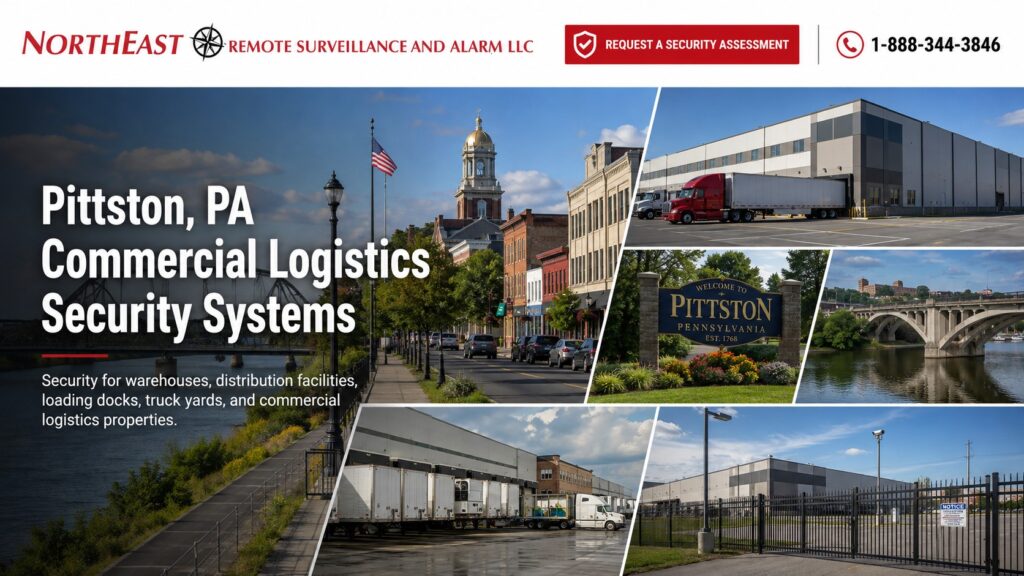
We plan camera coverage, controlled entry, alarms, and supporting infrastructure around freight movement, employee access, and after-hours operations. Pittston and Greater Pittston connect to the Wyoming Valley, I-81, I-476, Route 315, Route 11, and nearby freight corridors.
For facilities across the region, explore our Northeastern Pennsylvania commercial and industrial security guide, including the separate Scranton, Wilkes-Barre, Pittston, and Hazleton service areas.
Northeast Remote Surveillance and Alarm, LLC designs, installs, integrates, monitors, upgrades, and supports commercial and industrial security systems. We serve qualifying warehouses, distribution facilities, logistics operations, contractor properties, and truck and trailer yards. Our work also covers industrial buildings, commercial campuses, and loading facilities in Pittston, Pittston Township, Jenkins Township, West Pittston, Duryea, Avoca, and surrounding Northeastern Pennsylvania communities.
Logistics properties require more than general building security. Employee movement, drivers, deliveries, loading docks, overhead doors, trailers, gates, parking areas, inventory, exterior storage, and after-hours vehicle activity all create different security requirements across the property.
For broader regional warehouse, industrial, and logistics planning, visit the Northeastern Pennsylvania Logistics Guide Security Directory.
Commercial Logistics Security Planning in Pittston
A Pittston logistics-security system should be designed around the actual movement of employees, drivers, freight, vehicles, inventory, vendors, and contractors.
Planning may consider:
- Employee entrances
- Driver entrances
- Shipping and receiving
- Loading docks
- Overhead doors
- Warehouse aisles
- Inventory areas
- Truck courts
- Trailer parking
- Vehicle gates
- Employee parking
- Visitor parking
- Exterior storage
- Fence lines
- Detached structures
- Office-to-warehouse transitions
- After-hours activity
- Existing cameras and alarms
- Access-control users
- Network and low-voltage infrastructure
The objective is not to install the greatest possible number of cameras, readers, or alarm devices.
The objective is to create useful visibility, controlled access, dependable after-hours protection, better freight and vehicle documentation, and a system that remains practical to operate and expand.
Pittston’s Warehouse and Distribution Environment
Greater Pittston contains a mix of warehouse buildings, distribution operations, industrial properties, commercial service facilities, contractor businesses, transportation-related properties, and office-industrial locations.
These properties may experience:
- Multiple employee shifts
- Continuous delivery traffic
- Early-morning arrivals
- Late-night departures
- Truck and trailer staging
- High-value inventory
- Exterior storage
- Large parking areas
- Multiple loading doors
- Temporary drivers and contractors
- Seasonal operating changes
- Unattended exterior areas
- Expansion into adjoining buildings or suites
Security should be planned around those conditions rather than around a generic commercial-property template.
Employee, Driver, and Vendor Accountability
Logistics facilities often have several groups using the property for different reasons.
Employees may need regular building access, while drivers may require limited access to shipping areas, vendors may use specific entrances, and contractors may require temporary permissions.
Security planning should clearly establish:
- Which entrances are public
- Which doors are employee-only
- Where drivers should report
- Which areas visitors may enter
- How temporary users are handled
- Who can access restricted spaces
- How former users are removed
- How after-hours access is documented
The completed system should support operations without giving every user unnecessary access to the entire facility.
Loading, Shipping, and Receiving Activity
Loading areas are among the most active parts of many Pittston logistics properties.
Employees, drivers, trailers, forklifts, freight, overhead doors, shipping paperwork, and exterior vehicle movement may all converge within a relatively small area.
Security planning should provide enough information to understand:
- When a trailer arrived
- Which dock was used
- When an overhead door opened
- Who was present
- What activity occurred around the shipment
- Whether activity happened during approved hours
The purpose is to improve operational documentation and incident review without interfering with normal shipping and receiving.
Truck, Trailer, and Exterior Exposure
Many logistics properties have substantial exposure outside the building.
Truck courts, trailer parking, employee lots, gates, fence lines, rear approaches, and exterior storage areas may remain accessible or lightly supervised after normal office hours.
Exterior security should be planned around actual distances, lighting, vehicle movement, camera mounting locations, network availability, and the level of identification required.
Existing Logistics Security Systems
Pittston commercial properties frequently have existing cameras, recorders, intrusion alarms, access control, gates, cabling, wireless links, or network equipment installed during different phases of the property’s history.
Existing equipment should be evaluated before complete replacement is recommended.
The appropriate project may involve:
- Repair
- Reconfiguration
- Expansion
- Camera replacement
- Recorder modernization
- Access-control cleanup
- Alarm communication upgrades
- Monitoring changes
- Network improvements
- Provider takeover
- Phased modernization
For broader modernization planning, visit Commercial Security System Upgrades, Retrofits & Takeovers.
Pittston Logistics Security Resources
For warehouse and distribution properties requiring coordinated inventory, employee, loading-area, exterior, and after-hours protection, visit Warehouse and Logistics Security Systems.
For loading docks, shipping and receiving, overhead doors, driver activity, and shipment documentation, visit Loading Dock Security Systems.
For truck yards, trailer parking, vehicle staging, gates, perimeter activity, and after-hours yard protection, visit Truck Yard Security Systems.
For focused trailer-row and truck-parking camera planning, visit Trailer Yard and Truck Parking Lot Security Cameras.
For controlled vehicle entrances, credentials, gate operators, visitor communication, and vehicle-access administration, visit Commercial Gate Access Control Systems.
For properties requiring focused vehicle and license-plate documentation, visit License Plate Recognition Camera Systems.
For parking lots, employee vehicles, visitor parking, building approaches, and exterior incident documentation, visit Parking Lot Security Cameras.
For commercial alarm monitoring in Pittston, define the protected zones, operating hours, authorized contacts and escalation instructions.
An existing-system review should check the alarm panel, communicator, account access and service compatibility before a monitoring takeover.
Review NERSA security monitoring services to scope the response process.
For selected yard, dock, gate, or exterior-camera events requiring professional review and live audio intervention, visit Remote Video Monitoring and Live Talk-Down.
For structured cabling, fiber, wireless links, PoE switching, equipment racks, power, and supporting security infrastructure, visit Commercial & Industrial Infrastructure and Cabling.
Regional Logistics Connections
For broader logistics and industrial planning throughout Scranton, Wilkes-Barre, Pittston, Hazleton, the Wyoming Valley, and surrounding NEPA markets, visit the Northeastern Pennsylvania Logistics Guide Security Directory.
For warehouse, industrial, distribution, freight, and logistics planning across the Greater Scranton market, visit Greater Scranton Logistics Guide Security Systems.
For warehouse, manufacturing, industrial, and logistics properties throughout the Wilkes-Barre and Wyoming Valley market, visit Wilkes-Barre Industrial and Logistics Security Systems.
For Hazleton-area commercial, manufacturing, warehouse, and logistics properties, visit Commercial and Industrial Security Systems in Hazleton, PA.
For logistics properties connected to the Pennsylvania Turnpike Northeast Extension, visit I-476 Northeastern Pennsylvania Logistics Security Corridor.
Why Pittston Logistics Properties Choose Northeast Remote Surveillance and Alarm
Northeast Remote Surveillance and Alarm, LLC focuses on commercial and industrial security systems rather than single-family home alarm packages.
NERSA evaluates Pittston logistics properties around:
- Facility operation
- Employee movement
- Drivers and vendors
- Freight movement
- Loading docks
- Overhead doors
- Truck and trailer activity
- Gates
- Parking
- Exterior storage
- After-hours exposure
- Existing equipment
- Monitoring
- Network infrastructure
- Future expansion
The objective is to provide a commercial logistics security system that remains dependable, manageable, serviceable, and appropriate for the actual operation of the property.
Put the project responsibilities in writing
A logistics property may involve an owner, an occupant, several operational teams and outside carriers. Identify who can approve changes to each building, entrance and equipment location. Permission to manage one tenant’s space does not automatically include neighboring or common areas. A current drawing should show the boundary of the proposed work and identify any approvals that remain outstanding.
Assign responsibility for everyday administration as well as installation. Someone needs to approve users, maintain contact lists, request service and preserve recordings when a question arises. Distinguish those duties from dispatch and inventory decisions. The system should help authorized staff understand an event, not create uncertainty about which team owns the underlying business decision.
Compare proposed improvements with a real example
Choose an ordinary operational question that the current arrangement handles poorly. It might concern a delivery that changed doors, a contractor whose access should have ended or a recording that could not be retrieved. Explain the sequence and the missing information. That example is a stronger basis for evaluation than asking only how many cameras or readers a proposal includes.
Ask each proposed approach to explain how staff would handle the example after completion. Identify the information that will be available, the person authorized to retrieve it and any limitations. A view of a vehicle may help establish movement without proving the contents of a shipment. Setting that expectation early helps management judge the actual benefit.
Plan changes around operating periods
Discuss receiving peaks, shift changes and other activity that affects installation access. Identify which entrances or areas can be worked on and when. The responsible operational contact should understand any temporary interruption and the approved alternative procedure. Avoid leaving staff to improvise because a device is unexpectedly unavailable.
For phased work, describe what each stage delivers and what remains outside it. A completed first phase should provide its promised result without depending on an unspecified later purchase. If a temporary arrangement is required, give it an owner and an expected end point, then confirm its removal or replacement during the next stage.
Agree on the connection and support boundaries
Camera recording, visitor calls, controlled entry and remote viewing can depend on different parts of the installation. Involve facilities and IT when reviewing power, network connections and equipment locations. Clarify which party investigates each kind of fault and how the customer reports it.
Document behavior during an interruption for the actual proposed equipment. A communication outage may affect remote viewing differently from local recording. Staff should not have to guess which records remain available or invent an access workaround. Qualified professionals should evaluate physical gate equipment, door hardware and any affected life-safety requirements.
Keep the finished system usable across staff changes
Use recognizable building, entrance and camera names. Keep authorized administration separate from routine viewing where practical. When employees leave or contractors finish, review the permissions associated with their role. A functioning device does not establish that its user list remains appropriate.
At handover, ask ordinary users to demonstrate their own tasks: find a known event, handle an unanswered entry call or remove a temporary permission. Test an export on an approved device and identify support contacts. Retain relevant drawings and responsibility records so a new supervisor can understand the arrangement without relying on the memory of the person who ordered it.
Bring the right information to the first discussion
Prepare the property address, current layout, operating hours, equipment categories and one or two recurring concerns. Explain planned changes in occupancy, storage or delivery patterns. Detailed credentials and private incident material should be handled only through appropriate authorized arrangements when needed, not included casually in a general inquiry.
The resulting proposal should identify included work, customer responsibilities, ongoing service requirements and unresolved dependencies. This gives the property a practical basis for deciding what to improve now and what can reasonably wait without overstating the coverage already in place.
Frequently Asked Questions About Pittston Commercial Logistics Security Systems
What types of Pittston properties does this guide cover?
This resource covers qualifying warehouses, distribution facilities, logistics businesses, truck and trailer properties, contractor operations, industrial buildings, commercial campuses, and other logistics-connected properties throughout Greater Pittston.
What areas are included in Greater Pittston?
Projects may include Pittston, Pittston Township, Jenkins Township, West Pittston, Duryea, Avoca, and surrounding Wyoming Valley communities depending on the property and project requirements.
What are the most important areas to protect at a logistics property?
Important areas commonly include employee entrances, loading docks, shipping and receiving, overhead doors, truck courts, trailer parking, inventory areas, gates, parking lots, exterior storage, and after-hours approaches.
Can existing warehouse security equipment be upgraded?
Yes. Existing cameras, alarms, access control, cabling, networks, gates, monitoring, and administrator accounts can be evaluated to determine what should remain, be corrected, expanded, upgraded, or replaced.
Can cameras help document loading-dock disputes?
Yes. Properly positioned cameras may help document trailer arrival, dock activity, driver interaction, freight movement, overhead-door use, and activity around shipping and receiving.
Can Pittston logistics properties use remote video monitoring?
Yes. Selected docks, yards, gates, parking areas, and exterior zones may be appropriate for remote event review and live audio response.
Can gate access be integrated with the rest of the property?
Compatible gate, access-control, intercom, video, and monitoring systems can be coordinated when doing so supports the property’s actual operating requirements.
Does every logistics property need license-plate recognition?
No. LPR should be used when reliable plate documentation serves a defined operational or security objective and the vehicle approach can support appropriate camera placement.
For related planning, explore Pittston and Wyoming Valley Logistics Security.
Greater Pittston & Luzerne County Project Experience
For nearby Luzerne County project proof, Luis Cohen and Sons Metal Recycling uses NERSA video surveillance to document activity inside the recycling facility and across the property during and after business hours.
Read the Luis Cohen and Sons metal recycling case study.
Request a Pittston Commercial Security Assessment
Tell us where your Pittston-area property needs better visibility or control. Priorities may include loading docks, truck and trailer areas, entrances, gates, parking, or remote monitoring. NERSA can evaluate your existing system and recommend improvements suited to your warehouse, industrial site, contractor operation, or commercial campus.
Request a Pittston Commercial Security Assessment.
Pittston Security Resources
Pittston warehouse and distribution security: Warehouse and distribution planning follows goods from receiving through storage, picking and dispatch.
Pittston manufacturing plant security: Manufacturing planning separates production access, contractor visits and restricted support areas.
Pittston logistics, truck-yard, and loading-dock security: Truck-yard and dock planning follows driver check-in, trailer staging and freight handoffs.
Pittston commercial gate and vehicle access control: Vehicle-entry planning defines credential use, delivery approval and responsibility for exceptions.
Pittston intercom and visitor entry systems: Visitor-entry planning connects callers with authorized employees before an opening is released.
Pittston temporary and mobile surveillance: Temporary-surveillance planning covers placement, power, communication and the end of a short-term deployment.
Compliance, Codes & Project Standards
NERSA plans commercial and industrial security work with applicable code, documentation, inspection and authority-having-jurisdiction requirements in mind. Requirements vary by system, property and jurisdiction. These resources support project planning; they do not establish legal compliance, certification or AHJ approval.
Related guidance: Regulatory compliance & inspection readiness · Warehouse & logistics compliance · NERSA project standards