
Contractor yard security planning considers equipment, vehicles, materials, gates, fences, storage and activity after hours.

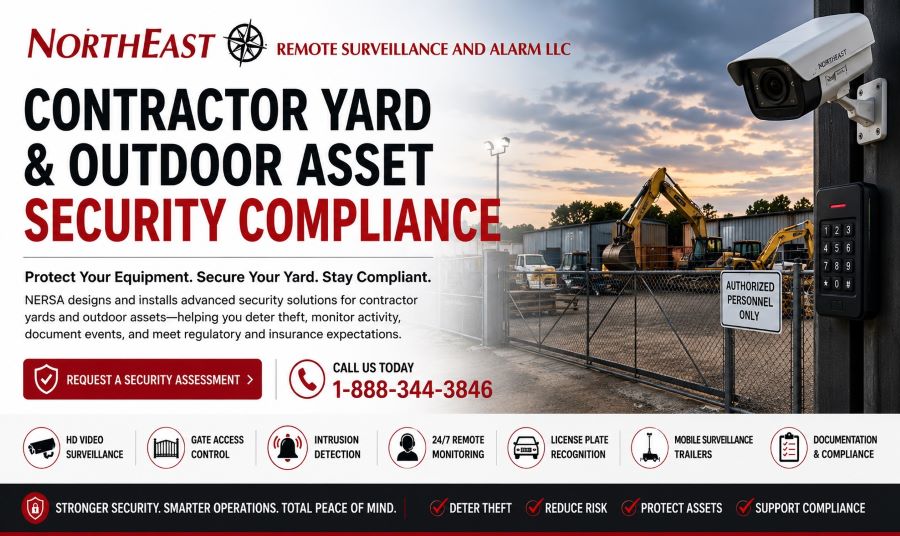
Cameras, alarms, access control and monitoring are parts of the plan.
NERSA supports regulatory compliance and inspection readiness for commercial security systems for contractor and equipment yards, fleet lots, material storage, utility yards and construction staging areas.
We also serve outdoor storage and industrial properties.
This guide covers outdoor cameras, gate access, intrusion detection, monitoring, lighting, cellular backup, video retention, records, low-voltage infrastructure and ongoing service.
Contractor Yard and Outdoor Asset Security Compliance Planning for Contractor Yards
Contractor yards and outdoor asset sites have different risks than standard office buildings. These properties often include fenced perimeters, vehicle gates, pedestrian gates, equipment storage, trailers, tools, materials, fuel areas, fleet parking, temporary structures, conex boxes, utility areas, and large outdoor zones with limited after-hours visibility.
Review how the yard operates before selecting security or communication equipment. Identify who enters, when they arrive and where valuable assets are stored. Map vehicle movement and gates that need event records. Define how video will be reviewed and how equipment will remain reliable outdoors.
Security systems do not create OSHA compliance, insurance compliance, code compliance, or inspection approval by themselves. They can support better visibility, access accountability, documentation, response, and long-term service when they are planned correctly.
Contractor yard and outdoor asset security planning may involve:
- Perimeter camera coverage
- Gate access control
- Vehicle entrance monitoring
- Pedestrian gate monitoring
- Equipment yard cameras
- Fleet parking cameras
- Material storage visibility
- Fuel area monitoring
- Tool trailer and conex box protection
- Intrusion detection
- Gate-forced-open alerts
- Motion-based event alerts
- Remote video monitoring
- Live talk-down where appropriate
- License plate recognition
- Mobile surveillance trailers
- Solar or battery-supported cameras
- Cellular communication
- Wireless bridge planning
- Video retention and evidence export
- Low-voltage infrastructure documentation
- Site-specific response procedures
The goal is a security system that helps protect outdoor assets, document activity, and support response without creating unnecessary blind spots, false alerts, service problems, or documentation gaps.
Outdoor Asset Security Is Not One-Size-Fits-All
A contractor yard, utility yard, construction staging area, fleet lot, equipment storage site, and industrial outdoor storage property may all require different security planning. A small fenced yard with one gate is not the same as a multi-acre equipment yard with trailers, service trucks, materials, and multiple access points.
A camera on a pole is not always enough. A gate reader does not document the whole yard. A motion alert is not useful if it triggers constantly from wind, animals, headlights, or normal after-hours traffic. A security plan must reflect the actual property.
NERSA reviews the yard layout, fencing, gates, lighting, vehicle movement, asset locations, storage patterns, power availability, network access, cellular signal, and response needs before recommending a design.
Security Systems Do Not Replace Yard Safety and Storage Practices
Security systems can support documentation, but they do not replace safety programs, material storage practices, employee training, supervision, maintenance, or employer responsibilities. Cameras may show what happened in a yard, but they do not replace safe storage, clear travel paths, equipment maintenance, or written procedures.
Security systems may help document:
- Gate entry and exit
- Vehicle activity
- Equipment movement
- Material storage areas
- After-hours access
- Unauthorized activity
- Fuel area activity
- Tool trailer access
- Contractor or vendor entry
- Door or gate alarms
- Motion events
- Video review requests
- Manager notifications
- Incident response activity
For broader workplace documentation planning, visit Warehouse and Industrial Safety Documentation with Security Systems.
Security technology should support the operation with better visibility and records. It should not be presented as a replacement for safe work practices, site rules, supervision, or regulatory responsibilities.
Perimeter Camera Coverage
Outdoor cameras are one of the most important parts of contractor yard security. The camera layout should be designed around useful views, not just general coverage.
Perimeter camera planning may include:
- Fence lines
- Vehicle gates
- Pedestrian gates
- Yard entrances
- Equipment rows
- Material storage zones
- Fuel areas
- Trailer parking
- Fleet parking
- Tool storage areas
- Conex boxes
- Loading and unloading areas
- Remote corners
- Blind spots
- Building entrances
- After-hours approach paths
For permanent camera system design, visit Commercial Video Surveillance Systems.
Camera placement should account for distance, lighting, lens selection, mounting height, weather exposure, glare, headlights, vegetation, fence obstruction, pole movement, and service access.
Gate Access Control and Entry Documentation
Gates are often the most important control points in a contractor yard. A properly planned gate system can help document who entered, when they entered, and whether the access event was authorized.
Gate access planning may include:
- Keypad entry
- Card reader access
- Mobile credential access
- Remote gate release
- Intercom communication
- Gate position monitoring
- Gate-forced-open alerts
- Vehicle detection
- Visitor entry procedures
- Vendor access schedules
- Temporary user access
- Camera views of gate activity
- License plate capture
- After-hours access alerts
For access control planning, visit Commercial Access Control Systems.
A gate access system should be manageable. Shared codes, old users, unclear schedules, and undocumented permissions can weaken accountability and create avoidable risk.
Fenced Yards, Pedestrian Gates, and Restricted Outdoor Areas
A fence is only one layer of protection. Contractor yards often need visibility and documentation at gates, pedestrian entrances, storage zones, and restricted outdoor areas.
Security planning may support:
- Main vehicle gates
- Side gates
- Pedestrian gates
- Fuel storage areas
- Tool trailers
- Outdoor equipment cages
- Material racks
- Utility areas
- Remote service entrances
- Fleet access points
- Yard office entrances
- Maintenance buildings
- After-hours entry points
The security system should show how people and vehicles actually move through the yard. A gate camera should capture more than a vehicle passing through. It should provide useful documentation when management needs to review who entered, what happened, and whether the event was expected.
Equipment, Fleet, Trailer, and Material Protection
Contractor yards often store high-value assets outdoors. These may include work trucks, trailers, heavy equipment, generators, compressors, lifts, tools, copper, pipe, HVAC equipment, building materials, fuel, and specialty inventory.
Security planning may help protect and document:
- Service trucks
- Fleet vehicles
- Heavy equipment
- Skid steers
- Excavators
- Trailers
- Generators
- Compressors
- Lifts
- Tool trailers
- Conex boxes
- Fuel tanks
- Copper and wire storage
- Pipe and fittings
- Building materials
- Seasonal equipment
- Rental equipment
- High-value outdoor inventory
The system should be planned around asset value, storage location, lighting, vehicle paths, camera angles, and response procedures.
Intrusion Detection and After-Hours Yard Protection
Outdoor intrusion detection can support after-hours security, but it must be planned carefully. Outdoor environments create challenges that indoor systems do not face.
Intrusion planning may include:
- Gate contacts
- Building door contacts
- Tool trailer contacts
- Conex box contacts
- Outdoor motion detection
- Fence-line analytics
- Camera-based alerts
- Alarm zones
- Schedule-based arming
- Remote notifications
- Video verification
- Live talk-down where appropriate
- Manager escalation
- Response procedures
For alarm system planning, visit Commercial Alarm Systems.
Outdoor alarm systems should reduce nuisance alerts. Wind, animals, rain, snow, headlights, shadows, moving materials, and expected after-hours activity should be considered during design.
Remote Video Monitoring and Live Talk-Down
Contractor yards often benefit from remote monitoring because many events happen after hours when staff are not on site. Remote video monitoring can help verify activity, document events, and support faster response.
Remote monitoring may support:
- After-hours yard activity
- Gate activity
- Fence-line alerts
- Equipment area movement
- Fuel area activity
- Trailer or fleet movement
- Unauthorized vehicles
- Loitering
- Material theft concerns
- Vandalism concerns
- Alarm verification
- Live talk-down warnings where appropriate
- Manager notification
- Event documentation
For managed event handling, visit Security Operations Center and Managed Security Response.
Remote monitoring should be tied to clear site instructions. The business should define who is contacted, when video is reviewed, when audio warnings may be used, and when escalation is appropriate.
Mobile Surveillance Trailers for Temporary or Remote Coverage
Some contractor yards and outdoor asset sites do not have permanent power, network access, poles, buildings, or finished infrastructure. A mobile surveillance trailer can provide fast temporary coverage while a permanent system is being planned or when the security need is temporary.
Mobile surveillance trailers may be useful for:
- Construction staging areas
- Temporary equipment yards
- Remote material storage
- Utility work zones
- Parking overflow areas
- Vacant commercial properties
- Emergency security coverage
- Yard expansion areas
- Sites waiting for permanent cameras
- Areas without power or internet
- Seasonal storage locations
For temporary and remote coverage, visit Mobile Surveillance Trailers.
Mobile surveillance should still be planned carefully. Camera views, solar exposure, battery capacity, cellular signal, lighting, monitoring rules, and response procedures all affect performance.
Lighting, Power, Cellular, and Wireless Planning
Outdoor security systems depend heavily on infrastructure. A great camera in the wrong lighting or a remote device with weak communication will not provide dependable protection.
Outdoor infrastructure planning may include:
- Pole locations
- Camera mounting height
- Exterior lighting
- Headlight glare review
- Solar exposure
- Battery capacity
- Cellular signal strength
- Wireless bridge paths
- Fiber or network availability
- PoE switching
- Weather-rated enclosures
- Surge protection
- Grounding considerations
- UPS backup
- Power supply locations
- Service access
- Device labeling
For infrastructure-specific planning, visit Low-Voltage Infrastructure Compliance for Security Systems.
Outdoor systems should be designed for serviceability. If equipment is difficult to reach, poorly labeled, exposed to damage, or dependent on weak communication paths, the system may become unreliable over time.
License Plate Recognition and Vehicle Documentation
Contractor yards with vehicle gates, fleet traffic, vendor access, and after-hours vehicle movement may benefit from license plate recognition when vehicle documentation is important.
LPR planning may support:
- Gate entry documentation
- Visitor vehicle records
- Vendor vehicle records
- Fleet movement review
- Unauthorized vehicle investigation
- After-hours vehicle activity
- Parking area review
- Law enforcement support when appropriate
- Incident review
LPR must be planned carefully. Camera angle, mounting height, vehicle speed, lane position, lighting, plate visibility, and retention settings all affect performance. A general camera at a gate does not automatically provide reliable plate capture.
Outdoor Storage, Materials, and Yard Documentation
Contractor yards often need documentation around stored materials, equipment movement, deliveries, and outdoor asset conditions. Security systems can help management review activity when there is a missing item, damage claim, dispute, or after-hours event.
Documentation may support review of:
- Material deliveries
- Equipment loading
- Trailer movement
- Fleet activity
- Vendor access
- Gate events
- Fuel area activity
- Tool storage access
- Damaged property
- Unauthorized dumping
- Theft concerns
- Inventory disputes
- After-hours yard activity
Video and access logs should be easy to review. A security system is more valuable when managers can quickly locate footage, match access events, and export clips when needed.
Environmental Monitoring and Facility Alerts
Some outdoor asset sites also need facility alerts for power, water, temperature, pump rooms, equipment rooms, or remote structures. These alerts may not involve intrusion, but they can still affect operations.
Facility alerts may support:
- Power loss alerts
- Equipment room alerts
- Water leak detection
- Temperature alerts
- Pump room alerts
- Gate power trouble
- Communication trouble
- Low battery alerts
- Remote building alerts
- Door-left-open alerts
For facility condition alerts, visit Environmental Monitoring and Facility Alerts.
Environmental monitoring does not replace maintenance or inspections. It can provide an added notification layer when a monitored condition needs attention.
Cybersecurity, Remote Access, and User Administration
Contractor yard security systems may include remote cameras, cloud video, mobile apps, access control software, cellular devices, monitoring platforms, and user accounts. These systems should be administered carefully.
Cybersecurity-aware planning may involve:
- User account controls
- Administrator permissions
- Remote viewing access
- Mobile credential management
- Camera network separation
- Firmware management
- Password practices
- Vendor access control
- Network segmentation
- Audit trails
- Deactivation of former users
- Role-based permissions
- Temporary user expiration
For security system cybersecurity planning, visit Cybersecurity and Data Protection Standards for Commercial Security Systems.
Outdoor asset security should not create unnecessary technology risk. Cameras, access control platforms, cellular devices, and monitoring tools should be managed as part of the business’s broader security environment.
Video Retention, Export, and Evidence Documentation
Contractor yards may need footage for theft investigation, damage claims, employee review, vendor disputes, fuel loss, unauthorized access, insurance review, or law enforcement support when appropriate.
Video retention and evidence planning should consider:
- How long footage is retained
- Which cameras are most important
- Whether gate cameras are retained longer
- Who can view footage
- Who can export footage
- How exports are named and stored
- Whether time and date settings are accurate
- Whether managers can locate incidents quickly
- Whether footage quality is sufficient
- Whether incident review procedures are documented
For evidence-focused planning, visit Video Surveillance Documentation and Evidence Retention Planning.
The best time to plan retention and export procedures is before equipment is missing, a gate is damaged, or a claim needs review.
Documentation for Service, Insurance, and Long-Term Support
Contractor yard security systems are easier to service, troubleshoot, and upgrade when documentation is clean. Documentation also helps owners, managers, insurance representatives, and service technicians understand what the system covers.
Useful documentation may include:
- Camera location list
- Camera view descriptions
- Gate device list
- Access-controlled gate list
- Alarm zone list
- Motion detection zones
- Power source notes
- Cellular device notes
- Wireless bridge locations
- Pole locations
- Monitoring information
- Communication path notes
- User permission structure
- Access schedules
- Video retention settings
- Response procedures
- Testing records
- Service notes
- As-built information when applicable
- Warranty and support details
Documentation should support future service, ownership changes, insurance review, system expansion, and long-term reliability.
Common Contractor Yard Security Compliance Problems
Many contractor yard security problems happen because equipment is installed without reviewing the full outdoor operation.
Common issues include:
- Cameras mounted too far from assets
- Poor nighttime lighting
- Gate cameras that cannot capture useful details
- No camera view of pedestrian gates
- Weak cellular signal
- No backup communication path
- Solar equipment placed without enough sun exposure
- Motion alerts that trigger constantly
- No gate status monitoring
- Shared gate codes
- Former employees not removed from access control
- No evidence export process
- No video retention plan
- Unlabeled outdoor equipment
- Poor service access
- No clear after-hours response instructions
- No documentation for camera views, gates, or alarm zones
A better plan starts with the movement of people, vehicles, equipment, materials, gates, and information across the yard.
Related Planning
Coordinate security with the yard’s safety procedures, storage practices, and project requirements.
- Regulatory Compliance and Inspection Readiness for Commercial Security Systems — Review project requirements and inspection coordination.
- Commercial Video Surveillance Systems — Plan the views and recorded evidence needed around outdoor assets.
- Mobile Surveillance Trailers — Explore temporary camera coverage for changing work areas.
- Security Operations Center and Managed Security Response — Define how reported events are reviewed and escalated.
Why Contractor Yards Choose Northeast Remote Surveillance and Alarm
Northeast Remote Surveillance and Alarm, LLC designs commercial and industrial security systems for outdoor environments where equipment, materials, vehicles, gates, and after-hours activity matter.
Our team helps contractors, facility managers, utility and fleet operators, equipment yards and industrial properties plan security. We review cameras, access control, intrusion detection, monitoring and lighting. Planning also covers cellular and wireless connections, video retention, user permissions and records.
Contractor yards and outdoor asset sites choose NERSA because we provide:
- Commercial and industrial security experience
- Outdoor camera placement planning
- Gate access control support
- Equipment yard and fleet visibility
- Remote monitoring and live talk-down options
- Mobile surveillance trailer support
- Cellular and wireless communication planning
- Low-voltage infrastructure planning
- Video retention and documentation planning
- Long-term service and support
A contractor yard security system should help protect assets, document activity, reduce confusion, and support response with clearer information.
Request a Contractor Yard Security Compliance Assessment
NERSA can help plan security for contractor yards, equipment and fleet areas, utility yards, construction staging, and outdoor material storage. We can review cameras, gates, alarms, monitoring, lighting, and cellular communications. Mobile surveillance trailers and documentation may also be relevant to your site.
Call 1-888-344-3846 or request a security assessment to review your yard layout, gates, asset locations, camera coverage, alarm needs, monitoring procedures, communication paths, documentation gaps, and long-term security goals.
We support contractor yard and outdoor asset security compliance planning throughout the Lehigh Valley, Northeastern Pennsylvania, Central Pennsylvania, Greater Philadelphia, New Jersey, Delaware, and the Mid-Atlantic region.
Frequently Asked Questions
Does a security system make a contractor yard compliant?
No. A security system does not make a contractor yard compliant by itself. Cameras, access control, alarms, and monitoring can support visibility, documentation, access accountability, and response procedures, but they do not replace safety programs, material storage practices, insurance requirements, management policies, inspections, or applicable code requirements.
What should contractor yard cameras cover?
Common camera views include vehicle gates, pedestrian gates, fence lines, equipment rows, material storage areas, fuel zones, fleet parking, tool trailers, conex boxes, yard offices, and after-hours approach paths.
Can access control be used on outdoor gates?
Yes. Outdoor gate access control can use keypads, card readers, mobile credentials, intercoms, remote release, and gate status monitoring depending on the site conditions and gate equipment.
Can remote monitoring help protect outdoor assets?
Yes. Remote monitoring can support after-hours awareness, alarm verification, video review, live talk-down where appropriate, manager notification, and event documentation for gates, yards, equipment areas, and fence lines.
When should a mobile surveillance trailer be used?
A mobile surveillance trailer may be useful when a site needs fast, temporary, or remote camera coverage where permanent power, network access, poles, or building infrastructure is not available.
Why does lighting matter for contractor yard cameras?
Lighting affects video quality. Poor lighting, glare, headlights, shadows, weather, and long distances can reduce the usefulness of footage when an incident needs to be reviewed.
Can license plate recognition help at contractor yards?
Yes. License plate recognition can support vehicle documentation at gates and entrances when camera angle, lighting, mounting, speed, and plate visibility are planned correctly.
What documentation should be kept for contractor yard security?
Useful documentation may include camera locations, gate devices, alarm zones, cellular equipment, power sources, monitoring information, user permissions, video retention settings, response procedures, testing records, and service notes.
Can contractor yard security work without internet?
Some sites can use cellular communication, wireless bridges, or other network options when wired internet is not available. The correct approach depends on signal strength, bandwidth needs, power, camera count, and monitoring requirements.
What is the best next step for contractor yard security compliance planning?
The best next step is a site-specific assessment. NERSA can review the yard layout, gates, asset locations, camera views, lighting, power, communication paths, alarm needs, monitoring procedures, and documentation requirements before recommending a system design.