
Lehigh Valley gate access should control vehicle entry without confusing drivers or disrupting daily operations.

Lehigh Valley Gate Security Assessment
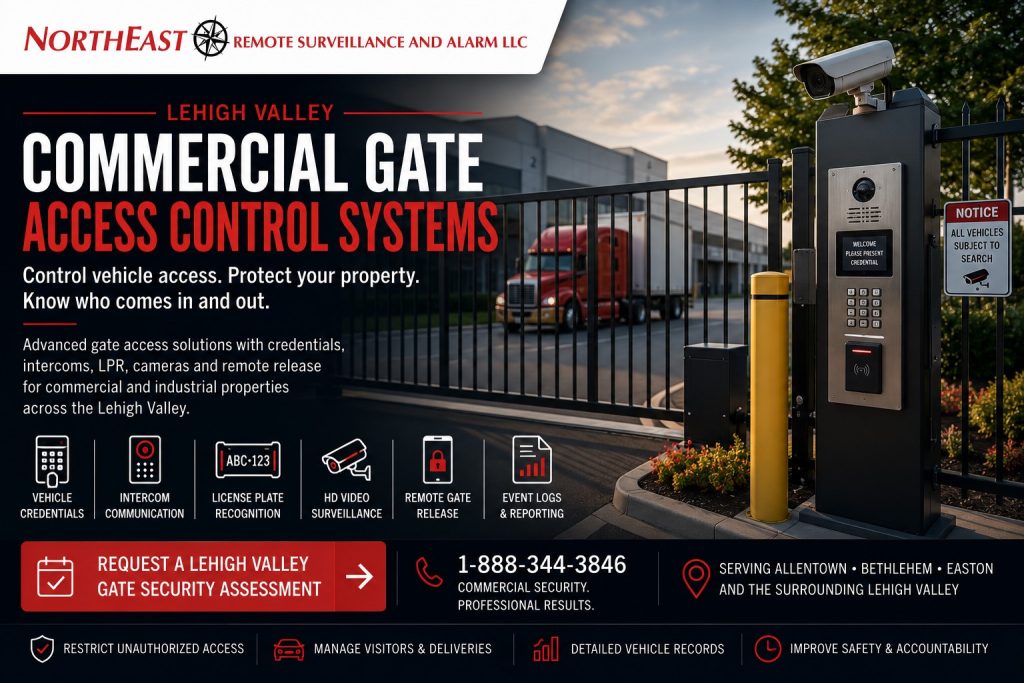
Northeast Remote Surveillance and Alarm, LLC (NERSA) plans commercial gate access around employee traffic, deliveries, visitor calls, and after-hours activity.
First, identify who needs entry and how permission is granted. An employee arriving each day needs a different process from an unfamiliar delivery driver. Coordinate credentials, communication, and vehicle documentation around those needs.
Plan Lehigh Valley Gate Access Around Traffic
Review vehicle types, approach lanes, queues, turning space, and the location of readers or intercoms. Drivers should be able to identify the correct entry point and reach the required device. Keep pedestrian routes part of the property review.
Next, decide how employee, contractor, and visitor traffic will be handled. Then set approved schedules and identify who may make an exception. For deliveries, define who confirms the destination and what the driver should do after entry.
Choose Credentials and Visitor Communication
Cards, fobs, mobile credentials, and other vehicle-entry methods depend on equipment compatibility and the operating plan. Also assign access to approved users and define how lost credentials or departing employees are handled.
An intercom can let staff verify an unfamiliar visitor before releasing entry. In addition, cameras may document the vehicle and the surrounding activity. Agree on who can view records, how incidents are reviewed, and what information staff need.
Coordinate Gate Equipment and Infrastructure
Gate access control and the gate operator perform different jobs. Review the existing operator, controls, communication paths, power, and supporting hardware with the responsible providers. Assess safe operation separately from permission to enter.
Do not assume a reader or software change resolves a mechanical or safety issue. Document interface requirements and responsibilities before work begins. Also include procedures for power loss, communication failure, and authorized emergency access.
Test Entry and Plan Expansion
Finally, test approved and denied credentials, schedules, visitor calls, and expected event records. Check the process with the vehicles that use the property. Confirm that the approved staff can manage permissions and recognize the correct gate.
Lehigh Valley gate access can be coordinated across multiple properties when compatible systems and clear administration support that goal. Plan equipment names, user responsibilities, network capacity, and support arrangements before adding more entrances.
Use the related guides below to coordinate gate access with intercoms, cameras, monitoring, and the wider facility security plan.
Related Services and Local Planning
- Lehigh Valley Commercial and Industrial Security Systems — Coordinate gate entry with the wider property security plan.
- Lehigh Valley Commercial Intercom and Visitor Entry Systems — Plan how staff verify delivery drivers and unfamiliar visitors.
- Lehigh Valley Commercial Video Surveillance Systems — Choose camera views that document vehicles and activity around the entrance.
- Lehigh Valley Remote Video Monitoring and Live Talk-Down — Decide when operators should review an event or use live audio.
- Lehigh Valley Commercial Security System Upgrades, Retrofits and Takeovers — Assess which existing components can remain before replacing equipment.
- Lehigh Valley Low-Voltage and Security Infrastructure — Review power, cabling and network connections at the gate.
- Lehigh Valley Commercial Access Control Systems — Manage approved users, credentials and access schedules.
- Lehigh Valley Unified Commercial Security Systems — Coordinate gate events with cameras, alarms and other access points.
- Lehigh Valley Gate Security Assessment — Review traffic patterns, existing equipment and operating responsibilities on site.