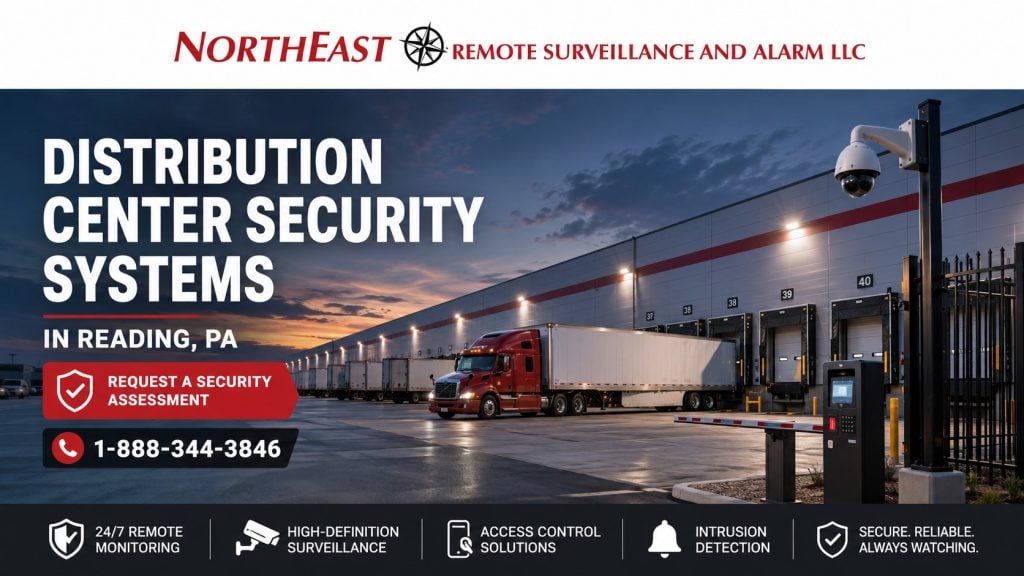
Distribution center security systems in Reading, Pennsylvania should be designed around the continuous movement of employees, drivers, visitors, inventory, pallets, packages, trailers, forklifts and vehicles through the facility.
Northeast Remote Surveillance and Alarm, LLC designs and installs commercial video surveillance, access control, intrusion alarms, intercoms, vehicle-gate systems, professional monitoring, remote video monitoring and low-voltage infrastructure for distribution centers, fulfillment operations and logistics facilities throughout Reading.
A properly designed system should help authorized personnel document shipping and receiving activity, manage employee access, investigate inventory discrepancies, monitor loading docks, identify vehicles, protect trailer areas, verify alarms and maintain useful records across multiple shifts and buildings.
A smaller distribution operation may need carefully positioned dock cameras, controlled employee entrances, an intrusion alarm and secure remote viewing. A large fulfillment facility may require hundreds of cameras, multiple access-control panels, separate alarm partitions, vehicle gates, license plate recognition, fiber between buildings, extended recording retention and centralized administration.
For complete citywide commercial-security planning, visit Commercial Security System Installation in Reading, PA.
Request a Reading Distribution Center Security Assessment
Call 1-888-344-3846 to discuss security planning for a Reading distribution center or fulfillment facility.
Commercial and industrial systems only • New installations • Facility expansions • Integrated logistics security • Small operations through enterprise facilities

Security Designed Around Distribution-Center Operations
Distribution centers operate differently from conventional storage warehouses.
A general warehouse may primarily receive, store and release inventory. A distribution or fulfillment facility may continuously receive, sort, pick, stage, package and ship products across multiple docks, departments and shifts.
Security planning may need to account for:
- High-volume shipping and receiving
- Multiple loading docks
- Driver and vendor entry
- Employee shift changes
- Temporary and seasonal employees
- Forklift and pallet movement
- Picking and packing stations
- Staging areas
- High-value inventory
- Returns and damaged goods
- Trailer storage
- Truck courts
- Vehicle gates
- Yard activity
- Several buildings
- After-hours operations
- Remote management
- Delayed discovery of inventory discrepancies
The completed security system should support the operation without unnecessarily interfering with shipping schedules, employee movement or production targets.
A distribution-center assessment may review:
- Employee and visitor entrances
- Driver check-in procedures
- Shipping and receiving desks
- Dock doors
- Trailer positions
- Interior staging areas
- Picking and packing departments
- Inventory aisles
- Restricted cages
- Returns and quarantine areas
- Server and network rooms
- Exterior yards
- Truck entrances
- Employee parking
- Existing networks and cabling
- Available power
- Required video retention
- Monitoring and response procedures
- Future expansion plans
The objective is not to install equipment everywhere. The objective is to place the correct security control where it provides a measurable operational or investigative benefit.
Distribution Center Video Surveillance
Commercial Video Surveillance Systems in Reading, PA explains new commercial camera design, image quality, recording, retention, analytics, remote access and local, cloud-managed or hybrid platforms.
Distribution center camera systems may help authorized personnel review:
- Vehicle arrival and departure
- Driver interaction
- Trailer positioning
- Loading and unloading
- Shipping and receiving
- Pallet movement
- Picking and packing activity
- Inventory staging
- Employee entrances
- Controlled-storage areas
- Returns processing
- Parking areas
- Exterior yards
- After-hours events
Every camera should have a defined objective.
A wide camera may provide general visibility across several docks but fail to identify a driver, package or pallet. A closer camera may be required where identification, transaction documentation or detailed incident review is important.
Possible camera objectives include:
- General situational awareness
- Facial identification
- Vehicle identification
- License plate capture
- Dock-door overview
- Trailer-position documentation
- Shipping-counter evidence
- Package or pallet movement
- Employee entrance documentation
- Restricted-area evidence
- Perimeter detection
- Alarm verification
- Live operator intervention
Overview and identification should be treated as separate objectives when one camera cannot provide both.
Loading-Dock Security and Documentation
Reading Loading Dock Security Systems covers dock cameras, trailer-position views, overhead-door monitoring, driver entry, shipping documentation, intercoms, lighting and alarm coordination.
Loading docks combine employees, drivers, forklifts, trailers, packages, pallets and open building entrances within a concentrated operating area.
A coordinated dock-security design may include:
- Exterior trailer-position cameras
- Interior dock-door overview cameras
- Driver identification views
- Shipping-desk cameras
- Receiving-area cameras
- Overhead-door contacts
- Controlled personnel doors
- Driver intercoms
- Vehicle entrance cameras
- Dock lighting
- Video associated with access or alarm activity
The system may help management determine:
- When a vehicle arrived
- Which entrance it used
- Which dock received the trailer
- When an overhead door opened
- Who entered through the personnel door
- When loading or unloading began
- Which staging area was used
- When the vehicle departed
A camera system cannot automatically determine the condition or quantity of every shipment. It can provide evidence supporting the company’s shipping, receiving and inventory procedures.
Shipping and Receiving Areas
Shipping and receiving departments may require different views from the dock itself.
Security planning may include cameras covering:
- Driver check-in
- Shipping counters
- Receiving desks
- Package condition
- Labeling stations
- Staging lanes
- Pallet wrapping
- Trailer assignment
- Door release activity
- Employee entrances
- Visitor waiting areas
An exterior dock camera may show the trailer while an interior camera documents the people, pallet or package involved in the transaction.
Recording retention should reflect how quickly shipping discrepancies, damage claims or missing inventory are normally discovered.
Picking, Packing and Fulfillment Areas
High-volume fulfillment operations may require coverage across picking aisles, packing stations, conveyor areas and shipping lanes.
Camera planning may consider:
- Wide department views
- Selected packing stations
- Conveyor transfer points
- High-value product areas
- Exception-handling stations
- Returns processing
- Damaged-item review
- Restricted storage
- Employee movement
- Supervisor areas
A broad camera may help reconstruct the overall sequence of an event. A closer camera may be needed where package condition, labeling or a specific action must be reviewed.
Camera placement should avoid interfering with conveyors, scanners, material-handling equipment, fire-protection systems and normal maintenance access.
Inventory and Staging Areas
Distribution centers frequently move products through several temporary locations before final shipment.
Inventory may pass through:
- Receiving staging
- Inspection
- Storage
- Picking
- Packing
- Shipping staging
- Returns
- Quarantine
- Damaged-goods areas
- High-value storage
Security design should account for the fact that inventory locations may change throughout the day.
Fixed cameras can provide strong evidence at entrances, aisles, controlled cages, workstations and transfer points. They should not be expected to identify every item anywhere within a large changing storage area.
Warehouse Storage Within a Distribution Facility
Reading Warehouse Security Systems covers warehouse aisles, high-bay cameras, inventory storage, employee entrances, overhead doors, alarms, access control and integrated warehouse protection.
The warehouse page should be used when the facility’s primary need is general storage-building protection.
This distribution-center page should remain focused on higher-throughput logistics operations involving frequent receiving, order movement, fulfillment, shipping, trailers and multiple vehicle or employee workflows.
A distribution facility with substantial warehouse storage may use both resources during system planning without creating duplicate page intent.
Employee Entrance Security
Distribution centers may have large employee populations, temporary workers, several shifts and frequent credential changes.
Employee entrance security may include:
- Card or mobile credential readers
- Identification cameras
- Door-position contacts
- Forced-open alerts
- Held-open alerts
- Visitor separation
- Intercom communication
- Shift-based schedules
- Access-event reporting
- Video associated with credential events
Credentials should generally be assigned individually rather than shared among employees.
When an employee, contractor or temporary worker leaves, the appropriate credential and system access should be removed promptly.
Access permissions may be organized by:
- Shift
- Department
- Employment status
- Building
- Door group
- Supervisor role
- Temporary assignment
- Contractor status
- Authorization level
The access structure should remain understandable to authorized administrators as the workforce changes.
Access Control for Restricted Areas
Distribution centers may contain areas requiring more limited access than the general warehouse floor.
These may include:
- High-value inventory
- Controlled product cages
- Returns or quarantine areas
- IT and network rooms
- Maintenance rooms
- Key storage
- Management offices
- Cash or payment areas
- Pharmaceutical or regulated storage where applicable
- Vehicle-key storage
- Shipping documentation rooms
Access control can determine which credentials are permitted, when access may occur and which opening was used.
Access events show activity at a controlled opening. They do not automatically prove which person physically used the credential or which item was removed.
Nearby cameras, individual credential policies and appropriate supervision may provide additional context.
Commercial Door Hardware
A card reader is only one component of a controlled opening.
The complete assembly may include:
- Door
- Frame
- Lock
- Exit device
- Door closer
- Reader
- Controller
- Door-position contact
- Request-to-exit equipment
- Power supply
- Power-transfer hardware
- Automatic operator
- Emergency operation
A new reader cannot correct a door that drags, fails to close or does not latch consistently.
Distribution-center doors may experience:
- Heavy daily use
- Cart or forklift impact
- Temperature changes
- Exterior exposure
- Building movement
- Worn closers
- Damaged exit devices
- Misalignment
- Repeated propping
Controlled egress, panic hardware, fire-rated doors, magnetic locking and automatic operators require project-specific review and appropriate life-safety coordination.
Intrusion Alarm Systems
Distribution centers may operate continuously or use different schedules for offices, warehouse areas, shipping departments and exterior buildings.
A commercial intrusion-alarm system may include:
- Exterior-door contacts
- Overhead-door contacts
- Interior motion detection
- Glass-break detection
- Roof-hatch contacts
- Restricted-room protection
- Panic or duress devices
- Several alarm partitions
- Cellular or IP communication
- Professional monitoring
- Video verification
Separate alarm partitions may allow authorized users to secure:
- Offices
- Shipping departments
- Warehouse sections
- Remote buildings
- Restricted cages
- Maintenance facilities
Alarm-zone descriptions should identify locations clearly.
Generic labels such as “Zone 8” or “Rear Motion” become difficult to interpret across a large facility.
Overhead-Door Protection
Loading and service doors may remain open during active operations and require different protection from ordinary personnel doors.
Protection may include:
- Commercial overhead-door contacts
- Door-position reporting
- After-hours alarm scheduling
- Nearby camera views
- Held-open procedures
- Separate alarm partitions
- Monitoring instructions
The system should distinguish normal dock operations from unauthorized after-hours activity.
Repeated alarms caused by normal operations should be corrected through appropriate design and procedures rather than ignored.
Professional Security Monitoring
Professional monitoring connects alarm activity with a documented notification and response process.
Monitoring planning may define:
- Which signals are transmitted
- Who receives notifications
- Which events result in dispatch
- What information the monitoring center receives
- Which contacts are authorized
- How employee call lists are updated
- How several partitions or buildings are identified
- What happens during communication failure
- How alarm verification is performed
A large distribution operation may require different contacts for security, facilities, management and after-hours response.
Monitoring information should be reviewed whenever personnel, building use or response procedures change.
Remote Video Monitoring and Live Talk-Down
Remote video monitoring can provide active after-hours intervention at selected locations.
Suitable applications may include:
- Trailer yards
- Truck courts
- Vehicle gates
- Loading docks
- Remote buildings
- Employee parking
- Exterior inventory
- Perimeter areas
- Recurring trespassing locations
A properly designed monitored system may allow trained operators to:
- Review selected video events
- Determine whether visible activity requires action
- Issue live audio warnings
- Notify designated contacts
- Escalate according to documented procedures
- Request law-enforcement response when appropriate
- Preserve information about the event
Remote monitoring requires properly positioned cameras, dependable analytics, adequate lighting, reliable communication, defined schedules and clear response instructions.
Ordinary motion alerts alone do not constitute a complete remote-monitoring design.
Truck Courts and Trailer Yards
Reading Truck and Trailer Yard Security Systems covers truck courts, fleet properties, trailer storage, vehicle gates, plate capture, outdoor cameras, perimeter analytics and after-hours monitoring.
Distribution-center yard risks may include:
- Cargo theft
- Trailer entry
- Fuel theft
- Unauthorized vehicle activity
- Trespassing
- Illegal dumping
- Vandalism
- Seal tampering
- After-hours loitering
- Unverified trailer movement
A coordinated yard system may combine:
- Fixed perimeter cameras
- Multi-sensor cameras
- Vehicle identification views
- License plate recognition
- Gate access control
- Video analytics
- Outdoor speakers
- Remote monitoring
- Intrusion alarms
- Cellular or wireless communication
Camera positions should account for changing trailer locations, vehicle headlights, long distances, lighting, weather and available mounting structures.
Vehicle Gates and Driver Entry
A distribution-center vehicle entrance may need to distinguish among:
- Company vehicles
- Delivery drivers
- Contract carriers
- Vendors
- Employees
- Visitors
- Maintenance personnel
- Emergency responders
- After-hours arrivals
A coordinated gate design may include:
- Credential readers
- Keypads
- Mobile entry
- Long-range credentials
- Video intercoms
- Driver cameras
- Vehicle-overview cameras
- License plate recognition
- Gate-position monitoring
- Safety loops
- Remote release
- Access schedules
- Event reporting
Gate access should be designed as a complete vehicle-control system rather than as a card reader added to an operator without considering safety, communication and emergency procedures.
License Plate Recognition
Dedicated license plate recognition may help document vehicles entering or leaving a distribution property.
Successful plate capture depends on:
- Lane width
- Camera angle
- Mounting height
- Distance
- Vehicle speed
- Lighting
- Headlight exposure
- Plate size within the image
- Vehicle stopping position
- Direction of travel
A general parking or yard camera should not automatically be expected to provide dependable plate evidence.
Plate cameras may be paired with wider vehicle views so management can review both the plate and the complete truck, trailer or passenger vehicle.
Intercom and Driver Communication
Video intercoms can help employees communicate with drivers, visitors and contractors before releasing a door or gate.
Intercom locations may include:
- Vehicle gates
- Driver check-in doors
- Shipping entrances
- Receiving entrances
- Guard stations
- Remote employee entrances
- After-hours delivery points
A coordinated system may allow an authorized employee to:
- See the caller
- Communicate with the person
- Review the surrounding area
- Confirm the vehicle
- Release an approved gate or door
- Record the interaction
- Associate the call with nearby cameras
The entry procedure should identify who answers, what information is verified and when release is permitted.
Low-Voltage Cabling and Network Infrastructure
Distribution-center security devices rely on the infrastructure supporting them.
A project may require:
- Cat6 or Cat6A cabling
- Fiber between buildings
- Alarm wiring
- Reader and door wiring
- Conduit
- Cable tray
- Managed PoE switches
- Network cabinets
- Equipment racks
- Wireless bridges
- UPS equipment
- Security power supplies
- Battery backup
- Equipment labeling
- Network documentation
Infrastructure planning should account for:
- Large building dimensions
- Long cable distances
- High ceilings
- Multiple network rooms
- Electrical interference
- Exterior pathways
- Future additions
- Available PoE capacity
- Network bandwidth
- Backup power
- Access for future service
A modern camera connected to failing cable remains unreliable. A new recorder connected to an undersized network may still lose video. An access-control panel connected to damaged door wiring may continue generating trouble.
Fiber and Inter-Building Connectivity
Large distribution properties may include warehouses, gatehouses, offices, maintenance buildings and remote yard equipment.
Fiber may be appropriate for:
- Long distances
- Separate buildings
- High camera counts
- Centralized recording
- Electrical isolation
- Future expansion
- Redundant pathways where required
Wireless bridges may be appropriate where trenching or physical pathways are impractical.
Successful wireless design depends on line of sight, mounting stability, frequency conditions, bandwidth, available power, environmental exposure and long-term serviceability.
Recording Retention
Distribution-center investigations may begin days or weeks after the original event.
Examples include:
- Inventory shortages discovered during a count
- Damage claims reported after delivery
- Missing pallets found during reconciliation
- Trailer activity questioned after shipment review
- Employee incidents reported later
- Customer complaints received after delivery
- Returns disputes
- Vendor or carrier claims
Retention should be selected according to the facility’s investigation cycle.
Storage planning may consider:
- Camera count
- Resolution
- Frame rate
- Compression
- Scene activity
- Continuous or event-based recording
- Future cameras
- Required retention
- Redundant storage
- Cloud limits
- Bandwidth
A recorder should not be sized only by its available camera-channel count.
Video Search and Evidence Export
A commercial video system should provide a practical way to locate and preserve relevant footage.
Authorized users may need to:
- Select the correct building
- Locate the correct dock or department
- Search by date and time
- Review synchronized cameras
- Search person or vehicle events where supported
- Export a video segment
- Capture still images
- Verify the exported file
- Preserve incident footage
- Document which camera and time were involved
Camera names should describe locations clearly.
Useful names may include:
- Receiving – Dock 04 Exterior
- Shipping – Door 12 Interior
- North Yard – Trailer Row B
- Employee Entrance – East Vestibule
- Vehicle Gate – Inbound Lane
- Packing – Line 3 Overview
Default names such as “Camera 21” become difficult to manage across a large facility.
AI Video Analytics
AI-supported analytics may help authorized users locate people, vehicles or activity more efficiently.
Potential applications include:
- Person detection
- Vehicle detection
- Direction of travel
- Line crossing
- Entry into a defined area
- Loitering
- After-hours activity
- Vehicle classification
- Appearance-based search where supported
- Perimeter event generation
Analytics should support a defined objective.
Poorly positioned cameras, weak lighting or broad detection areas can produce unreliable results and unnecessary alerts.
The project should establish:
- What event matters
- Where detection applies
- When the rule is active
- Who receives the event
- Whether verification is required
- What response is expected
- How false activity will be adjusted
Local, Cloud-Managed and Hybrid Systems
Distribution-center security platforms may be locally managed, cloud managed or hybrid.
Local Systems
Local systems may retain recording and system-management equipment at the facility.
They may provide direct on-site operation but require appropriate:
- Hardware maintenance
- Software support
- Backups
- Remote-access security
- Storage planning
- Administrator management
- Replacement planning
Cloud-Managed Systems
Cloud-managed systems may simplify:
- Remote administration
- User management
- Software updates
- Multi-site access
- System-health monitoring
- Event notification
They may also involve:
- Recurring subscriptions
- Internet dependency
- Bandwidth requirements
- Manufacturer-specific licensing
- Retention limits
- Cloud-account ownership
Hybrid Systems
A hybrid architecture may combine local operation or recording with cloud administration, health monitoring, event management or selected storage.
The correct approach depends on facility size, internet reliability, retention, cybersecurity, IT capabilities, licensing preferences and long-term support requirements.
Cybersecurity and User Administration
Commercial cameras, access controllers, intercoms, recorders and cloud platforms may connect to the customer’s network.
Cybersecurity planning may include:
- Unique device credentials
- Removal of default passwords
- Individual user accounts
- Role-based permissions
- Multi-factor authentication where available
- Supported firmware
- Network segmentation
- Secure remote access
- Removal of former users
- Cloud-account ownership
- Backup procedures
- Administrator documentation
- Manufacturer support status
Shared administrator credentials should be avoided.
A shipping manager may require access to dock cameras. A facility manager may need alarm and door information. A regional administrator may need several locations. Not every user requires unrestricted control of every system.
Unified Distribution Center Security
A unified platform may connect cameras, access control, intrusion alarms, intercoms, gates and monitoring when integration improves administration or investigation.
Useful integrations may include:
- Displaying video for a credential event
- Recording when a dock door opens
- Reviewing forced-door activity
- Verifying selected alarm events
- Associating gate access with vehicle video
- Displaying video during an intercom call
- Centralizing several buildings
- Managing users across multiple sites
- Creating consistent event reporting
Integration should solve an operational problem.
It should not create unnecessary licensing, unsupported dependencies or an environment that authorized customer personnel cannot understand.
New Installations Versus Existing-System Modernization
This page owns new and expanded distribution-center security-system design in Reading.
Facilities with aging, inherited, unsupported, unreliable or poorly documented equipment should begin with Reading Commercial Security System Upgrades, Retrofits and Takeovers.
That assessment can determine whether the correct path is:
- Repair
- Expansion
- Camera replacement
- Analog-to-IP migration
- Recorder modernization
- Access-control upgrade
- Alarm takeover
- Monitoring change
- Infrastructure correction
- Administrative recovery
- Phased migration
- Complete replacement
Existing equipment should be retained because it remains compatible, dependable and supportable—not merely because it is already installed.
Distribution Center Security Installation Process
1. Initial Consultation
NERSA discusses the operation, facility layout, shifts, loading activity, inventory flow, vehicle traffic, existing systems, concerns and future plans.
2. Site Assessment
The assessment may review docks, entrances, shipping, receiving, staging, storage, parking, yards, gates, network rooms, cabling routes, lighting and available power.
3. Define Security Objectives
Each proposed camera, controlled door, alarm device, intercom and gate function should have a defined purpose.
4. Design the Complete System
The proposed design identifies equipment, locations, architecture, recording, retention, access permissions, alarm operation, monitoring, cabling, power and expansion capacity.
5. Prepare a Written Scope
The customer should receive a defined scope identifying included equipment, installation work, licensing, assumptions, customer responsibilities, exclusions and options.
6. Coordinate Installation
Work may be organized around employee shifts, shipping schedules, loading activity, facility access and available downtime.
7. Program and Test
Testing may include cameras, recording, playback, export, credentials, doors, alarm zones, monitoring signals, intercoms, gates, remote access and backup power.
8. Train Authorized Personnel
Training may cover video search, evidence export, credential administration, alarm use, monitoring contacts, gate operation and user permissions.
9. Complete Documentation
Handoff may include camera names, door lists, alarm zones, administrator information, monitoring contacts, equipment locations, known limitations and future recommendations.
What Affects Distribution Center Security Cost?
Project cost depends on:
- Facility size
- Number of buildings
- Camera count and required evidence
- Controlled-door count
- Door hardware
- Alarm-point count
- Number of partitions
- Loading-dock count
- Vehicle entrances
- Gate equipment
- License plate recognition
- Intercom stations
- Required retention
- Software and licensing
- Monitoring
- Remote video monitoring
- Cabling distances
- Fiber requirements
- Network and PoE capacity
- Ceiling height
- Lift requirements
- Exterior installation
- Work-hour restrictions
- Project phasing
- Permits or inspections
- Existing infrastructure
A smaller distribution operation has a different scope from a large fulfillment campus with dozens of docks, several buildings, hundreds of employees, trailer yards and centralized administration.
A dependable proposal requires a site-specific assessment.
Why Reading Distribution Centers Choose NERSA
Commercial and Industrial Experience Since 2008
Northeast Remote Surveillance and Alarm, LLC has provided commercial security and low-voltage services since 2008.
Logistics-Focused Planning
Security is designed around shipping, receiving, fulfillment, docks, inventory, employees, trailers, gates and vehicle movement.
Complete-System Evaluation
Cameras, access control, alarms, monitoring, intercoms, doors, gates, cabling, networks, power and documentation are considered together.
Small Operations Through Enterprise Facilities
NERSA supports smaller distribution properties as well as large fulfillment centers, multi-building campuses and multi-location organizations.
New Systems and Existing-System Support
Services include new installations, expansions, inspections, maintenance, repairs, upgrades, retrofits, takeovers, integrations and phased modernization.
Practical Project Phasing
Installation can be coordinated around loading schedules, shifts, operating areas, peak periods and available downtime.
Documented Customer Control
Authorized personnel should understand who controls the system, how users are managed, how events are reviewed and how future support will be provided.
Reading and Nearby Distribution Markets Served
NERSA supports distribution and logistics facilities in:
- Reading
- West Reading
- Wyomissing
- Shillington
- Laureldale
- Temple
- Muhlenberg Township
- Exeter Township
- Spring Township
- Cumru Township
- Sinking Spring
- Mount Penn
- Kenhorst
- St. Lawrence
- Nearby Reading and Berks County industrial areas
For regional planning beyond the city, begin with the Greater Reading Area commercial and industrial security resource.
Frequently Asked Questions
Does NERSA install residential security systems?
No. NERSA focuses on commercial, industrial, warehouse, distribution, manufacturing, institutional and other non-residential properties.
How is distribution-center security different from general warehouse security?
Distribution-center security places greater emphasis on high-volume shipping, receiving, picking, packing, staging, driver entry, loading docks, truck courts, trailers and continuous inventory movement.
What security systems are commonly used in distribution centers?
Systems may include commercial cameras, access control, intrusion alarms, monitoring, intercoms, vehicle gates, license plate recognition, remote video monitoring and supporting low-voltage infrastructure.
Can NERSA install loading-dock cameras?
Yes. Dock systems may include trailer views, interior dock cameras, driver identification, shipping-desk coverage, overhead-door monitoring and video associated with access or alarm events.
Can cameras document pallet and package movement?
Properly positioned cameras may provide useful context and evidence, but they do not replace the customer’s inventory, barcode, shipping or warehouse-management systems.
How long should distribution-center video be retained?
Retention should reflect how long it normally takes the company to discover shipping discrepancies, inventory loss, claims or operational incidents.
Can cameras read truck license plates?
Dependable plate capture normally requires dedicated cameras designed around lane position, distance, angle, speed and lighting.
Can access control be organized by shift?
Yes. Permissions may be assigned according to shift, department, building, employee status, contractor role or authorization level.
Can temporary employees receive credentials?
Yes. Temporary credentials may be assigned limited doors and schedules and should be disabled when the assignment ends.
Can loading-dock doors be alarmed?
Yes. Overhead-door contacts, partitions, schedules, cameras and monitoring procedures can be coordinated around normal dock operations.
Can the office remain alarmed while warehouse operations continue?
Possibly. Separate alarm partitions may allow different areas to follow different operating and arming schedules.
Can cameras integrate with access control?
Yes. Compatible systems may associate video with accepted credentials, denied entries, forced doors, held-open events or gate access.
Can cameras integrate with intrusion alarms?
Yes. Selected alarm activity may trigger recording, notifications, camera display or video verification.
Can NERSA provide remote video monitoring?
Yes. Suitable yards, docks, gates, parking areas and perimeter locations may use analytics, operator review, live audio warnings and documented escalation.
Can intercoms be installed at driver entrances?
Yes. Video intercoms may support vehicle gates, shipping entrances, receiving doors and remote release.
Can several buildings be connected?
Yes. Buildings may be connected through fiber, suitable existing networks or properly designed point-to-point wireless links.
Can NERSA coordinate with our IT department?
Yes. Coordination may include IP addressing, network segmentation, bandwidth, PoE capacity, firewalls, remote access, cloud platforms and cybersecurity.
Can the system continue operating during an internet outage?
Local and some hybrid systems may continue operating locally. Cloud-dependent functions may be interrupted. Behavior depends on the selected architecture.
Can installation occur while the distribution center remains open?
Many projects can be phased around shipping schedules, shifts and active departments. Actual disruption depends on the scope and installation conditions.
Can the project be completed in phases?
Yes. Priority docks, employee entrances, gates, yards, infrastructure or buildings may be completed first.
Can existing cameras or cabling be reused?
Possibly. Existing equipment should be tested for condition, compatibility, cybersecurity, support and long-term reliability before reuse is approved.
Can NERSA take over equipment installed by another provider?
Sometimes. Takeover depends on authorized access, equipment ownership, licensing, system condition, manufacturer restrictions and supportability.
What documentation should we receive?
Depending on the project, documentation may include camera names, door lists, alarm zones, monitoring contacts, user structure, equipment locations, administrator information and known limitations.
How much does distribution-center security cost?
Cost depends on the facility, docks, cameras, doors, alarms, gates, intercoms, retention, cabling, fiber, networking, licensing, monitoring and project phasing.
How should a Reading distribution center begin?
Begin with a site assessment covering shipping, receiving, docks, inventory flow, employees, vehicles, yards, infrastructure, current concerns and future plans.
Request a Reading Distribution Center Security Assessment
Distribution-center security should be designed around how goods, employees, drivers, trailers and vehicles move through the operation.
Northeast Remote Surveillance and Alarm, LLC can evaluate:
- Shipping and receiving
- Loading docks
- Picking and packing
- Inventory staging
- Employee entrances
- Restricted storage
- Truck courts
- Trailer yards
- Vehicle gates
- License plate recognition
- Parking areas
- Intrusion alarms
- Professional monitoring
- Remote video monitoring
- Intercoms
- Commercial door hardware
- Cabling and fiber
- Networks and PoE
- Multiple buildings
- Existing-system modernization
- Future expansion
Whether the project involves a smaller logistics operation or a large multi-building fulfillment center, NERSA can develop a practical security system around the property’s current requirements and long-term growth.
For complete Reading commercial-security planning, visit Commercial Security System Installation in Reading, PA.
For aging or inherited systems, visit Reading Commercial Security System Upgrades, Retrofits and Takeovers.
Call 1-888-344-3846 to request a Reading distribution center security assessment.
Commercial and industrial systems only • New installations • Distribution-center expansions • Existing-system modernization • Small facilities through enterprise operations