
Plan Route 33 cargo security around the points where freight changes hands and trailers wait.

plan a cargo-security solution
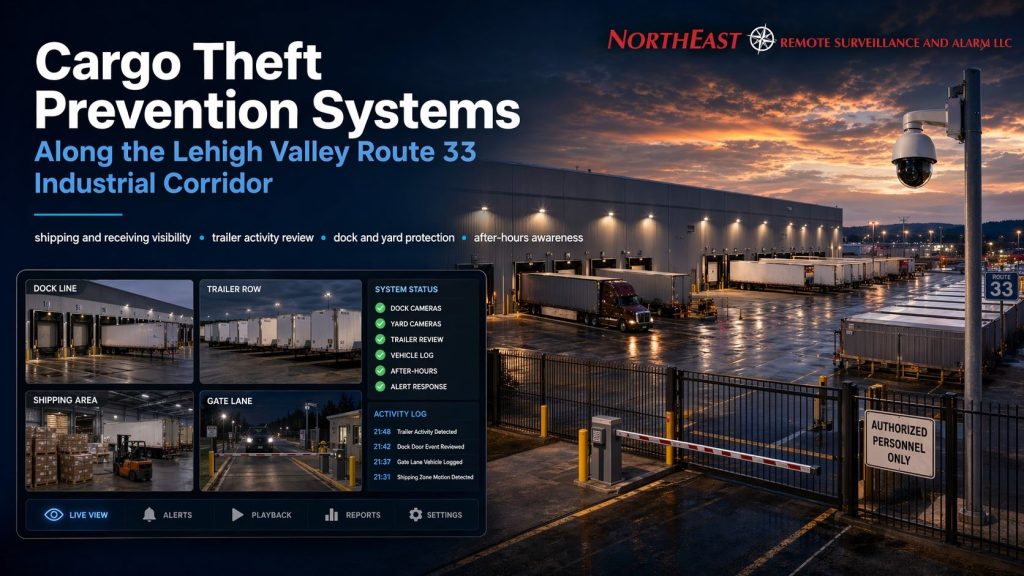
Northeast Remote Surveillance and Alarm, LLC plans cargo theft prevention systems for warehouse, distribution, and industrial properties along the Lehigh Valley Route 33 corridor. We focus on freight visibility, access to higher-risk work areas, and records of trailer and vehicle activity. The design follows how your site handles freight.
For broader corridor planning, visit Lehigh Valley Route 33 Industrial Corridor Security Systems.
For broader warehouse-focused coverage, visit Warehouse Security Systems Along the Lehigh Valley Route 33 Industrial Corridor.
For dock-focused protection, visit Loading Dock Security Systems Along the Lehigh Valley Route 33 Industrial Corridor.
Cargo Theft Prevention Is Built Around Exposure Points
Identify where freight is exposed before choosing cameras. Check access to shipments and trailers, then plan how staff will review activity after hours. In many Route 33 corridor properties, the highest-risk points are not spread evenly across the site. They are concentrated around dock lines, trailer staging sections, yard areas, shipping offices, gate approaches, and other operational zones where freight movement and control intersect.
That is why cargo theft prevention should be planned around exposure points instead of treated like a generic warehouse camera project.
What Route 33 Corridor Properties Commonly Need to Protect
Properties along the Lehigh Valley Route 33 industrial corridor often need stronger cargo theft prevention around the exact areas where shipments, trailers, and freight activity create the most operational risk.
Shipping and Receiving Areas
Shipping and receiving zones often sit at the center of freight handling. Product is staged, checked, transferred, loaded, unloaded, and documented in these areas. That makes them one of the most important places to improve visibility and accountability.
Loading Dock Doors and Dock Aprons
Dock doors and surrounding dock aprons often need stronger protection because they are the direct connection point between the building and the trailer. These areas may involve repeated trailer changes, carrier activity, outbound staging, and after-hours exposure.
Trailer Rows and Staging Areas
Detached and staged trailers may sit outside for long periods, leaving freight exposed. Plan views and activity records for trailer rows. General yard camera coverage may not provide enough detail.
For yard-focused protection, visit Truck Yard and Trailer Security Systems Along the Lehigh Valley Route 33 Industrial Corridor.
Dispatch, Shipping, and Support Offices
Cargo security also depends on who can access shipping records and freight-handling information. Review access to shipping offices, dispatch rooms, and nearby support spaces. These rooms may need tighter entry control and clearer activity records than an unlocked office provides.
Gate Lanes and Vehicle Entry Points
Some properties also need stronger documentation around the vehicles entering and exiting the site, especially where trailer movement, truck arrivals, or unexpected after-hours traffic may be tied to theft exposure or freight investigations.
Cargo Theft Prevention Should Be Built Around Freight Movement
Plan cargo security around how freight moves through your property. Review trailer staging areas, shipment transfer points, truck approaches, and outbound routes. Identify areas exposed after hours and places where freight could be lost, disturbed, or moved without a record.
Route 33 logistics properties often handle frequent carrier visits and active loading operations. Large outdoor areas and freight-handling zones can remain exposed after daytime staff leave. The security plan needs to account for those hours.
Common Cargo Theft Prevention Priorities Along Route 33
Better Visibility Around Freight-Handling Zones
Many properties need stronger review capability around dock lines, staging areas, receiving zones, shipping lanes, and trailer sections where theft-related exposure often starts. Stronger visibility helps provide clearer documentation and faster review when something goes wrong.
Better Documentation Around Trailer and Vehicle Activity
Cargo theft investigations often depend on understanding when a trailer was moved, what vehicle entered the site, what lane was used, or whether unusual activity occurred before or after an event. Better vehicle and trailer documentation can make those reviews much more useful.
Better After-Hours Awareness
Many theft-related risks increase after staffing drops or when only part of the site is occupied. Cargo theft prevention often depends on stronger after-hours visibility around the exterior areas where freight, trailers, and vehicle movement remain exposed.
For monitored after-hours awareness, visit Remote Video Monitoring Along the Lehigh Valley Route 33 Industrial Corridor.
Better Control Around Restricted Operational Areas
Some properties need tighter control over shipping offices, dispatch areas, inventory support rooms, cage areas, or other restricted spaces tied to freight operations. Cargo theft prevention is often stronger when those rooms are not treated like open-access areas.
Better Separation Between Broad Site Security and Freight-Specific Risk
Not every security issue on a warehouse property is a cargo-theft issue. A strong design should keep freight-related prevention focused on the operational zones where cargo risk is actually concentrated instead of trying to treat the entire site as one undifferentiated problem.
Cargo Theft Prevention Is Not the Same as General Warehouse Security
Cargo theft prevention focuses on freight, shipments, trailers, and the handling areas where cargo is exposed to loss.
If the property needs broader warehouse protection, visit Warehouse Security Systems Along the Lehigh Valley Route 33 Industrial Corridor. If the main concern is loading dock activity, visit Loading Dock Security Systems Along the Lehigh Valley Route 33 Industrial Corridor. If the main concern is trailer rows, yard lanes, and exterior logistics exposure, visit Truck Yard and Trailer Security Systems Along the Lehigh Valley Route 33 Industrial Corridor
Security Systems for Cargo Theft Prevention Along the Lehigh Valley Route 33 Industrial Corridor
Northeast Remote Surveillance and Alarm, LLC designs cargo theft prevention systems for properties that need stronger protection around shipping and receiving zones, dock doors, staged freight, trailer rows, dispatch-related activity, vehicle entry points, and after-hours exterior risk. These systems may involve better visibility across freight-handling areas, stronger review of trailer and vehicle movement, tighter control around restricted operational spaces, improved after-hours awareness, and better documentation around the points where cargo-related theft risk is most concentrated.
The right design depends on the type of operation, the freight flow, the dock layout, the trailer staging pattern, the vehicle-entry structure, the after-hours exposure, and the parts of the property where cargo risk is most concentrated.
Plan Your Cargo Security Project
For your Route 33 corridor property, identify where freight visibility or incident records need improvement.
Include trailer movements, truck activity, and after-hours conditions.
NERSA can help plan a cargo-security solution around your daily operations.
For broader corridor planning, visit Lehigh Valley Route 33 Industrial Corridor Security Systems.
Compliance, Codes & Project Standards
NERSA plans commercial and industrial security work with applicable code, documentation, inspection and authority-having-jurisdiction requirements in mind. Requirements vary by system, property and jurisdiction. These resources support project planning; they do not establish legal compliance, certification or AHJ approval.
Related guidance: Regulatory compliance & inspection readiness · NERSA project standards · Documentation, testing & inspection readiness