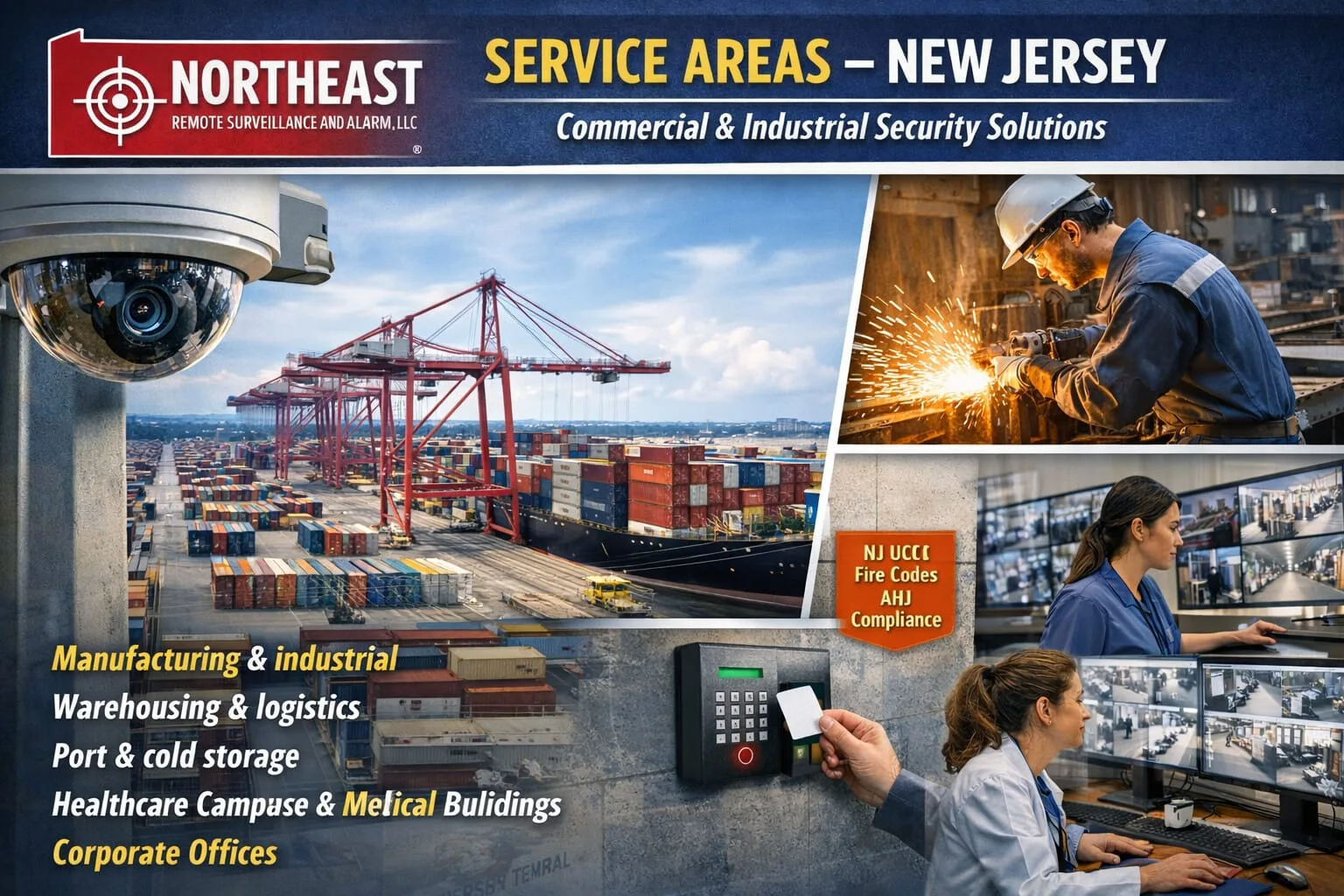
Commercial & Industrial Security Installation Services in NJ
New Jersey commercial and industrial security systems should be planned around how each facility operates, including employee access, visitor movement, loading areas, parking lots, restricted rooms, gates, alarms, monitoring, fire alarm coordination, and after-hours activity. Northeast Remote Surveillance and Alarm, LLC designs, installs, monitors, and supports commercial security, life safety, access control, video surveillance, alarm, and low-voltage infrastructure systems for New Jersey facilities that require professional planning and long-term support. For broader regional planning, start with Commercial and Industrial Security Systems in Pennsylvania and the Mid-Atlantic.

Security Planning for New Jersey Commercial and Industrial Facilities
New Jersey includes a wide range of commercial and industrial environments, including warehouses, logistics centers, manufacturing facilities, healthcare buildings, schools, municipal properties, office buildings, contractor yards, commercial campuses, and multi-site organizations.
A commercial security system in New Jersey should do more than place cameras on a wall or connect a basic alarm panel. Real commercial protection requires a plan that accounts for doors, people, vehicles, visitors, employees, vendors, parking areas, loading activity, restricted spaces, alarm response, fire alarm coordination, network infrastructure, and long-term service requirements.
Northeast Remote Surveillance and Alarm, LLC does not install consumer or residential alarm systems. Our work is focused on business-critical commercial, industrial, municipal, institutional, healthcare, logistics, and enterprise environments where security systems must be reliable, documented, scalable, and coordinated with building operations.
New Jersey Enterprise Security Coverage
New Jersey facilities often operate in dense commercial, industrial, and logistics environments. Many properties have high vehicle traffic, multiple user groups, shared entrances, employee parking, delivery activity, vendor access, after-hours operations, and inspection-sensitive life-safety requirements.
Security planning may include:
- Video surveillance for entrances, parking areas, loading areas, work zones, and building exteriors
- Access control for employee doors, tenant spaces, restricted rooms, gates, and shared areas
- Alarm systems for exterior doors, overhead doors, storage areas, offices, and vulnerable zones
- Remote video monitoring for after-hours exterior exposure and repeat activity areas
- Fire alarm coordination, documentation, testing, monitoring, and inspection awareness
- Low-voltage cabling, PoE switching, fiber, wireless links, and network infrastructure
- Intercoms, paging, gate communication, and emergency communication support
- License plate recognition and vehicle documentation where appropriate
- Security assessments, system documentation, service planning, and future expansion standards
The goal is not simply to install equipment. The goal is to create a security plan that supports visibility, access accountability, alarm response, incident review, operational continuity, inspection readiness, and long-term system management.
Commercial Video Surveillance Systems in New Jersey
Commercial video surveillance helps New Jersey businesses document entrances, parking lots, lobbies, loading areas, exterior approaches, vehicle movement, work areas, restricted zones, and after-hours activity.
A properly designed camera system should support usable evidence, remote access, incident review, operational visibility, and long-term system management. Camera planning should consider field of view, lighting, mounting locations, retention needs, network conditions, user permissions, and how video will be reviewed when an incident occurs.
For camera-specific planning, use Commercial Video Surveillance Systems.
Commercial Access Control Systems in New Jersey
Access control helps New Jersey facilities manage employee doors, visitor entry, tenant spaces, restricted rooms, warehouse transitions, gates, server rooms, administrative areas, and sensitive spaces.
A well-planned access control system should support user permissions, credential management, door schedules, audit history, employee turnover, contractor access, emergency egress coordination, and long-term service support.
For deeper planning around controlled entry, credentials, door hardware, and user permissions, use Commercial Access Control Systems.
Commercial Alarm and Monitoring Systems in New Jersey
Commercial alarm systems protect exterior doors, overhead doors, offices, warehouse areas, storage rooms, restricted spaces, and vulnerable areas when a property is closed, lightly staffed, or accessed after hours.
Alarm planning should consider partitions, schedules, response procedures, false alarm reduction, cellular communication, video verification, monitoring needs, and how employees, vendors, or cleaning crews access the building outside normal business hours.
For intrusion detection and alarm response planning, use Commercial Alarm Systems.
Fire Alarm, Life Safety, and Security Coordination
Commercial and industrial security systems should be coordinated with fire alarm, life safety, door hardware, emergency egress, ADA access, and authority having jurisdiction expectations. Security improvements should not create problems for required exiting, fire alarm operation, emergency response, inspection readiness, or building code coordination.
New Jersey facilities may need planning around fire alarm monitoring, fire alarm documentation, access-controlled doors, electrified hardware, emergency communication, backup power, system testing, and service records.
Security systems do not replace code compliance, fire alarm requirements, emergency procedures, safety programs, or AHJ review. They can, however, support access accountability, documentation, incident review, alarm response, and safer daily operations when planned correctly.
For broader code-conscious planning, use Code and Compliance for Commercial Security Systems.
Low-Voltage and Security Infrastructure Planning
Modern security systems depend on reliable infrastructure. Cameras, access control panels, alarm communicators, intercoms, monitoring equipment, wireless links, and fire alarm support systems may require structured cabling, PoE switching, fiber, wireless bridges, equipment racks, backup power, surge protection, and clean network pathways.
Poor infrastructure can cause camera outages, dropped connections, access control failures, alarm communication problems, and long-term service issues.
New Jersey commercial and industrial facilities should plan security infrastructure with future expansion in mind. A system that works for one phase of a building may need to support additional doors, cameras, gates, tenants, buildings, parking areas, or remote users later.
Facility Types We Support in New Jersey
Security planning should match the property type. A warehouse, manufacturing plant, healthcare office, school, municipal building, office campus, contractor yard, and multi-tenant industrial property should not be treated as the same project.
Northeast Remote Surveillance and Alarm, LLC supports security planning for:
- Warehouses and distribution centers
- Logistics and fulfillment facilities
- Manufacturing and industrial buildings
- Contractor yards and exterior storage properties
- Healthcare and medical office facilities
- Schools and institutional properties
- Municipal and public-sector buildings
- Office buildings and commercial campuses
- Multi-tenant commercial properties
- Parking areas and vehicle-heavy facilities
- Multi-site commercial and industrial organizations
Each facility type has different access points, visitor patterns, camera needs, alarm zones, parking exposure, restricted rooms, network conditions, and response expectations.
Warehouse, Logistics, and Industrial Security in New Jersey
New Jersey warehouse and logistics properties often require stronger planning around loading docks, truck courts, employee entrances, trailer areas, shipping offices, receiving zones, fenced areas, gate lanes, parking lots, and after-hours exterior exposure.
Security planning for these facilities may include camera coverage, gate access control, intrusion alarms, remote video monitoring, license plate recognition, vehicle documentation, dock visibility, employee access control, and network infrastructure planning.
A warehouse near a logistics corridor does not operate like a medical office or school. The system should be designed around real freight movement, vehicle activity, employee shifts, staged goods, vendor access, and after-hours risk.
Healthcare, School, Municipal, and Office Security in New Jersey
Healthcare, school, municipal, and office properties require careful planning around public access, visitor movement, employee entrances, records, restricted rooms, parking exposure, emergency response, and life-safety coordination.
These environments need practical systems that protect people, property, records, and operations without creating unnecessary friction for staff, patients, students, visitors, tenants, or the public.
For healthcare security planning, use [Healthcare Security Systems]. For educational facility planning, use [School Security Systems]. For office building planning, use [Office Building Security Systems].
Compliance-Aware Security Planning for New Jersey Facilities
New Jersey commercial and industrial facilities should approach security planning with awareness of building use, workplace safety, emergency egress, accessibility, fire alarm coordination, wiring standards, inspection-sensitive conditions, and documentation expectations.
Compliance-aware planning may involve:
- New Jersey Uniform Construction Code awareness
- Local AHJ coordination
- Fire alarm and life-safety coordination
- OSHA-aware workplace safety considerations
- ADA-accessible entry and egress coordination
- Door hardware and electrified locking review
- Backup power and communication pathway planning
- Documentation, testing, service records, and inspection readiness
Northeast Remote Surveillance and Alarm, LLC does not replace the role of architects, engineers, code officials, fire marshals, safety directors, or legal compliance advisors. NERSA helps commercial and industrial clients plan security systems that support the facility’s operating needs while respecting code-conscious installation, documentation, and coordination requirements.
Why New Jersey Businesses Choose Northeast Remote Surveillance and Alarm, LLC
Northeast Remote Surveillance and Alarm, LLC focuses on commercial and industrial security systems, not residential alarm packages.
Businesses choose NERSA when they need more than a basic camera installer or alarm vendor. They need a security partner that understands access points, vehicle movement, loading areas, parking exposure, restricted rooms, alarm response, fire alarm coordination, monitoring workflows, low-voltage infrastructure, documentation, and long-term service support.
NERSA helps New Jersey commercial and industrial clients plan systems that support:
- Better visibility
- Stronger access control
- After-hours protection
- Alarm response
- Incident review
- Vehicle documentation
- Employee accountability
- Fire alarm coordination
- Infrastructure reliability
- Documentation and service support
- Future expansion
- Multi-site management
From single-site commercial facilities to larger logistics, healthcare, municipal, manufacturing, office, and multi-site operations, NERSA provides scalable commercial security planning for organizations that need dependable systems and long-term support.
Frequently Asked Questions About New Jersey Commercial Security Systems
Does NERSA install residential security systems in New Jersey?
No. Northeast Remote Surveillance and Alarm, LLC focuses on commercial, industrial, municipal, institutional, healthcare, logistics, and enterprise security systems.
What types of New Jersey facilities does NERSA support?
NERSA supports warehouses, manufacturing facilities, logistics operations, healthcare facilities, schools, municipal buildings, office properties, contractor yards, industrial buildings, commercial campuses, and multi-site organizations.
What security systems do New Jersey commercial properties usually need?
Most commercial properties need some combination of video surveillance, access control, intrusion alarms, monitoring, intercoms, gate control, fire alarm coordination, parking lot cameras, low-voltage infrastructure, and documented procedures.
Why is New Jersey industrial security different from basic commercial security?
Industrial and logistics properties often include loading docks, truck courts, employee shift changes, contractor access, trailer areas, exterior storage, production-support spaces, restricted rooms, and after-hours vehicle movement. These conditions require a more operational security plan than a basic office or retail system.
Should New Jersey security systems be planned around code and AHJ coordination?
Yes. Security systems should be planned with awareness of fire alarm operation, egress, door hardware, ADA access, wiring conditions, inspection requirements, and local AHJ expectations.
Can NERSA support multi-site organizations in New Jersey?
Yes. NERSA supports multi-site commercial security planning for organizations that need consistent cameras, access control, alarm systems, monitoring, documentation, infrastructure standards, and service support across more than one facility.
When should a New Jersey business request a security assessment?
A business should request a security assessment when it has security gaps, outdated cameras, uncontrolled access points, false alarms, after-hours exposure, loading dock risk, parking lot incidents, tenant changes, compliance concerns, or plans for expansion.
Request a New Jersey Commercial Security Assessment
If your New Jersey commercial or industrial property needs better visibility, stronger access control, dependable alarm protection, improved after-hours monitoring, fire alarm coordination, infrastructure support, or a clearer security plan, Northeast Remote Surveillance and Alarm, LLC can help.
Call 1-888-344-3846 or use Request a Security Assessment to review your property, operating risks, access points, vehicle flow, doors, loading areas, parking lots, cameras, alarms, monitoring needs, fire alarm coordination, infrastructure conditions, and long-term security goals.