
Plan loading dock security around daily freight movement along the Lehigh Valley Route 33 corridor.

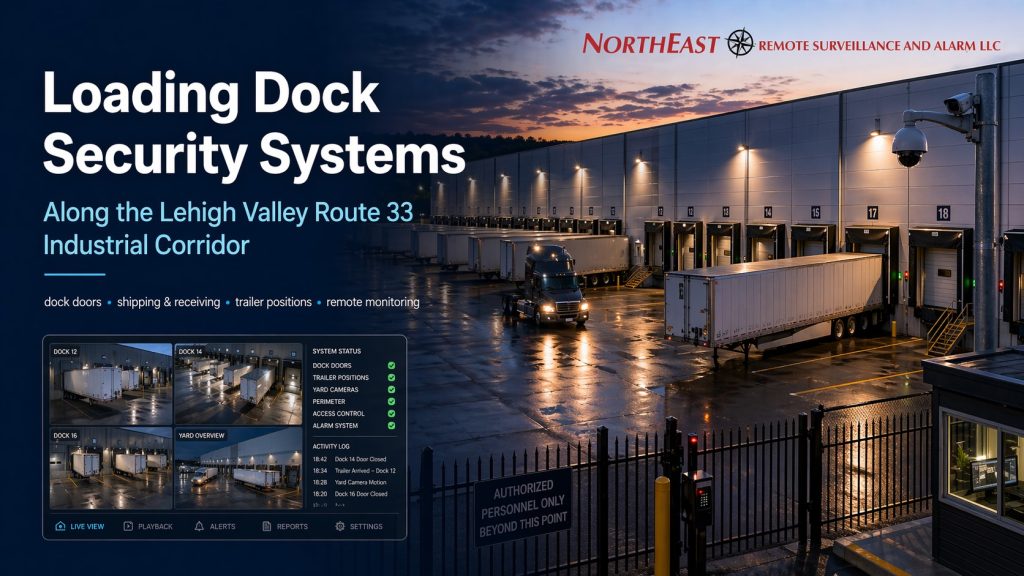
Dock doors, trailer positions, receiving lanes, outbound staging, carrier traffic, employee movement, shipping offices, and after-hours exterior exposure all create security demands that are different from the rest of the building. A properly designed system should improve visibility, support incident review, tighten control, and protect the parts of the property where freight movement and operational risk are most concentrated.
Northeast Remote Surveillance and Alarm, LLC provides loading dock security along the Lehigh Valley Route 33 corridor. We help plan dock visibility, shipping and receiving review, and access to freight-handling areas. The design should support daily dock operations.
This guide covers loading dock security along the Lehigh Valley Route 33 industrial corridor.
For broader corridor planning, visit Lehigh Valley Route 33 Industrial Corridor Security Systems.
For broader warehouse-focused coverage, visit Warehouse Security Systems Along the Lehigh Valley Route 33 Industrial Corridor.
For distribution-focused properties, visit distribution Center Security Systems Along the Lehigh Valley Route 33 Industrial Corridor.
Security Systems Built for Loading Dock Operations
Loading docks are some of the most active and exposed parts of a warehouse, distribution center, or industrial property. Freight arrives and leaves through dock doors. Trailers back into position. Drivers and employees move through the area. Shipments are loaded, unloaded, staged, checked, and transferred. Doors may remain open for long periods. Activity may shift quickly between multiple dock positions throughout the day.
That kind of environment creates different security needs than a general warehouse floor or a standard commercial entrance. A loading dock security system should be built around dock operations, not treated as a side extension of a broader building camera layout.
What Loading Dock Areas Along the Route 33 Corridor Commonly Need to Protect
Properties along the Lehigh Valley Route 33 corridor often need stronger protection around the exact points where freight handling and dock activity create the most exposure.
Dock Doors and Dock Lines
Dock doors are often one of the most important parts of the property to monitor. They are active access points tied directly to inbound and outbound freight movement, trailer activity, employee handling, and after-hours vulnerability.
Receiving and Shipping Zones
Shipping and receiving zones often need better visibility around staged product, pallet movement, carrier traffic, paperwork exchanges, and the transfer of inventory between trailers and the building.
Trailer Positions and Backing Areas
Trailer positions, maneuvering zones, and backing areas often create both operational and security concerns. These areas may need stronger visibility for event review, damage claims, disputes, and after-hours activity.
Exterior Dock Aprons and Drive Lanes
The dock apron and surrounding drive lanes often remain exposed long after interior activity slows down. These areas may see trailer drop-offs, driver movement, vehicle circulation, and other activity that needs stronger documentation and review capability.
Dock-Adjacent Doors and Interior Transition Points
Many properties also need better visibility around man doors, side doors, employee entrances, and other transition points near the dock area where unauthorized access or undocumented movement can create additional risk.
Loading Dock Security Should Be Built Around Freight Movement
A loading dock security system should do more than simply show a row of dock doors. It should be designed around how freight, people, trailers, and activity move through the dock area. That includes how trucks approach the dock, how trailers are staged, how employees circulate between the building and the dock, where receiving and outbound activity occurs, and which parts of the dock environment remain vulnerable after hours.
This is especially important along the Lehigh Valley Route 33 industrial corridor, where many properties operate in high-traffic industrial environments with recurring freight movement, multiple dock positions, shipping and receiving pressure, and broad exterior exposure.
Common Security Priorities for Loading Docks Along Route 33
Better Visibility at Dock Doors
Many properties need better coverage at each dock position so management can review trailer arrivals, dock activity, loading events, shipping flow, and after-hours movement around the doors that matter most.
Better Review of Shipping and Receiving Activity
Dock environments often create disputes around timing, carrier arrival, shipment handling, staging, and inventory movement. Stronger video coverage can help provide clearer review of what actually happened.
Better Documentation Around Trailer Activity
Trailer positioning, drop-offs, pickups, backing movement, and activity around staged trailers often require better visibility than a general perimeter camera provides.
For trailer-yard and yard-lane purpose, visit Truck Yard and Trailer Security Systems Along the Lehigh Valley Route 33 Industrial Corridor.
Better After-Hours Awareness Around Exterior Freight Zones
Many loading dock areas remain exposed when staffing drops, when part of the building is closed, or when trailers remain on site overnight. That often makes the dock area one of the most important exterior zones to protect after hours.
For stronger monitored awareness, visit Remote Video Monitoring Along the Lehigh Valley Route 33 Industrial Corridor.
Better Control Over Personnel and Restricted Openings
Some properties also need tighter control over who can enter dock-adjacent doors, shipping offices, restricted support areas, and employee-only entry points tied to dock operations.
For entry-control purpose, visit Warehouse Access Control Systems Along the Lehigh Valley Route 33 Industrial Corridor.
Loading Dock Security Is Not the Same as General Warehouse Security
This guide covers loading dock environments. A loading dock creates a narrower and more operationally intense exposure zone than the warehouse as a whole. Dock activity involves concentrated freight flow, trailer movement, outbound and inbound handling, and repeated exterior-to-interior transitions that deserve their own security planning.
If the property is better defined by broader warehouse operations, visit Warehouse Security Systems Along the Lehigh Valley Route 33 Industrial Corridor.
If the site is centered on full distribution operations, visit Distribution Center Security Systems Along the Lehigh Valley Route 33 Industrial Corridor.
If the primary issue is yard activity, trailer rows, or perimeter exposure, visit Truck Yard and Trailer Security Systems Along the Lehigh Valley Route 33 Industrial Corridor.
Security Systems for Loading Dock Areas Along the Lehigh Valley Route 33 Industrial Corridor
NERSA plans security around dock doors, shipping and receiving areas, trailer positions, and freight-handling zones. Camera views can support review of inbound and outbound activity and trailer movements. Controlled dock-adjacent doors and attention to after-hours exterior activity can address other gaps. The right combination depends on where freight activity and risk are concentrated.
The right design depends on the number of dock positions, the site layout, the trailer flow, the shipping and receiving pattern, the surrounding exterior exposure, and the areas where freight activity creates the greatest operational risk.
Plan Your Loading Dock Security
Need clearer dock views or better records of shipping, receiving and trailer activity along the Route 33 corridor?
Northeast Remote Surveillance and Alarm, LLC can help design a solution around your daily dock operations.
For broader corridor planning, visit Lehigh Valley Route 33 Industrial Corridor Security Systems.
Compliance, Codes & Project Standards
NERSA plans commercial and industrial security work with applicable code, documentation, inspection and authority-having-jurisdiction requirements in mind. Requirements vary by system, property and jurisdiction. These resources support project planning; they do not establish legal compliance, certification or AHJ approval.
Related guidance: Regulatory compliance & inspection readiness · NERSA project standards · Documentation, testing & inspection readiness