
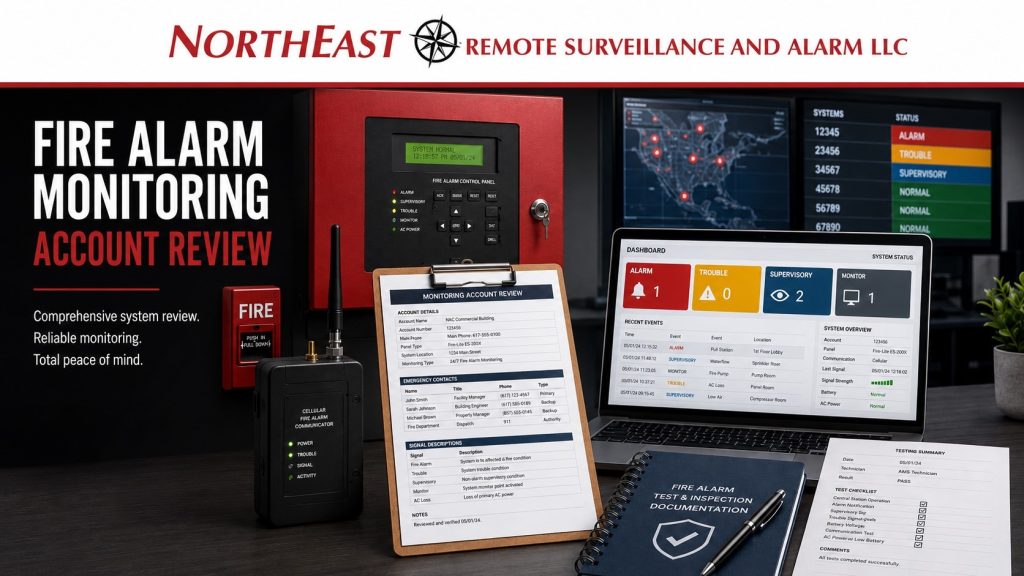
A fire alarm monitoring account review checks whether the monitoring provider’s site details, contacts, signal descriptions, and response instructions match the facility’s current arrangement.

Confirm the Site and Responsible Contacts
Review the property name, address, relevant building or tenant identifiers, and authorized account contacts with the monitoring provider. Confirm who can approve changes and who maintains the facility’s current records.
Check contact names, telephone numbers, availability, and escalation order. Review the instructions when ownership, management, tenants, or responsible personnel change.
Match Signal Descriptions to the Installed System
Compare the monitoring account’s descriptions with the current panel and site documentation. Identify unclear, outdated, or duplicate labels that could make an event harder to understand.
Review the descriptions used for alarm, trouble, supervisory, waterflow, and tamper conditions where applicable. Record discrepancies for correction by the appropriate service and monitoring personnel.
Review Communications and Account Changes
For a platform-specific example, consult Alarm.com commercial fire-communicator planning and confirm the proposed path with the responsible fire-alarm and monitoring parties.
Document the communicator arrangement and any planned changes to telephone service, network equipment, cellular communication, or the monitoring provider. Coordinate those changes before an existing communication path is removed.
Keep a record of the approved work, responsible parties, and verification needed after the change. Equipment service and account administration should remain coordinated throughout the transition.
Coordinate Signal Verification
Arrange any test with the authorized service provider and monitoring center under their approved procedures. Confirm the scope, responsible contacts, and handling of test signals before work begins.
Record which signals were transmitted and received, whether their descriptions were correct, and any follow-up required. Confirm that the account and system are returned to their intended operating status after testing.
Keep a Current Review Record
Document the review date, participants, changes approved, unresolved issues, and the person responsible for each next step. Store the current account information where authorized personnel can retrieve it.
Revisit the records after changes to the building, system, communications, monitoring arrangement, or responsible contacts.
Related Fire Alarm Guides
Use these guides to follow up on account discrepancies, signal descriptions, communication changes, and coordinated inspection preparation.
- Fire Alarm Monitoring and Supervision — Return to fire alarm monitoring and supervision.
- Fire Alarm Trouble and Supervisory Signals — Review trouble and supervisory signal descriptions.
- Fire Alarm Waterflow and Tamper Monitoring — Review waterflow and tamper monitoring.
- Sprinkler System Monitoring — Review sprinkler-system monitoring.
- Fire Alarm Communicator Upgrades — Review communicator upgrade planning.
- Fire Alarm Phone Line Replacement — Plan replacement of existing fire alarm phone lines.
- Fire Alarm Elevator Recall Integration — Review elevator fire alarm coordination.
- Fire Alarm Inspection Readiness for Commercial Buildings — Prepare for fire alarm inspection and testing.
- Commercial Fire Alarm Monitoring, Testing, and Inspection Readiness — Review monitoring, testing, and inspection considerations.
- NFPA 72 Fire Alarm Standards for Commercial Buildings — Review NFPA 72 fire alarm standards.
- Commercial Fire Alarm & Life Safety Systems — Explore commercial fire alarm services.
Request a Monitoring Account Review
Request an assessment to review monitoring records, signal descriptions, and account coordination needs.
Compliance, Codes & Project Standards
NERSA plans commercial and industrial security work with applicable code, documentation, inspection and authority-having-jurisdiction requirements in mind. Requirements vary by system, property and jurisdiction. These resources support project planning; they do not establish legal compliance, certification or AHJ approval.
Related guidance: Regulatory compliance & inspection readiness · NERSA project standards · Documentation, testing & inspection readiness