
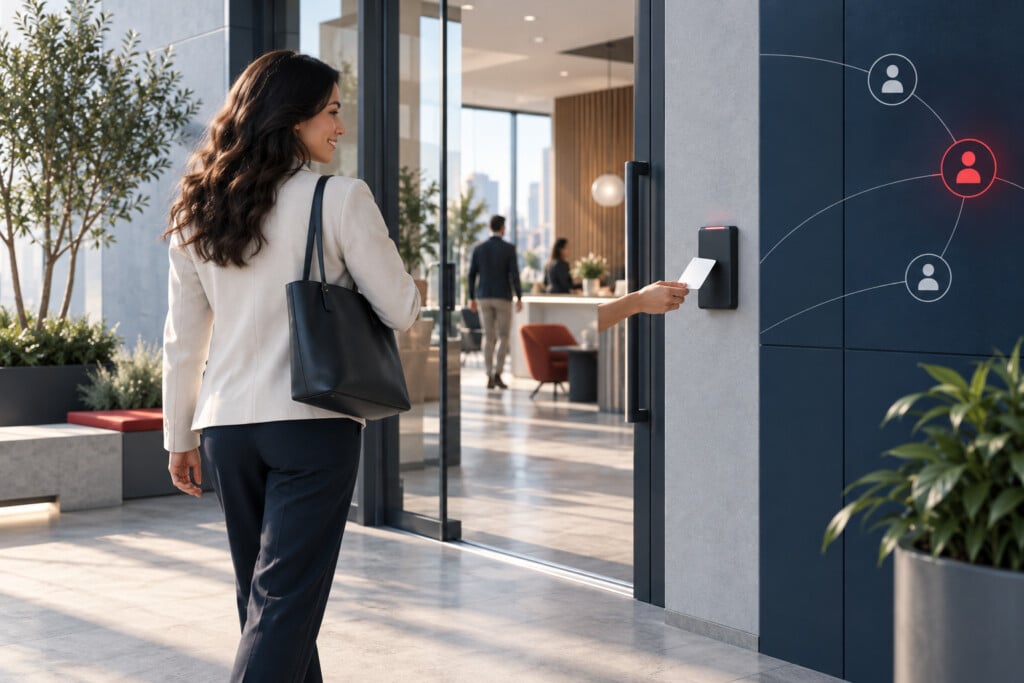


Enterprise access control connects people, permissions, buildings, and administrative authority. Establish who approves and maintains access across the organization before choosing credentials or copying door groups between facilities.
Part of Enterprise Security Systems Integration.
Complete Hardware Installation and Door Adjustments Included
NERSA installs all access-control hardware specified for your system and fine-tunes the complete door opening as part of the installation. This includes door, hinge, latch and closer adjustments so the door closes, latches and operates reliably with the access-control system.
Before handover, we test credential operation, authorized entry, door closing, latching and required exit operation. Hardware installation and these door adjustments are part of our installation work.
Model the organization before the doors
Identify employee, contractor, visitor, administrator, and service roles. Separate the authority to enter an area from the authority to grant access or configure the system. Define which decisions are corporate, regional, departmental, and local, including temporary access and exceptions.
Plan the credential lifecycle
Document enrollment, transfers, replacement, suspension, expiry, and termination. Decide how the platform matches identity records and which system owns each field. Mobile credentials, cards, and fobs may coexist, but revocation and reporting should still follow a consistent process. Validate the supported lifecycle for the exact platform and integrations.
Define behavior across buildings
Review local controller decisions, communication loss, cached permissions, and synchronization after recovery. Elevator, gate, multi-building, and anti-passback applications introduce dependencies that the team must test individually. Do not treat access events or occupancy estimates as a complete personnel accounting system.
Make administration reviewable
Keep an approval record for permission changes and define who reviews administrator privileges. Test positive and negative access cases, expired credentials, changed schedules, disabled identities, and outage conditions. Document the resulting behavior and exceptions before the team adds the next site.
Elevators and multi-building permissions
Map elevator floor permissions, building access, tenant boundaries, and after-hours schedules to approved roles. Confirm the supported interface with the elevator contractor and responsible project team. Document what changes locally and centrally, who removes permissions, and which functions depend on communication. Test representative floors and building transfers without assuming that a credential valid at one entrance should work throughout the campus.
Parking and gate access
Treat vehicle entry permissions as a defined application of the access model. Identify employee, contractor, delivery, and visitor schedules, the system that owns authorization, and the event record used for review. Gate hardware and safety behavior require qualified review. Use the dedicated vehicle-intelligence resources when plate recognition or cross-site vehicle records are part of the workflow.
Explore supporting enterprise resources
- Enterprise Credential Lifecycle Management — A credential lifecycle defines how a person gains, changes, and loses physical access across the organization.
- Enterprise Physical Access Roles and Delegated Administration — An enterprise role model separates a person’s authority to enter a building from an administrator’s authority to change the system.
- Enterprise Access Control and Identity Directory Integration — Identity integration can connect employee records with physical access administration, but the connection must have a defined source of truth and a verified lifecycle.
- Enterprise Mobile Credential Deployment — A mobile credential rollout is an enrollment and support program as well as a technology choice.
- Enterprise Anti-Passback and Occupancy Planning — Anti-passback and access-based occupancy functions depend on a reliable model of entrances, exits, zones, and credential events.
- Enterprise Access Control Continuity and Redundancy — Access-control continuity planning specifies which functions must remain available when a server, network connection, power source, or hosted service fails.
- Enterprise Access Control Audit Trails and Reporting — Enterprise access reporting should allow authorized reviewers to understand permission changes and relevant door events across locations.
Related planning resources
- Commercial & Industrial Access Control Systems
- Managed Access Control Systems and System Health Monitoring
- Enterprise Visitor Management Systems (VMS)
- Commercial Gate Access Control Systems
- Access Control System Upgrades
Let’s talk about your next step
Tell us what you want to improve and which locations are involved. We can help you work through the questions, check what your systems support, and define a practical project scope.